Showing posts with label Pinot Gris. Show all posts

Wednesday, June 22, 2011

Oregon Pinot Gris Symposium at Oak Knoll Winery in Hillsboro, USA

Picture: Paul Gregutt, Seattle Times (right) and Greg Lint, President of Oak Knoll Winery (left) at the 1. Oregon Pinot Gris Symposium

The 1. Oregon Pinot Gris Symposium took place at Oak Knoll Winery in Hillsboro, near Portland, on June 9, 2011. It consisted of two parts: Lectures and round table discussion in the morning and an Oregon Pinot Gris tasting in the afternoon.

The Wines of Oregon

About two-thirds of Oregon’s wineries and vineyards are in the Willamette Valley. Buffered from Pacific storms on the west by the Coast Range, the valley follows the Willamette River north to south for more than a hundred miles from the Columbia River near Portland to just south of Eugene. But Oregon is not only about Willamette Valley. Oregon’s vineyards span the whole State, rising up and falling over the rolling hills and gentle valleys of more than 12,000 acres (4,858 hectares) of wine grapes. Other major wine regions are the Rogue Valley, Umpqua Valley, and the Columbia Gorge. Some regions straddle the border between Oregon and the States of Washington and Idaho.

Wine has been produced in Oregon since the Oregon Territory was settled in the 1840s, when Italian and Swiss immigrants planted wine grapes and started bottling wine. Oregon's wine industry was suppressed during Prohibition. It was not until 1961, when Richard Sommer set up shop in southern Oregon, that the modern Oregon wine industry was borne. Other pioneers include David Lett, David Adelsheim, Dick Ponzi and Bill Sokol-Blosser. Then the French also came with Domaine Drouhin bringing European sophistication to Oregon.

Picture: The Wine Regions of Oregon

In the past 40 years, Oregon has become one of the country’s top three wine States, with 450 wineries producing an average of 3,500 cases. Most of it is Pinot Noir (8000 acres), Oregon’s signature grape variety, followed by Pinot Gris (1300), Chardonnay (800), Merlot (500) and Riesling (500). Oregon produces wine on a much smaller scale than its southern neighbor California. The majority of wineries in Oregon operate their own vineyards, although some purchase grapes on the market.

Pinot Gris in the World

There are about 25,000 hectares of Pinot Gris in the world, accounting for less than 0.5 percent of total wine production. With about 12,000 hectares, Italy is the front-runner, with Germany (4,000 h), California (3,000 h), Alsace (2,000 h) and Hungary (1.500 h) following. Oregon, with about 500 hectares, belongs to the group of smaller producers, along with New Zealand (700 h) and Australia (300 h).

Pinot Gris comes from the Bourgogne in France. The Pinot Gris has grayish-blue fruit. This explains the name: Pinot Gris (in France), or Pinot Grigio (in Italy) or Grauburgunder (in Germany) - Gris, Grigio and Gris mean “grey”.

Pinot Gris is a heat-sensitive grape that does not fare well in hotter climates as it needs colder temperatures to ripen fully and produce distinct flavors. It prefers a cooler climate with long, temperate summer days.


Pictures: During the Morning Sessions

In Italy, plantings can be found in the Lombardy region and in Alto Adige, Italy's northern most wine region, as well as in the Friuli-Venezia Giulia region. Some 9 million cases are produced in Italy today, of which 90% is exported. Italian Pinot Grigio tends to be light-bodied, often lean; light in color; neutral, sometimes spritzy flavors, crisp and acidic. Almost all Italian Pinot Grigio wines are dry.

A German merchant by the named Johann Seger Ruland (re)discovered grapes growing wild in the fields of the Pfalz region in Germany in the 1700s. The wine he produced with these grapes became known as Rulaender; the Rulaender was later discovered to be Grauburgunder (Pinot Gris). Many wine producers in Germany sell their Grauburgunder still as Rulaender. German Grauburgunder/Rulaender tends to be medium- to full-bodied; typically dry but sometimes with noticeable residual sugar, but always well balanced with good acidity.

French Pinot Gris from Alsace can be rich and almost oily in texture. Like the German Grauburgunder, Alsatian Pinot Gris can be made in a dry or sweet-style.

Pinot Gris in Oregon

Pinot Gris has been grown in Oregon as long as Pinot Noir. David Lett, founder of Oregon's first winery, The Eyrie in McMinnville, planted a tiny amount alongside his first plantings of Pinot Noir more than 40 years ago. Other pioneers were Dick Ponzi and David Adelsheim. But it was not until the King Estate was founded in the 1990s that the Oregon Pinot Gris got national attention. The Estate, which grows only organically, is in the southernmost end of the Willamette Valley near Eugene.

Almost all Oregon Pinot Gris vines are found on slopes, southeast to southwest facing at elevations from 250 to 700 feet. Mid-slope positioning generally keeps vines above frost levels, and below less fertile soils near the ridge. Southern exposure rewards grapes with extra hours of sunlight.

The 1. Oregon Pinot Gris Symposium at Oak Knoll Winery

This was a very well organized ¾ day event at the Oak Knoll Winery in Hillsboro. It was sponsored by Oak Knoll Winery and organized by PR veteran Jo Diaz. The event was very inspiring and entertaining. The star was Paul Gregutt, from the Seattle Times.

Evidently, there are different styles of Pinot Gris in the world. Living in Germany and on the US East Coast, I am not as familiar with Oregon Pinot Gris as most other participants were. So, I was curious how the wines would taste. Alsatian or Italian style? Dry or with a bit of remaining sugar? Aged in oak to add flavors and tannins?


Pictures: Afternoon Tasting of the Pinot Gris Wines; Paul Gregutt and Christian G.E.Schiller (top)

What I found at the tasting were very few, if any, Italian style Pinot Grigio wines. In terms of residual sugar, the wines I tasted were overwhelmingly dry. Finally, I found very little oak in the wines. Overall, the wines were medium-bodied, crisp, with lively flavors, often with aromas of pear, apple, and melon.

Oregon Pinot Gris Symposium Program

7:30 - 8:30 a.m. Registration & Continental Breakfast

8:30 - 8:35 a.m. WELCOME ~ Greg Lint and Jeff Herinckx

8:35 - 8:45 a.m. INDIVIDUAL INTRODUCTIONS

SESSION I KEYNOTE SPEAKER ~ Paul Gregutt

8:45 - 9:30 a.m. "The Potential for Pinot Gris From Oregon, Regarding Its Terroir"

BREAK ~ 9:30 - 9:45 a.m.

SESSION II VITICULTURE ~ Al MacDonald, Chemeketa Community College Vineyard Management Programs

9:45 - 10:30 a.m "Understanding the Terroir of Oregon Pinot Gris"

SESSION III ENOLOGY
• Robert Brittan, Robert Brittan Vineyards
• Jason Bull, Zimri Cellars, winemaker at David Hill Vineyards
• Jeff Herinckx, Oak Knoll Winery
10:30 - 11:15 a.m. "Crafting Signature Pinot Gris"

BREAK ~ 11:15 - 11:30 a.m.

SESSION IV MARKETING

11:30 - 12:30 p.m.
Ryan Lumaco, Odom-Southern Distributors of Oregon "Having Your Pinot Gris Stand Out From The Oregon Crowd"
Eugenia Keegan, Vineyard Consultant "Having Your Pinot Gris Stand Out From The National Crowd"

12:30 ~ 1:30 p.m. LUNCHEON w/MEDIA

1:30 - 3:00 p.m. BEST OF THE OREGON PINOT GRIS TASTING With MEDIA

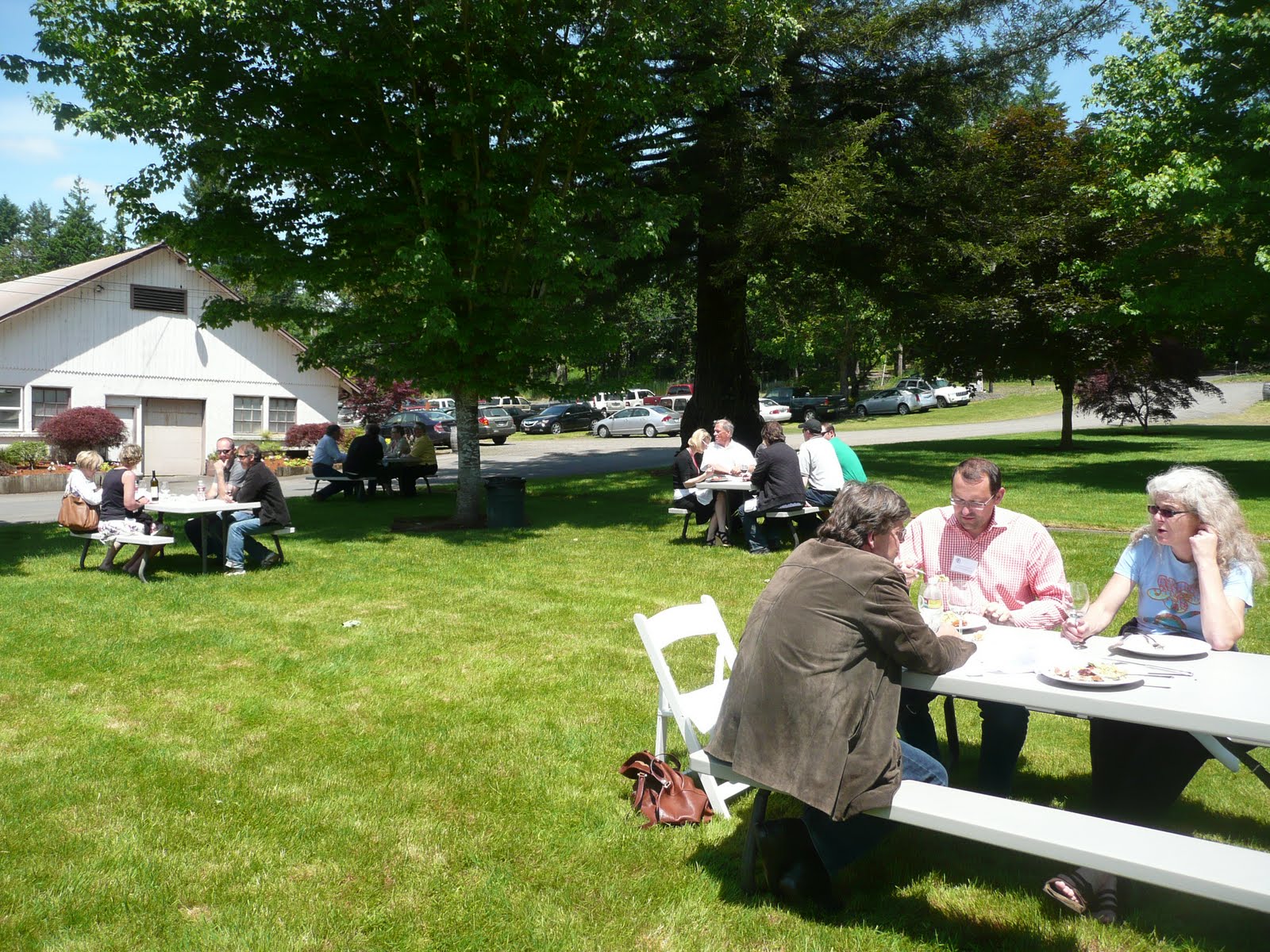
Pictures: Luncheon; Christian G.E.Schiller, Nicolas Quille, head winemaker of Pacific Rim, Jennifer Henry from Henry Estate Winery in Umpqua in Oregon

Participants

Winery and Grape Growers:

Airlie Winery
Abiqua Wind Vineyard
Ankeny Vineyard Winery
Apolloni Vineyards
Brittan Vineyards
Cardwell Hill Cellars
Christoper Bridge Cellars
David Hill
Dion Vineyard
Henry Estate
King Estate Winery
Lange Estate Winery
Left Coast Cellars
Maysara Winery
Methven Family Vineyards
Montinore Estates Winery
NW Wine Company, L.L.C.
Oak Knoll Winery
Pacific Rim Winemakers
Phelps Creek Vineyards
Plum Hill Vineyards
Provincial Vineyards
Pudding River Wine Cellars
Ribera Vineyards
Ron Johnson
Sineann
Sokol Blosser Winery
Spindrift Cellars
Terrapin Cellars
Willamette Valley Vineyards
Wy’East Vineyards
Yamhill Valley Vineyards
Zimri Cellars

Wine Trade:

Chemeketa Community College
Diaz Communications
Eugenia Keegan Consulting
Ombiasy Public Relations
Odom-Southern Distributors of OR
TheZenture

Wine Media:

Paul Gregutt ~ www.paulgregutt.com, Wine Enthusiast
Barbara Trigg ~ Appellation America
Ryan Reichert ~ Northwest Whites
Dr. Christian G.E.Schiller ~ Schiller Wine
Jim Gullo ~ Oregon Wine, b/t/w
Mark Hinton ~ Enobytes, Oregon Live
Pamela Heiligenthal ~ Enobytes
Jo Diaz ~ Wine-Blog ~ Juicy Tales by Jo Diaz
Gary Werner ~ Vineyard and Winery Management

schiller-wine: Related Postings

One of Oregon's Pioneering Winemakers - Myron Redford - with his Amity Vineyard Wines in Washington DC

Wine tasting: Soter Wines from Oregon at Out-of-Sight Wines in Vienna, US

Wine Tasting: The Pinot Noirs of Patricia Green, Oregon, US

The Excellent Wines of Ken Wright Cellars, Oregon

The Jay Somers Wines of Bill Holloran, Oregon

Meeting Bill Holloran from Oregon and Tasting His Holloran and Stafford Hill Wines

5. Deutscher Grauburgunder Preis – 5. German Pinot Gris Award

The Doctor Made a House Call - A Tasting with Ernst Loosen, Weingut Dr. Loosen, at MacArthur Beverages in Washington DC

Wednesday, October 20, 2010

5. Deutscher Grauburgunder Preis – 5. German Pinot Gris Award

Picture: Christian G.E.Schiller with Karl Sonntag, Retired Cellar Master of the Hagnauer Winzerverein

5. Deutscher Grauburgunder Preis – 5. German Pinot Gris Award

The 5. German Pinot Gris/Grauburgunder Award Competition took place in Germany a few weeks ago. Most of the submitted wines were from Germany, but a few other old world producers also participated in the contest.

Grauburgunder/Pinot Gris/Pinot Grigio in the World


Grauburgunder is better known as Pinot Gris or Pinot Grigio in the world, a mutant clone of the Pinot Noir grape. Total production area in the world is about 15.000 hectares.

Pinot Gris has been known from the Middle Ages in the Bourgogne region in France.

It spread from there, along with Pinot Noir, to other European. The grape was a favorite of Emperor Charles IV, who had cuttings imported to Hungary and Bohemia.

A German merchant by the named Johann Seger Ruland (re)discovered a grape growing wild in the fields of the Pfalz region in Germany in the 1700s. The wine he produced became known as Ruländer; the Rulaender was later discovered to be Grauburgunder. Many wine producers in Germany sell their Grauburgunder as Rulaender.

Today, Pinot Gris is often associated with the Alsace region of France, where it makes up about 14 percent of the vineyard plantings. The Alsatian Pinot Gris wines were originally labeled Tokay d'Alsace. It is very popular in Italy, known as Pinot Grigio. Plantings can be found in the Lombardy region and in Alto Adige, Italy's northern most wine region, as well as in the Friuli-Venezia Giulia region. Pinot Gris was first introduced into Australia in the early 1800s. Pinot Gris is grown in both the North and South Islands of New Zealand. David Lett, from Eyrie Vineyards, planted the first American Pinot Gris vines in the US, in Oregon in 1966.

The 5. German Grauburgunder Award

338 Grauburgunder - Pinot Grigios - Pinot Gris were submitted from 151 producers from Germany, Switzerland, Austria, Italy and France. New World producers were absent. The bulk of the producers were from Germany – 133 producers submitting 315 wines.

The German Grauburgunder Prizes were awarded in 4 different categories. The top 3 in each category are listed below. The section below also contains some remarks on two winners which I visited recently, the Markgraf von Baden Estate and the Winzerverein Hagnau.

Category I Winners

Category I: dry (+2.0 acidity, max. 9.0 g/l residual sugar) fruity wine, (not aged or stored in a wooden barrel/barrique) Alcohol content of up to max. 12.5% vol.

1. Köninger Tobias, Weingut, 77876 Kappelrodeck
2009 Kappelrodecker Grauburgunder Kabinett
2. Sonnenhof, Mattmüller M. Weingut, Sonnenhof 1, 79241 Ihringen
2009 Ihringer Fohrenberg Grauburgunder Kabinett
3. Rammersweier WG, Weinstr. 97, 77654 Offenburg
2009 Rammersweirer Kreuzberg Grauburgunder QbA

Among the winners, but not in the top 3 group, was a Birnauer Kirchhalde from Weingut Markgrafen von Baden / Schloss Salem. I visited Schloss Salem a few weeks ago.

Pictures: Birnauer Kirchhalde

Salem Castle is one of the finest cultural monuments in the region around Lake Constance in southern Baden-Württemberg. Founded in 1137 by Cistercian monks, the gigantic monastery complex with its agricultural estates passed into the hands of the ruler of Baden, the Margrave of Baden, during secularization in 1803. After 200 years, it again changed hands a few years ago, when the State of Baden-Wuerttemberg bought it, as the family of the Margrave of Baden was unable to maintain it.

The vineyard area of Schloss Salem totals 110 hectares. Varieties planted here are mainly Müller-Thurgau and Pinot Noir.

Picture: Schloss Salem

The von Baden family had a decisive influence on viticulture in Baden. Großherzog (Grand Duke) Carl-Friedrich von Baden (1738-1811) is regarded as the creator of quality wine production in Baden. In 1782, he brought in 3.500 Riesling vines from the Rheingau region. In the 1920s, the Margrave of Baden was the first Estate in Baden to show faith in the new variety Müller-Thurgau. Since 1998, Bernhard Prinz von Baden has continued the viticultural tradition and manages the Schloss Salem Estate. He also lives there. The original base of the von Baden family is Schloss Staufenberg in the Ortenau, with 25 hectares of vineyard land. These were the only vineyards of the von Baden family until they received the Lake Constanze vineyards as part of Napoleon’s secularization.

Categorie II Winners

Category II: dry, fruity wine (+2.0 acidity, max. 9.0g/l residual sugar) (not aged or stored in a wooden barrel) Alcohol content of more than 12.5 - 13.5% vol.

1. Laible Alexander, Weingut, Unterweiler 48, 77770 Durbach
2009 Grauburgunder QbA
2. Hagnauer Winzerverein, Strandbadstr. 7, 88709 Hagnau
2009 Hagnauer Burgstall Grauburgunder Spätlese

I visited the Wine Cooperative of Hagnau, a little village at Lake Constanze in Germany, earlier this year. Winzerverein Hagnau is the oldest Wine Cooperative in the Baden region, founded in 1881 by Pastor Dr. Heinrich Hansjakob.

Pictures: Hagnau and Truck of Winzerverein Hagnau

The secularization of 1803, when Napoleon tried to reorganize Europe by expropriating the Church and giving the assets to dukes and margraves that were on good relations with him, had an important impact on the economic situation of the Hagnau winemakers. Before secularization, for about 110 years, the winemakers of Hagnau were under the rule of the Benedictine Abbey of Weingarten. These were not bad days. Under the monastery’s rule, the wine makers received as a reward for their work half the wine yield and a field on which they could grow potatoes and vegetables for self-catering.

This changed dramatically after the secularization. The wine makers lost the field on which to grow food and had to bear all costs of wine production themselves, but were paid for their output. As it turned out, prices and revenues kept on falling. In view of the difficult situation of the smallholders, the pastor and civil rights activist of Hagnau, Dr. Heinrich Hansjakob, encouraged them to form a wine cooperative and market their wine themselves. On October 20, 1881, the first wine cooperative of Baden was founded in Hagnau at Lake Constance.

It currently has over hundred members. In the regions of Baden and Wuerttemberg in Germany, being a member of a wine cooperative is the rule. Independent winemakers are the exception.

The vineyard area of the Winzerverein Hagnau is 140 hectares. The grape distribution is as follows: 40 % Müller-Thurgau, 40 % Spätburgunder, 8 % Ruländer/Grauburgunder, 3 % Weißburgunder, 2 % Bacchus, 2 % Kerner, 5 % other, including Regent.

The Hagnauer Winzerverein wine portfolio is broad, focusing on good quality day-to-day wines. The entry wine in the 0.75 liter bottle costs Euro 4.50. This is a tick higher than what you pay in the Pfalz or in Rheinhessen for comparable quality. However, most wines do not exceed Euro 10. One of those beyond Euro 10 is the 2007 Hagnauer Burgstall Spaetburgunder Rotwein Barrique trocken for Euro 14.90, the Haganuer Winzerverein’s best red wine.

3. Reiss, Weingut, Unterdürrbacher Str. 182, 97080 Würzburg
2009 Würzburger Pfaffenberg Grauburgunder Kabinett

Categorie III Winners


Category III: dry (2.0 acidity, max. 9.0 g/l residual sugar) Premium wines, "Selektion", "Grand cru", etc.

1. Pix, Weingut, Eisenbahnstr. 19, 79241 Ihringen
2009 Ihringer Winklerberg Grauburgunder Spätlese
2. Schätzle Gregor u. Thomas, Heinrich-Kling-Str. 38, 79235 Vogtsburg
2008 Schelinger Kirchberg Grauburgunder RS QbA
3. Konstanzer Horst, Weingut, Quellenstr. 22, 79241 Ihringen
2008 Ihringer Winklerberg Grauburgunder Spätlese

Categorie IV Winners

Category IV: sweet wine/dessert wine.

1. Laufener Winzergenossenschaft, Weinstr. 48, 79295 S.-Laufen
2007 Laufener Altenberg Ruländer Eiswein
2. Jechtinger Winzergenossenschaft, Winzerstr. 1, 79361 Sasbach
2007 Jechtinger Steingrube Ruländer Eiswein
3. Bischoffinger Winzergenossenschaft, Bacchusstr. 20, 79235 Vogtsburg
2009 Bischoffinger Steinbuck Ruländer Trockenbeerauslese

Complete List of 2010 Winners

You find the list here.


Schiller Wine - Related Postings

A Wine Feast in the Rheingau, Germany: The 2010 Grand Wine Convention

A Combination of Extraordinary Wine and Art: Peter Winter's Georg Mueller Stiftung in the Rheingau

Impressions from the Riesling & Co World Tour 2010 in New York

Best of German Dry White Wines and Winemakers - The Falstaff 2010 Ranking

When Americans Drink German Wine - What They Choose

German Wine Basics: Erstes Gewaechs, Grosses Gewaechs, Erste Lage

German Wine Basics: Sugar in the Grape - Alcohol and Sweetness in the Wine

Wine Caravan from Germany Visiting the East Coast, US: Dr. Fischer, Fitz Ritter, Bolling-Lehnert, Schneider, Dr. Thanisch

The Exciting Lake Wines of the Aufricht Brothers from Lake Constance in Germany