Thursday, October 6, 2011

Leo Hillinger Wines and Alsatian Food with Hillinger’s Michael Hoeffken and Chef Jacques E. Haeringer at L’Auberge Chez François in Virginia, USA

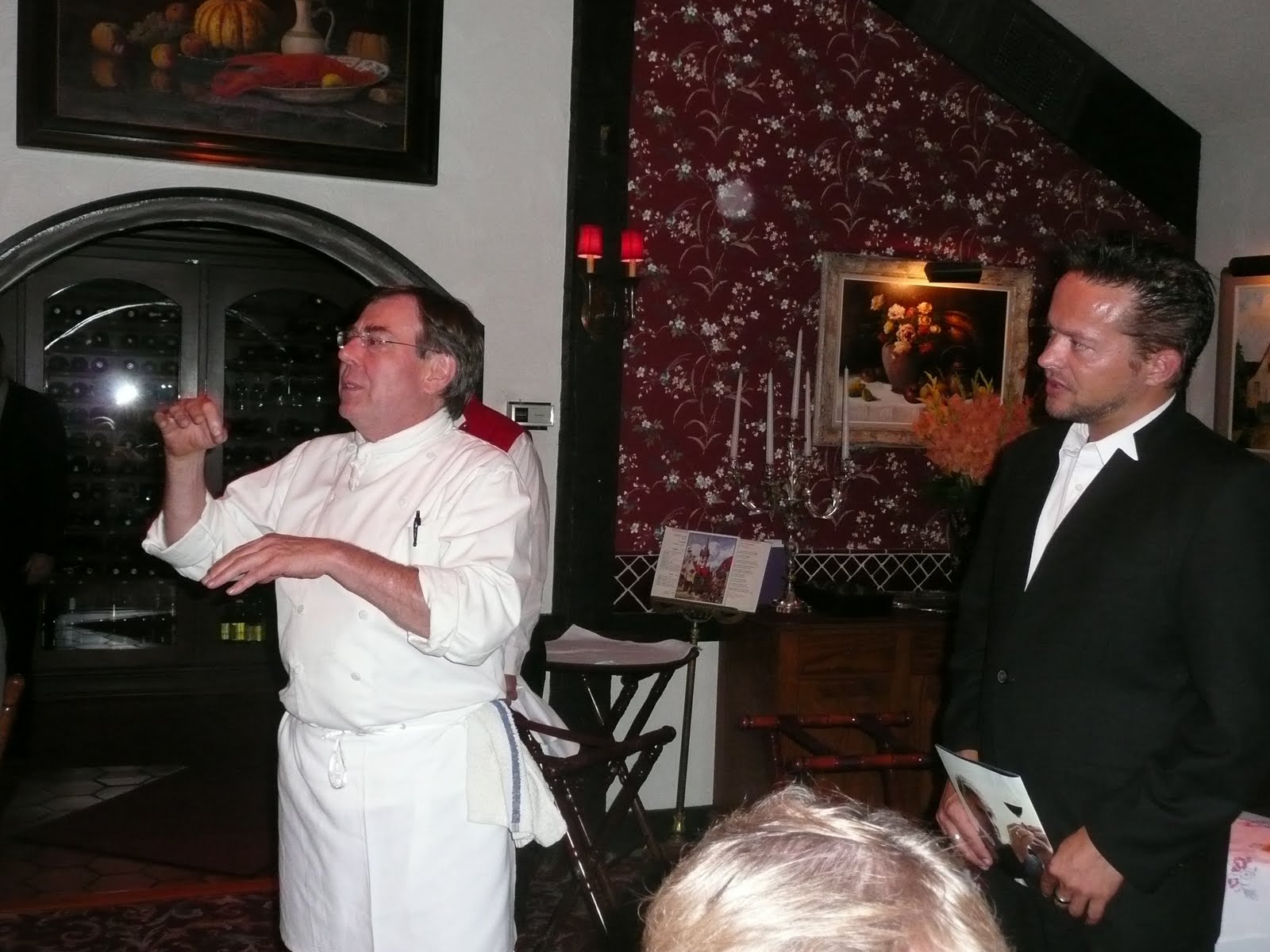
Pictures: Leo Hillinger's Michael Hoeffken with Christian G.E. Schiller, L'Auberge Chez François' Chef Jacques E. Haeringer and Importer Klaus Wittauer at L'Auberge Chez François in Virginia, USA

This time, Michael Hoeffken from Weingut Leo Hillinger in Austria teamed up with Chef Jacques E. Haeringer from the famous Alsatian restaurant L’Auberge Chez Francois in the hills outside of Washington DC for an extraordinary evening. They were supported by Leo Hillinger wine importer Klaus Wittauer. My last winemaker dinner at L’Auberge Chez Francois was with Catherine Faller from Domaine Weinbach in Alsace, supported by Danny Haas from Vineyard Brands.

The wines of Leo Hillinger from Austria are known all over the world. The main public face of Weingut Leo Hillinger for consumers in the US and Asia, along with Leo Hillinger of course, is Michael Hoeffken, Sommelier, Assistant Winemaker and Sales Person at Weingut Leo Hillinger.

I was in Austria this summer, including in Hofturn in Burgenland, by car just 30 minutes away from Jois, where Weingut Leo Hillinger is located. When Michael heart about this, he invited me over and we spent a couple of hours together at the winery. We were joined by Edgar Butler, the winemaker and also by Leo Hillinger. I had met Michael Hoeffken the first time in Vienna, Austria and then later in Washington DC, where we tasted some Leo Hillinger red wines.

Picture: Christian G.E. Schiller, Leo Hillinger and Hillinger Winemaker Edgar Butler in Jois, Austria

Jacques E. Haeringer and L'Auberge Chez François in Great Falls, Virginia

L’Auberge Chez Francois is an extraordinary place in the hills outside of Washington DC. It was founded by François Haeringer in the heart of Washington DC in 1954. Twenty years later, in 1975, the Claridge Hotel, which housed Chez François, was sold to make room for an office building. Instead of retiring at age 57, Francoise Haeringer decided to fulfill his dream of opening an "auberge" - a family inn prevalent in his native Alsatian countryside. L'Auberge Chez François opened in 1976 and became a family business. The eldest son Jacques, by then a chef in his own right, became Chef de Cuisine.

Pictures: Chef Jacques E. Haeringer and Christian G.E. Schiller at L'Auberge Chez François

Today, L'Auberge Chez François is much the same as when François first opened it - family-run, with Jacques’ brother Paul as the restaurant's sommelier and Jacques as Chef de Cuisine. L'Auberge Chez François is on the top 50 list of "Best Overall" Restaurants in US, as voted by users of the Open Table reservation system.

Chef Jacques is one of America’s most respected culinary personalities. His menus feature classic Alsatian and French cuisine reinterpreted for American palates. While his father Francois used to say that the chef has to stay in the kitchen, Chef Jacques is very present in the restaurant. He clearly enjoys talking about food and to communicate with his guests. He is great fun to listen to. No wonder that Jacques can be found sharing his cooking secrets on radio and television programs across the country. In addition to his own popular PBS cooking show “Two for Tonight”, Jacques has appeared on other national television programs. Jacques can also be heard the first Friday night of each month serving up “Lewd Food” on the nationally syndicated Food & Wine Radio Network.

Pictures: Michael Hoeffken, Chef Jacques E. Haeringer and Guests the Dinner at at L’Auberge Chez François

Jacques is also a great writer and his articles have been featured in such journals as Gourmet, Wine & Spirits,and Cosmopolitan.Finally, Jacques is the author of “Two for Tonight,” a collection of recipes that inspire romance through food and togetherness, and the “Chez François Cookbook,” the bible of classic Alsatian cuisine featuring some of the restaurant’s most popular recipes.

With Michael Hoeffken, Edgar Butler and Leo Hillinger at Weingut Leo Hillinger in Jois

I visited Weingut Leo Hillinger in Jois in the Neusiedlersee area earlier this year. Leo Hillinger took over from his father in 1990. At the time, the Weingut was tiny with only one hectare of vineyard area. Under Leo’s stewardship the winery has seen a phenomenal growth. Today, the vineyard area totals 46 hectares. 60% of the area is planted with red varieties - Blaufränkisch, Zweigelt, St. Laurent, Pinot Noir, Cabernet Sauvignon, Merlot and Syrah - and the remaining 40% are planted with the white varieties - Welschriesling, Sauvignon Blanc and Chardonnay. In addition, grapes are sourced from contract growers with another 70 hectares of vineyards. Weingut Leo Hillinger is one of the top names in Austria. It ranks among Austria's largest producers of premium wines. More than 50% of the production is exported.

Pictures: Michael Hoeffken, Edgar Butler and Christian G.E. Schiller at the Leo Hillinger Winery in Jois, Austria

The winery in Jois is an impressive super-modern building in the middle of the vineyards. In the cellar, winemaker Edgar Brutler explained that the cellar technique equipment ranks among the most modern in Europe. After the cellar tasting we went outside to see a bit of the vineyards that are in Jois. We had a wonderful view of Lake Neusiedl. Above all, Michael said, the warm and sunny climate in Burgenland is decisive for the wine quality. The near Lake Neusiedl accounts for rising temperatures in summer which lead to higher sugar gradations and full-bodied wines. The soils on which the grapes ripen are an additional criterion. They decisively influence the character of the wines. The light, dry loess and black earth soils are responsible for powerful compact wines.

We finished up in the tasting room and the conference center. Leo Hillinger joined us there. “When the grape is excellent, then one has much less to do in the cellar. From years of experience and much-experimenting, I know that the fruit needs to be perfect and bottled without alteration.” Leo said and he continued: “I do not want an interchangeable fashionable wine, rather I want to produce a truly Austrian, if not Burgenlandian top-quality wine.” Leo concluded by saying: “Making wine is for me a source of happiness. It combines hobby with vocation. I cannot imagine anything more beautiful.”

What Michael Hoeffken, Klaus Wittauer and Chef Jacques E. Haeringer Served

What a feast - a fascinating combination of outstanding white and red wines from Austria and superb food from Alsace.

Canapés
Hillinger Secco


Salmon Soufflé, with a Pinot Noir Sauce
Hillinger Pinot Noir Eveline 2008


Grilled Quail with Harvest Vegetables Gateau
Hillinger St Laurent 2007


Beef Wellington
Hillinger Blaufrankisch Leithaberg 2008


Fresh Raspberry Napoléon
Eiswein Cuvee Klaus 2009


schiller-wine: Related Postings

In the Glass: 2007 Leo Hillinger HillSide Unfiltered With Weingut Hillinger's Michael Hoeffken

Welcome to America: Franz and Christine Netzl Estate, Carnuntum, Austria

Lunch with Silvia Prieler, Weingut Prieler, Schuetzen am Gebirge, Austria

Austria’s Best Wines and Winemakers - Falstaff WeinGuide 2010

Producing Wines in Austria and Hungary - Franz and Franz Reinhard Weninger

With the WienWein Winemakers in Vienna in the Heurigen Drinking Gemischter Satz Wine

Schiller’s Favorite Spots to Drink Wine in Vienna, Austria

Tasting Leo Hillinger Red Wines with Leo Hillinger’s Assistant Winemaker Michael Hoeffken and US Importer Klaus Wittauer

Visit: Gerhard Wohlmuth sen. and his Weingut Wohlmuth in Austria

Visiting Leo Hillinger, Michael Hoeffken and Edgar Brutler at the Leo Hillinger Winery in Jois, Austria

Domaine Weinbach Wines and Alsatian Food with Winemaker Catherine Faller, Alsace, and Chef Jacques E. Haeringer, Virginia

A German Riesling Dinner at Open Kitchen in Washington DC, USA

Wine and Crab Cakes: Amy Brandwein from Casa Nonna and Chris Clime from PassionFish win the 6th Annual Crab Cake Competition in Washington DC, USA

Morton’s Steakhouse Presented Peter Mondavi Jr. at a Charles Krug Winemaker Dinner

A Glass of Bordeaux – What Else? – With Wine Journalist Panos Kakaviatos

A Dinner with Wine Importer Robert “Bobby” Kacher at Ruth’s Chris Steakhouse in Dupont Circle in Washington DC, USA

Wednesday, October 5, 2011

Tasting Don Manuel Villafane Wines from Argentina with Wine Maker Frederico Isgro, USA

Picture: Christian G.E. Schiller and Frederico Isgrò, winemaker of Don Manuel Villafañe in Mendoza in Argentina, at screwtop wine bar in Arlington, Virginia, USA

It was great fun to meet Frederico Isgrò, winemaker of Don Manuel Villafañe in Mendoza in Argentina, at screwtop wine bar in Arlington, Virginia, US. We sat around a communal table and tasted 5 Don Manuel Villafañe wines. Charcutterie and cheese with bread was also served. Price: US 19.

Winery Don Manuel Villafañe is joint venture between Sr. Tomás Machado Villafañe and his family (3o%), and a group of Washington DC and Virginia based investors (70%). The winery is in Mendoza, Argentina.

Wine Producer Argentina

Argentina has always been a giant wine producer. But historically, Argentine winemakers were more interested in quantity than quality with the country consuming 90% of the wine it produced. For most of the 1900s, Argentina produced more wine than any other country outside Europe, with the vast majority being consumed domestically. Argentine wines started being exported during the 1990s. it is now the second biggest wine exporter in Latin America, following Chile. The devaluation of the Argentine peso in 2002, following the economic collapse, further fueled the wine industry.

Picture: The Wine Regions of Argentina

Argentina is the 5th largest producer of wine in the world, following Spain, France, Italy and the US. Like much of the new world, Argentina owes its first vineyards to the Catholic Church. As early as 1556, missionary priests crossed the Andes from the Spanish colony in what is now Chile, to Argentina. The wine industry grew rapidly, as the Spanish and Italian immigrants brought with them the habit of having a bottle of wine with every meal. In the 1920s, Argentina was the 8th richest nation in the world. Domestic wine consumption was as high as 90 liters per person. Yet it is only very recently - perhaps over the last ten or fifteen years - that the wine industry has really begun to develop the methods, attitudes and will to become a serious player in the international wine market.

Pictures: Frederico Isgrò, winemaker of Don Manuel Villafañe in Mendoza in Argentina

The Andes Mountains are the dominant geographical feature of Argentine wine regions, with the snow cap mountains often serving as a back drop view in the vineyards. Most of the wine regions are located within the foothills of the Andes. The most important wine regions of the country are located in the provinces of Mendoza and San Juan and La Rioja. Salta, Catamarca, Río Negro and more recently Southern Buenos Aires are also wine producing regions. The Mendoza province produces more than 60% of the Argentine wine and is the source of an even higher percentage of the total exports.

There are many different varieties of grapes cultivated in Argentina, reflecting her many immigrant groups. The French brought Malbec, which makes most of Argentina's best known wines. The backbone of the early Argentine wine industry were the high yielding, pink skin grapes Cereza, Criolla Chica and Criolla Grande which still account for nearly 30% of all vines planted in Argentina today.

Mendoza

Mendoza is the leading producer of wine in Argentina. The vineyard acreage in Mendoza alone is slightly less than half of the entire planted acreage in the US and more than the acreage of New Zealand and Australia combined. Located in the shadow of Mount Aconcagua, the average vineyards in Mendoza are planted at altitudes of 1,970-3,610 feet (600-1,100 meters) above sea level. The soil of the region is sandy and alluvial on top of clay substructures and the climate is continental with four distinct seasons that affect the grapevine, including winter dormancy.

The Villafañe Family

The Villafañe family has been in the wine business for almost 400 years. In 1611 Don Manuel Villafañe came to Argentina from Spain as a soldier to fight against the English pirates who attacked Spanish ships. Later he settled in South America as a farmer, and became a pioneer of winemaking in Argentina for being one of the first people to plant vines on that land. The objective at that time was to provide wine for the priests of the church and much later for the settlers, who came to the 'New Word' to take advantage of the new opportunities.

Pictures: Frederico Isgrò, winemaker of Don Manuel Villafañe in Mendoza in Argentina

While overall, most of the wine produced in Argentina stays in the country and is consumed there, Don Manuel Villafane is very export-oriented, with 90% of the production being exported. 2/3 of it go to the US and 1/3 to China.

Current production is 500.000 bottles. "The wine is almost organic, because it is very dry in Mendoza and we do not need any pesticides" said Frederico.

Federico J. Isgró

Federico J. Isgró is Don Manuel Villafañe's winemaker with over 10 years experience in viticulture and olive orchard management in Argentina, Italy and Chile. He is a very pleasant guy and knows what he is talking about. It was a very entertaining tasting.

His educational background includes: a Master of Enology and Viticulture degree from Università degli Studi di Siena. Montalcino, Tuscany, Italy; Certified Agronomist, F.C.A., from the Universidad Nacional de Cuyo. Mendoza. Argentina; and Certified Winemaker, L.A.E., also from Universidad Nacional de Cuyo. Mendoza. Argentina.

This was Frederico's first visit to Washington DC. Welcome Frederico!

The Wines Frederico Poured

Picture: The Wines Frederico Poured

2010 DON MANUEL VILLAFAÑE CLASSIC CHARDONNAY

"The wine did not see any oak. It is an easy-drinking wine" Frederico said.

On the nose, this pretty Chardonnay has aromas of baked apple and tropical fruits. The first sip reveals ample fruit on entry, with the tropical notes balancing out nicely. On the palate it is clean, with nice texture from the lees, a touch of stony minerality, and a clean finish balancing the fruit and crispness.

US$ 15.99

2009 DON MANUEL VILLAFAÑE CLASSIC MALBEC

This dense red colored wine gives a full and rich fruit nose of spicy plum, wild berries, and cassis. The mouth is lush and full, with plenty of spice and dark fruit: plum, blackberry, and cassis leading to a very well balanced and long finish. Beautifully balanced, with a very pleasant, fruity entry, this wine has much complexity and balance to recommend it.

Pictures: Frederico Isgrò, winemaker of Don Manuel Villafañe in Mendoza in Argentina

US$ 15.99

2008 DON MANUEL VILLAFAÑE RESERVA CABERNET SAUVIGNON

The wine was 8 months in French oak, half new oak and half second year oak.

Dark ruby red in color with an intense nose of rich cassis berries, vanilla, and pepper. On the entry it is very open, full bodied yet soft and rich, with more blackberry and chocolate flavors in the mouth. The finish is long and elegant with balanced sweet tannins.

US$ 19.99

2008 DON MANUEL VILLAFAÑE RESERVA MALBEC

It displays purple hints of very good intensity. It is a delicious wine with a wonderful palate. Its aromas are a mix of plums, morello cherry, truffle and, as time goes by, chocolate, coffee and vanilla. Beautiful balance between fruit, spice, and tannins.

US$ 19.99

2008 DON MANUEL VILLAFAÑE GRAN RESERVA MALBEC

Only 5000 bottles are produced. Was aged for 18 months in oak. The grapes come from a very old vineyard (90 years).

Dense red color gives a full and rich fruit nose of wild berries and black currant. The mouth is lush and full leading to a very well balanced and long finish.

US$ 41.99

Schiller Wine - Related Postings

The Wines of Argentina's Cult Winemaker Achaval-Ferrer

World Malbec Day - Malbec from its Birthplace: Cahors in France

Julia Zuccardi from Familia Zuccardi in Argentina Visited the US to Introduce New Santa Julia Wines

The Wines of Chateau La Caminade in the Cahors, France - Malbec from its Birthplace

In the Glass: 3 Malbecs from Santa Julia, Argentina - Santa Julia [+], Organica and Reserva

Tuesday, October 4, 2011

Tasting with Wilhelm Weil the 2010 Weingut Weil Wines in Kiedrich, Germany

Picture: Christian G.E. Schiller and Wilhelm Weil, Weingut Robert Weil, Kiedrich, Germany

Weingut Robert Weil is without any doubt the Rheingau’s flagship winery. It is currently managed and co-owned by Wilhelm Weil. I met Wilhelm for the first time at the 1. International Riesling Symposium last year at Schloss Rheinhartshausen and we have been in touch since then. For more on the Symposium see here. I was delighted when he invited me over to his Weingut in Kiedrich, when I was in Germany during the summer.

Wilhelm showed us the vineyards and the winery, followed by a tasting of the 2010. An earlier posting “Visiting Wilhelm Weil at his Weingut Robert Weil in Kiedrich, Germany” focused on the first part of the visit. This second posting focuses on the tasting of the 2010 Weil wines will.

Weingut Robert Weil


Founded in 1875, Weingut Robert Weil in Kiedrich is the Rheingau’s #1 estate and one of Germany’s best. Four generations and over a century ago Dr. Robert Weil, who was a Professor of German at the Sorbonne, was forced to leave Paris because of the Franco-Prussian War (1870/1871). He subsequently joined his brother August in Kiedrich in the Rheingau and established the Robert Weil winery.

Picture: Weingut Robert Weil in Kiedrich

Dr. Robert Weil purchased his first vineyards in Kiedrich and moved there in 1875, when he bought the estate manor from the heirs of Sir John Sutton, an English baronet. A man of vision, he built up the estate by purchasing 2 local wine estates and the vineyards of Count von Fürstenberg. Contacts throughout the world and the production of great wines brought rapid growth to the Weingut Robert Weil.

Picture: The Rheingau

Today, Weingut Robert Weil is managed by Wilhelm Weil, who owns the winery jointly with Suntory from Japan. 75 hectares under vine, it is one of the largest estates in the Rheingau. The historical manor house, the ultra-modern cellars and the vinothek stand side by side in a beautiful park – the same synthesis of old and new that is reflected in the estate’s philosophy of winemaking. While I visited Weingut Weil in the summer of 2011, major extension works were going on.

In 1988, the estate was sold by Robert Weil to the Japanese beverage group Suntory, and his son Wilhelm appointed as estate director. The vineyard area was doubled, and an ultra-modern cellar built. I did not ask Wilhelm, but he is reportedly in the process of repurchasing shares from Suntory.


Pictures: Wilhelm Weil at the Wine Tasting

While we visited Weingut Robert Weil, there was construction work going. “We want to double the surface of the winery’s underground cellar” Wilhelm said.

Weingut Robert Weil and Riesling

The vineyards are planted 99% with Riesling and 1% with Spätburgunder, but Wilhelm told me that the production of Spaetburgunder at Weingut Weil will cease. The estate’s dedication to Riesling since 1875 has led numerous observers of the international wine world to regard Weingut Robert Weil as a worldwide symbol of German Riesling culture. A Riesling wine of the 1893 vintage, grown on the Gräfenberg site, made the estate famous. The imperial Habsburg court in Vienna purchased 800 bottles of this wine at a price of 16 gold Marks per bottle in 1900. The 1920 vintage of the Kiedricher Gräfenberg Trockenbeerenauslese is described as a Zeppelin wine, as it was served on board the LZ 127 „Graf Zeppelin” dirigible on its circumnavigation of the world in 1929. Robert Weil’s top botrytis wines are sold today at extremely high prices - they are among the most expensive in the world. The current world record (in 2006) is held by a 1999 Weil Trockenbeerenauslese, at DM 5.000 (EUR 2500).

The Top Weil Vineyards: Kiedricher Klosterberg, Kiedricher Turmberg and Kiedricher Gräfenberg

Weingut Robert Weil’s top vineyards all belong to the group of the highlying sites of the Rheingau: Kiedricher Klosterberg, Kiedricher Turmberg and Kiedricher Gräfenberg. Inclination (up to 60 %), exposure (southwest) and the ability of the barren stony soils to absorb heat are the factors that make for three perfect Riesling sites. These conditions, as well as ideal circulation, enable the grapes to remain on the vine for a long time, ripening well into November.

Picture: Christian G.E. Schiller and Wilhelm Weil Looking at the Weil Vineyards

Classification: Gutswein, Ortswein, Lagenwein, Erste Lage, Grosse Lage, Erstes Gewaechs, Grosses Gewaechs, Predicates, Dry Wines

Weingut Robert Weil is member of the VDP (Wilhelm Weil is the VDP President of the Rheingau) and overall follows the rules and regulations of the VDP for classifying wines.

Importantly, the VDP has introduced for its members the rule that only sweet-style wines can carry the predicate labels Kabinett, Spaetlese and Auslese. Dry wines, even if they are harvested at Kabinett, Spaetlese or Auslese level in terms of ripeness at harvest do not carry the predicate labels Kabinett, Spaetlese and Auslese, but are marketed as Qualitaetswein besonderer Anbaugebiete (QbA). QbA wines – in contrast to predicate wines – can be chaptalized within certain limits. Furthermore, under German law, winemakers can add sweetreserve – sterilized juice – to the wine in order to increase and fine-tune the level of sweetness in the wine. But this approach is not used at Weingut Robert Weil. “For the sweet, non noble-sweet wines, the desired level of remaining sweetness is achieved by interrupting the fermentation” explained Wilhelm.

Picture: The Weingut Robert Weil Tasting Room

Accordingly, for dry wines, the level of quality is expressed by the terroir concept. As a rule, the more specific the vineyard area, the better the quality. As for the Weingut Robert Weil wines, Wilhelm said: “Gutsweine are wines from other vineyards than the top vineyards Turmberg, Klosterberg and Graefenberg. Ortsweine are from Turmberg, Klosterberg und Graefenberg, but only the pre-selected grapes go into these wines. Lagenweine are the best grapes from the three Weil top vineyards, with Klosterberg and Turmberg being a Erste Lage (Premier Cru) and Graeffenberg a Grosse Lage (Grand Cru).”

Another classification concept that the VDP introduced for its members is the Grosses Gewaechs. Grosses Gewaechs wines are always fully fermented, dry wines from Erste Lage vineyards. The Grosses Gewaechs label is thought to resemble the Grand Cru designation in neighboring France. Here and there, these wines refer to a top dry wine from a top vineyard. About 150 sites have been officially deemed Erste Lagen, capable of making a Grosses Gewächs. As all other dry wines, Grosses Gewaechs wines are always sold as QbA wines – Qualitaetswein besonderer Anbaugebiete, although as a condition they must be at least at Spaetlese level in terms of sugar content at harvest.

In addition to Grosses Gewaechs wines, there is also the concept of Erstes Gewaechs wines. These terms basically mean the same thing, but for some reasons the latter is used in the Rheingau and the former in all other wine regions. Importantly, in Hessen, Erstes Gewaechs is not a term reserved only for VDP winemakers, but all winemakers can produce an Erstes Gewaechs wine, if the wine meets the quality requirements. Weingut Robert Weil belongs to the 40 or so VDP members in the Rheingau in Hessen and thus produces Erstes Gewaechs wines.

If a Weil wine carries a predicate like Kabinett, Spaetlese, Auslese, Eiswein, Beerenauslese and Trockenbeerenauslese, it is a sweet wine, with increasing sweetness as you move up the ladder. Each predicate level suggests a certain sweetness as well as quality level. This is the traditional German wine classification based on the sugar content of the selected grapes at harvest. Weingut Robert Weil’s noble-sweet wines – Eiswein, Beerenauslese and Trockenbeerenauslese - are renowned in the world.

Grosse Lage and Erste Lage - A New Approach?

When you talk to Wilhelm or if you have read the previous text carefully, you notice that Wilhelm Weil not only refers to Erste Lage (premier cru) but also to Grosse Lage (grand cru), a distinction that I knew from France, but had not yet heard in Germany. Kiedricher Klosterberg and Kiedricher Turmberg are premier cru wines (top sites), while the Kiedricher Graefenberg is grand cru (finest top site). “This distinction” Wilhelm Weil explained ”marks a return to the practice of a century ago when only the finest wines bore the name of a specific vineyard site; all others were sold under village or domain names. The estate guarantees the quality of both, but wines labeled with an individual vineyard name also have unique, site-specific qualities.”

The Wines Wilhelm Poured

Wilhelm Weil took us through the whole range of his portfolio.

Pictures: Tasting Room and Tasting Sheet

2010 Weingut Robert Weil Rheingau Riesling Trocken

Gutswein – dry, with grapes from other than the 3 top Weil vineyards, fully fermented in stainless steel, in the old classification a light Spaetlese trocken. I was very surprised that with an entry level Weil wine, you were already in the Spaetlese level in terms of ripeness of the grapes at harvest.

2010 Kiedricher Riesling, Robert Weil, Trocken

Ortswein – dry, with grapes from the early picking at the 3 top vineyards, also fully fermented in stainless steel, more mouth feel than the previous wine.

2010 Kiedrich Klosterberg Riesling, Robert Weil, Trocken

Lagenwein (premier cru) – dry, the first of a 3-wines-flight from the 3 top Weil vineyards, a premier cru wine in the Weil classification, fermented half in stainless steel and half in a Stueckfass, with honey melon and mineral notes.

Picture: The Dry Weil Wines we Tasted

2010 Kiedrich Turmberg Riesling, Robert Weil, Trocken

Lagenwein (premier cru) – dry, the Turmberg consists primarily of phyllite mixed with small portions of loess and loam, which accounts for the pure minerality in the wine. The 2009 Kiedrich Turmberg Riesling Trocken made it to the Wine Spectator Top 100 wines for 2010 (2009 vintage).

2010 Kiedrich Graefenberg Riesling Robert Weil Trocken

Lagenwein (grand cru) – dry, almost exclusively fermented in the Stueckfass, a lush, ripe and full-bodied Riesling that is carried nimbly on a fine mineral frame, less filgrane, more complex than the Turmberg.

2010 Kiedrich Turmberg Riesling Robert Weil Spaetlese

Lagenwein (premier cru) – sweet, the sweet-style version of the Turmberg Lagenwein, lower in alcohol than the dry wine with a noticeable level of remaining sugar.

Picture: The Sweet and Noble-sweet Weil Wines we Tasted

2010 Kiedrich Gräfenberg Riesling Robert Weil Spätlese,

Lagenwein (grand cru) – sweet, 8,5% alcohol, possibly a wine that in 10 or 20 years will be regarded as the one of the best wines the 2010 vintage had to offer, great Spaetlese with a fantastic finish, the 2009 Kiedrich Graefenberg Riesling Robert Weil Spaetlese was selected the “Spaetlese of the Year 2011” by the German Gault Millau WeinGuide.

2010 Kiedrich Turmberg Riesling Robert Weil Auslese

Lagenwein (premier cru) – sweet, a wine of stunning nobility and richness, with many layers of complex fruit.

Picture: The Noble-sweet Weil Wines we Tasted

2010 Kiedrich Gräfenberg Riesling Robert Weil Auslese

Lagenwein (grand cru) – sweet, grapes were harvested at the Beerenauslese level (135 degrees Oechsle), thick and rich, racy structure, impressive concentration, with a lingering aftertaste of apricot preserves.

2010 Kiedrich Gräfenberg Riesling Robert Weil Trockenbeerenauslese

Lagenwein (grand cru) – sweet, dazzling golden yellow in the glass, intensive aromas of caramelized apricot, truffley botrytis on the nose, extraordinarily dense and creamy, stunningly long.

schiller-wine - Related Postings

Visiting Weingut Josef Leitz in Ruedesheim – Johannes Leitz is Germany’s Winemaker of the Year, Gault Millau WeinGuide 2011

1.International Riesling Symposium

Impressions from the Riesling & Co World Tour 2010 in New York

When Americans Drink German Wine - What They Choose

German Wine Basics: Sugar in the Grape - Alcohol and Sweetness in the Wine

Wine Caravan from Germany Visiting the East Coast, US: Dr. Fischer, Fitz Ritter, Bolling-Lehnert, Schneider, Dr. Thanisch

Terry Theise's Top German Wines of the 2009 Vintage

The 100 Best German Winemakers 2010 – Handelsblatt online and Vinum

Germany's Top 16 Winemakers - Feinschmecker WeinGuide 2011

Aging Potential of Riesling – A Wine Tasting at the 1st International Riesling Symposium in Germany Led by Jancis Robinson

Lusciously Sweet Rieslings - Wine Tasting at the 1st International Riesling Symposium

In the Glass: 2009 Kiedricher Turmberg Riesling Trocken and 2009 Riesling Kiedricher Graefenberg Spaetlese, both Weingut R. Weil, Kiedrich, Rheingau

Visiting Wilhelm Weil at his Weingut Robert Weil in Kiedrich, Germany

Wrap-Up: 4 Extraordinary Riesling Tastings at the 1. International Riesling Symposium at Schloss Rheinhartshausen in the Rheingau in Germany

Monday, October 3, 2011

A Rare Washington DC Appearance from one of the Best Importers in the USA - Fran Kysela – at MacArthur’s Beverages, USA

Picture: Christian G.E. Schiller with Fran Kysela at Mac Arthur’s Beverages

I joined the team of Mac Arthur’s Beverages on Saturday, September 10 for a rare Washington DC appearance from one of the best Importers in the USA, Fran Kysela.

Fran Kysela

For those of us who aren’t familiar with Fran, the invitation of Mac Arthur Beverages included a quick “review” from Robert Parker himself: “Fran Kysela, unlike most Americans, was born into a family that consumed and appreciated fine wine. One of the youngest specialty importers, Kysela began his career as the national manager for the import arm of Kermit Lynch's sprawling wine business. Subsequently, he worked briefly for another high quality importer, Weygandt-Metzler in Unionville, Pennsylvania. Inevitably, Kysela founded his own firm, dedicated to discovering high quality top estates in France and Italy [and Portugal]. Kysela's offerings all tend to be extremely pure, ripe, fruity wines...in short, faithful reflections of their appellations. He is not an aggressive interventionalistic importer à la Robert Kacher (or to a lesser extent, Neal Rosenthal, Eric Salomon, or Peter Weygandt), but neither does he permit his producers to take a laissez-faire approach to their work. In a few short years Kysela has emerged as one of the finest palates and selectors of top wine, whether it be an inexpensive Muscadet or a top of the line Burgundy.”

Picture: Fran Keysela

In 1989, Fran received the Master Sommelier award from the British Court of Master Sommeliers. I think there are about 200 Master Sommeliers world wide. In addition, in 1992 he passed the first part of the Master of Wine diploma (the tasting half – he still needs to complete the essays).

Keysela Pere et Fils LTD

Fran Keysela founded Keysela Pere et Fils, LTD in 1994. Here is a short overview of what Keysela Pere et Fils LTD stands for, in Fran’s own words:

"I work directly with producers in a range of countries: France, Spain, Italy, Australia, New Zealand, Portugal, Germany, USA, Argentina, South Africa, Chile and Austria.

Gross sales are 250,000 cases. The long term goal is 300,000 cases.

Wine Style: Fruit driven, true to type, not over oaked.

Motto: Value, bang for the buck. Any loser can find good wine that is expensive. It takes talent to find wines that "over deliver".

Picture: Fran Keysela

We believe wine is a beverage of pleasure. One doesn't need a Ph.D. to drink wine, nor does one have to suffer while drinking wine. Hedonism in wine is a good thing.

Wine needs to be properly shipped and stored under refrigerated conditions.

Quality wine is about fresh flavors, good acidity, length of finish and balance.

We purchase finished wines. Buying by barrel sample, and not by finished wine, can lead to major disappointments for the importer and his clients."

Fran Keysela and German Wine

Fran became acquainted with wine around the age of fifteen. This was in the early 1970’s and he was first interested in German wines: “I remember falling in love with the Steinberger Riesling Kabinett Staatsweingüter in the 1971, ’75 and ’76 vintages, but especially the 1975. My father initially introduced me to wine through his tasting groups, most notably Les Amis du Vin. My early education in wine centered around the classic growing regions of France, Germany, Italy and Spain. What I do today is an outgrowth of that early training.”

What German wines does Fran import? Here is his German portfolio: Bastgen, Gessinger, Hähn, Hansen-Lauer, Maringer-Reif, Matheus, St Nikolaus-Hospital, Winzer von Erbach . Except for the Winzer von Erbach, all winemakers are from the Mosel. And these are not the high-priced elite winemakers you typically find in the portfolio of say Rudi Wiest and Terry Theise. But there are almost 50.000 winemakers in Germany and the Gault Millau WeinGuide Deutschland covers just 800 of them. Many of the winemakers not included in the Gault Millau WeinGuide (Bastgen Gessinger and St. Nikolaus-Hospital are included in the Gault Millau WeinGuide Deutschland 2011) make very good wine, at very reasonable prices.

The Wines Fran Poured

Picture: The Wines Fran Poured

2010 Jean Reverdy Sancerre “La Reine Blanche” (Loire, France) 17.99

2009 Gaudrelle Vouvray Clos de Vigneau (Loire, France) 13.99

2010 Bastgen Riesling Qba Blauschlefer (Mosel, Germany) 13.99

2010 Mordoree Tavel Rose “La Dame Rousse” (Rhone, France) 24.99

2009 Cotes du Rhone Clos Hermitage (Lanzac) Segries (Southern Rhone, France) 27.99

2009 Mordoree Lirac “La Dame Rousse” (Southern Rhone, France) 19.99

2009 Mordoree Lirac “Reine des Bois” reg (Southern Rhone, France) 37.99

2009 Cave de Tain Crozes Hermitage (Northern Rhone, France) 29.99

2008 Thorn Clarke Shotfire Quartage (Australia) 14.99

2009 Thorn Clarke Shotfire Shiraz (Australia) 17.99

2008 Mullineaux Syrah (South Africa) 29.99

schiller-wine: Related Postings

Meeting Up-and-coming Winemaker Rita Ferreira Marques from the Duoro Area in Portugal at Screwtop Winebar in Clarendon, Virginia

Morton’s Steakhouse Presented Peter Mondavi Jr. at a Charles Krug Winemaker Dinner

Meeting a Rhone Ranger and Tasting His Wines - Sherman Thacher from Paso Robles in California

Meeting Rupert Symington from the Symington Family - One of the Oldest Families of Port Producers

Christian G.E. Schiller Leads Tasting of US-American Wines in Hochheim, Germany

Wine and International Women Day 2010

Tasting Leo Hillinger Red Wines with Leo Hillinger’s Assistant Winemaker Michael Hoeffken and US Importer Klaus Wittauer