Pictures: Christian G.E. Schiller and Chef Daniel Singhofen at Eola
When President Obama was elected for the second time as President of the United States of America, Todd Kliman from the monthly “Washingtonian” wrote a piece entitled “Where Barack Obama Should Eat Out During His Second Term”. One of the recommendations was Eola:
“You and Michelle have done well in this category, having already logged meals at Citronelle (now temporarily closed), Tosca, Vermilion, and Komi. The next restaurants on your list should be two Dupont Circle-area gems: Eola and Little Serow. Both are independently owned, with kitchens that are—to put it in political terms—rigorously “on message.” Eola serves a rustic version of contemporary American cooking in a charming rowhouse; Little Serow (from Komi chef Johnny Monis) is a spicy and thrilling tour of northern Thailand.”
Annette Schiller from Ombiasy PR and Wine Tours selected Eola for a winemaker dinner with Co-owner Anne Cuvelier, Château Léoville Poyferré on May 1, 2013 and we went there for discussing the winemaker dinner with Daniel Singhofen and Sommelier Darlin Kulla, and had dinner ourselves, with our friend Gunther.
Picture: Annette Schiller from Ombiasy PR and Wine Tours and Chef Daniel Singhofen at Eola
Château Léoville Poyferré in St.Julien, Boredaux, is a 2ième grand cru classé; the 2010 grand vin just got 98+ points by Robert Parker. The wine searcher average price is currently 155US$ per bottle.
Picture: Annette Schiller, Didier Cuvelier and Christian Schiller at Château Léoville Poyferré in St.Julien, Boredaux
See more:
Ombiasy Wine Tours: Bordeaux Trip Coming up in September 2013
Lunch with Didier Cuvelier at Château Léoville-Poyferré in Saint-Julien, Bordeaux
Eola
In a nutshell, at Eola expect to spend the evening dining on the cutting-edge at an innovative New American restaurant, where a $75 five-course prix fixe menu (no à la carte) is served at a leisurely pace in a quiet townhouse with beautiful aged wooden floors and sparsely decorated with exposed bricks and ochre walls.
Pictures: Eola
Restaurants such Eola—intimate, personal spaces with driven and visionary chefs—are the exception in the United States, not the norm. Komi and Obelisk in Washington DC also belong to this group of restaurants.
Daniel Singhofen
Daniel Singhofen came to Washington DC by way of Orlando, his hometown, where he cooked at a couple of well-regarded restaurants before turning in his apron to follow his fiancée, an employee of the World Bank, north in 2007.
He trained at the Culinary Institute of America and was the sous chef for Kevin Fonzo at K restaurant in College Park, before opening Eola. Eola is owned by him and his parents.
The Place
Eola is simple and pleasant. The first-floor dining room is a relatively narrow exposed-brick affair with a yellow back wall. The kitchen, seen through an open window, adds a low hum to the room. Bare wood tables, simple candles, a wood floor of some vintage and a wall of exposed brick make it a warm and friendly place.
Eola’s Menu
Eola’s menu changes nightly and offers 5 prix fixe options: the main menu with 3 options, a vegetarian option and one of offal offerings. Gunther and Christian went for the regular menu, while Annette picked the offal offerings.
As for the offal menu, Daniel Singhofen said he didn’t create his menu to shock his guests. Rather, he is demonstrating his respect for ingredients. “If we’re responsible for taking life, then we need to be responsible with what we do with that animal,” Daniel Singhofen said. “We try to use as much as we can, as often as we can, and not waste anything.”
More generally, Daniel Singhofen said that he works to create a symbiotic relationship between the chef and his purveyors, like David Ober of West Virginia’s Cedarbrook Farms, who provides Eola with all things swine.
Turning to the wines, we picked the US$ 45 wine menu and did not bother to check the excellent wine card.
Our Selections
The Chef’s Welcome, a selection of small plates
We started with 4 amuse bouche:
Potato Roesti
Arctic Char
Duck Rilette
Deviled Quail Eggs
Wine: Naveran Cava Brut 2010
First Course
Christian:
Coddled Amish Egg, spinach, leek, gaunciale bits, sunchoke puree, crab froth
Castellar Rose Cava
Gunther:
Corona Bean and Rosemary Stew, parmesan, turnip, rutabaga, salsify, spinach
Mueller-Catoir Riesling 2011
Annette:
Confit of Gizzard and Heart, grits, mushroom, baby carrots, apple
Solluna Priorat 2006
Second Course
Christian:
Saffron Risotto, mussels, clams, crab, parmesan
Columna Albarino 2011
Gunther:
Hand Cut Fettuccine, fennel sausage, ragout, chard, parmesan
Mauro Molino Nebbiolo, 2010
Annette: Fettuccine, cured pig liver, coddled egg
Mauro Molino Nebbiolo, 2010
Third Course
Christian:
Cobia, lentils, root vegetables, blood orange, parsley root cream
Lioco Chardonnay 2010
Gunther:
Shenandoah Beef Loin, potato, wilted greens, jus
Chateau La Chapelle 2009
Annette:
Pork Jowl Confit, lentils, kale, radish, carrot and mustard jus
Vincent Girardin Bourgogne 2009
Dessert
We all went for the same:
Meyer Lemon Pudding, ginger anglaise, candied citrus
Kracher Beerenauslese 2008
Cheese Plate
We skipped the Artisan Cheese plate for US$ 15
Cookie Plate
A cookie plate full of choices like a crunchy chocolate hazelnut biscotti, a duo of soft brownie cubes, a bittersweet chocolate chunk cookie and a pair of ginger infused molasses drops was a comforting swansong.
schiller-wine: Related Postings
Lunch with Didier Cuvelier at Château Léoville-Poyferré in Saint-Julien, Bordeaux
Ombiasy Wine Tours: Bordeaux Trip Coming up in September 2013
Bordeaux Trip September 2012, France
Bordeaux Wines and their Classifications: The Basics
An Afternoon with Owner Michel Tesseron at Château Lafon-Rochet, 4ème Cru Classé en 1855, in Saint-Estèphe, Bordeaux
Château Léoville-Poyferré, Chateau Le Crock, Didier Cuvelier in Bordeaux and the Cuvelier Los Andes Wines in Argentina
Tasting with Alfred Tesseron the last 10 Vintages of Château Pontet-Canet in Washington DC, USA/France
Union des Grands Crus de Bordeaux (UGCB) on North America Tour in Washington DC - Schiller’s Favorites
Owner Jean-Bernard Grenié and Wine Journalist Panos Kakaviatos Presented the Wines of Chateau Angélus and Chateau Daugay at Black Salt Restaurant in Washington DC, USA
In the Kitchen: Chef Javier Romero at Taberna del Alabardero in Washington DC, USA
Alejandro Luna Beberide from Bodegas y Vinedos Luna Beberide in Spain at the Taberna del Alabardero in Washington DC
Bodegas Marqués de Murrieta Winemaker Dinner at Taberna del Alabardero in Washington DC, USA/Spain
Thursday, March 7, 2013
Wednesday, March 6, 2013
Texas, Virginia, Missouri, Colorado …. Maryland: Drink Local Wine Conference 2013 in Baltimore, Maryland, USA
Picture: Maryland Wineries Association (MWA)
Drink Local Wine will hold its fifth annual conference April 13, 2013 in Baltimore, focusing on Maryland wine. The state’s industry is one of the fastest growing in the country, and its 61 wineries are almost 50 percent more than in 2010.
The state’s four growing regions allow it to produce a variety of wines, including the classic European varietals but also some that are distinctly New World in style. The Maryland Wineries Association is the conference’s primary sponsor.
“We’re growing a world of wine styles and varieties throughout Maryland, and we’re excited to share them through Drink Local Wine,” says Kevin Atticks, the Maryland Wine Association’s executive director.
DLW 2013 will include a Grand Tasting of Maryland Wines and Twitter Taste-off, featuring two dozen of the state’s best wineries, on April 13, plus three seminars featuring some of the top names in Maryland wine.
For more information and to register go here or here.
A Bunch of History
Maryland’s modern wine history dates to the 1970s, but grapes have been planted in the area since the 17th century. Most of the state’s wineries are in the Piedmont Plateau in central Maryland, but grapes also thrive in the Eastern Shore, Southern Plain, and Western Mountains.
Grapes have been grown in Maryland since 1648, but not even John Adlum – one of our earliest growers who became known as the “Father of American Viticulture” – would have predicted that over 90 varieties of grapes are being grown commercially in The Free State.
Picture: Maryland
Maryland’s 60+ wineries are producing incredible wines from locally-grown grapes, fruit and honey, and selling their bottles (and even bag-in-boxes, etc.) to over 1,200 wine shops and restaurants in Maryland, DC and beyond.
Maryland Blue Crabs
Of course, the focus of the 2013 Drink Local Wine Conference in Maryland will be on the exciting wines of Maryland. But I hope that I (and other conference participants) will also have a chance to taste Maryland’s delicious seafood, in particular Chesapeake Bay Blue Crab dishes. Last year in May, wine guru and Maryland resident Robert J. Parker tweeted: “Maryland’s greatest culinary delicacy – blue channel soft-shelled crabs are starting to arrive … lightly floured and sautéed in butter.” Maryland – with the large Chesapeake Bay – is indeed blessed with Blue Crabs which came in different forms, when you eat them at a Crab Shack.
The Blue Crab
The blue crab is a crustacean found in the waters of the western Atlantic Ocean, the Pacific Coast of Central America and the Gulf of Mexico. Male and female blue crabs can be distinguished by their "aprons", or their abdomens. Male crabs have a long, narrow apron, while mature female crabs have a wide, rounded one.
Chesapeake Bay Blue Crabs
The Chesapeake Bay, located mainly in Maryland is famous for its blue crabs. Chesapeake Bay Blue Crabs undergo a seasonal migration; after mating, the female crab travels to the southern portion of the Chesapeake, fertilizing her eggs with sperm stored up from the last mating months or almost a year later. In November or December, the female crab releases her eggs. The crabs hatch in a larval form and float in the mouth of the bay for four to five weeks, then the juvenile crabs make their way back up into the bay.
Four Ways to Eat Chesapeake Blue Crabs
Hard Shell Blue Crabs
Blue crabs are most often eaten in the hard shell. Steaming them in large pots with water, vinegar and seasoning is the norm on the East coast. You need the whole experience: the smell of steamed crabs in the air, a pile of large steamed blue crabs covered with Old Bay Seasoning, ready to be cracked with wooden mallets, accompanied by corn on the cob, plus a roll of paper towels and a metal bucket for tossing the empty shells.
The cooked crabs are cracked by hand, but most diners will use a small knife to pry the shell apart and cut the unwanted parts from the crab. The meat is pulled out and eaten directly.
Picture: Hard Shell Blue Crabs
Crab shells can be very sharp and because the interior of the crab comprises a series of compartments separated by a somewhat pliable but still sharp shell, getting the meat out is also a lot of work for the relatively small amount of edible crab meat.
Soft Shell Crabs
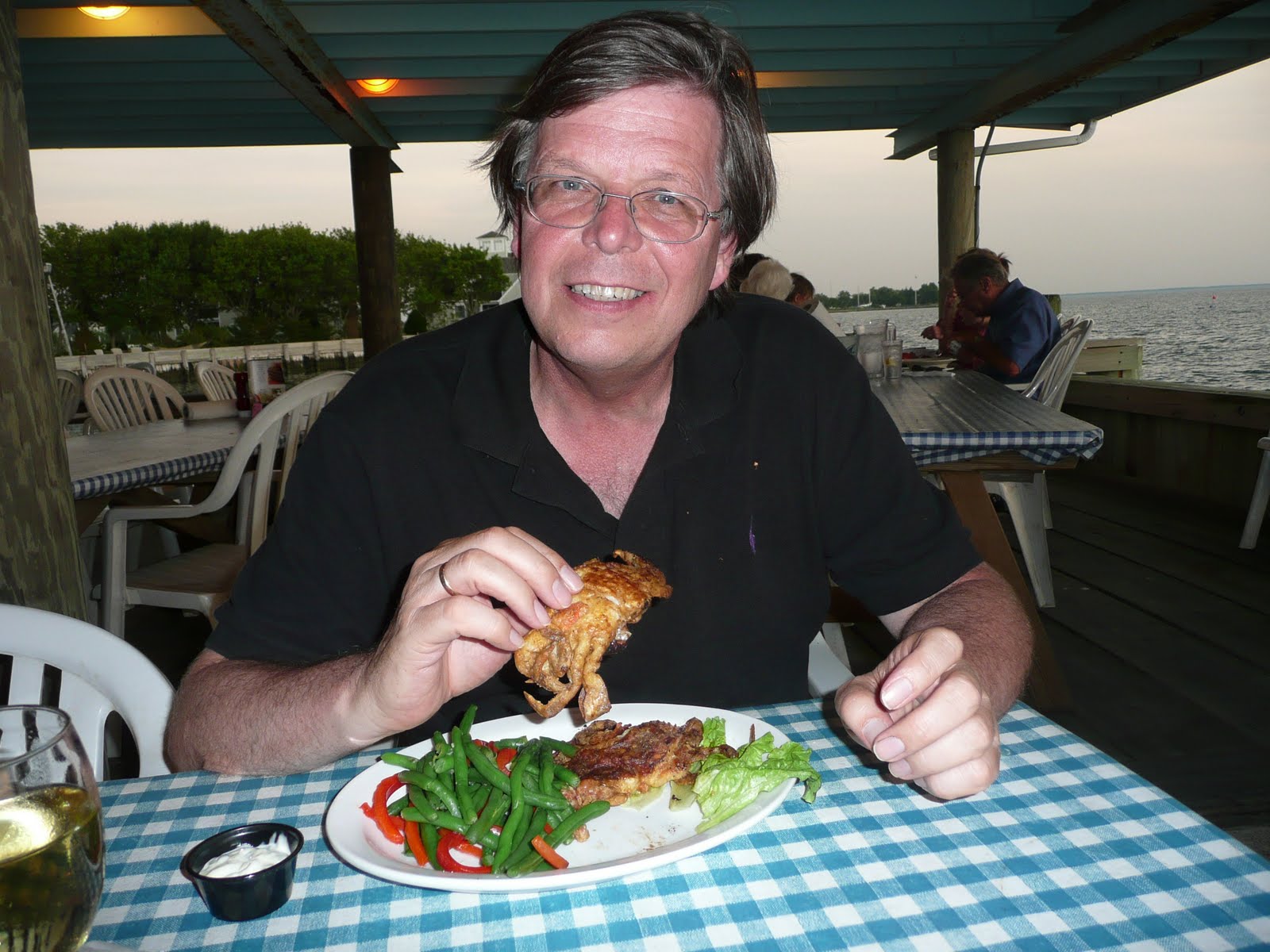
The Chesapeake Bay is famous for its soft-shell blue crabs. As crabs grow larger, their shells cannot expand, so they molt the exteriors and have a soft covering for a matter of days when they are vulnerable and considered usable. Crabs caught just after molting are prepared as soft shell crabs: first cutting out the gills, face, and guts; the crab is then battered in flour, egg, and seasoning, then fried in oil until crispy. The entire crab is consumed, legs and all.

Pictures: Christian G.E. Schiller eating Soft Shell Crabs
Usually crabs must be eaten within four days of molting to be useful as soft-shell crabs. They begin to rebuild their shells after that, and when eaten, have a thin shell. These are often referred to as “papershells” or “tinbacks” and are more crunchy when eaten, making them less desirable.
This molting is highly seasonal and usually lasts from early May to July in the Chesapeake Bay. The soft shell season is longer in other regions.
Crab Cake
Crab cakes is another delicacy. Crab Cakes are basically Hamburgers made out of crab meat. We ate it recently as a starter with tomatoes and avocado on the side.
Picture: Maryland Crab Cake
See more:
Wine and Crab Cakes: Amy Brandwein from Casa Nonna and Chris Clime from PassionFish win the 6th Annual Crab Cake Competition in Washington DC, USA
Maryland Crab Soup
Usually I start my crab dinner with a Maryland Crab Soup. This is a kind of an Italian Minestrone with crab meat. The other fish soup I have come to like on the US East Coast is the New England Clam chowder. New England clam chowder is a milk- or cream-based chowder, traditionally made with potatoes, onion, bacon or salt pork, flour or hardtack, and clams.

Pictures: Annette Schiller, Ombiasy PR and Wine Tours, eating Maryland Crab Soup
See more:
Maryland Crabs and Wine
Schiller's World of Seafood
There is a Wine Industry in all 50 US States
The US is the 4th largest wine producing country in the world, after France, Italy, and Spain. Wine is now produced in all 50 States, with California, Washington State and Oregon leading the way. However, some States outside the Northwest do not grow popular vitis vinifera grapes such as Cabernet Sauvignon and Chardonnay very easily, and some wineries in the smaller wine-producing States buy juice or grapes from other States. For reviews of wines from all 50 States go to here for an excellent Time Magazine article. (http://www.time.com/time/magazine/article/0,9171,1837245,00.html)
Drink Local Wine Conferences: 2009 to 20013
The Drink Local Wine goal is to spotlight wine made in the 47 states and Canada that aren't California, Washington, and Oregon. It's the brainchild of Washington Post wine columnist Dave McIntyre and wine blogger Jeff Siegel, the Wine Curmudgeon.
So far, 4 annual conferences have taken place:
in Dallas featuring Texas wine in 2009,
in Loudoun County featuring Virginia wine in 2010,
in St. Louis featuring Missouri wine in 2011, and
in Denver featuring Colorado wine in 2012.
This is my third DLW conference; I participated in the Virginia and Missouri conferences and have written about them on schiller-wine.
For Virginia, see:
The 2010 DrinkLocalWine Conference in Virginia, US
For Missouri, see:
Drink Local Wine Conference 2011 in St. Louis: The World of Missouri Wine
Wine Producer Missouri – Once a Major Force in the US Wine Market, Then Non-existant and Now on a Rebound with French American Hybrid Grapes
schiller-wine: Related Posting
Drink Local Wine Conference 2011 in St. Louis: The World of Missouri Wine
Wine Producer Missouri – Once a Major Force in the US Wine Market, Then Non-existant and Now on a Rebound with French American Hybrid Grapes
In the Oldest AVA - American Viticultural Area - Augusta in Missouri
French American Hybrid Grapes - Vidal Blanc, Seyval Blanc and Others
Maryland Crabs and Wine
The 2010 DrinkLocalWine Conference in Virginia, US
Thomas Jefferson, 3. President of the United States, Visited Hochheim, Germany on April 10,1978
New Hampshire, US: Cheese ... Lobster and Oysters ... and Wine!
Wine Region: Upcoming Long Island, New York State
Wine and Crab Cakes: Amy Brandwein from Casa Nonna and Chris Clime from PassionFish win the 6th Annual Crab Cake Competition in Washington DC, USA
Schiller's World of Seafood
Drink Local Wine will hold its fifth annual conference April 13, 2013 in Baltimore, focusing on Maryland wine. The state’s industry is one of the fastest growing in the country, and its 61 wineries are almost 50 percent more than in 2010.
The state’s four growing regions allow it to produce a variety of wines, including the classic European varietals but also some that are distinctly New World in style. The Maryland Wineries Association is the conference’s primary sponsor.
“We’re growing a world of wine styles and varieties throughout Maryland, and we’re excited to share them through Drink Local Wine,” says Kevin Atticks, the Maryland Wine Association’s executive director.
DLW 2013 will include a Grand Tasting of Maryland Wines and Twitter Taste-off, featuring two dozen of the state’s best wineries, on April 13, plus three seminars featuring some of the top names in Maryland wine.
For more information and to register go here or here.
A Bunch of History
Maryland’s modern wine history dates to the 1970s, but grapes have been planted in the area since the 17th century. Most of the state’s wineries are in the Piedmont Plateau in central Maryland, but grapes also thrive in the Eastern Shore, Southern Plain, and Western Mountains.
Grapes have been grown in Maryland since 1648, but not even John Adlum – one of our earliest growers who became known as the “Father of American Viticulture” – would have predicted that over 90 varieties of grapes are being grown commercially in The Free State.
Picture: Maryland
Maryland’s 60+ wineries are producing incredible wines from locally-grown grapes, fruit and honey, and selling their bottles (and even bag-in-boxes, etc.) to over 1,200 wine shops and restaurants in Maryland, DC and beyond.
Maryland Blue Crabs
Of course, the focus of the 2013 Drink Local Wine Conference in Maryland will be on the exciting wines of Maryland. But I hope that I (and other conference participants) will also have a chance to taste Maryland’s delicious seafood, in particular Chesapeake Bay Blue Crab dishes. Last year in May, wine guru and Maryland resident Robert J. Parker tweeted: “Maryland’s greatest culinary delicacy – blue channel soft-shelled crabs are starting to arrive … lightly floured and sautéed in butter.” Maryland – with the large Chesapeake Bay – is indeed blessed with Blue Crabs which came in different forms, when you eat them at a Crab Shack.
The Blue Crab
The blue crab is a crustacean found in the waters of the western Atlantic Ocean, the Pacific Coast of Central America and the Gulf of Mexico. Male and female blue crabs can be distinguished by their "aprons", or their abdomens. Male crabs have a long, narrow apron, while mature female crabs have a wide, rounded one.
Chesapeake Bay Blue Crabs
The Chesapeake Bay, located mainly in Maryland is famous for its blue crabs. Chesapeake Bay Blue Crabs undergo a seasonal migration; after mating, the female crab travels to the southern portion of the Chesapeake, fertilizing her eggs with sperm stored up from the last mating months or almost a year later. In November or December, the female crab releases her eggs. The crabs hatch in a larval form and float in the mouth of the bay for four to five weeks, then the juvenile crabs make their way back up into the bay.
Four Ways to Eat Chesapeake Blue Crabs
Hard Shell Blue Crabs
Blue crabs are most often eaten in the hard shell. Steaming them in large pots with water, vinegar and seasoning is the norm on the East coast. You need the whole experience: the smell of steamed crabs in the air, a pile of large steamed blue crabs covered with Old Bay Seasoning, ready to be cracked with wooden mallets, accompanied by corn on the cob, plus a roll of paper towels and a metal bucket for tossing the empty shells.
The cooked crabs are cracked by hand, but most diners will use a small knife to pry the shell apart and cut the unwanted parts from the crab. The meat is pulled out and eaten directly.
Crab shells can be very sharp and because the interior of the crab comprises a series of compartments separated by a somewhat pliable but still sharp shell, getting the meat out is also a lot of work for the relatively small amount of edible crab meat.
Soft Shell Crabs
The Chesapeake Bay is famous for its soft-shell blue crabs. As crabs grow larger, their shells cannot expand, so they molt the exteriors and have a soft covering for a matter of days when they are vulnerable and considered usable. Crabs caught just after molting are prepared as soft shell crabs: first cutting out the gills, face, and guts; the crab is then battered in flour, egg, and seasoning, then fried in oil until crispy. The entire crab is consumed, legs and all.
Usually crabs must be eaten within four days of molting to be useful as soft-shell crabs. They begin to rebuild their shells after that, and when eaten, have a thin shell. These are often referred to as “papershells” or “tinbacks” and are more crunchy when eaten, making them less desirable.
This molting is highly seasonal and usually lasts from early May to July in the Chesapeake Bay. The soft shell season is longer in other regions.
Crab Cake
Crab cakes is another delicacy. Crab Cakes are basically Hamburgers made out of crab meat. We ate it recently as a starter with tomatoes and avocado on the side.
See more:
Wine and Crab Cakes: Amy Brandwein from Casa Nonna and Chris Clime from PassionFish win the 6th Annual Crab Cake Competition in Washington DC, USA
Maryland Crab Soup
Usually I start my crab dinner with a Maryland Crab Soup. This is a kind of an Italian Minestrone with crab meat. The other fish soup I have come to like on the US East Coast is the New England Clam chowder. New England clam chowder is a milk- or cream-based chowder, traditionally made with potatoes, onion, bacon or salt pork, flour or hardtack, and clams.
See more:
Maryland Crabs and Wine
Schiller's World of Seafood
There is a Wine Industry in all 50 US States
The US is the 4th largest wine producing country in the world, after France, Italy, and Spain. Wine is now produced in all 50 States, with California, Washington State and Oregon leading the way. However, some States outside the Northwest do not grow popular vitis vinifera grapes such as Cabernet Sauvignon and Chardonnay very easily, and some wineries in the smaller wine-producing States buy juice or grapes from other States. For reviews of wines from all 50 States go to here for an excellent Time Magazine article. (http://www.time.com/time/magazine/article/0,9171,1837245,00.html)
Drink Local Wine Conferences: 2009 to 20013
The Drink Local Wine goal is to spotlight wine made in the 47 states and Canada that aren't California, Washington, and Oregon. It's the brainchild of Washington Post wine columnist Dave McIntyre and wine blogger Jeff Siegel, the Wine Curmudgeon.
So far, 4 annual conferences have taken place:
in Dallas featuring Texas wine in 2009,
in Loudoun County featuring Virginia wine in 2010,
in St. Louis featuring Missouri wine in 2011, and
in Denver featuring Colorado wine in 2012.
This is my third DLW conference; I participated in the Virginia and Missouri conferences and have written about them on schiller-wine.
For Virginia, see:
The 2010 DrinkLocalWine Conference in Virginia, US
For Missouri, see:
Drink Local Wine Conference 2011 in St. Louis: The World of Missouri Wine
Wine Producer Missouri – Once a Major Force in the US Wine Market, Then Non-existant and Now on a Rebound with French American Hybrid Grapes
schiller-wine: Related Posting
Drink Local Wine Conference 2011 in St. Louis: The World of Missouri Wine
Wine Producer Missouri – Once a Major Force in the US Wine Market, Then Non-existant and Now on a Rebound with French American Hybrid Grapes
In the Oldest AVA - American Viticultural Area - Augusta in Missouri
French American Hybrid Grapes - Vidal Blanc, Seyval Blanc and Others
Maryland Crabs and Wine
The 2010 DrinkLocalWine Conference in Virginia, US
Thomas Jefferson, 3. President of the United States, Visited Hochheim, Germany on April 10,1978
New Hampshire, US: Cheese ... Lobster and Oysters ... and Wine!
Wine Region: Upcoming Long Island, New York State
Wine and Crab Cakes: Amy Brandwein from Casa Nonna and Chris Clime from PassionFish win the 6th Annual Crab Cake Competition in Washington DC, USA
Schiller's World of Seafood
Tuesday, March 5, 2013
Governor’s Cup Competition 2013, Virginia, USA
Picture: Daniele Tessaro, Associate Winemaker of Barboursville Vineyards, and Rachel Martin, Boxwood's General Manager. The Picture was taken at TasteCamp 2012, for more, see: TasteCamp 2012 in Virginia, USA – A Tour d’Horizont
Barboursville Vineyards wins 2013 Governor’s Cup
Governor Bob McDonnell awarded the 2013 Virginia Wineries Association's Governor's Cup to Barboursville Vineyards' 2009 Octagon. By winning this year's Governor's Cup, Barboursville becomes the first Virginia winery to win the award four times. Barboursville also won in 1992 (1988 Cabernet Sauvignon Reserve), 1999 (1997 Cabernet Franc), and 2007 (1998 Cabernet Sauvignon Reserve).
Barboursville Vineyards is located in the Monticello American Viticulture Area of Central Virginia, in and around the Charlottesville region. The historic Virginia winery is located on the estate of James Barbour, former Governor of Virginia, in Barboursville. The winery was founded in 1976 by Gianni Zonin, a prominent Italian winemaker whose family has roots in Italian viticulture going back to 1821. The Zonin Group is based in Vicenza, Italy. Barboursville is Zonin's sole American venture.
Barboursville's award-winning Octagon is a Meritage-style blend of the winery's best Bordeaux varietals. The wine is made only in top vintage years. The 2009 vintage is comprised of 70% Merlot, 15% Cabernet Franc, 10% Petit Verdot and 5% Cabernet Sauvignon.
"It has been a pleasure and a reward to follow the evolution of the 2009 vintage of Octagon. Since harvest I took notice of its promising characters, and I was not shy to share with many that it was destined to be among the best wines I will ever produce in my life," said Luca Paschina, Barboursville's General Manager and Winemaker.
2013 Virginia Governor's Cup Competition
The 2013 Virginia Governor's Cup Competition was conducted over two weeks of tasting. The preliminary tastings were held over ten days at the Capital Wine School in Washington DC, while the final round of tastings was held at the Jefferson Hotel in Richmond.
Picture: Owner Rutger de Vink, RdV Vineyards and Annette Schiller, Ombiasy PR and Wine Tours, at a Bordeaux Tasting in Washington DC in 2013; for more, see: Union des Grands Crus de Bordeaux (UGCB) on North America Tour in Washington DC - Schiller’s Favorites
The Governor's Cup award winner was selected from the 2013 Governor's Cup Case, the top 12 scoring wines of the competition, which were selected from 377 entries of both red and white wines, from 93 wineries.
Governor’s Cup Case
In addition to Barboursville's 2009 Octagon, the other 11 top scoring wines of the competition, forming the Governor's Cup Case, are:
• Cooper Vineyards – 2010 Petite Verdot Reserve
• King Family Vineyards – 2010 Meritage
• Lovingston Winery – 2009 Josie's Knoll Estate Reserve (Meritage)
• Philip Carter Winery – 2010 Cleve (Petite Verdot, Tannat)
• Pollak Vineyards – 2009 Cabernet Franc Reserve
• Potomac Point Vineyard and Winery – 2010 Richland Reserve Heritage (Merlot, Cabernet Franc, Cabernet Sauvignon, Tannat, Petite Verdot)
• Rappahannock Cellars – 2010 Meritage
• RdV Vineyards – 2010 Rendevous (Meritage)
• RdV Vineyards – 2010 Lost Mountain (Meritage)
• Sunset Hills Vineyard – 2010 Mosaic (Merlot, Cabernet Sauvignon, Cabernet Franc, Petite Verdot)
• Trump Winery – 2008 Sparkling Rose (Chardonnay, Pinot Noir)
20 Gold Medals (90 to 100 Points)
Twenty gold medals were awarded, up from 13 last year — possibly a reflection of the strong 2010 vintage, which provided most of those winners. Medals were awarded based on the following average of scores:
• Gold Medal – Outstanding/Classic, 90-100 points
• Silver Medal – Very Good, 85-89 points
• Bronze Medal – Good, 80-84 points
The Gold Medalists
• Barboursville Vineyards, 2009 Octagon
• Bluemont Vineyard, 2010 Cabernet Franc
• Cooper Vineyards, 2010 Petit Verdot Reserve
• Glen Manor, 2010 Hodder Hill
• Keswick Vineyards, 2010 Cabernet Sauvignon Estate Reserve
• King Family Vineyards, 2010 Meritage (unfiltered)
• Lovingston Winery, 2009 Josie’s Knoll Estate Reserve Meritage
• Philip Carter Winery, 2010 Cleve (Petit Verdot, Tannat)
• Pollak Vineyards, 2009 Cabernet Franc Reserve
• Potomac Point Vineyad & Winery, 2010 Richland Reserve Heritage Red
• Rappahannock Cellars, 2010 Meritage
• RdV Vineyards, 2010 Rendevous (Meritage)
• RdV Vineyards, 2010 Lost Mountain (Meritage)
• Shenandoah Vineyards, 2010 Cabernet Franc
• Shenandoah Vineyards, 2010 Rhapsody in Red
• Sunset Hills Vineyard, 2010, Mosaic Red
• Trump Winery, 2008 Sparkling Rose
• Virginia Wineworks, 2010 Shaps Wild Meadow Vineyard
• Virginia Wineworks, 2010 Cabernet Franc, Carter’s Mountain Vineyard
• Virginia Wineworks, 2008, Cabernet Franc, Red Hill Reserve
Nine of the 20 gold medalists were red blends of Bordeaux grape varieties, suggesting once again that Virginia’s best wines are blends rather than single-variety wines. Advocates of Cabernet Franc as Virginia’s red grape, however, will point to the five golds won by wines with that variety on the label. Interesting — and not surprising to some — not one Viognier in the bunch.
Wine Producer Virginia
Virginia is the 5th largest wine industry in the US, with 230 wineries and 2,500 acres of vineyards. Sales of Virginia wine reached a record high in fiscal year 2012 with more than 485,000 cases sold.
In the original charter of the thirteen colonies was a royal commission to pursue three luxury items that England was unable to provide for itself: wine, silk, and olive oil. Every colony made attempts to satisfy the requirements of its charter. Despite many years of failure, the early Americans persisted in their efforts. A big step forward was made in 1740 when a natural cross pollination occurred between a native American grape and a European vitis vinifera. Other successful crossings followed.
Picture: Virginia
In 1762, John Carter, who had 1,800 vines growing at Cleve Plantation, sent 12 bottles to the Royal Society of Encouragement of the Arts, Manufacture and Commerce in London for their evaluation. Minutes of their meeting on the 20th of October 1762 declared Carter’s wines to be “excellent” and a decision was taken to reward Carter’s efforts with a gold medal for his wines. These were the first internationally recognized fine wines produced in America.
Over the past 30 years or so, Virginia wines have experienced a tremendous development - to elegant and balanced, mostly European vinifera-based wines. Recently, Donald Trump as well as AOL founder Steve Case bought a Virginia winery.
Today, the vitis vinifera grapes Chardonnay and Viognier are the leading white varieties. Increasingly they are made without any or with neutral oak, to retain natural acidity and freshness. It appears Viognier is on its way to becoming Virginia’s official “signature grape”.
Picture: Winemaker Jeremy Ligon from Philip Carter Winery
For French-American hybrid varieties, Seyval Blanc is still popular, but resembles now the fresh and crisp wines from France’s South West. Vidal has become the backbone of the artificially frozen (cryoextraction), ice wine which I am not a great fan of. Cryoextraction is an approach, developed by the French, which kind of simulates the frost in the vineyard in the wine cellar.
As far as red wines are concerned, there has been a shift from straight varietal wines to blends, with the blends now being dominated by Merlot and Cabernet Franc. Mirroring the Virginia white wines, there is an increasing focus on neutral oak and clean, vibrant fruit.
Tannat, Uruguay’ signature grape from the South West of France, is showing up in more Virginia wines, usually as a blend. The only red French American hybrid which has performed consistently well in Virginia is Chambourcin, which resembles the Gamay grape of Beaujolais.
Finally, Claude Thibault, a native from France, has taken Virginia sparkling wines to a new level. His NV Thibault-Janisson Brut, made from 100 percent Chardonnay, which President Obama offered his guests at his first state dinner, is as close as you can get to Champagne outside of France.
See:
As Close as You Can Get to Champagne – Claude Thibaut and His Virginia Thibaut Janisson Sparklers at screwtop Wine Bar, USA
schiller-wine: Related Posting
Northern Virginia Magazine October 2012: Wine Recs from Local Winos
Visiting Jennifer Breaux Blosser and Breaux Vineyards in Virginia, USA
Virginia Wines Shine in San Francisco - 2012 San Francisco International Wine Competition, USA
Judging Virginia Wines in Suffolk, Virginia - Virginia Wine Lover Magazine Wine Classic 2012
A New Winery in Virginia - The Barns at Hamilton Station Vineyards, USA
As Close as You Can Get to (French) Champagne at the US East Coast – Claude Thibaut and His Virginia Thibaut Janisson Sparklers at screwtop Wine Bar
Jim Law and Linden Vineyards in Virginia – A Profile, USA
As Close as You Can Get to Champagne – Claude Thibaut and His Virginia Thibaut Janisson Sparklers at screwtop Wine Bar, USA
Boxwood Winery in Virginia: Lunch with Wine Makers Rachel Martin and Adam McTaggert in the Chai between the Tanks – TasteCamp 2012 East Kick-Off, USA
Book Review: "Beyond Jefferson's Vines - The Evolution of Quality Wine in Virginia" by Richard Leahy, USA
An Afternoon with Jordan Harris, Winemaker of Tarara, Virginia, USA
TasteCamp 2012 in Virginia, USA – A Tour d’Horizont
Monday, March 4, 2013
Lunch with Didier Cuvelier at Château Léoville-Poyferré in Saint-Julien, Bordeaux
Picture: Didier Cuvelier and Christian G.E. Schiller lunching at Château Léoville-Poyferré
I recently had the honor and pleasure to have lunch with Didier Cuvelier at his Château Léoville-Poyferré. The lunch was preceded by a tour of the winery. I have provided a general introduction to Didier Cuvelier at his Château Léoville-Poyferré here: Château Léoville-Poyferré, Chateau Le Crock, Didier Cuvelier in Bordeaux and the Cuvelier Los Andes Wines in Argentina
The Cuvelier Family in the North of France, in Bordeaux and in Argentina
The story begins in 1804 when Henri Cuvelier set out to share his great passion for fine wine with his friends of the grand bourgeoisie residing in the rich and dynamic towns of the North of France, including Lille, Boulogne Sur Mer, Arras, and Valenciennes. To this aim, he created Maison de Négoce de Vins Henri Cuvelier in Haubourdin, a wine merchant company whose success continued to develop throughout the 19th century.
100 years later, at the beginning of the 20th century, Paul Cuvelier and his young brother Albert, decided to purchase top quality estates in the Bordeaux area. They bought Château Le Crock in 1903, then Château Camensac in 1912 and finally the prestigious Château Léoville Poyferré as well as Chateau Moulin Riche in 1920.
Picture: Touring Chateau Leoville Poyferre with Didier Cuvelier
In 1947, Max Cuvelier, under the instructions of his associates, opened a second Wine Merchant company in Bordeaux, moving nearer to the family properties.
Two of Max Cuvelier’s children have taken over the family’s activities in Bordeaux: Didier Cuvelier has been running Chateau Leoville Poyferre, Chateau Moulin-Riche and Chateau Le Crock since 1979 and Olivier Cuvelier has been managing the Wine Merchant company H. Cuvelier and Fils in Bordeaux since 1985.
The Haubourdin wine merchant company was sold in 2002. The name has remained unchanged and it continues to distribute the Cuvelier estates wines.
Pictures: Didier Cuvelier Explaining
In 1998, the Cuvelier family started to branch out to Argentina. Bertrand Cuvelier accompanied Michel Rolland in his great Argentine project, which was to become the« Clos de Los Siete »group. Three years later, Jean-Guy Cuvelier decided to join his cousin Bertrand in the joint aim of building a Winery and producing fine wines worthy of the family tradition. Since then, the Winery has been built and each year the vines of Cuvelier Los Andes have contributed 50% of their production to « Clos de Los Siete », the wine signed by Michel Rolland. The success of this wine is worldwide due to the exceptional value for money it offers.
Château Léoville - Poyferré, Barton and Las-Cases
The Cuvelier family bought Château Léoville-Poyferré – one of the 3 Léoville estates that currently exist - in 1920.
The 3 Léoville chateaux are the result of vast property broken up a long time ago. But up until the French Revolution, Léoville was the largest Médoc wine-growing property.
The story of the 3 Léoville estates go back to 1638. At the time, the estate was called Mont-Moytié, named after its founder, Jean de Moytié. Domaine Mont-Moytié remained in the family for almost 100 years. It is through the marriage of one of the Moytié women that the estate passed into the hands of Blaise Antoine Alexandre de Gascq, who was the seigneur of Léoville and a president of the Bordeaux parliament.
The groundwork for the split was laid in 1769, when Blaise Antoine Alexandre de Gascq died without an obvious heir. As a consequence the Léoville estate was inherited by four family members. One of them was the Marquis de Las-Cases-Beauvoir. One quarter was sold off by the four heirs. A number of years later, in 1826, this part of Léoville estate was purchased by Hugh Barton and became Château Léoville Barton.
The other three quarters remained in the family. This was the state of affairs when the Marquis was succeeded in 1815 by his son, Pierre-Jean and his daughter, Jeanne. Pierre-Jean inherited what is now Château Léoville Las Cases, whilst the portion that came to Jeanne was passed onto her daughter, who married Baron Jean-Marie de Poyferré; this is the part that is today Château Léoville-Poyferré.
Although the estate bears the name of the Poyferré family to this day, it was not in their ownership for a long time. But it was under the ownership of the Poyferré family when the estate was classified as a deuxième cru in 1855 (as were the Barton and Las-Cases estates).
In 1865 Château Léoville-Poyferré was purchased by Baron d'Erlanger and Armand Lalande, bankers and local courtiers. The Lalande family, and later through marriage also the Lawton family, were in charge of Château Léoville-Poyferré until after World War I had passed. The Cuvelier family bought Château Léoville-Poyferré in 1920.
While the vineyards were separated, the buildings remained connected, just as they are today.
Didier Cuvelier and Château Léoville Poyferré
In the beginning, the Cuveliers did not operate their chateaux themselves. Roger Delon, one of the owners of Chateau Leoville Las Cases was the first to manage Chateau Léoville-Poyferré. This changed in 1979 with the accession of Didier Cuvelier, who at 26 became the first member of his family to take charge of Leoville Poyferre, along with Moulin Riche and Le Crock. Didier Cuvelier put Leoville Poyferre on the map of wine lovers all over the world. Didier Cuvelier trained as a chartered accountant before passing the DUAD (a university diploma in wine tasting) in 1976.
When he arrived in 1979, Didier Cuvelier embarked on an extensive program of renovation in the vineyard. Having previously been strong on Merlot, under the direction of Didier Cuvelier the proportion of Cabernet Sauvignon more than doubled, from 30% to its current figure of 65%, the balance being 25% Merlot, 8% Petit Verdot and 2% Cabernet Franc. The vineyard area now totals 80 hectares, compared with 48 hectares in 1979.
Pictures: Tasting after the Tour
In 2010, the vat rooms were completely renovated. 10 large vats were replaced with 20 new, stainless steel double skin vats with a capacity from 60 hectoliters to 165 hectoliters.
The grand vin is Château Léoville-Poyferré (20000 cases). Typically the oak is 75% new each year. Wines produced from the plots once belonging to Château Moulin Riche (17000 cases) are vinified completely in cuve, before transfer into a mix of new and one-year-old barrels. The second wine is Pavillon de Poyferré.
Château Le Crock
The first purchase made by the Cuvelier family was their property in St. Estephe, Chateau Le Crock in 1903.
Today the vineyards of Château Le Crock cover a total of 32.5 hectares and touch two of the most prestigious châteaus of the appellation, Château Cos d’Estournel and Château Montrose.
The vines are 60% Cabernet Sauvignon, 25% Merlot, 10% Cabernet Franc and 5% Petit Verdot.
In the (annulled) 2003 Classification, it was a Cru Bourgeois Superieur. The 2010 Chateau Le Crock qualified for the Cru Bourgeois Label.
Chateau Moulin Riche
Chateau Moulin Richewas bought in 1920 by the Cuvelier family. In 2003, it was incorporated in the Chateau Léoville-Poyferré vineyards.
Lunch
Lunch was served in the large, new reception hall of Chateau Léoville-Poyferré.
Pictures: Lunch with Didier Cuvelier in the large, new reception hall of Chateau Léoville-Poyferré
Fricassee of Monkfish, Cockles and Clams in Saffron Butter
Fillet Mignon
Cheese
Poached Williams Pear in Caramelized Custard
Chateau Léoville-Poyferré 2007
Wine Searcher Average Price: US$ 74
Deep red garnet color in the glass, nose of cedar and tobacco, easy drinking, soft on the palate, a pleasure, given the relatively low price.
Chateau Léoville-Poyferré 2000
Wine Searcher Average Price: US$ 202
Deep red garnet color in the glass, tobacco, cedar, earth, wood, chocolate nose, a big wine, with good tannins and a long finish.
Chateau Léoville-Poyferré 1996
Wine Searcher Average Price: US$ 147
Deep red garnet color in the glass, notes of tobacco combined with gravel and sweet blackcurrant fruit on the nose, full bodied on the palate, good acidity and a good length finish.
Chateau Le Crock 2005
Wine Searcher Average Price: US$ 51
Red garnet color in the glass, notes of red fruits and smoke on the nose, good structure, medium long finish with some notes of roasted coffee.
schiller-wine: Related Postings
Bordeaux Trip September 2012, France
Bordeaux Wines and their Classifications: The Basics
An Afternoon with Owner Michel Tesseron at Château Lafon-Rochet, 4ème Cru Classé en 1855, in Saint-Estèphe, Bordeaux
The Wine Empire of the von Neipperg Family in France, Bulgaria and Germany
Château Léoville-Poyferré, Chateau Le Crock, Didier Cuvelier in Bordeaux and the Cuvelier Los Andes Wines in Argentina
Château Pape Clément in Pessac-Léognan and the World Wide Wine Empire of Bernard Magrez, France
Tasting with Alfred Tesseron the last 10 Vintages of Château Pontet-Canet in Washington DC, USA/France
Tasting the Wines of Chateau Lafon-Rochet, Saint-Estèphe, 4ème Cru Classé en 1855, with Owner Basil Tesseron at the French Embassy in Washington DC, USA/France
Union des Grands Crus de Bordeaux (UGCB) on North America Tour in Washington DC - Schiller’s Favorites
Owner Jean-Bernard Grenié and Wine Journalist Panos Kakaviatos Presented the Wines of Chateau Angélus and Chateau Daugay at Black Salt Restaurant in Washington DC, USA
Friday, March 1, 2013
American Wines with German Roots
Picture: Christian G.E. Schiller with Walter Schug in Carneros
This is a compilation of American wines or wineries that have in one way or another German roots. The German component can take different forms.
First, the most extreme, I believe, is blending of grapes grown in America with grapes grown in Germany. It seems unusual, but it happens.
The second form is a joint venture of an American and a German wine maker, using American grapes.
Third, there are a number of winemakers in the US who make their wine in the US with American grapes, but who have learned how to make wine in Germany. They came to the US some years ago, are settled in the US and produce American wines, but you can see the German roots in the wines.
Fourth, there are wine producers in the US that were founded by Germans some time ago.
Blending American and German Grapes
NV Pacific Rim Dry Riesling, Pacific Rim – A German American Blend
Pacific Rim is a winery in Washington State that produces 190,000 cases of wine, almost all of which is Riesling made from Washington grapes. Pacific Rim was founded by Bonny Doon’s Randall Grahm in 1992. He sold it a couple of years ago to the Banfi family as part of his general downsizing strategy.
Picture: Christian G.E. Schiller with Randall Grahm in San Francisco
One of the Rieslings that Pacific Rim used to produce was an intercontinental blend, made from grapes from Washington State and grapes from the Mosel area in Germany. 80 percent of the grapes come from the Columbia Valley in Washington State and 20 percent from the Mosel Valley, selected by the German wine maker Johannes Selbach. Because it was an intercontinental blend, the wine had to be labeled as a NV. Randall Grahm stopped using German grapes in 2008.
Fore more, see:
Pacific Rim Riesling #1 of Wine Enthusiast Top 100 Best Buy List 2011 - Meeting Founder Randall Grahm and Winemakers Nicolas Quille and Steven Sealock
Visiting Winemaker Steven Sealock at Pacific Rim Winemakers in Washington State, USA
German American Wines: (1) Pacific Rim Dry Riesling, (2) Eroica, (3) Woelffer and his Schiller Wine
Joint Ventures
Eroica in Washington State – A Joint Venture between Chateau Ste. Michelle and Dr. Ernst Loosen
Eroica is a collaboration between Chateau Ste. Michelle, the huge Washington winemaker, and Dr. Ernst Loosen, the eminent Riesling producer from the Mosel region of Germany. The wine is made at Chateau Ste. Michelle from grapes grown in the Columbia Valley.
Eroica was launched in 1999. Named for Beethoven’s Third Symphony, Eroica is supposed to reflect not only its variety and site, but also its heritage: bold and forward from its Washington roots, elegant and refined from German inspiration.
Picture: Christian G.E. Schiller with Ernst Loosen in Washington DC
Founded in 1934, Chateau Ste. Michelle pioneered European vinifera grape growing in Washington State and has been producing classic European varietal wines under the Ste. Michelle label since 1967. The Dr. Ernst Loosen Estate in the Mosel valley has produced fine Riesling for over two centuries. It is one of the top German wine estates.
They make three kinds of the Eroica. The regular, dry Eroica, an ice wine and a Single Berry Selection. The latter is made in the traditional German Trockenbeerenauslese (TBA) style, for which the Mosel valley is so famous, and is one of the few TBAs in North America. This wine is made in very limited quantities and has scored a 98 in the Wine Spectator.
For more, see:
German American Wines: (1) Pacific Rim Dry Riesling, (2) Eroica, (3) Woelffer and his Schiller Wine
Wine ratings: Two American/German wines - Eroica and Poet's Leap - on Top 100 Wines from Washington State list for 2009
The Doctor Made a House Call - A Tasting with Ernst Loosen, Weingut Dr. Loosen, at MacArthur Beverages in Washington DC, USA
J. Christopher Wines in Oregon – Ernst Loosen’s Second Project in the USA
A more recent joint venture of Ernst Loosen is the Loosen Christopher Wines LLC with Jay Somers in Oregon. Jay Somers and Ernst Loosen met years ago. Their friendship led to a partnership, and in 2010, they began building a winery and vineyard in Newberg, Oregon. The new venture, Loosen Christopher Wines LLC, produces wines under the already-established “J. Christopher” brand. As winemaker for the joint venture, Jay is in charge of all winery operations. Ernst sees his role as that of an investor who both supports the growth of the brand and broadens the winery’s exposure to Old World ideas and techniques.
Picture: Christian G.E. Schiller with Jay Somers in Portland, Oregon
For more, see:
A Riesling Guru and a Killer Guitarist cum Cult Winemaker: Ernst Loosen and Jay Somers and their J. Christopher Winery in Newberg, Oregon
Poet’s Leap Riesling in Washington State – A Joint Venture between Long Shadows and Schlossgut Diel
Long Shadows has become, in a short time, one of the premier wineries in Washington State. Based in Walla Walla, it is an unusual set up. Former Stimson-Lane CEO Allen Shoup works with renowned winemakers from around the world for this venture. Each winemaker creates a single wine using Washington State fruit. Add resident winemaker Gilles Nicault to shepherd all of the wines along.
One of the wines is the Poet’s Leap Riesling, made in joint ventue with Armin Diel, one of Germany’s most highly regarded Riesling producers. His family has owned the celebrated estate of Schlossgut Diel in Burg Layen in the Nahe river valley since 1802. Schlossgut Diel is international renowned for its white wines, predominately Rieslings, across a wide range of styles. Armin Diel is also one of Germany’s leading wine writers. Armin and his wife Monika live in Burg Layen. Their daughter Caroline just completed her studies in enology in Geisenheim, Germany’s UC Davis equivalent, and is now co-managing the winery in the Nahe Valley.
Pictures: Christian G.E. Schiller with Armin Diel and Caroline Diel at Schlussgut Diel in Germany
Fore more, see:
Visiting Long Shadows Vintners in Walla Walla, Washington State - Where Armin Diel’s Poet’s Leap Riesling is Made
Visiting Armin and Caroline Diel and their Schlossgut Diel in Burg Layen in Germany
German Winemaker and American Grapes
Woelffer Estate on Long Island in New York State – All German, Except for the Grapes
The Woelffer Estate is located in the Hamptons on Long Island in New York State. The Woelffer Wine Estate, one of the top wine estates on Long Island, New York State, would not be what it is today without the two Germans Christian Woelffer, its founder, and Roman Roth, its wine maker.
Christian Wölffer was born in Hamburg, Germany. He made a successful career in investment banking, real estate, venture capital and agriculture in different countries, before moving into wine and establishing the critically acclaimed Woelffer Estate.
Christian Wölffer purchased land on Long Island in 1978. He joined the wine movement in 1987, when he started to grow wine, and became a driving force of wine making in the Long Island in the following years until his untimely death in 2008. In 1997, Christian Wölffer completed work on his state-of-the-art winery, unquestionably the most stylish on Long Island.
The other driving force behind the Wölffer Estate is the German winemaker Roman Roth. Born in Rottweil, Germany, Roth was a choirboy in his youth. In 1982, at age 16, he began a three-year apprenticeship at the Kaiserstuhl Wine Cooperative in Oberrotweil. Turning 20, Roman Roth traveled to California, where he worked at the Saintsbury Estate and Australia, where he worked at the Rosemount Estate. Back in Germany, for further study, Roth worked at the Winzerkeller Wiesloch in Baden.
The year 1992 became a turning point for Roman Roth for two reasons: first, he earned his Master Winemaker and Cellar Master degree from the College for Oenology and Viticulture in Weinsberg. And second, he accepted Christian Wölffer’s invitation to join him in New York to be the winemaker at what was then the mere start-up of a winery, at that time known as Sagpond Vineyards in Sagaponack.
Over the next several years, Roth managed the cultivation and expansion of the vineyards, which today number 50 acres, and the vinification, ultimately producing wines that embody the essence of the Hamptons appellation—ripe fruit and natural acidity born of a unique terroir, a lush combination of soil, sun, moisture and the ever-present maritime breezes from the nearby Atlantic Ocean.
For more, see:
German American Wines: (1) Pacific Rim Dry Riesling, (2) Eroica, (3) Woelffer and his Schiller Wine
German Winemakers in the World: Christian Woelffer and Roman Roth
Otium Cellars in Virginia – German Ownership and German Grape Varieties
Otium Cellars is owned by the German Gerhard Bauer and located in Loudoun County, Virginia. Gerhard Bauer is the CEO of Frenzelit North America Inc., the Frenzelit headquarters in Germany.
Picture: Christian G.E. Schiller and Gerhard Bauer in Virginia
Gerhard Bauer started the winery a few years ago: “Rooted in old Franconian tradition, our boutique winery is taking wines in Northern Virginia to new heights. Our quest is focused on making high-quality wines.”
Planted in 2007, the vineyard is home to several German varietals: Lemberger, Dornfelder and Grauburgunder (Pinot Gris). “We believe wine is not only made in the cellar but is a philosophy and year-round effort in the vineyard. The vines are constantly being attended to during all four seasons. Each wine demonstrates the best aroma, character, and flavor you can achieve with the different grape varietals we cultivate . . . Each of our wines receive a specific treatment, and we call this Otium Terroir Management . . . Perfecting the ideal ripeness according to the year.”
Ben Renshaw has been working with Gerhard Bauer to produce and sell the wines of Otium Cellars while Gerhard Bauer’s winery was being built. Gerhard Bauer did his first planting on six and a half acres at Goose Creek Farms in 2007.
For more, see:
Tasting the “German” Otium Wines with Gerhard Bauer and Ben Renshaw at Otium Cellars, Virginia, USA
Anthony Road Wine Company in the Finger Lakes, New York State – A German Winemaker, Johannes Reinhardt
The Anthony Road Wine Company, a top winemaker in the Finger Lakes region, caught international attention recently with their 2006 Finger Lakes Riesling Trockenbeeren, when it was awarded one of the 7 Trophies of Excellence of the Riesling Du Monde Competition 2010 in France.
Ann and John Martini opened the winery in 1990. It is on the west shore of Seneca Lake in the town of Torrey, about 10 miles south of Geneva. The German connection? The winemaker, Johannes Reinhardt, is a German native, born in at little village of Franconia, 80 miles east of Frankfort. Johannes grew up in a family that has been in the wine business since 1438. He has been in the vineyards and wine cellars all his life. He joined Anthony Road in 2000.
The award winning wine was released in the Martini-Rheinhardt Selection Series. These are special wines named after the Anthony Road’s vineyard manager, Peter Martini, and winemaker Johannes Reinhardt to honor the collaboration between the vineyard and the winery.
This is a lusciously sweet wine. How was it made? Mother Nature, under normal circumstances, produces dry wines in the vineyard - everywhere in the world. All the sugar in the grapes at harvest disappears during fermentation and no sweetness remains in the wine. There are, however, plenty of sweet wines made around the world. Different techniques exist to make a wine sweet. One of them is to let the noble rot – botrytis cinerea – suck the water out of the grape, so that the degree of sugar in the grapes is extra-ordinary high. Botrytis cinerea is a fungus that under the right conditions attacks already-ripe grapes, shrivelling them, concentrating the sweetness and acidity. The grapes end up looking disgusting but they make profound sweet white wines.
The 2008 Finger Lakes Riesling Trockenbeeren was produce with this method. 2008 was a good year for noble rot in the Finger Lakes region, with some rain, enough heat and fog or dew in the morning at harvest time.
For more, see:
Celebrating the Rieslings of the Finger Lakes Region, New York State, US East Coast
The Wines and the Food at President Obama’s Inauguration Luncheon, January 21, 2013, USA
Walter Schug’s Sensational Pinot Noirs – A German in California
Walter Schug is one of California’s Pinot Noir pioneers. His home is Walter Schug Carneros Estate winery in Sonoma, California, but he was born and grew up in Assmannshausen in the Rheingau in Germany. He also received his formal training as winemaker in Germany. Walter Schug first made Pinot Noir in 1954, with his father in Assmannshausen in the Rheingau.
Picture: Christian G.E. Schiller with Walter Schug in Sonoma
Walter Schug was the first winemaker at Joseph Phelps in 1973, where he initially built a reputation for Riesling and Cabernet Sauvignon, but also made Pinot Noir. In 1989, Walter purchased 50 acres in the Sonoma portion of the Carneros Appellation for their new Carneros Estate.
For more, see:
California Pinot Noir Pioneer Walter Schug: From the Rheingau in Germany to Carneros in California
Lunch with Pinot Noir Giant Walter Schug in Sonoma, California
Visiting Walter Schug and his Schug Carneros Estate Winery in Carneros, California
Anne Moller-Racke’s Donum Estate in California: Old World, Terroir-driven Winemaking in the New World
Anne Moller-Racke is President and Winegrower at the Donum Estate in Sonoma, California. Now ten years old, the Donum Estate is a small producer of ultra-premium Pinot Noir wines.
Anne Moller-Racke’s live began in a small village in Germany, Oberwesel. It took a major turn, when she married Markus Racke from the Racke family. It took another turn, when the Racke family purchased the Buena Vista Carneros Estate in 1981 and she settled with Markus in California.
Picture: Christian G.E. Schiller with Anne Moller-Racke at Donum Estate in Sonoma
Anne quickly moved up the ranks at Buena Vista Carneros Estate. She became vineyard manager for Buena Vista Carneros Winery in 1983. She was named director of vineyard operations in 1988 and was promoted to vice president of vineyard operations in 1997.
Anne was instrumental in developing Buena Vista’s Carneros Estate, now the appellation’s largest vineyard, expanding the planted acreage from 540 in 1981, when the Racke family took over, to 935 a decade later, and supplying fruit to premier producers like Acacia, Etude and Sterling. In the 1990s, she also replanted over 500 acres, carefully innovating viticultural practices and selecting rootstocks, clones, trellising and irrigation techniques for each vineyard block.
Anne Moller-Racke’s life took another turn in 2001, when the Racke family sold the Buena Vista Carneros Estate. At the same time Markus and Anne divorced, after Markus had moved back to Germany to take over the management of the Racke Group 10 years earlier. Anne was able to split off 200 acres of the Buena Vista Estate to start her personal project, the Donum Estate. The name, Donum, translates from the Latin to “donation” and refers to grapes as a gift of the land.
Now ten years old, Anne farms 70 acres of vines at the home ranch, 20 acres of the venerable Ferguson Block in Carneros, and the Nugent Vineyard, an 11-acre Russian River Valley estate she planted in the mid-1990s. As caretaker of vineyards she has farmed for decades, Anne brings a vast knowledge of the appellations and sites to her role as wine grower.
The Donum Estate is leading the cadre of Pinot Noir producers in Carneros that are producing stunning wines to rival any made in California today.
Fore more, see:
Visiting Anne Moller-Racke and her Donum Estate in California: Old World, Terroir-driven Winemaking in the New World
Founded by Germans
Schramsberg – A Leading Sparkling Wine Producer Founded by a German
In 1826, in the small town of Pfeddersheim Germany, along the Rhine River, Jacob Schram was born. He came from a winemaking family. When he was sixteen, the young Schram immigrated to New York. He was educated in the trade of barbering, and in 1852 sailed across the Caribbean, crossed-over the Panama Isthmus, and continued up to San Francisco. He spent the next several years barbering, eventually moving his way north, to the Napa Valley.
In 1859 he married Annie Christine Weaver, also from Germany, and they started a family. For several years he continued to barber full time. Never far from his thoughts were his homeland and his roots in the vinelands of Germany. In 1862, Jacob purchased a large piece of land on the mountainsides of the Napa Valley. He was going to be a part of the emerging efforts by many fellow German countrymen in the Napa Valley to make wine; thus Schramsberg was born.
Korbel Champagne Cellars – A Leading Sparkling Wine Producer with Roots in Bohemia
Sparkling wine production in California dates to the late 1800s, when two groups -- Almaden Vineyards and the Korbel brothers -- offered their first bottles of sparklers (“Champagne”) for sale. Korbel Champagne Cellars was founded by 3 brothers -- Francis, Anton, and Joseph-- from Bohemia, which has historically been home to both Czechs and Germans and now is part of the Czech Republic. The first German University was founded in Bohemia. When the Korbel brothers were born, they were born in the Kingdom of Bohemia, which was, along with 39 other sovereign states, part of the German Confederation (Deutscher Bund).
It was the timber that first attracted the Korbel brothers to the Russian River Valley of Sonoma County in 1872. When the building boom subsided, they began to grow alfalfa, beets, corn, prunes, and wheat, and also began to plant vineyards on their Russian River property. In 1984, they brought a Prague winemaker named Frank Hasek to California. Hasek used the methode champenoise approach to making sparkling wine. By 1894, the Korbel brothers began to sell their sparklers and by the end of the 1800s, Korbel was an award-winning, internationally recognized label.
In the early 1950s, the Koerbel family sold the business to Adolf L. Heck, a third generation winemaker whose family had roots in the Alsace Loraine straddling France and Germany. In 1956, Adolf L. Heck reintroduced Korbel Brut, making it much lighter and drier than other American sparklers. He developed his own yeasts and introduced Korbel Natural, Korbel Blanc de Blancs, and Korbel Blanc de Noirs. Adolph Heck ran Korbel until his death in 1984. His son, Gary, took over as chairman of the board and Robert Stashak became Korbel's sparkling wine master.
For more, see:
German Wine Makers in the World: The Korbel Brothers from Bohemia Introduced "Champagne" to the US
The Wines and the Food at President Obama’s Inauguration Luncheon, January 21, 2013, USA
Charles Krug Winery and the Mondavis
The Charles Krug Winery has been owned for many decades by Mondavis, but it was founded by Charles Krug, a German. He was born as Karl Krug in Tendelburg, near Kassel, which at that time was part of Prussia. When he arrived in San Francisco in 1852, he came with no grape-growing or winemaking experience. He was a university-trained journalist (with controversial political beliefs – a supporter of the March revolution - for which he was briefly jailed in Prussia). Until 1854, he worked for the German San Francisco Staats-Zeitung.
In the following years, he would become the major local winery figure of his era, greatly influencing Napa Valley's development as a world-renown wine producing region. Charles Krug made the first commercial wine in the Napa Valley, and the winery he built in 1861 is where Napa wine began. His leadership was said to be inspirational. Innovations such as using a cider press to efficiently crush the grapes, planting insect-resistant rootstock, and establishing the first public tasting room, truly made him a founding father of the pioneer Napa Valley wine industry.
Picture: Christian G.E. Schiller with Peter Mondavi Jr. in Washington DC
When Charles Krug died in 1892, the winery was purchased by his close friend, James Moffitt, a San Francisco banker, who owned the winery through prohibition and sold the winery to Cesare and Rosa Mondavi, Italian immigrants, in 1943. Cesare was 60 when he purchased the winery for $75,000. His two sons, Peter and Robert, both went to Stanford, then came back to run the winery. Cesare died in 1959. The Mondavi brothers Peter and Robert could not agree on the general direction of the Charles Krug Winery and in 1966 there was the famous breakup between the two brothers. Robert left, was paid off and founded the Robert Mondavi Winery. Peter stayed and has been at the helm of the Charles Krug Winery since then.
There were tremendous enological, viticultural and marketing innovations that Peter Mondavi undertook during the last four decades. Among them were vintage dated varietals, pioneering cold fermentation and sterilization for white wines, use of small French oak barrels and glass lined steel tanks.
Meanwhile, Peter's two sons -- Marc and Peter Jr. - were educated at UC Davis and Stanford, respectively, and have been playing a major role in winemaking and winery management since the early 1980's. Marc oversees the vineyards and winemaking, while Peter Jr. manages marketing, sales and general winery functions.
Located one-and-a-half miles north of St. Helena, “the Charles Krug Winery focuses production on lush red Bordeaux style blends, New Zealand style Sauvignon Blanc and classically crafted Chardonnay, Pinot Noir and Zinfandel” said Peter. Over the years, the Charles Krug Winery has grown to 850 acres of estate land. The wine portfolio comprises three groups of wines.
Fore more, see
Morton’s Steakhouse Presented Peter Mondavi Jr. at a Charles Krug Winemaker Dinner
Dr. Konstantin Frank and the Vitis Vinifera Revolution on the US East Coast
Dr. Konstantin Frank (1897-1985) was a viticulturist and wine maker in the Finger Lakes region of New York State, USA. He was born in Europe, in Odessa, now Ukraine into a Russian-German family. Dr. Konstantin Frank ignited the so-called vitis vinifera revolution, which changed the course of wine growing in the Finger Lakes and the North-East of the US.
Well, was Dr. Konstantin Frank a German? He was born in the former Soviet Union into a family with German roots. The Germans came in waves from the West to Russia and settled there from the 16th century onwards. A big wave of German immigration occurred in the 18th century under Catherine the Great, who herself was a German from Anhalt. The Frank family belongs to the Black Sea Germans. At the time Konstantin Frank was born, Odessa belonged to the Russian Empire. When he left for the US, it was part of the Soviet Union. Now, after his death, it has become Ukraine. I met Dr. Konstantin Frank's grandson, Fred, who now owns and runs the estate this year; we communicated in German. Fred got his wine growing and wine making training at the wine college in Geisenheim in the Rheingau, Germany.
Dr. Konstantin Frank’s achievement is that he was the first to find a way to plant vitis vinifera varietals in the cool northern fringes of the north-eastern US. The struggle to do this goes back many centuries.
In the original charter of the 13 colonies was a royal commission to pursue three luxury items that England was unable to provide for itself: wine, silk, and olive oil. Every colony made attempts to satisfy the requirements of its charter, but made only limited progress. The problem was that on the one hand there were the native American grapes. All these native American grapes were cold tolerant and disease and pest resistant, but not that well suited for wine making, due to their coarseness, high tannins, and foxy flavors. On the other hand, the vitis vinifera which settlers brought from Europe, were well suited for wine making, but uniformly unable to survive long enough to produce a crop.
Despite many years of failure, the early Americans persisted in their efforts. And they had some success. A big step forward was made in 1740 when a natural cross pollination occurred between a native American grape and a European vitis vinifera. Other successful crossings followed.
So, only native American grapes and European American hybrids were grown in the Finger Lakes area, when Dr. Konstantin Frank arrived in the United States in 1951, finding work at a Cornell University experimental station in the Finger Lakes region. Having grown vitis vinifera back home in regions so cold that "spit would freeze before touching the ground" Dr. Frank believed that the lack of proper rootstock, not the cold climate, was the reason for the failure of vitis vinifera in the Finger Lakes region. He thought that European grapes could do well on the rolling, well-drained hills around the Finger Lakes provided they were grafted onto early maturing American rootstock.
With the help of the French champagne maker Charles Fournier, Dr. Frank put his ideas into practice. He developed the right root stock and grafted European vitis vinifera on them. He planted these vitis vinifera in the slate soil around Lake Keuka and he opened a winery, Vinifera Wine Cellars, in 1962. Despite his success, other winemakers still doubted him for many years and he had trouble getting New York distributors to handle his wine.
Today, Dr. Frank is recognized as having led the revolution in wine quality in New York State and the East Coast. With the help of his cousin Eric Volz as vineyard manager, Fred Frank, Konstantin's grandson took over the winery in 1993. Fred’s business degree from Cornell University and his study of viticulture and enology in Germany helped prepare him to take over the family business.
For more, see:
German Wine Makers in the World: Dr. Konstantin Frank (USA)
Hermann J. Wiemer from the Mosel Valley and the Riesling Revolution in the Finger Lakes
Hermann J. Wiemer is another pioneer of viticulture and winemaking in the Finger Lakes region with German links. He was born and raised in Germany, and arrived in the US in 1968. His first wine was released in 1980. In the 30 years since then, the winery has been lauded as one of the nation’s premier white wine producers, in particular of Riesling. Hermann J. Wiemer was born in Bernkastel into an influential family in the wine business. Hermann's father was the head of the Agricultural Experiment Station in Bernkastel and was responsible for restoring vines in the Mosel region after WWII. He came to the US in the early 1970s. When he arrived, wine making in the Finger Lakes area was dominated by native American grapes and American European hybrid grapes. Riesling, for which Hermann J. Wiemer has become famous, was not grown. Initially, he made hybrid and American wines for Walter Taylor at the Bully Hill winery on Keuka Lake.
In 1973 Hermann J. Wiemer bought 140 acres of land, the barn and a mid-19th-century house on the west side of Route 14, which runs along Seneca Lake and turned it into one of the premier vineyards and nurseries in the region. Starting with four acres, he developed the right root stock for grafting European vinifera on them. The first vintage, a 1979, was released in 1980. Hermann Wiemer quickly became known for his German-style vinifera wines. He claims that he made the first dry Riesling in the US and said that many scoffed at him for making Riesling even though today it's the flagship wine grape variety of the region. Wiemer has three estate vineyards within 10 miles of the winery on the west side of Seneca Lake: Magdalena, Josef, and HJW. The vineyards are farmed under strict sustainable agricultural practices.
Hermann J. Wiemer retired a few years ago. Today the winemaking process is managed by Hermann J Wiemer’s long-term winemaker Fred Merwarth who has worked closely with Hermann as one of his winemakers for the last 8 years. Hermann is still passionately and practically involved in the life of the winery, and Fred continues faithfully executing the Hermann J. Wiemer Vineyard legacy and heritage.
Fore more, see:
German Winemakers in the World: Hermann J. Wiemer, 1900/2000, Finger Lakes, US
Robert Stemmler’s Sensational Pinot Noirs – A German in California
Robert Stemmler, a native from Germany, is another early and passionate producer of outstanding California Pinot Noir. He arrived in Napa Valley in 1961 after making wine for nearly a decade in Germany. In 1976, he founded his own winery in Sonoma’s Dry Creek Valley and in 1982, having found a cool-climate Russian River Valley fruit source, released his first Pinot Noir to great critical acclaim. Robert traveled tirelessly promoting his Pinot Noir at tastings dominated by Cabernet Sauvignon and Chardonnay producers, and he steadily developed his own following.
Fore more, see:
German winemakers in the World: Robert Stemmler (USA)
The Beringer Brothers and the Rhine House from Mainz in Germany
Beringer Vineyards is the oldest continuously operating winery in the Napa Valley. In 2001, the estate was placed on the National Register for Historic Places as a Historic District.
Jacob Beringer left his home in Mainz, Germany, in 1868 to start a new life in the U.S., enticed by his brother, Frederick, who had sailed to New York five years earlier and wrote home constantly of the grand opportunities to be found in the vast new world. New York did not appeal to Jacob, however. He had enjoyed working in wine cellars in Germany when he was younger and had heard that the warm, sunny climate of California was ideal for growing wine grapes. So in 1870 he traveled by train from the East Coast, first to San Francisco and then on to Napa Valley. To his delight, he discovered rocky, well-drained soils similar to those in his native Rhine Valley.
Jacob and Frederick together bought land in 1875 and set about making wines that compared to the best in Europe . In 1876, they founded the Beringer Winery. In 1883, Frederick permanently moved to the Napa Valley and began construction of a 17-room mansion – the Rhine House- that was to be his home—a re-creation of the Beringer family home located on the Rhine River in Germany.
Today, Beringer Winery is owned by the Beringer (Wolfgang) Blass Group from Australia. The Beringer Winery has 4200 hectares of land under vine, more than the whole Rheingau region. Incidentially, Wolfgang Blass is also a native of Germany and considered to be the “father” of the Australian wine industry.
schiller-wine: Related Postings
German American Wines: (1) Pacific Rim Dry Riesling, (2) Eroica, (3) Woelffer and his Schiller Wine
Wine ratings: Two American/German wines - Eroica and Poet's Leap - on Top 100 Wines from Washington State list for 2009
German American Wines: (1) NV Two Worlds Pinot Noir, (2) Poet's Leap Riesling and (3) Herrmann Wiemer's Finger Lakes Rieslings
Visiting Long Shadows Vintners in Walla Walla, Washington State - Where Armin Diel’s Poet’s Leap Riesling is Made
Visiting Winemaker Steven Sealock at Pacific Rim Winemakers in Washington State, USA
The Doctor Made a House Call - A Tasting with Ernst Loosen, Weingut Dr. Loosen, at MacArthur Beverages in Washington DC, USA
A Riesling Guru and a Killer Guitarist cum Cult Winemaker: Ernst Loosen and Jay Somers and their J. Christopher Winery in Newberg, Oregon
California Pinot Noir Pioneer Walter Schug: From the Rheingau in Germany to Carneros in California
German winemakers in the World: Robert Stemmler (USA)
Visiting Walter Schug and his Schug Carneros Estate Winery in Carneros, California
German Wine Makers in the World: The Korbel Brothers from Bohemia Introduced "Champagne" to the US
President Obama Serves a “German” Riesling at State Dinner for Chinese President Hu Jintao
German Winemakers in the World: Hermann J. Wiemer, 1900/2000, Finger Lakes, US
German Wine Makers in the World: Dr. Konstantin Frank (USA)
German Winemakers in the World: Christian Woelffer and Roman Roth
Celebrating the Rieslings of the Finger Lakes Region, New York State, US East Coast
State Dinner at the White House: Chancellor Merkel Dined and Wined with President Obama - The Wines they Drank and the Wines they did not Drink
The Wines and the Food at President Obama’s Inauguration Luncheon, January 21, 2013, USA
Subscribe to:
Posts (Atom)