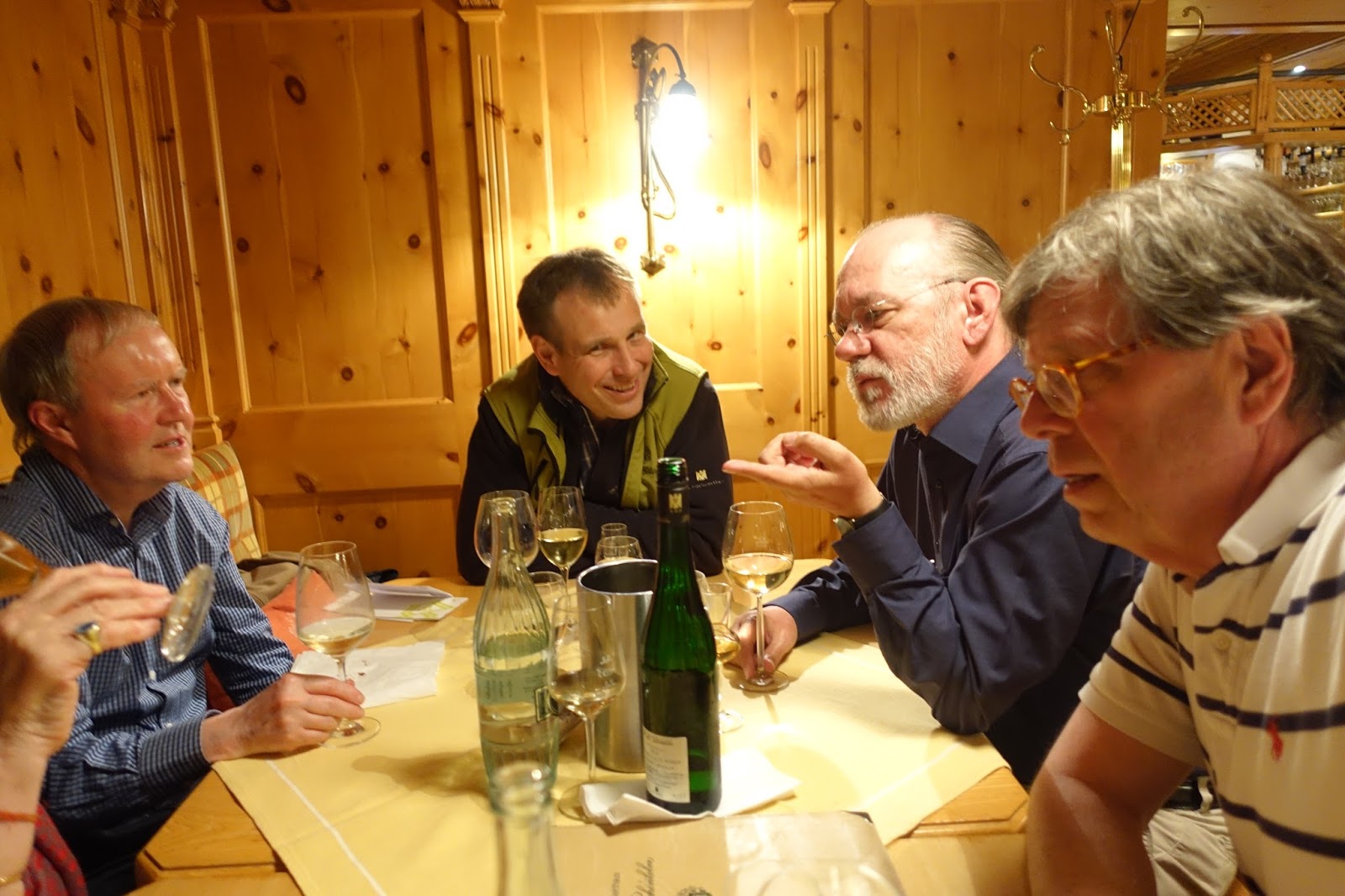
The German Wine Society (Washington DC Chapter) organized a Sparkling Wines of the World tasting. It took place at our home and was limited to 16 people in order to fit around our large round table. GWS Secretary Joseph Aguiar was the event coordinator. Annette Schiller and Joseph Aguiar led through the evening.


Invitation
Prost, German wine drinkers! We are excited to present another small group tasting at the home of Christian and Annette Schiller in McLean, Virginia, this time for a showcase of the sparkling wines of the world. Many wine drinkers do not know that Germany is the #1 consumer and #2 producer of sparkling wines in the world, and we will show why! We will begin tasting at 7:00pm, Saturday 25 March 2017 and attendance will be limited to 16 people.


German Wine Society Secretary, Joe Aguiar, and member, Annette Schiller, will present on the different styles and terroirs of sparkling wines. We will taste wines from Germany, France, Italy, California, Virginia, and England. We will learn that sparkling wine is for much more than just celebrating special occasions—though this is certainly a good thing too—and are some of the most complex, food-friendly wines in the world!
You are invited to stay after the tasting for socializing and are encouraged to bring an extra bottle of wine if you would like to stay.
There is no metro access to this location, so attendees will either need to drive or arrange for a car to pick you up. Here is the address and phone number:
6404 Woodsong Ct
McLean, VA 22101
703-462-8672
Light refreshments of cheese and baguette will be served with the wines and we will serve an additional sparkling wine during the beginning of the tasting while attendees are arriving.


Sparkling Wine: The Basics
Sparkling wine is wine that contains carbon dioxide, which makes it fizzy, when you open the bottle. The French monk Dom Perignon is credited with having invented sparkling wine.
The production of a sparkling wine is essentially a two-step operation. The first step is the production of a still wine - not different from any other still wine. Then, in the second step, you have to get the carbon dioxide in the bottle. There are 3 methods: The carbon dioxide may result from (1) a second fermentation in a bottle (méthode champenoise), the most sophisticated and costly method use for ultra-premium sparklers, (2) a second fermentation in a large tank that can withstand the pressures involved (Charmat process), the typical method used for good quality sparklers, and (3) an injection of carbon dioxide, the method used for cheap mass sparklers.
The most sophisticated and expensive is the méthode champenoise: The introduction of yeast and sugar triggers a second fermentation in the bottle that the wine will eventually be sold in. If you leave it at that, you will have a sparkler made in the methode ancestral. The appearance of the sparkling wine will be marred by lees, the sediment of dead yeast cells that are still in the bottle. Until Anton Mueller, the German cellar master of Veuve Clicquot, invented with Veuve Clicquot the system of remuage (riddling), it was necessary to either decant the sparkling wine before serving it or to leave it in the glass for some time so the sediment could settle before drinking the Champagne.
Mueller’s remuage technique revolutionized sparkling wine drinking and remains a key elemement in the méthode champenoise production of sparkling wine until today. The system centers around wooden racks into which the bottles are placed neck first at an angle of 45 degrees. Each day the bottles are turned and tilted so that the bottle points further downwards with each day, the process gradually bringing all the sediment into the neck right behind the cork. The sediment is then frozen to form a "plug" which is then being removed (dégorgement).
After adjusting the level of fill and setting the sweetness, the bottle is corked, caged and labeled; the sparkler is clear --- without any sediment.
Importantly, the amount of sugar added after degorgement determines the sweetness level of the sparkler. Most Champagnes are brut, i.e. with no or very little sweetness.
The Charmat method is much simpler and more cost effective as the second fermentation takes place in stainless steel tanks that are pressurized. The process of carbon injection is the most basic one as it does not involve a secondary fermentation but rather injecting carbon dioxide gas directly into the wine. This method is generally only used in the cheapest sparkling wines.
The classic sparkler of course is Champagne, produced according to certain rules in the Champagne region of France. Other sparkling wines in France are referred to as Crémant. The grapes used are generally Chardonnay, Pinot Noir and Pinot Meunier and the production method is the secondary fermentation in the bottle.
Sparkling wines are made throughout Italy. Though Franciacorta wines are made according to the traditional method, most Italian sparkling wines, in particular Asti and Prosecco, are made with the Charmat method.
The majority of Sekt – the German term for sparkling wine – is made by the Charmat method while the premium Sekts are being made according to the méthode traditionnelle. German production of sparkling wines dates back to the early 1800s, when G. C. Kessler & Co. was founded by Georg Christian Kessler, who had previously worked at the Champagne House Veuve Clicquot. Also, many (French) Champagne Houses have German origins, such as Bollinger, Mumm, Taitinger.
Austria's history of producing sparkling wine dates back to the Austro-Hungarian empire. The first Austrian producer of sparkling wine was the German Robert Alwin Schlumberger, who had worked in the Champagne House Ruinart and fallen in love with an Austrian, before he moved to Vienna in 1842 and started to produce premium sparkling wines.
Production of premium sparklers in England – were vine growing conditions are not that different from the Champagne region - started in the 1960s. Today, there are over 100 producers of sparkling wines.
The United States is an important producer of sparkling wine and has agreed to no longer call its sparklers Champagne, although there is a grandfathering clause. In the US, the history of producing quality sparkling wine goes back to the Korbel brothers, who immigrated from Bohemia on the 1850s. The last decades of the 1900s have seen a wave of foreign investments from some of France’s most prominent Champagne Houses, including Moët et Chandon, Louis Roederer and Taittinger.

Reception Sparkler
NV La Companie de Burgondie, Crémant de Bourgogne, Brut Réserve
Trader Joe's US$9.99

La Compagnie de Burgondie is a co-operative with 1000 members.
Cépages : Pinot Noir, Chardonnay, Aligoté et Gamay.
Vinification : Méthode traditionnelle.
Élevage : 12 mois sur lattes.
Dosage : Brut
Germany: Sekt
Sekt is made in all German wine regions, both in the méthode traditionnelle and charmat method. There are three groups of Sekt makers: (i) large and (ii) smaller Sekt houses, who only make Sekt and (iii) winemakers, who make predominantly wine, but complement their wine selection by a few Sekts. The Sekts produced by large Sekt estates tend to be in the demy-sweet and sweet range, while the Sekts of smaller estates and the wine makers are mostly in the brut and extra brut range. In addition to Sekt, Germany produces semi-sparkling wine, which is called Perlwein. But the production of Perlwein is small.
Large Sekt Houses
There is a dozen or so large Sekt houses. They produce more than 2.000.000 bottles each annually. Most of these large Sekt houses were established in the 1800s. At that time, there was only one method known to produce Sekt, the méthode traditionnelle. But in contrast to the champagne houses, the large Sekt houses have all moved to the charmat method as main method of the second fermentation after World War II. Like the champagne houses, Sekt houses do not own vineyards, but purchase the base wine from winemakers. More than three quarters of the base wine used to make Sekt is imported from other EU countries, essentially Italy, France and Spain. Sekt can only be labeled as Deutscher Sekt if it is made exclusively from German grapes, which is rare in the case of the large and the smaller Sekt houses. Most of the Sekt houses have beautiful chateau-type facilities with old underground cellars for the second fermentation and storage. Overall, these Sekts are reasonably priced, are of good quality, but with the introduction of the charmat method are no longer in the same class as their counterparts in the champagne region.
Smaller Sekt Houses
The smaller Sekt houses, like the large Sekt houses, do not own vineyards, but also buy the base wine from winemakers. They also tend to have a long history and often links to the champagne region, beautiful facilities and old cellars for the second fermentation and storage. The big difference is that they typically have not gone the route of tank fermentation but continue to ferment in the méthode traditionnelle.
Geldermann in Breisach makes its Sekt exclusively from French wines imported from the Loire valley. The two Germans Deutz and Geldermann founded a champagne house in 1838 in the champagne, and the Breisach (Baden) outlet became their German branch in 1904 for tax reasons. Another one is Kessler, in Esslingen (Baden-Wuerttemberg), the first German Sekt house, founded in 1826 by Georg Kessler, who had worked for Veuve Clicqot. Fürst von Metternich Sekts are produced in a beautiful castle overlooking the Rhein river in the Rheingau. Von Metternich received the castle from the Austrian Emperor Franz I in 1816 as a gift for his skillful negotiations as his Minister of Foreign Affairs during the Vienna congress (1814 -15). The von Metternich Sekts are all Rieslings from von Metternich vineyards.
Small Sekt and Wine Producers
Finally, increasingly, there is a number of top quality winemakers, who, in addition, to their still wines, have started to include Sekts in their portfolio. These Sekts are typically vintage Sekts, from a specified vineyard, made of specific grapes, often Riesling, in the méthode champenoise and with little or not dosage (brut or extra but). While the first fermentation typically takes place at the winery, the second fermentation is often not in the cellar of the winemaker but in the cellar of a Sekt house that bottle-ferments for other wineries.
See: German Wine Basics: Sekt

NV Wein- und Sektgut Barth Pinot Noir Rosé Brut – Rheingau, Germany
Truly Fine Wines, California, US$24
NV Wein- und Sektgut F.B. Schönleber Riesling Extra Brut – Rheingau, Germany
Astor Wines, New York, US$24
Wein- und Sektgut Barth
The Wine and Sekt Estate Barth was founded in 1948 by the father of Norbert Barth, the current owner. Besides excellent wines, from early on Barth produced sparkling wines – Sekt – and in 1992 a Sekt manufactury was completed to be able to produce the Sekts entirely at the premises. All Sekts are bottle fermented in the méthod traditionelle starting with base wine production, subsequent bottling, bottle fermentation, hand-riddling, and disgorging. All Sekts remain on the lease between 24 and 36 months. In 2010 Barth released the first ever German sparkler made from a Premier Cru base wine. The novelty was named Barth Primus, and put Barth on the map for the serious Sekt lover.
See:
Tour and Wine Tasting with Lunch, with Mark Barth at Wein- und Sektgut Barth in Hattenheim, Rheingau – Germany-North Tour by ombiasy WineTours (2015)
Barth Primus is Germany's First Sekt Made with an Erstes Gewaechs Base Wine


Wein- und Sektgut F.B. Schönleber
The Schönleber family can trace its viticulture tradition back to the year 1783. Today the winery is managed by winemaker brothers Bernd and Ralf Schönleber. They own 25 acres of vineyards of which 94% are planted with Riesling and 6 % with Pinot Noir, and they produce 80,000 bottles of Riesling and 20,000 bottles of Sekt, the German equivalent of Champagne. The quote of the GaultMillau wineguide for Germany says it all: “This is one of the most reliable wine estates of the Rheingau and it thoroughly understands how to produce top dry Rieslings and excellent sparkling wines.”
See: Cellar Tour, Tasting and Dinner at Wein- und Sektgut F.B. Schönleber in Östrich-Winkel, Rheingau, with Ralp and Bernd Schönleber - Germany-North Tour 2016 by ombiasy WineTours


Italy: Franciacorta and Prosecco
Franciacorta
Unlike the Champagne region, which can look back to several centuries of fame, Franciacorta’s history is very short. It started only 50 years ago, when Franco Ziliani produced a couple of thousand bottles of a sparkling wine for the Guido Berlucchi winery, which sold very well. It sold so well, that over night, the region of Franciacorta was born and the well-equipped and architecturally varied wineries we know today sprang up within a short period of time to establish the region. Franco Ziliani and Guido Berlucchi are considered to be the fathers of Franciacorta. The name Franciacorta comes from the latin Franchae Curtes, or Monastery-controlled courts that were, thanks to the power of the Church, exempt from the taxes of nearby Brescia.
See: The Up and Coming Premium Sparklers of Franciacorta (#EWBC), Italy


 Pictures: Brescia
Prosecco
Prosecco is an Italian white wine. Prosecco DOC can be spumante (sparkling wine), frizzante (semi-sparkling wine), or tranquillo (still wine), depending on the perlage. It is made from Glera grapes, formerly known also as Prosecco, but other grape varieties may be included. The name is derived from that of the Italian village of Prosecco near Trieste, where the grape may have originated.
Prosecco DOC is produced in nine provinces spanning the Veneto and Friuli Venezia Giulia regions. Prosecco Superiore DOCG comes in two varieties: Prosecco Conegliano Valdobbiadene Superiore DOCG, which can only be made in the Treviso province of Veneto on the hills between the towns of Conegliano and Valdobbiadene (north of Treviso), and the smaller Asolo Prosecco Superiore DOCG, produced near the town of Asolo.
Prosecco is the main ingredient of the Bellini cocktail and can be a less expensive substitute for Champagne. It is also a key ingredient of spritz, a cocktail popular in northern Italy.
See: Italy's Prosecco

NV Bisol Prosecco Superiore Valdobbiadene Crede Brut – Italy
MacArthur Beverages US$21.99
NV Ferghettina Franciacorta Brut DOCG – Italy
MacArthur Beverages US$27.99
Taittinger: France and USA

2011 Domaine Carneros by Taittinger Brut Napa – Napa, California
MacArthur Beverages US$21.99
NV Taittinger Brut La Francaise – Champagne, France
MacArthur Bevreages US$39.99
Champagne Taittinger
The Champagne House Taittinger was founded in 1734 by Jacques Fourneaux, who worked closely with the Benedictine Abbeys who owned the finest vineyards at that time. In 1932, Pierre Taittinger bought the Château de la Marquetterie from the wine house of ForestFourneaux. Taittinger has extensive vineyard holdings of 752 acres, including prestigious Grand Cru vineyards. Highestquality production: exceeding minimum aging for all cuvées, high percentage of estate grapes, sustainable practices, use of a higher proportion of Chardonnay grapes in its blends than other large houses—this all gives the Taittinger’ Champagne a unique personality.
See: Cellar Visit and Tasting at the Champagner House Taittinger in Reims, Champagne - Burgundy (and Champagne) 2016 Tour by ombiasy WineTours


England and Virginia

2014 Ridgeview Bloomsbury Brut – England
MacArthur Beverages US&33.99
NV Thibault-Janisson Blanc de Chardonnay Brut – Virginia
MacArthur Beverages US$24.99
Thibaut-Janisson
Thibaut-Janisson is a new French-French joint venture of the production of ultra-premium sparkling wine in Virginia, owned by Claude Thibaut and Manuel Janisson. Claude is also the winemaker, while Manuel is producer of Grower-Champagne in France. Output currently is around 2500 cases. The NV Thibaut-Janisson Chardonnay, Brut was served at President Obama’s first State Dinner (in 2009), which gave the Thibaut-Janisson sparkler a nation-wide audience.
See: As Close as You Can Get to Champagne – Claude Thibaut and His Virginia Thibaut Janisson Sparklers at screwtop Wine Bar, USA

Pictures: Christian Schiller with Claude Thibaut
France: Crémant
Crémant is a sparkling wine produced in the méthode traditionnellen in France, but not a Champagne. Currently, there are eight appellations in France for sparkling wine which include the designation Crémant in their name:
Crémant d'Alsace
Crémant de Bordeaux
Crémant de Bourgogne
Crémant de Die
Crémant du Jura
Crémant de Limoux
Crémant de Loire
Crémant de Savoie
As a new development in the EU, the Crémant designation has started to appear outside of France, including in Belgium, Luxembourg and Germany.

NV Michel Gahier, Crémant du Jura, Brut - France
McArthur Beverages US$25
NV Alexandre Monmousseau, Crémant de Loire, Brut -France
MacArthur Beverages US$15.99
France: Champagne

2011 Jean Josselin Blanc de Blancs – Champagne, France
NV Herbert Beaufort Bouzy Premier Cru, Brut Brut Réserve - Champagne, France
MacArthur Beverages US$35
NV Aubry Brut Premier Cru - Champagne; France
Chain Bridge Cellars US$39
Champagne Jean Josselin in Gyé-sur-Seine
The Josselin family has been growing grapes since 1854 in GyésurSeine in the Côte des Bar, located 150km south of Epernay and 200km south of Reims and crossed by two rivers: the Seine and the Aube. The Côte des Bar became part of the official Champagne region in the early 1900s. In 1957 Jean Josselin decided to create his own brand: ‘Champagne Jean Josselin’. Champagne Jean Josselin ist a typical so called ‘grower Champagne’. The entire operation is managed by the family. Jean Pierre Josselin and son Jean Félix tend to the vines and take care of the vinification and Veronique Josselin does sales and marketing. They hired an American Sharona Tsubota to get into the American market. The Champagne house Jean Josselin produce about 100,000 bottles per year depending on the vintage.
See:
Visit and Tasting at Champagne Jean Josselin, a Grower Champagne House in Gyé sur Seine – Bourgogne (and Champagne) Tour 2016 by ombiasy WineTours, France


schiller-wine: Related Postings
Burgundy (and Champagne) 2016 Tour by ombiasy WineTours: From Lyon to Reims - Wine, Food, Culture and History
Bordeaux Tour by ombiasy WineTours 2016, France
Heads up for the 2017 Tours - to Germany and France - by ombiasy WineTours
Germany-East Tour 2016 by ombiasy WineTours: Wine, Art, Culture and History
Germany-North Tour 2016 by ombiasy WineTours: Quintessential German Riesling and the Northernmost Pinot Noir
Germany-South Tour by ombiasy WineTours (2015)
Champagne – An Introduction, France
French Champagne Houses and German Roots
Visit and Tasting at Champagne Jean Josselin, a Grower Champagne House in Gyé sur Seine – Bourgogne (and Champagne) Tour 2016 by ombiasy WineTours, France
Cellar Visit and Tasting at the Champagne House AR Lenoble in Epernay, with Christian Holthausen - Burgundy (and Champagne) 2016 Tour by ombiasy WineTours
German Wine Basics: Sekt
Cellar Tour, Tasting and Dinner at Wein- und Sektgut F.B. Schönleber in Östrich-Winkel, Rheingau, with Ralp and Bernd Schönleber - Germany-North Tour 2016 by ombiasy WineTours
Tour and Wine Tasting with Lunch, with Mark Barth at Wein- und Sektgut Barth in Hattenheim, Rheingau – Germany-North Tour by ombiasy WineTours (2015)
Barth Primus is Germany's First Sekt Made with an Erstes Gewaechs Base Wine
The Up and Coming Premium Sparklers of Franciacorta (#EWBC), Italy
Nyetimber's Classic Cuvee 2003 from England was Crowned Champion of Sparkling Wines in the World
As Close as You Can Get to Champagne – Claude Thibaut and His Virginia Thibaut Janisson Sparklers at screwtop Wine Bar, USA
Visit and Tasting at Champagne Jean Josselin, a Grower Champagne House in Gyé sur Seine – Bourgogne (and Champagne) Tour 2016 by ombiasy WineTours, France