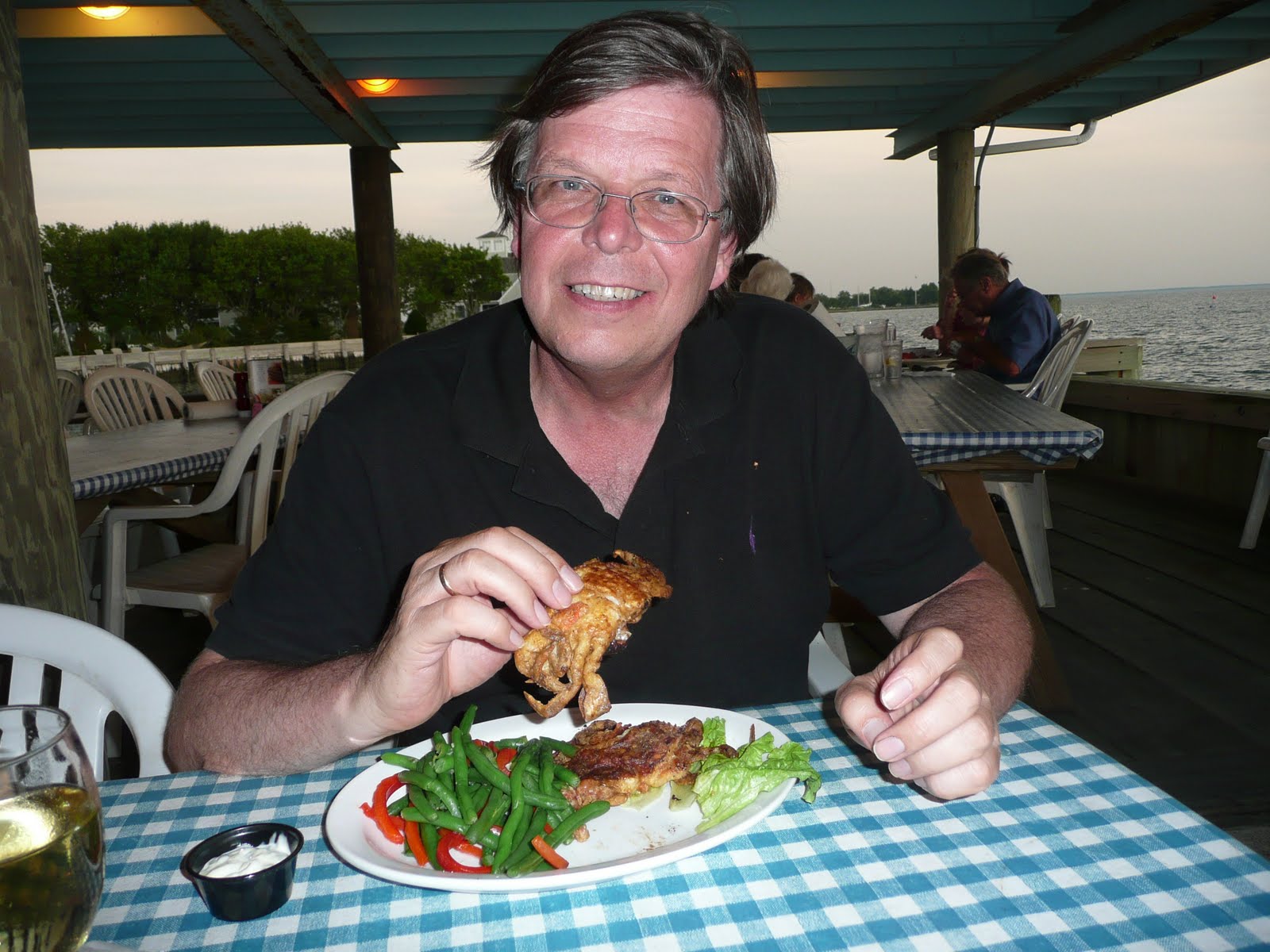
Picture: Christian G.E. Schiller with Robert B. Deford, President, at Boordy Winery in Maryland
Blue crabs are iconic in Maryland. Few food and wine aficiniados, however, would point to premium wines, when talking about Maryland; instead, Maryland has the reputation of being a mediocre wine producer. But Maryland winemakers are very successfully changing that. Increasingly, winemakers in Maryland are moving away from fruit wines and non-European grape varieties that have long plagued the East Coast to produce wines that can compete with the best wines in the world. As Drew Baker of the brand-new Old Westminster Winery explained to Frank Morgan, a popular wine blogger, “Maryland has great potential and I believe that the quality bar is rising quickly. Soon, poorly made wines will be the exception in an otherwise great region.”
Pictures: Robert B. Deford, President, at Boordy Winery in Maryland and his Son Phin Deford
Old Westminster Winery, led by the three siblings Drew, Lisa, and Ashli, who manage the vineyard, winemaking, and marketing, respectively, has not yet released any wine, but is already generating a buzz. Other promising newcomers include Black Ankle, Slack, Sugar Loaf Mountain and Port of Leonardtown. Add to that the Maryland classics Boordy, Basignani and Elk Run, which are in the process of changing gears.
See also:
At the Fifth Annual Drink Local Wine Conference in Baltimore, Maryland, USA
Grand Tasting of Maryland Wines and Twitter Taste-off - Drink Local Wine Conference 2013 in Maryland, USA
Touring Wine Country Maryland, USA
Maryland Crabs and Wine
Schiller’s Favorite Crab Houses in the Washington DC Region, USA
This is a posting in a series of 3 profiles of Maryland wineries:
Sugarloaf Mountain Vineyard in Maryland - A Profile, USA
Boordy Vineyards in Maryland - A Profile, USA
Black Ankle Vineyards in Maryland - A Profile, USA
Boordy Vineyards
Boordy Vineyards is the oldest commercial winery in Maryland. Boordy was founded in 1945 by Philip and Jocelyn Wagner. The Wagner’s enthusiasm for experimentation and the winery’s rapid growth eventually lead to a partnership with the Deford family who purchased Boordy in 1980. The Defords moved the winery to its present day location at their Long Green Valley farm, just north of Baltimore. The farm has since been placed in permanent preservation with the Maryland Environmental Trust, demonstrating owner Rob’s commitment to agriculture.
Pictures: Boordy Vineyards, Maryland
The winery is currently housed in the ground-floor level of a 19th century barn. Next to the barn a new similarly sized building is going up. The new building will become the home of the winery. As it is purpose-built, future wines will see more gravity and less pumps along with being raised with more accurate temperature control. The original barn will become a barrel cellar.
Boordy Wine Portfolio
Boordy produces three tiers of wines: Just for Fun, Icons of Maryland and the Landmark series. The Landmark series is the very best of each vintage year; the Icons of Maryland are designed with food in mind; and the Just for Fun series offers sweet, party wines.
At a recent visit at Boordy with Aaron Nix-Gomez from Hogshead (Aaron took and published notes, see below) and other wine writers, we only tasted Landmark wines. These wines are produced from 100% Maryland fruit of which 95% is estate fruit. The Landmark Project was begun in 2006. It follows the guidance of viticulturist Lucie Morton which initiated a complete replanting of the vineyards. The vineyards were replanted with closer spacing, 1 meter by 8 feet, averaging 1500 vines per acre for all 45 acres.
The Wines I Tasted
Picture: Landmark Wines
2010 Boordy Vineyards, Landmark, Cabernet Franc Reserve – $25
Aged for 18 months in French oak.
Hogshead: There were concentrated aromas of black fruit and violets. The wine had a weighty mouth feel, power, and an inky finish. Nice.
2010 Boordy Vineyards, Landmark Reserve – $35
Blend of 69% Merlot, 19% Syrah, 6% Cabernet Sauvignon, and 6% Petit Verdot which were fermented separately. Aged for 24 months in French oak.
Hogshead: The nose was light with racy blue and black fruit. There was good fruit in the mouth along with concentrated drying tannins. There were racy, weighty flavors in the finish. The drying tannins mixed with vintage perfume in the finish. The aftertaste brought some spicy, citric tannins. This could benefit from a few years of age.
Pictures: Boordy Wine Cellars
2010 Boordy Vineyards, Landmark, Merlot Reserve
Hogshead: This had a nose of low-lying perfumed berries. There was more structure to this wine with expansive almost grainy, blue and black fruit. It had focused and a powerful structure at the end. This needs age.
schiller-wine: Related Postings
At the Fifth Annual Drink Local Wine Conference in Baltimore, Maryland, USA
Grand Tasting of Maryland Wines and Twitter Taste-off - Drink Local Wine Conference 2013 in Maryland, USA
Touring Wine Country Maryland, USA
Wine and Crab Cakes: Amy Brandwein from Casa Nonna and Chris Clime from PassionFish win the 6th Annual Crab Cake Competition in Washington DC, USA
Maryland Crabs and Wine
Schiller's World of Seafood
Chef Spike Gjerde's Farm-to-Table Food of Woodberry Kitchen and Sarah O’Herron's and Ed Boyce's Premium Organic Wines of Black Ankle Vineyards, Maryland, USA
Schiller’s Favorite Crab Houses in the Washington DC Region, USA
Sunday, July 7, 2013
Friday, July 5, 2013
Schiller’s Favorite Crab Houses in the Washington DC Region, USA
Last year in May, wine guru and Maryland resident Robert J. Parker tweeted: “Maryland’s greatest culinary delicacy – blue channel soft-shelled crabs are starting to arrive … lightly floured and sautéed in butter.” Maryland – with the large Chesapeake Bay – is indeed blessed with Blue Crabs which came in different forms, when you eat them at a Crab Shack.
Bluecrab.info: “My definition of a crab house is any restaurant that serves hot steamed Maryland-style hard shell crabs. You know that you're in a crab house as soon as you walk through the door, the smell of steamed crabs is in the air and you hear the sound of wooden mallets banging against crab and table as hungry diners crack into the succulent claws. As you look around you see paper-covered tables with trays of cooked bright orange crabs, mounds of discarded shells, pitchers of ice cold beer, shakers of Old Bay seafood seasoning, and bottles of apple cider vinegar. And, yes, there's the occasional basket of piping hot shell-on spiced shrimp! Ah, the memories... there's nothing quite like the atmosphere of a genuine Chesapeake Bay crab house."
Crab Shacks in the Washington Area
Here are my favorites in or close to the Washington DC area:
Washington DC City Area
The Dancing Crab - 4611 Wisconsin Ave, NW, Washington, DC (202) 244-1882. The family owned restaurant is a classic.
Bethesda Crab House - 4958 Bethesda Ave, Bethesda, Maryland (301) 652-3382. There's a large outdoor patio available weather permitting.
Ernie's Original Crab House - 1743 King Street Alexandria, Virginia. (703) 836-0046. Located in the heart of Old Town Alexandria. Offers traditional Chesapeake Bay seafood dishes including steamed crabs.
The Quarterdeck - 1200 Fort Myer Drive, Arlington, VA 22209, (703) 528-2722, Open Daily 11:30a.m. - 2a.m. A fixture of the Fort Meyer Heights neighborhood for over 30 years providing a relaxed atmosphere perfect for family dining.
Maine Avenue Seafood Market: You can pick up live crabs to steam at home or buy some already steamed at the Washington DC seafood market on Maine Avenue at the Potomac River. It is a fascinating place. 1100 Maine Ave.
Outside Washington DC City Area
Jimmy Cantler's: Be prepared for long waits on the weekends, but the tranquil riverside setting in Annapolis is worth it. About 45 minutes from Washington DC. 458 Forest Beach Rd., Annapolis.
Tim’s Rivershore Restaurant and Crabhouse: a favorite place for Harley riders and RocknRoll lovers on the western shores of the Potomac, about 1 hour south of Washington DC. 1510 Cherryhill Road, Dumfries
Captain Billy’s Crab House - 11495 Popes Creek Rd, Newburg, MD About 1 ½ hours from Washington DC on the Potomoc eastern shore.
Visiter: “And if you are looking for a Maryland crab experience, this is your place. Everyone is dressed down. There is nothing fancy. Less than 5 minutes after you order, your food is hot and ret' ta' go. You get a plastic bucket, a laminated menu and the best dang crabs MD has to offer. You are presented with only male crabs (unless you ask for a mix) Tip: Female Crabmeat is sweeter. Your drinks will be refilled, your crabs will be plentiful.”
Happy Harbor - 533 Deale Road, Deale, MD 20751, (410) 867-0949. A little dive located on the water, bar on one side, restaurant on the other. About 1 hour drive from Washington DC, on the western shore of the Chesapeake Bay.
Stoney’s – 3 locations in Calvert County, Maryland: Broomes Island, Kingfisher’s and Solomons Pier. About 1 ½ hours from Washington DC on the western shore of the Chesapeake Bay. Famous for its crab cakes.
Stoney’s: “We have since grown to a family of three restaurants and continue to serve the best that the Washington D.C. area has to offer. Our menus do not stop with crab cakes but also offer a variety of steaks, seafoods, appetizers, and salads. Each location offers stunning views of the Chesapeake Bay and whether you are looking for an upscale dinner or a casual happy hour, you will find that Stoney’s is the place to go.
Beyond Bay Bridge
These are all places where you have to cross the Chesapeake Bay. The Bay Bridge is about 1 hour drive from Washington DC.
Harris Crab House & Seafood Restaurant - 433 N Kent Narrows Way Grasonville, MD 21638 (410) 827-9500. Well worth the drive in Grasonville, overlooking the Kent Narrows
Fisherman's Crab Deck - 3032 Kent Narrow Way S Grasonville, MD 21638 (410) 827-6666. Also in Grasonville.
Waterman’s Crab House - Rock Hall. 10 nautical miles north of the Bay Bridge but 11/2 hours by car in weekend traffic.
Visitor: “Waterman's has been around for a long time, recently having expanded (again) to an indoor, rather plain restaurant seating perhaps a 100 or so and two enormous outdoor wooden decks with a sit down 20 seat bar and bandstand across from it, flanked on either side by the decks which are directly over the water.”
Visitor: “This afternoon, eighty degrees and sunny with only a few puffy clouds in the sky, both decks were mobbed with several hundred middle aged, full bellied, Rolex wristed crab eaters often accompanied with partners with big hair and a lot of gold. The six member band crooned Wilson Pickett, James Brown and a bit of Lloyd Price while mallets and pitchers were hammered and quaffed repeatedly. Almost every brown paper topped picnic table had a plastic garbage can at the side of it. It seemed everyone was eating crabs. This is as close to Heaven as I have ever felt in the state of Maryland.”
Visitor: “We liked Waterman's-a LOT! I would take this over Cantler's or Stoney's in a heartbeat! The setting is just truly fantastic. While not great crab cakes and a bit more expensive than other places on the Eastern Shore, this is a real find. I would suggest that Chesapeake Living magazine may be right: this may be my favorite crab house in Maryland. I would go elsewhere for crab cakes (Narrows) and perhaps for dinner (Suicide Bridge, Jerry's in Lanham). But for hard shells and to sit out on an incredibly scenic deck with a bit of Smokey Robinson in the background while hammering over the water, this IS what the Good Life is all about!”
Crab Claw in St. Michael's
Schooners on the Creek in Oxford
Suicide Bridge - 6304 Suicide Bridge Rd Hurlock, MD 21643 (410) 943-4689 11:00 am – 10:00 pm. Waterfront dining overlooking Cabin Creek. In the Easton/Cambridge area.
Maryland Blue Crabs
The blue crab is a crustacean found in the waters of the western Atlantic Ocean, the Pacific Coast of Central America and the Gulf of Mexico. Chesapeake Bay Blue Crabs undergo a seasonal migration; after mating, the female crab travels to the southern portion of the Chesapeake, fertilizing her eggs with sperm stored up from the last mating months or almost a year later. In November or December, the female crab releases her eggs. The crabs hatch in a larval form and float in the mouth of the bay for four to five weeks, then the juvenile crabs make their way back up into the bay.
Four Ways to Eat Chesapeake Blue Crabs
Hard Shell Blue Crabs
Blue crabs are most often eaten in the hard shell. Steaming them in large pots with water, vinegar and seasoning is the norm on the East coast. You need the whole experience: the smell of steamed crabs in the air, a pile of large steamed blue crabs covered with Old Bay Seasoning, ready to be cracked with wooden mallets, accompanied by corn on the cob, plus a roll of paper towels and a metal bucket for tossing the empty shells.
Soft Shell Crabs
The Chesapeake Bay is famous for its soft-shell blue crabs. As crabs grow larger, their shells cannot expand, so they molt the exteriors and have a soft covering for a matter of days when they are vulnerable and considered usable. Crabs caught just after molting are prepared as soft shell crabs: first cutting out the gills, face, and guts; the crab is then battered in flour, egg, and seasoning, then fried in oil until crispy. The entire crab is consumed, legs and all.
Picture: Soft Shell Crab
Crab Cake
Crab cakes is another delicacy. Crab Cakes are basically Hamburgers made out of crab meat. We ate it recently as a starter with tomatoes and avocado on the side.
See more:
Wine and Crab Cakes: Amy Brandwein from Casa Nonna and Chris Clime from PassionFish win the 6th Annual Crab Cake Competition in Washington DC, USA
Maryland Crab Soup
Usually I start my crab dinner with a Maryland Crab Soup. This is a kind of an Italian Minestrone with crab meat.
See more:
Maryland Crabs and Wine
Schiller's World of Seafood
Maryland Wine
Blue crabs are iconic in Maryland. Few food and wine aficiniados, however, would point to premium wines, when talking about Maryland; instead, Maryland has the reputation of being a mediocre wine producer. But Maryland winemakers are very successfully changing that. Increasingly, winemakers in Maryland are moving away from fruit wines and non-European grape varieties that have long plagued the East Coast to produce wines that can compete with the best wines in the world. As Drew Baker of the brand-new Old Westminster Winery explained to Frank Morgan, a popular wine blogger, “Maryland has great potential and I believe that the quality bar is rising quickly. Soon, poorly made wines will be the exception in an otherwise great region.” Old Westminster Winery, led by the three siblings Drew, Lisa, and Ashli, who manage the vineyard, winemaking, and marketing, respectively, has not yet released any wine, but is already generating a buzz. Other promising newcomers include Black Ankle, Slack, Sugar Loaf Mountain and Port of Leonardtown. Add to that the Maryland classics Boordy, Basignani and Elk Run, which are in the process of changing gears.
Maryland’s modern wine history dates to the 1970s, but grapes have been planted in the area since the 17th century. Most of Maryland’s 60 plus wineries are in the Piedmont Plateau in central Maryland, but grapes also thrive in the Eastern Shore, Southern Plain, and Western Mountains: (1) A majority of the state’ vineyards are planted in Piedmont Plateau in central Maryland. (2) The Chesapeake Bay has always been among my favorite regions, but the Eastern Shore is also a fantastic growing region. The soil is sandy and well-drained, and the climate is moderated/protected by the water, perfect for warm days and cool nights. (3) In the Southern Plain in southern Maryland it can get rather hot. And stay hot during the night. Barbera, Sangiovese, and Chardonnay dominate. (4) Western Maryland is mountainous, and while there are only two wineries, there is a number of vineyards.
I have written extensively about a number of Maryland wineries, see:
At the Fifth Annual Drink Local Wine Conference in Baltimore, Maryland, USA
Touring Wine Country Maryland, USA
Grand Tasting of Maryland Wines and Twitter Taste-off - Drink Local Wine Conference 2013 in Maryland, USA
Chef Spike Gjerde's Farm-to-Table Food of Woodberry Kitchen and Sarah O’Herron's and Ed Boyce's Premium Organic Wines of Black Ankle Vineyards, Maryland, USA
Schiller’s Favorites
This posting is part of the Schiller’s favorites series. Here is a full list of all Schiller’s favorites postings so far.
Schiller’s Favorite Crab Houses in the Washington DC Region, USA
Schiller’s Favorite Wine Bars in Charleston, South Carolina, USA
Schiller’s Favorite Wine Bars in Frankfurt am Main, Germany
Schiller’s Favorites from the VDP Grosses Gewaechs – Grand Cru – Presentation at Kloster Eberbach, 2012, Germany
Schiller’s Favorite Wine Bars in New York City, USA
Schiller’s Favorite Wine Bars and Other Wine Spots in Vienna, Austria
Schiller’s Favorite Wine Bars in San Francisco, USA
Schiller's Favorite Wine Bars in Bordeaux (City), France
Schiller's Favorite Wine Bars in Budapest, Hungary
Schiller’s 12 Favorite Restaurants of Antananarivo, the Capital of Madagascar
Schiller's Favorite Apple Wine Taverns in Frankfurt am Main, Germany
Schiller’s Favorite Wine Taverns in Mainz, Germany
Schiller's Favorite Wine Bars and Other Places Where You Can Have a Glass of Wine in Healdsburg, California
Labels:
Maryland,
Schiller's Favorites,
US,
wine and food
Thursday, July 4, 2013
A Firework of Flavors at Komi, the Best Restaurant in Town (Washington DC, USA)
Picture: Chef Johnny Monis and his Team (Source: Komi Website)
Komi is arguably the best restaurant in town (Washington DC, USA). Komi serves a set multi-course dinner for $135 per person, beginning with a series of mezzethakia – small, light dishes – and progressing to heartier flavors, including pasta and a family-style entrée, followed by desserts.
Komi is open Tuesday-Saturday. Reservations are difficult to get. You must call at noon, exactly one month before your chosen date. My friend Gunther, who in the meantime has returned to Germany, had managed to get a 5:30 pm reservation for himself and asked me if I was up for joining him. I did and spent a memorable evening with Gunther, while my wife Annette was visiting our daughter Katharina in Nepal.
Little Serow - Chef Johnny Monis' recently opened tiny northern Thai place - is next door and Johnny also spends time there during the evening. Little Serow is on the Washingtonian's list of 100 Best Restaurants 2013 - also no menu, prix fixe ($45) and no reservations; you queue up for a slot at 5:30pm and they call or text you when a table becomes free.
To do a posting on Komi is not easy: photos are not allowed, no written menu (but they send you one after the dinner) - the courses are announced only as they are delivered.
Bistronomics Cuisine
In a way, I would classify Komi as a bistronomics restaurant. Bistronomics food is generally referred to as high-end cuisine served at reasonable prices in a nice bistro-style outlet. A smart mix of economy, variety and seasonality. In Paris, bistronomics include Frenchie, Saturne, Le Chateaubriand, Rino, Yam’Tcha, La Bigarrade and Passage 53. Le Chateaubriand is on the famous San Pellegrino Top 50 Restaurants in the World list. In Frankfurt, Germany, André Rickert at Weinsinn is showcasing bistronomic food.
See:
The 2010 World's Best 50 Restaurants
Lunch and Beaujolais at Weinsinn in Frankfurt am Main, Germany
Other bistronomics restaurants in Washington DC include Eola (which charges US$75 for five courses plus a series of small bites), Obeliske (which charges $72 for an Italian set multi-course dinner, just opposite of Eola) and Rouge 24 (which has a range of offers, from $75 to $135 for a 24 course menu).
See:
Dining on the Cutting-edge - Daniel Singhofen’s Eola in Washington DC, USA
Château Léoville-Poyferré Winemaker Dinner with Anne Cuvelier at Eola in Washington DC, USA
The Setting
Komi is a small place with only a handful of tables (mostly fours), with a half-open kitchen in the back. The interior is simple, warm, understated. With only the front window providing any real glimpse of sunlight, lighting is provided by candles on the walls and small lights hiding around the ceiling. Instead of Liszt, you hear Bright Eyes and Wilco. Flowers are absent from the table. Diners may be dressed as if for casual Friday at the office.
Picture: The Restaurant (Source: foodlushblog.com)
The service at Komi is impeccable. Each course comes out to you in seamless timing; your table is constantly cleaned and re-set with new utensils, plates, and glasses.
The Food
Chef Johnny Monis invokes the Greek food and flavors he grew up with as a child both in the area, and by visiting his family in the Greek islands. Each course is a bit of a surprise. Each course delivers new flavor profiles that are equally enticing. Many of the courses are only a bite or two. Chef Johnny Monis is a master of one-bite works of art.
The Wines
Do not expect an extensive wine list with expensive, world class wines. The focus is more on niche wines, unusual wines in the entry and medium price level. The wine list at Proof, also in Washington DC, for example, is just the opposite: Pages and pages of world class wines from Bourgogne, Bordeaux, Napa Valley and elsewhere. I love to study the wine menu and choose my wine when I go to a top restaurant. Not possible at Komi.
Gunther and I opted for the accompanying flight for $70. The wine pairings menu was generous and consisted of interesting wines, but not of premium or even ultra premium wines, which I would prefer for the extraordinary food.
See:
Rock ‘n’ Roll and Wine: Rolling Stones Live and Wine at Proof in Washington DC, USA
The Menu
Here is what we ate.
Trout Roe: The first course was an amuse bouche of steamed brioche, crème fraiche, and salmon roe. Perfectly light but with some nice flavor. It did the job of an amuse-bouche: announced how the meal was going to go - interesting flavor combinations painted with a Mediterranean palette.
Picture: Trout Roe (Source: Yelp - Pui ying S.)
Spanakopita: The spanakopita was another one-bite wonder. Due to its liquid center, the waiter recommended to eat it in one bite. It was lightly fried with spinach and feta cheese. There is a burst of flavor that elicits surprise and delight.
Sea Bream
Suzuki
Scallop: A two ways dish with scallops; the first was shaved scallop topped with rhubarb and served on an oyster shell, the second preparation was diced scallop formed together with coconut milk cream.
Asparagus
Quail Egg
Sourdough
Foie Gras
Dates: The marscapone stuffed dates topped with sea salt are a Komi classic. They come out piping hot. The salt adds a nice texture to the soft consistency of the date, and it also cuts the sweetness of the flavors.
Picture: Date (Source: Komi Twitter Account)
Salt Cod
Ravioli: The pasta course. It was an excellent intermediary dish - hearty yet a perfectly small portion to keep you hungry for the heavier dish to come. The noodles were thick and eggy, and the sauce was delicious with a touch of spice.
Katsikaki: The main course was a roasted goat, served with hot pita and lovely Mediterranean accoutrements: tzatziki, red onion mostarda, red peppers, and a sea salt. The goat had a crispy layer on top, but was also moist and fell off the bone quite easily.
Picture: Katsikaki (Source: Yelp - Michael U)
Sorbet
Loukoumades
Chocolates
Lollipop: The feast's finale is another Johnny Monis’ signature - house-made lollipops.
schiller-wine: Related Postings
Tête-à-tête Dinner with Henri Lurton, Owner of Château Brane-Cantenac, a Deuxieme Grand Cru Classe en 1855 in Margaux, at CityZen in Washington DC, USA
The 2010 World's Best 50 Restaurants
Dinner with Wine Maker Gerhard Wohlmuth sen., his Wines and the Food of Steierland’s Chef Ruth Stelzer, Austria
Schiller's World of Seafood
Château Léoville-Poyferré Winemaker Dinner with Anne Cuvelier at Eola in Washington DC, USA
Dining on the Cutting-edge - Daniel Singhofen’s Eola in Washington DC, USA
Foie Gras Around the World
Dinner in McLean, Virginia - What We Ate and Drank
Rock ‘n’ Roll and Wine: Rolling Stones Live and Wine at Proof in Washington DC, USA
Sea, Sand, Soul and Sakafo, and Whales and Wine – At Princesse Bora Lodge on Ile Sainte Marie in the Indian Ocean
Dinner at Plum in Oakland, California - Sister Restaurant of Coi, #58 on the 2012 San Pellegrino World’s Best Restaurants List
Weinhaus Bluhm in Mainz: A Cosy and Basic Wine Tavern Serving World Class Wines from Germany
The 2010 World's Best Restaurants
In the glass: Hugel et Fils wines at the cuisine des emotions de Jean Luc Brendel at Riquewihr in Alsace
A Plateau des Fruits de Mer and a Pessac-Leognan Wine in Bordeaux City, France
Oysters - and Wine - at Zuni Café in San Francisco, USA
Lunch and Beaujolais at Weinsinn in Frankfurt am Main, Germany
Wednesday, July 3, 2013
Late Night German Riesling Tasting with Riesling Gurus Paul Grieco and Stuart Pigott in Washington DC on the 2013 Riesling Road Trip, USA
Pictures: The 2013 Riesling Road Trip in Washington DC, USA, with the Wine Bar on Wheels
Between June 19 and June 27, 2013, German wine journalist Stuart Pigott went with a specially-designed "wine bar on wheels" on a Riesling Road Trip from the US West Coast to the US East Coast – from Los Angeles to New York City. For most of the trip, Stuart Pigott was accompanied by Paul Grieco from Hearth Restaurant and Terroir Wine Bars in NYC, except for the initial days (to Phoenix/Arizona), when Chris Miller, the Beverage Director at Spago in Beverly Hills, was with Stuart.
Kicking off at Spago in Los Angeles, the Riesling and Co mobile bar made stops in various culinary hot spots. At each location, Stuart and Paul hosted an intimate German wine tasting and seminar on the mobile bar. Attendees include prominent members of the wine trade, from sommeliers and beverage directors to retailers and wine media. The tour culminated in New York City for Wines of Germany’s annual Riesling and Co in Chelsea, with top winemakers in attendance to showcase the 2012 vintage.
Pictures: Stuart Pigott and Paul Grieco having a Beer before the Tasting
Stuart Pigott in his announcement: “The Riesling Road Trip is a coast to coast journey to promote German Riesling organized by Wines of Germany in New York Wine City commissioned by the German Wine Institute back in Mainz/Germany. Venice Beach is our official starting point and Manhattan the official finishing line around lunchtime June 27th. Yes, that is fast and I’ll be a little amazed if we make it on time, not least because one of our vehicles is a 20ft shipping container remodeled as a mobile tasting room.”
See more:
Best German Wines and Winemakers – Stuart Pigott’s Favorites (2012)
Paul Grieco and Stuart Pigott in Washington DC
The Riesling Road Trip hit Washington DC in the late evening of June 26. From 10:30 to 11:15pm, Paul and Stuart led a tasting of 5 German Rieslings in their small mobile wine bar in front of Oyamel in the Penn Quarter. Annette Schiller and I joined a small group of mostly sommeliers for the amazing tasting inside the mobile tasting truck.
Pictures: The Wine Bar on Wheels pulling up at Oyamel
Tasting 5 Rieslings
In tasting 5 wines, Paul and Stuart emphasized German Riesling’s enormous diversity from feather light to granite density and from bone dry to honey sweet. Stuart Pigott: “That’s something Chardonnay simply cannot match wherever it comes from.”
Pictures: The Wines
2011 Kuehling-Gillot, Riesling, Trocken, Rheinhessen
See more:
The Wine Maker Couple H.O. Spanier and Carolin Spanier-Gillot, with Roland Gillot, Lead Wine Tasting of Kuehling-Gillot and Battenfeld-Spanier Wines at Weingut Kuehling-Gillot, Germany
2012 Pfeffingen, Riesling, Trocken, Pfalz
2011 Kruger-Rumpf, Muensterer Pittersberg, Riesling Trocken, Nahe
See more:
Visiting Georg Rumpf and his VDP Weingut Kruger-Rumpf in the Nahe Region, Germany
2003 Dr. Loosen, Bernkasteler Lay, Riesling Kabinett, Mosel
See more:
Riesling, Pinot Noir and Indian Cuisine: A tête-à-tête Dinner with Winemaker Ernst Loosen, Weingut Dr. Loosen, at Rasika in Washington DC, USA
2006 S. A. Pruem, Wehlener Sonnenuhr, Auslese, Mosel
Dry and Fruity-sweet Rieslings
We tasted 3 dry and 2 fruity-sweet Rieslings. The latter two were prime examples for Germany’s low alcohol, fruity-sweet Rieslings from the Mosel that are so popular around the world. These are exceptional wines, skillfully made by first-class winemakers like Dr. Loosen, JJ Pruem, Egon Mueller, to name a few, essentially made by not letting the fermentation going its full course so that natural sugar remains in the wine. Alternatively, German winemakers are allowed to add sweet-reserve (sterilized grape juice) to increase the sweetness level in the wine, but today, this is mostly done, if at all, for fine tuning the residual sweetness. These fruity-sweet wines are the wines that are so popular among the fans of German wine in the world.
But today, wine loving Germans drink dry. There is no doubt about it. The large majority of the premium wines produced in Germany is dry. And the German (dry) grand cru Rieslings can compete with the best wines in the world. The word is getting around - slowly but surely - and more and more dry German Rieslings appear on the international market. “But while in Germany the demand for my fruity sweet wines is low, the Grosses Gewaechs wines are very high in demand. Here in the US, it is the other way around” says Ernst Loosen.
See more:
When Americans Drink German Wine - What They Choose
German Wine Basics: Sugar in the Grape - Alcohol and Sweetness in the Wine
Pictures: The Tasting
Riesling in the World and in Germany
Worldwide, there are about 34.000 hectares planted with Riesling. Germany – with 22.400 hectares – accounts for 2/3 of the total. The second largest Riesling producer is Australia, with 4500 hectares. But this is only about 1/10 of the total. Alsace follows with 3500 hectares. Austria, the US with Washington State and New York State as well as New Zealand make up the remainder. But overall Riesling is really a niche wine, accounting for only less than 1 percent of total wine production in the world - but a very special niche wine.
Pictures: The Tasting
German Wine Classification Systems
Although many people think that there is only one wine classification system in Germany – the classification system of the Law of 1971 – this is not correct. True, the classification system of the Law of 1971 with its pyramid of ripeness of the grapes at harvest (Qualitaetswein, Kabinett, Spaetlese, Auslese …) at the center is the standard classification system in Germany and the vast majority of winemakers in Germany use this approach. A large number of winemakers, however, have moved away from the standard, in particular the producers of premium and ultra-premium wines. Importantly, the powerful group of German elite winemakers – the VDP (Verband Deutscher Praedikatswein Produzenten) – has conceived its own classification system and is developing it further.
In sharp contrast with the standard classification system of the Law of 1971, the VDP classification system is based on the terroir principle. The pyramid of ripeness of the grapes at harvest has moved to the backburner in the VDP system. Indeed, for dry wines the pyramid of ripeness of the grapes at harvest has been completely eliminated in the VDP classification system.
Following Bourgogne, the classification system of the VDP comprises 4 quality layers:
• VDP.Grosse Lage (Grand Cru in Burgundy)
• VDP.Erste Lage (Premier Cru in Burgundy)
• VDP.Ortswein (Village level in Burgundy)
• VDP.Gutswein (Bourgogne régional in Burgundy)
See more:
Stepping up: From 3 … to 4 Quality Levels - The New Classification of the VDP, Germany
Approaches to Classifying German Wine: The Standard Approach (the Law of 1971), the VDP Approach and the Zero Classification Approach
Pictures: The Tasting
13 German Wine Regions
There are 13 German wine regions.
Five large regions - Rheinhessen 26000 hectares, Pfalz 23000 hectares, Baden 16000 hectares, Wuerttemberg 12000 hectares, Mosel 10000 hectares.
Three medium-size regions - Franken 6000 hectares, Nahe 4000 hectares, Rheingau 3000 hectares.
Five small regions - Saale Unstrut 700 hectares, Sachsen 500 hectares, Hessische Bergstrasse 500 hectares, Mittelrhein 500 hectares, Ahr 300 hectares.
Pictures: Paul Grieco at the Tasting
The German Wine Industry
Germany has 48.009 winemakers (Winzer) and a vineyard area of 102.000 hectares. Large wineries are rare to find, except for the wine co-operatives. In this concept, “winemaker” does not stand for making or even bottling wine, but stands for growing vines and producing grapes. In some areas of Germany, like Baden and Wuerttemberg, 80% of the so called winemakers deliver their grapes to a wine cooperative.
Pictures: Christian G.E. Schiller, Annette Schiller, wine tours by ombiasy, Paul Grieco and Stuart Pigott
See also:
Ombiasy Wine Tours: Wine and Culture Tour to Germany Coming up in August 2013
Almost 90% of the winemakers operate with less than 5 hectares of vineyard area. There are only about 6.000 wineries with more than 5 hectares of land. Excluding wine-cooperatives, there are only 10 wineries in Germany with more than 100 hectares of land.
Compared with an estimated vineyard area of 7.000.000 hectares in the world, Germany accounts for only a bit more than 1% of world production. The big 3 are Spain, France and Italy with a combined vineyard area of 3.000.000 hectares.
See more:
The Size and the Structure of the German Wine Industry
schiller-wine - Related Postings
Stepping up: From 3 … to 4 Quality Levels - The New Classification of the VDP, Germany
The Wine Maker Couple H.O. Spanier and Carolin Spanier-Gillot, with Roland Gillot, Lead Wine Tasting of Kuehling-Gillot and Battenfeld-Spanier Wines at Weingut Kuehling-Gillot, Germany
Visiting Weingut Josef Leitz in Ruedesheim – Johannes Leitz is Germany’s Winemaker of the Year, Gault Millau WeinGuide 2011
1.International Riesling Symposium
Impressions from the Riesling & Co World Tour 2010 in New York
When Americans Drink German Wine - What They Choose
Tasting with Wilhelm Weil the 2010 Weingut Weil Wines in Kiedrich, Germany
Visiting Armin and Caroline Diel and their Schlossgut Diel in Burg Layen in Germany
Phil Bernstein’s Third Annual German Riesling Tasting with the German Wine Society, Washington DC Chapter - Rieslings With a Touch of Sweetness
Visiting Georg Rumpf and his VDP Weingut Kruger-Rumpf in the Nahe Region, Germany
Riesling, Pinot Noir and Indian Cuisine: A tête-à-tête Dinner with Winemaker Ernst Loosen, Weingut Dr. Loosen, at Rasika in Washington DC, USA
Best German Wines and Winemakers – Stuart Pigott’s Favorites (2012)
Approaches to Classifying German Wine: The Standard Approach (the Law of 1971), the VDP Approach and the Zero Classification Approach
The Size and the Structure of the German Wine Industry
Ombiasy Wine Tours: Wine and Culture Tour to Germany Coming up in August 2013
Labels:
Germany,
Riesling,
US,
Washington DC
Subscribe to:
Posts (Atom)