Thursday, December 20, 2012

Bumping into Randall Grahm in San Francisco, Owner of famed Bonny Doon Vineyard in Santa Cruz in California, USA

Picture: Christian G.E. Schiller and Randall Grahm in San Francisco

While I was at the US West Coast the last time, I run into Randall Grahm in San Francisco, the iconic winemaker and owner of Bonny Doon Vineyard. I was at the Opera for Richard Wagner’s Ring der Nibelungen with my wife Annette and grown-up daughter Katharina, while Randall was at the Symphony with his wife and young and only daughter Amelie. Most people know Randall Grahm through his famous Bonny Doon Vineyard, but I have followed him mainly through his Pacific Rim Riesling venture, which started out as part of Bonny Doon Vineyard.

Picture: Christian G.E. Schiller and Annette Schiller at the Opera in San Francisco

Randall Grahm

Randall Grahm might be the USA’s most influential wine voice since Robert Mondavi. Like the late Robert Mondavi, his wine journey was not a straight one.

A Los Angeles native and philosophy major at UC Santa Cruz, Randall Grahm became interested in wine while working in a wine shop, while he was studying philosophy. He moved on to studying winemaking at UC Davis and worked at the Smothers Brothers winery after graduation. In 1983, he started his own winery – Bonny Doon Vineyard – near Bonny Doon in Santa Cruz County, which became one of the USA’s largest wine producers. At its peak, in 2006, Bonny Doon sold some 450,000 cases of wine.

These days are over. Randall Grahm has abandoned making mass-market wine and is now en route to make a vin de terroir in small quantities - high-end, boutique wines.

The U-turn has also allowed him to spend more time with his partner, Chinshu Huang, and their young daughter Amelie, following a health crisis, a bout with osteomyelitis ( a rare bone infection). The surgery kept him from attending the opening of his own 2004 rock opera - Born to Rhone.

Pacific Rim –  German  Style Riesling

Pacific Rim is in Washington State now and produces 190,000 cases of wine, almost all of which is Riesling made from Washington grapes. Only Chateau Ste. Michelle and Hogue Cellars make more Riesling in Washington State. It is owned by the Banfi family.

Randall Grahm founded Pacific Rim in 1992. His Pacific Rim Dry Riesling quickly gained a loyal following among Riesling lovers, for its fresh and bright characteristics. When Randall Grahm decided in 2006 to downsize and reorganize Bonny Doon Vinyard, including Pacific Rim, he started to spin off his Pacific Rim wines as a standalone winery in Washington State, where the US Riesling grapes came from. He worked with the Den Hoed family, longtime grape growers in the Yakima Valley, to create a winemaking facility in the shadow of Red Mountain. In 2011, Pacific Rim was purchased by the Banfi family, which owns an important wine import company in New York and a famous winery and vineyard in Italy.

Pictures: Christian G.E.Schiller, Nicolas Quille, head winemaker of Pacific Rim (and Jennifer Henry from Henry Estate Winery in Umpqua) in Oregon

One of the Rieslings Randall Grahm used to produce was an Organic Riesling. According to Randall Grahm,” it was sustainably produced from vine to bottle --- 99.2% of all components for our Riesling are organic. We even use native — not commercial — yeast to best present the natural character of our vineyard. We use no pesticides and every element within our sustainably-farmed vineyard is native to the vineyard. Our winery is centrally located within fifty miles of all our vineyards, reducing freight and therefore reducing our carbon footprint. Skylights offset demand for electrical lighting. And energy-efficient alternatives are employed throughout our wine making process. Additionally, the package is 100% recyclable. For all our wines, we exclusively use stainless steel tanks to preserve the complex character of the Riesling grape. No oak barrels or malolactic fermentation are used in our wine making.”

Pictures: Christian Schiller with Pacific Rim resident winemaker Steven Sealock at the Pacific Rim Winery in Washington State

Another Riesling was sold as a non-vintage. This wine was a very unusual wine. It was an intercontinental blend, made from grapes from Washington State and grapes from the Mosel area in Germany. 80 percent of the grapes come from the Columbia Valley in Washington State and 20 percent from the Mosel Valley, selected by the German wine maker Johannes Selbach. Because it was an intercontinental blend, the wine had to be labeled as a NV. Randall Grahm stopped using German grapes in 2008.

For more, see:

German American Wines: (1) Pacific Rim Dry Riesling, (2) Eroica, (3) Woelffer and his Schiller Wine

Visiting Winemaker Steven Sealock at Pacific Rim Winemakers in Washington State, USA

Pacific Rim Riesling #1 of Wine Enthusiast Top 100 Best Buy List 2011 - Meeting Founder Randall Grahm and Winemakers Nicolas Quille and Steven Sealock

Bonny Doon Vineyard – A Phenomenal Negociant

Bonny Doon began with Pinot Noir, became a leading voice in promoting Rhone grapes, and then touted Italian grapes. Randall Grahm promoted screwcaps and truth in labeling. Bonny Doon is known for its untraditional labels, including illustrations by Ralph Steadman, Grady McFerrin, and Gary Taxali.

After the vines in its own vineyard were destroyed by Pierce's disease in 1994, Randall Grahm switched to a negociant approach and supported its wine production by purchasing grapes from other California vineyards, as well as in Oregon and Europe. Wine production expanded significantly in this period.

At its peak, in 2006, Bonny Doon sold some 450,000 cases of wine, when Grahm Randall decided to change course. He sold the Big House wines and Cardinal Zin labels in 2006.

Production has dropped to 35,000 cases today. The lineup of 35 different wines has been reduced to around 10.

Vin de Terroir – Back to the Roots

Over the past several years, Randall Grahm has acquired a number of  properties, where he is going to make a vin de terroir in small quantities.

He brought in 1,000 goats to eat away the dense underbrush. The vineyard will be dry-farmed and head-pruned (no wires, just a single stake per vine) - a style of farming more in tune with the 19th century. At least half the vines will be planted on their own roots. If he is lucky, the vineyard will provide a modest 8,000 cases of wine to sell.

“I don’t want to rely on winemaking tricks anymore,” he said in an interview, enumerating aroma-enhancing yeasts, enzymes and spinning cones among the modern techniques he’s used to change the composition of a wine. Instead, he dreams of growing vines from seeds, unheard of in this post-phylloxera era of rootstocks and cuttings and grafts. He is intrigued by wines made in amphorae.

schiller-wine: Related Postings

German American Wines: (1) Pacific Rim Dry Riesling, (2) Eroica, (3) Woelffer and his Schiller Wine

Visiting Long Shadows Vintners in Walla Walla, Washington State - Where Armin Diel’s Poet’s Leap Riesling is Made

Visiting Winemaker Steven Sealock at Pacific Rim Winemakers in Washington State, USA

August Kesseler’s Pinot Noir and Richard Wagner’s Ring der Nibelungen in San Francisco, USA

Pacific Rim Riesling #1 of Wine Enthusiast Top 100 Best Buy List 2011 - Meeting Founder Randall Grahm and Winemakers Nicolas Quille and Steven Sealock


Wednesday, December 19, 2012

An Apple Wine Tavern as Traditional as can be in Frankfurt am Main: “Zu den 3 Steubern” of Wolfgang Wagner, Germany

Picture: Christian G.E. Schiller with Wolfgang Wagner in the Zu den 3 Steubern

I grew up with apple wine in Frankfurt am Main, Germany. Although there are 3 beer breweries in Frankfurt and the world renowned Rheingau and Rheinhessen wine regions just 30 minutes away from Frankfurt by S-Bahn or car, I would say that Frankfurt am Main is a city of apple wine - (hard) cider.

Frankfurt am Main has a large number of traditional apple wine taverns (Apfelweinwirtschaft), where you sit on communal benches, eat hearty local food and drink sour and tart German apple wine. Typically, there is only one apple wine – the house apple wine – available.

Overall, the various apple wine taverns do not differ that much one from another. However, while most of the apple wine taverns pour an apple wine bought from an apple wine producer, there are a few taverns that still make the apple wine they serve on the premise. Zur Buchscheer in Frankfurt Sachsenhausen is one of the apple wine taverns in Frankfurt, where the apple wine you drink is also produced on the premise. Then there are some apple wine taverns, where you meet more tourists and foreigners. These are very good apple wine taverns, which try to be open-minded to foreigners and tourists, while preserving the traditions of a typical apple wine tavern. A prime example is Adolf Wagner in the Schweizer Strasse in Sachsenhausen. Others are less accommodative to foreigners and more rigid in terms of how the place is being run.

Zu den 3 Steubern

Zu den 3 Steubern belongs to the category, where the share of tourists and foreigners is very low. Your rarely meet non-Frankfurters in this very charming apple wine tavern. And, the apple wine that owner Wolfgang Wagner serves, is apple wine he has been making on the premise for decades.

The first guests were rafters and fishermen from the near Main River as well as butchers from the Schlachthof that used to be in the neighborhood. Wolfgang Wagner (and his sister) took over the tavern from their grandfather in 1954 at a very young age. Wolfgang Wagner has become known as “Wirt” who can be a bit rough but always treat his guests with a full heart. At the bar (Tresen) you meet bankers, writers, marketing people and long time residents of Sachsenhausen.

Pictures: Zu den 3 Steubern

The Place

As in all apple wine taverns, you sit on communal benches. In the “Schankstube” there are 6 long tables for 8 to 10 people and 1 round table for the “Stammtisch” (daily regulars). In addition, behind the house in the backyard are 4 more tables. And then there is the bar (Tresen) where people stand.

The Food

The food is typical apple wine tavern food, nothing fancy, with the standards such as Rippchen mit Sauerkraut (grilled pork, sauerkraut and bread) and “Handkäs mit Musik” -a Frankfurt cheese speciality with “Musik” (oil, vinegar and onions). The prices are relatively modest. A house specialty is the original “Wasserweck” for 60 Cent (from bakery Kling in Sachsenhausen).

The House Apple Wine

A few years ago, a number of apple wine producers have ventured into the art of apple wine making by starting to produce vintage apple wines and special variety apple wines. This is not the world of Wolfgang Wagner. He only makes and serves one apple wine, his house apple wine made by himself.

It is served in a Geripptes, a glass with a lozenge cut that refracts light. A filled Geripptes is called a Schoppen. If you drink more than a glass or are in a group, you typically order a Bembel (a specific Apfelwein jug). The different sizes of a Bembel are designated after their contents in glasses from 4-er to 10-er Bembel.

The apple wine is produced on the premise in large barrels in the cellar of the tavern. For those, who can read German, a quote from an article in the Frankfurter Allgemeine Zeitung by Andreas Maier: „Die Höchstform des Apfelweins findet man unter den Selbstgekelterten. Es gibt, wie gesagt, nicht mehr viele in Frankfurt, die ihren Apfelwein von vorne bis hinten selbst machen. Mir fällt etwa die Buchscheer ein, das Rad, der Momberger, das Einhorn in Bonames und die Apfelweinwirtschaft zu den Drei Steubern, geführt vom Wirt Wolfgang Wagner. Und als Gipfel von allem gilt vielen, nicht nur mir, der Apfelwein in den Drei Steubern. Er ist massiv saurer als die anderen und trifft nicht den Geschmack derer, die sich an den „Weichgespülten“ oder auch Touristen“-Schoppen gewöhnt haben. Mit einer solchen Säure muss man erst mal zurechtkommen. .....Wenn dieser Apfelwein verlorengeht, geht viel in Frankfurt verloren.“

Pretzel Man in the Zu den 3 Steubern

A Sachsenhausen tradition, the Pretzel Man delivers fresh-baked soft pretzels and other breads along the street and from restaurant to restaurant, taking his bread basket indoors to sell tableside much as flower vendors do in other big cities. My soft, salty pretzel paired perfectly with a glass of apple wine.

Picture: Pretzelman

schiller-wine - Related Postings

Frankfurt Top Trendy Restaurants – Feinschmecker 2012, Germany

Wine in Frankfurt am Main? - Weingut der Stadt Frankfurt, Germany

In the Glass: Gluehwein at Frankfurt am Main Christmas Market

Wine Bar: Paris Bar and Cafe in Frankfurt am Main

The Premium Apple Wines of Andreas Schneider - Obsthof am Steinberg - in Frankfurt am Main, Germany

German Riesling and International Grape Varieties – Top Wine Makers Wilhelm Weil and Markus Schneider at Kai Buhrfeindt’s Grand Cru in Frankfurt am Main, Germany

Apple Wine Tavern Zur Buchscheer in Frankfurt am Main, Germany – The Traditional Way: Apple Wine Made on the Premises

Apple Wine in Frankfurt am Main, Germany and Cider in the World

Schiller's Favorite Apple Wine Taverns in Frankfurt am Main, Germany

In an Apple Wine (Cider) Mecca: The Apple Wine Bistrorant Landsteiner Muehle of Apple Wine Sommelier Michael Stoeckl near Frankfurt am Main, Germany 

Tuesday, December 18, 2012

Germany’s Top 100 Winemakers – Handelsblatt online and Vinum 2012

Picture: Christian G.E. Schiller with Gunter Kuenstler, Weingut Kuenstler in Hochheim, Rheingau.

See more:
The Wines of Franz Kuenstler from Hochheim, Rheingau, Germany  

Every year, towards the end of the year, Handelsblatt online and Vinum release a list of the Top 100 Winemakers in Germany, this year for the 27th time. This is a pretty good list of Germany’s Top 100 Wine Estates. Overall, I would say, right on the dot, although there are always wineries where you wonder why they are on the list and others where you wonder why they are not on the list.

Handelsblatt is the German equivalent of the Financial Times and Vinum is a wine journal. The list is compiled by a group of wine journalists: Pit Falkenstein (Chair), Christina Fischer, Carsten Henn, Rudolf Knoll and Joel Payne.

Here are postings on schiller-wine on previous years lists.
Germany’s Top 100 Winemakers – Handelsblatt online and Vinum 2011
The 100 Best German Winemakers 2010 – Handelsblatt online and Vinum 

Out

Here are the 4 winemakers that were dropped from the list this year.

Schloss Neuweier (Baden)
Koehler-Ruprecht (Pfalz)
Muenzberg (Pfalz)
Langwerth von Simmern (Rheingau)

In

Here are the 4 newcomers and returners.

Bischel (Rheinhessen)
Winter (Rheinhessen)
Gut Hermannsberg (Nahe)
Rings (Pfalz)

Picture: Gut Hermannsberg (Nahe)

Continued Presence for 27 Years

A dozen winemakers have been continuously on the list for 27 years. I find this very impressive. Here is the list.

Salwey
Dr. Heger
Rudolf Fuerst
Toni Jost
Schloss Saarstein
JJ Pruem
Egon Mueller
Schlossgut Diel
Oekonomierat Rebholz
Mueller-Catoir
Fuhrmann-Eymael
Dr. Buerklin-Wolf

Picture: Paul Fuerst, Weingut Rudolf Fuerst, at Schloss Johannisberg, Germany. The 2009 Weingut Rudolf Fürst Centgrafenberg Spätburgunder Grosses Gewächs was ranked #4 overall and was #2 of the German wines at the recent Pinot Noir Tasting in London, where German wines performed very strongly: The Tim Atkin Pinot Noir Taste-Off of October 2011: Germany Versus the Rest of the World - German Red Wines Show Stong Performance 

Organic and Biodynamic Wine Making

About 20 of the top 100 winemakers follow organic or biodynamic principles in the vineyard, indicated in a separate column.

Dry versus Sweet

The table also gives the share of dry wines in total production for each winery. There are obvious regional differences, with the Mosel region clearly standing out in terms of a large share of sweet wines in total output. For most of the Mosel estates, sweet wines account for 50 % or more of the production, while it is the opposite in all other German wine regions.

Size

In terms of size, none of the wineries is large by international standards. About 20 have less than 10 hectares and about 20 have more than 30 hectares. The largest is Juliusspital with 172 hectar, followed by Dr. Buerklin Wolf with 90 hectares. The remaining 60 percent of the wineries are in the 10 to 30 hectares range.

The List of 1012

The list including all details is available in the internet. In previous years, it was free of charge, but this year, you have to pay 99 cents if you want to download the page http://www.handelsblatt-shop.com/downloads/die-100-besten-weingueter-p4335.html Here is a shortened version, the 100 winemakers that made it to the list.

AHR

J.J. Adeneuer
Deutzerhof
H.J. Kreuzberg
Meyer-Näkel
Nelles
Jean Stodden

Picture: Friedrich Becker from Weingut Becker in the Pfalz, Werner Naekel from Weingut Meyer-Naekel in the Ahr and Ludwig Kreuzberg from Weingut H.J. Kreuzberg in the Ahr (from right to left, in Berlin)

BADEN
Bercher
von Gleichenstein
Dr. Heger
Bernhard Huber
Andreas Laible
Josef Michel
Salwey
Reinhold Schneider
Seeger

Picture: Christian G.E. Schiller with Joachim and Silvia Heger, Weingut Dr. Heger. Joachim Heger is the Gault Millau Weinguide 2013 Winemaker of the Year.

FRANKEN
Rudolf Fürst
Juliusspital
Horst Sauer
Rainer Sauer
Hans Wirsching

Picture: Horst Sauer in Berlin

MITTELRHEIN
Toni Jost Hahnenhof
Matthias Müller
Ratzenberger
Weingart

Picture: Christian G.E. Schiller and Ulrike Weingart, Weingut Weingart, in Spay.

MOSEL-SAAR-RUWER
Clemens Busch
Clüsserath-Weiler
Grans-Fassian
Fritz Haag
Reinhold Haart
Heymann-Löwenstein
von Hövel
Kees-Kieren
Bernhard Kirsten
R. und B. Knebel
Schloss Lieser
Dr. Loosen
Mönchhof-Christoffel
Markus Molitor
Egon Müller-Scharzhof
Joh. Jos. Prüm
Schloss Saarstein
Willi Schäfer
C. von Schubert
Sankt Urbans-Hof
Selbach-Oster
Vollenweider
van Volxem
Dr. Weins-Prüm

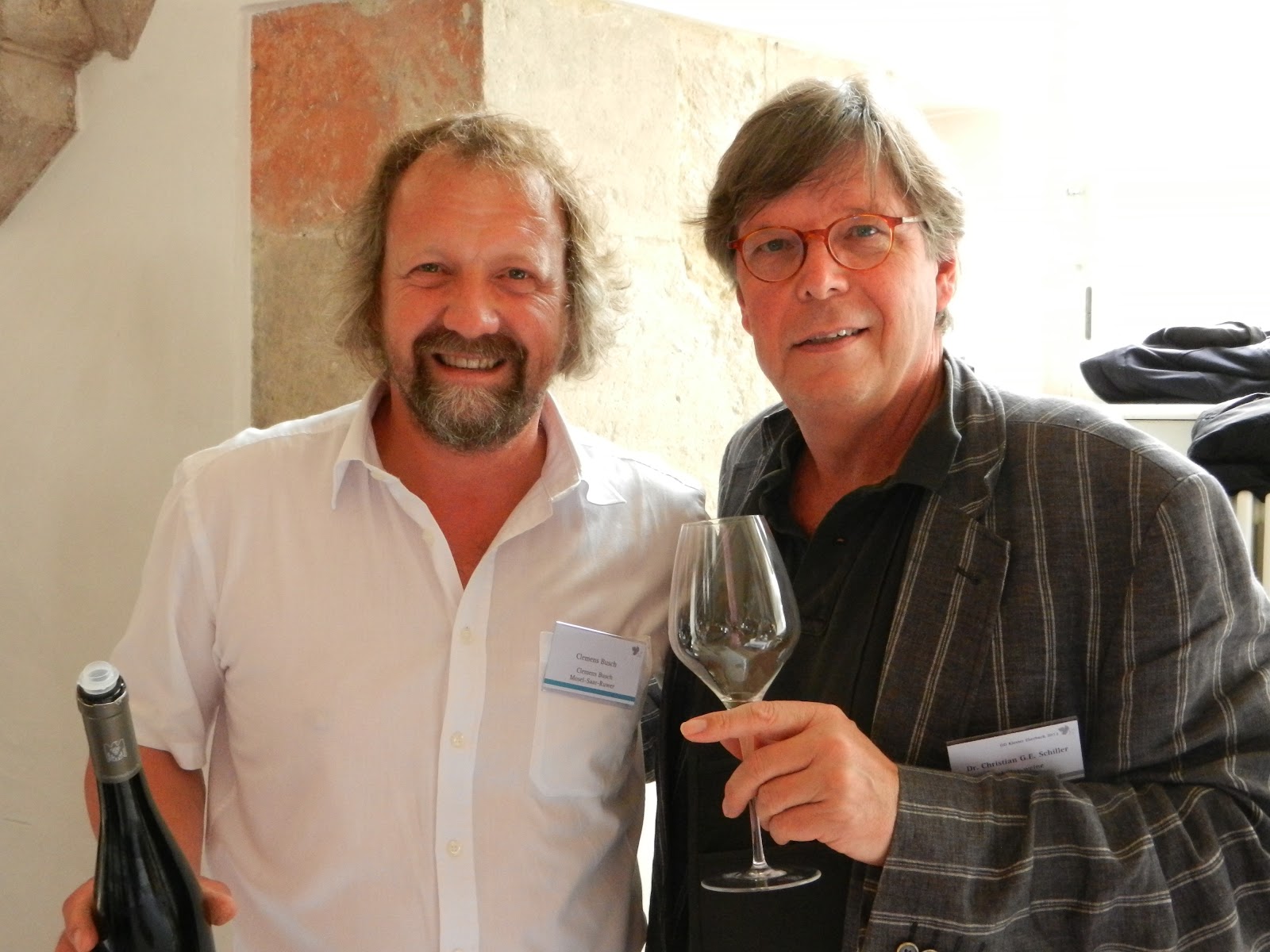
Pictures: Christian G.E. Schiller with Ernst Loosen, Weingut Dr. Loosen, in Washington DC and with Clemens Busch, Weingut Clemens Busch, in Puenderich in the Mosel Valley

See more:
The Doctor Made a House Call - A Tasting with Ernst Loosen, Weingut Dr. Loosen, at MacArthur Beverages in Washington DC, USA

NAHE
Dr. Crusius
Schlossgut Diel
Hermann Dönnhoff
Emrich-Schönleber
Göttelmann
Gut Hermannsberg (neu/wieder)
Korrell Johanneshof
Schäfer-Fröhlich

Picture: Christian G.E. Schiller with Peter Crusius, Weingut Dr. Crusius at Kloster Eberbach

PFALZ
Bassermann-Jordan
Friedrich Becker
Dr Bürklin Wolf
A. Christmann
Faubel Ullrichshof
Fuhrmann-Eymael
Knipser
Kranz (neu)
Philipp Kuhn
Theo Minges
Georg Mosbacher
Müller-Catoir
Ökonomierat Rebholz
Rings
Siegrist
Dr. Wehrheim
von Winning

Picture: Stuart Pigott and Jancis Robinson with Steffen Christmann of Weingut Christmann in Berlin

RHEINGAU
J.B. Becker
Georg Breuer
Johannishof Eser
Schloss Johannisberg
August Kesseler
Graf von Kanitz
Franz Künstler
Josef Leitz
Prinz
Schloss Schönborn
Josef Spreitzer
Schloss Vollrads
Weingüter Wegeler*
Robert Weil

Picture: Christian G.E. Schiller with August Kesseler, Weingut Kesseler, in Assmannshausen

See more:
A Pinot Noir Star: Visiting August Kesseler and his Weingut August Kesseler in Assmannshausen, Germany

RHEINHESSEN
Battenfeld-Spanier
Kühling-Gillot
Bischel (neu)
Dreißigacker
Keller
Wagner-Stempel
Winter (neu)
Wittmann

Picture: Christian G.E. Schiller with Caroline Spnier-Gillot in Bodenheim

See also: 
The Wine Maker Couple H.O. Spanier and Carolin Spanier-Gillot, with Roland Gillot, Lead Wine Tasting of Kuehling-Gillot and Battenfeld-Spanier Wines at Weingut Kuehling-Gillot, Germany

SACHSEN
Zimmerling

WÜRTTEMBERG
Gerhard Aldinger
Ernst Dautel
J. Ellwanger
Karl Haidle
Rainer Schnaitmann

Picture: Christian G.E. Schiller with Rainer Schnaitmann at Kloster Eberbach

schiller-wine - Related Postings

German Spaetlese Wines Can Come in Different Versions. I Have Counted Five.

Phil Bernstein’s Third Annual German Riesling Tasting with the German Wine Society, Washington DC Chapter - Rieslings With a Touch of Sweetness

Visiting Weingut Josef Leitz in Ruedesheim – Johannes Leitz is Germany’s Winemaker of the Year, Gault Millau WeinGuide 2011

When Americans Drink German Wine - What They Choose

Impressions from the Riesling and Co World Tour 2010 in New York

German Wine Basics: Sugar in the Grape - Alcohol and Sweetness in the Wine

JJ Pruem Goes Supermarket: Meeting Katharina Pruem and Tasting the Incredible JJ Pruem Wines at Wegmans

1st International Riesling Symposium, Rheingau, Germany

The Wines of the Roter Hang (Red Slope) in Nierstein, Rheinhessen, Germany

Best German Wines – Gault Millau WeinGuide Deutschland 2012

Germany’s Top 100 Winemakers – Handelsblatt online and Vinum 2011

The Doctor Made a House Call - A Tasting with Ernst Loosen, Weingut Dr. Loosen, at MacArthur Beverages in Washington DC, USA

One of the Fathers of the German Red Wine Revolution: Weingut Huber in Baden

German Riesling and International Grape Varieties – Top Wine Makers Wilhelm Weil and Markus Schneider at Kai Buhrfeindt’s Grand Cru in Frankfurt am Main, Germany

The Wines of Franz Kuenstler from Hochheim, Rheingau, Germany

Best German Wine and Winemakers – Stuart Pigott’s Favorites (2011)

A Pinot Noir Star: Visiting August Kesseler and his Weingut August Kesseler in Assmannshausen, Germany

Visiting Armin and Caroline Diel and their Schlossgut Diel in Burg Layen in Germany

The Wine Maker Couple H.O. Spanier and Carolin Spanier-Gillot, with Roland Gillot, Lead Wine Tasting of Kuehling-Gillot and Battenfeld-Spanier Wines at Weingut Kuehling-Gillot, Germany

Monday, December 17, 2012

A German Wine Maker in the Medoc: Dinner with Stefan Paeffgen at Château Le Reysse, France

Picture: Christian G.E. Schiller with Stefan Paeffgen at Château Le Reysse in Bégadan in the Bas Medoc

Château Le Reysse in Bégadan in the Bas Medoc is one of the 15.000 or so winemakers in Bordeaux that are not classified and thus not in the limelight. But the wines of Château Le Reysse are currently receiving a lot of attention - in Germany -  as Château Le Reysse was taken over by the German Stefan Paeffgen 2 years ago, which has created a special interest in German wine circles as to what he is doing there up in the north of Medoc. Thus, when Annette Schiller from Ombiasy Wine Tours took a group of German wine lovers to Bordeaux in late 2012, it was a “must” to include a stop at Château Le Reysse.

See more:
Bordeaux Trip September 2012, France

This was a wise decision. The group had a great time. The group enjoyed a vineyard walk with Stefan Paeffgen, followed by an inspection of some of the current construction projects and a wine tasting in the court of Château Le Reysse, coupled with delicious, hearty food prepared by Stefan’s wife.

Stefan Paeffgen

Stefan Paeffgen grew up on a farm in Germany, which his older brother took over, when their father retired. Stefan had to look for something different, although he would have loved to take over the family’s property.

Pictures: Annette Schiller, Ombiasy Wine Tours, with Stefan Paeffgen at Château Le Reysse in Bégadan in the Bas Medoc

Stefan studied agriculture in München, Stuttgart, Wisconsin, Paris and then worked for a large fertilizer company. He moved up in the company and made good money. There were mergers and was restructuring. At some point, he was offered a golden handshake and started to look for a winery he could take over. In that period, Stefan, his wife and the 3 children were living in Belgium, near Brussels.

In November 2010, he signed the sales contract with Patrick Chaumont, the owner of Château Le Reysse and moved to Begadan, initially without his family. By now they are all in Begadan.

Château Le Reysse

Patrick Chaumont run Château Le Reysse for several decades, in the second generation. When his son married into a winery in the southern part of Pauillac, he was forced to sell Château Le Reysse.

Pictures: The Wines of Château Le Reysse in Bégadan in the Bas Medoc

The vineyard area of Château Le Reysse totals 4.5 hectares, partially bordering with the vineyards of Rollan de By and La Tour de By. The vines are on average almost 50 years old. Cabernet Sauvignon accounts for 55% and Merlot for 45%. The vineyards are surrounded by a forest, which also belongs to Château Le Reysse.

Pictures: Château Le Reysse in Bégadan in the Bas Medoc

The first vintage that Stefan accompagnied from start to bottling was the 2010. The 2010er Châ¬teaux le Reysse was sold at Euro 9,95 en primeur. I recently bought a case of the 2010 for Euro 19 per bottle in Frankfurt am Main.

Pictures: Château Le Reysse in Bégadan in the Bas Medoc

Total production is 23.000 bottles, which Stefan Paeffgen sells through the old channels of Patrick Chaumont, but increasingly also through his new channels, primarily in Germany.

Château Lassus

Along with Château Le Reysse, Stefan Paeffgen bought Château Lassus – a 22.5 hectares estate – from Patrick Chaumont. The wine is sold en bloc to a Negoçiant in Bordeaux.

Clos du Moulin

Stefan Paeffgen is in the process of buying another estate, Clos du Moulin in St-Christoly with 23 hectares.

schiller-wine: Related Postings

Bordeaux Wines and their Classifications: The Basics

Vin Bio de Bordeaux - At Château Beauséjour in AOC Puisseguin-St.Emilion, France

Malbec World Day 2012 - Malbec in Bordeaux, France

Château Brane-Cantenac, Deuxieme Grand Cru Classe en 1855, Margaux – A Profile, France

Bordeaux Trip September 2012, France

The 5 Premiers Grands Crus Chateaux en 1855 of Bordeaux, France

The Wine Empire of the von Neipperg Family in France, Bulgaria and Germany

What is a Bordeaux Cru Bourgeois? France

Tasting with Alfred Tesseron the last 10 Vintages of Château Pontet-Canet in Washington DC, USA/France

(German) Winemakers in the World: The German Roots of Baron Philippe de Rothschild

Tasting the Wines of Chateau Lafon-Rochet, Saint-Estèphe, 4ème Cru Classé en 1855, with Owner Basil Tesseron at the French Embassy in Washington DC, USA/France

Château Léoville-Poyferré, Chateau Le Crock, Didier Cuvelier in Bordeaux and the Cuvelier Los Andes Wines in Argentina
 

Friday, December 14, 2012

Wining in Bernkastel-Kues in the Mosel Valley: Wine Tavern “Spitzhaeuschen”, Germany

Pictures: Christian G.E. Schiller with Peter Schmitz in the Spitzhaeuschen

I had couple of glass of excellent dry Mosel Riesling from Weingut Robert Schmitz-Herges in the Spitzhaeuschen, a cosy wine tavern, right in the middle of Bernkastel-Kues in the Mosel Valley. The wine was served by Peter Schmitz, who owns and manages Spitzhaeuschen and who also owns and makes the wines at Weingut Robert Schmitz-Herges. Peter Schmitz serves his own wine and the food prepared by his wife in this cosy wine tavern.

The Mosel Valley

The Mosel River begins in a mountain range in France (where it's called Moselle) and runs northward near the border with Luxembourg until it flows into the larger Rhine in Germany. More than two millenia ago ancient Rome sent its armies north over the Alps to this lovely forested and watered region, and tried to push beyond. The "Vandals" kept them from settling for long north of the Mosel, and thus the beautiful river towns along the Mosel River became Roman frontier encampments, then settlements, and finally the largest evolved into true Roman towns with public baths, villas, roads, bridges, theaters, and of course the ubiquitous Roman vineyards - the descendents of which line the riverbanks today.

Pictures: Christian G.E. Schiller at Weingut JJ Pruem and Weingut Dr. Loosen

See also:

The Doctor Made a House Call - A Tasting with Ernst Loosen, Weingut Dr. Loosen, at MacArthur Beverages in Washington DC, USA

JJ Pruem Goes Supermarket: Meeting Katharina Pruem and Tasting the Incredible JJ Pruem Wines at Wegmans

Bernkastel-Kues

Bernkastel-Kues lies at the heart of the Mittelmosel (Middle Mosel), between Graach and Wehlen to the north and Piesport to the west. The town of Bernkastel and the village of Kues (on the opposite side of the Mosel river) amalgamated in 1905 to become Bernkastel-Kues.

The town's Lay and Doctor vineyards have been classified by the VDP as Erste Lage (to be renamed Grosse Lage). In fact, the Berncasteler Doctor is one of the most famous vineyard names in the world. The Doctor is a small  (1.8 ha) plot – south-facing, and with an extremely steep slope of between 45% and 60%.

Pictures: Bernkastel-Kues with the Doctor Cellar

Bernkastel was granted town status by King Rudolph of Habsburg in 1291. The present town developed in the Middles Ages. The colorful medieval Market Square is beautiful. It is surrounded by many well preserved half-timbered houses, as well as the Renaissance Town Hall built in 1608.

Spitzhaeuschen Wine Tavern

The Spitzhäuschen wine tavern, built in 1416, is really a jewel of a rustic middle class building tradition of the Middle Ages. It is a narrow and grows in size the higher it gets. It looks as if it is ready to fall over.

Pictures: Spitzhäuschen

It used to be a winemaker’s house with a slate walled wine cellar. The typical outwards widening of the loft was used as a fodder to keep domestic animals during the winter.

Since 1971, it houses a wine tavern, where Peter Schmitz, Weingut Robert Schmitz-Herges serves his own wine and the food prepared by his wife, such as a “Winzerplatte” with lunch meat, ham and cheese.

Weingut Schmitz-Herges

For generations, the family owned Weingut Schmitz-Herges has produced fine Riesling wines and also Pinot Noir red wines since a couple of years.

Pictures: Peter Schmitz

Peter Schmitz's vineyards are just 1.7 hectar large. There, he produces  1800 cases or so of wine. He sells his wine directly to his customers at his Weingut and pours his wine at his the Spitzhaeuschen right in the center of Bernkastel Kues. All work in the vineyard is done manually because of the steepness of the vineyards.

Wine Portfolio

Notwithstanding the rather small growing area, Weingut Schmitz-Herges currently has about 4 dozens of different wines on its list. I noted that all wines carry information on the remaining sugar level and the alcohol content.

Picture: The Wines of Peter Schmitz

First, 10 wines are classified as dry wines. Interestingly, 6 of them are either Spaetlese or Auslese, and fully fermented, i.a. dry. In particular, the 2010 Lieserer Niederberg-Helden, Riesling Auslese trocken, with grams remaining sugar and 13% alcohol, for Euro 8.70 is a most interesting wine.

Second, another 10 or so wines are labeled as halbtrocken and feinherb, again many at the Spaetlese and Auslese level.

Third, then follow about 20 or so fruity sweet and noble sweet Rieslings, almost all of them Spaetlese or Auslese wines.

The final group are 6 red wines: Pinot Noir, Regent and Cabernet Mitos.

Schiller Wine - Related Postings

When Americans Drink German Wine - What They Choose

German Wine Basics: Sugar in the Grape - Alcohol and Sweetness in the Wine

Wine Caravan from Germany Visiting the East Coast, US: Dr. Fischer, Fitz Ritter, Bolling-Lehnert, Schneider, Dr. Thanisch 

The Doctor Made a House Call - A Tasting with Ernst Loosen, Weingut Dr. Loosen, at MacArthur Beverages in Washington DC, USA

A Riesling Guru and a Killer Guitarist cum Cult Winemaker: Ernst Loosen and Jay Somers and their J. Christopher Winery in Newberg, Oregon

New Wine (Federweisser) in Bernkastel-Kues in the Mosel Valley, Germany

JJ Pruem Goes Supermarket: Meeting Katharina Pruem and Tasting the Incredible JJ Pruem Wines at Wegmans

German Spaetlese Wines Can Come in Different Versions. I Have Counted Five.