Showing posts with label book review. Show all posts

Thursday, January 19, 2017

Book Review by Christian Schiller in Journal of Wine Economics (Vol 11, No 3): MARK E. RICARDO: Simply Burgundy: A Practical Guide to Understanding the Wines of Burgundy. Mark E. Ricardo Book, 2014, 56 pp., ISBN 978-0990513704 Q4 (paperback), $12.99

Picture: Simply Burgundy – “A Practical Guide to Understanding the Wines of Burgundy” by Mark E. Ricardo

Burgundy is the most terroir-oriented region in France if not in the whole world. The focus is on the area of origin, as opposed to Bordeaux, where classifications are producer driven and awarded to individual chateaux. A specific vineyard (climat or lieu-dit) will bear a given classification, regardless of the wine’s producer.

The main levels in the Burgundy classifications, in descending order of quality, are as follows:

– Grand cru wines are produced from a small number of grand cru vineyards in the Côte d’Or and make up 2% of the production at 35 hectoliters per hectare. There are 33 grand cru vineyards in Burgundy.

– Premier cru wines are produced from specific vineyards that are considered Q5 to be of high quality, but slightly lower than grand cru. They make up 12% of production at 45 hectoliters per hectare.

– Village appellation wines are produced from vineyard sites within the boundaries of 1 of 42 villages. Village wines make up 36% of production at 50 hectoliters per hectare.

– Regional appellation wines are wines that are allowed to be produced over the entire region or over an area significantly larger than that of an individual village. These appellations can be divided into four groups: The new Coteaux Bourguignons appellation covers wines made throughout the greater Bourgogne region, from the Chablis region in the north to and including the Beaujolais region in the south. Bourgogne is the standard appellation for wines made anywhere throughout the region excluding Chablis and Beaujolais; these wines may be produced at 55 hectoliters per hectare.

Subregional appellations cover a part of Burgundy larger than a village; examples are Hautes-Côtes de Beaune and Mâcon-Villages. -Wines of specific styles or other grape varieties include white Bourgogne Aligoté (which is made with the Aligoté grape), red Bourgogne Passe-Tout-Grains (which can contain up to two-thirds Gamay), and sparkling Crémant de Bourgogne.

Simply Burgundy: A Practical Guide to Understanding the Wines of Burgundy by Mark E. Ricardo, a practicing attorney, a registered investment advisor, and the founder and president of Trellis Fine Wine Investments, focuses on exactly that—the classification of Burgundy. With 45 pages plus three appendices, it is about the same number of pages as the Burgundy chapter in Karen MacNeil’s popular Wine Bible. I would call Simply Burgundy a booklet.

Although the Wine Bible provides a good introduction to Burgundy, Simply Burgundy: A Practical Guide to Understanding the Wines of Burgundy is not an introduction to Burgundy, but an introduction to the classification of Burgundy. Furthermore, it does not go deeply into the ins and outs of the Burgundy classification but stays with the essentials, leaving aside details and aspects of lesser importance of the classification.

The structure of the booklet is as follows: After 1 page on “Regions and Grape Varietals,” the author explains in 7 pages the concept of the Burgundy classification. This is followed by reviews of the classification region by region: Chablis (3 pages), Côte d’Or (23 pages), Côte Chalonaise (2 pages), Mâconais (3 pages), and Beaujolais (3 pages). Yes, the booklet includes Chablis and even Beaujolais, which in many books about Burgundy are excluded.

An essential part of the Burgundy classification is the system of climats, which I would have liked to be more developed by the author. Climat is a term for a specific vineyard site of a few hectares. The system of climats in Burgundy was granted World Heritage Status by UNESCO last year. Although the author never uses the word climat, he refers to the climats with grand cru and premier cru status but leaves all the other climats aside (village climat). You can find the latter regularly on Burgundy labels, more in Burgundy’s export than domestic market. Interestingly, the new German wine classification system, which is modeled after the Burgundy classification system, does not allow winemakers to indicate climats on labels that have neither grand cru nor premier cru status.

There are practically no numbers in the booklet. One does not find anything about the size of the various regions, subregions, and vineyards or yield restrictions at the various levels of the classification, to name a few areas, where numbers would have been helpful to understand Burgundy.

At the lowest level of the classification, the regional level, the booklet is silent on most categories. That may have been motivated by the thought that the targeted readers of the booklet would mainly be interested in the upper levels of the classification.

Looking beyond the classification, the Burgundy lovers agree that although the classification is important to ascertain the quality of a wine before opening a bottle, equally important, if not more important, is who produced the wine (i.e., the winemaker). The famous Clos Vougeot, for example, is owned by about 80 different vignerons, and they all put exactly the same text on the label of their wine bottles, while the quality of Clos Vougeot (and price) varies widely among the range of  producers.

The author touched on this issue by adding a list of top producers for each region. The effort is commendable, but I would have appreciated some background information on the producers, such as annual production, négociant (that buys the grapes) and/or domain (that grows its own grapes), and price range.

Continuing to look beyond the classification, there is, of course, nothing in Simply Burgundy: A Practical Guide to Understanding the Wines of Burgundy on the history of Burgundy, nor is there anything on the structure of the industry.

The origins of Burgundy’s classification can be found in the work of the Cistercians who were able to delineate plots of land that produced wine of distinct character. The Roman Catholic Church had an important influence on the Burgundy classification. As the power of the church decreased, vineyards were sold to the bourgeoisie. The Napoleonic inheritance laws resulted in the continued subdivision of many vineyards so that some winemakers hold only a row or two of vines.

In terms of the structure of the industry, the role of négociants, who do not own vineyards, is not referred to at all. Négociants play a vital role in the Bourgogne. Négociants sell wines at all quality levels, including grand cru.

To sum up, this is a very small book (a booklet) with the objective of providing “a practical guide to understanding the wines of Burgundy.” The author is concentrating on one aspect—the classification of the wines of Burgundy—and leaves many other aspects that are equally important to “understanding the wines of Burgundy” aside. On the aspect he covers (i.e., the classification), he does not explore the ins and outs of it but focuses on the essentials.

I like the booklet very much as a reference. For the next edition, I would love to see more maps in the booklet. In the current one, there is only an overall map of the Burgundy region with its five subregions.

Christian G.E. Schiller
International Monetary Fund (ret.) and
Emeritus Professor, University of Mainz, Germany
cschiller@schiller-wine.com

Journal of Wine Economics (JWE) (Vol 11, No 3)


Introduction to the Issue (FULL TEXT PDF)Karl Storchmann

Does Organic Wine Taste Better? An Analysis of Experts Ratings
(FULL TEXT PDF)
Magali A. Delmas, Olivier Gergaud & Jinghui Lim

Time-Varying Risk Premiums in the Framework of Wine Investment (ABSTRACT)
Eric Le Fur, Hachmi Ben Ameur & Benoit Faye 

The Political and Economic History of Vineyard Planting Rights in Europe: From Montesquieu to the European Union (FULL TEXT PDF)
Giulia Meloni & Johan Swinnen

Demand for Wine and Alcoholic Beverages in the European Union-A Monolithic Market? (ABSTRACT)
Lorraine Mitchell

Beer-Purchasing Behavior, Dietary Quality, and Health Outcomes among US Adults (ABSTRACT)
Richard Volpe, Michael McCullough, Michael K. Adjemian & Timothy Park

BOOK REVIEWS

HENRY H. WORK
Wood, Whiskey and Wine: A History of Barrels
Reviewed by Nick Vink
Pages 465 – 466

MARK E. RICARDO
Simply Burgundy: A Practical Guide to Understanding the Wines of Burgundy
Reviewed by Christian G.E. Schiller
Pages 466 – 469

MAXIMILLIAN POTTER
Shadows in the Vineyard: The True Story of the Plot to Poison the World’s Greatest Wine
Reviewed by Neal D. Hulkower
Pages 469 – 471

MARA P. SQUICCIARINI & JOHAN SWINNEN
The Economics of Chocolate
Reviewed by Howard-Yana Shapiro
Pages 471 – 475

JEFFREY L. LAMY
The Business of Wine Making
Reviewed by Karl Storchmann
Pages 476 – 478

Book Reviews by Christian G.E. Schiller in the Journal of Wine Economics

Book Review by Christian Schiller in Journal of Wine Economics (Vol 11, No 3): MARK E. RICARDO: Simply Burgundy: A Practical Guide to Understanding the Wines of Burgundy. Mark E. Ricardo Book, 2014, 56 pp., ISBN 978-0990513704 Q4 (paperback), $12.99

Book Review by Christian Schiller in Journal of Wine Economics (Vol 11, No 2): JOHN WINTHROP HAEGER: Riesling Rediscovered: Bold, Bright and Dry. University of California Press, Oakland, 2016, 369 pp., ISBN 978-0-520-27545-4, $39.95

Book Review of "Wine Atlas of Germany" in Vol 10, No 1, 2015 of Journal of Wine Economics (Cambridge University Press)

Christian G.E. Schiller's Review of the Book: Ralf Frenzel (ed.) - Riesling, Robert Weil. Tre Torri, Wiesbaden, Germany, 2013, in: Journal of Wine Economics, Volume 9, 2014, No. 1, Cambridge University Press

Pictures: Annette and Christian Schiller in the Bourgogne.

schiller-wine - Related Postings

Heads up for the 2017 Tours - to Germany and France - by ombiasy WineTours

Burgundy (and Champagne) 2016 by ombiasy WineTours: From Lyon to Reims - Wine, Food, Culture and History

Dinner at a Bouchon - Chez Paul - in Lyon: Schiller’s Favorite Bouchons in Lyon, France

Introduction to the Burgundy Wine Region at Antic Wine in Lyon with Flying Sommelier Georges Dos Santos - Burgundy (and Champagne) 2016 Tour by ombiasy WineTours

Lunch at L’Auberge du Pont de Collonges, Paul Bocuse’s Iconic Restaurant in Collonges­ au­ Mont­ d’Or, France - Burgundy (and Champagne) 2016 Tour by ombiasy WineTours

In the Most Prestigious AOC in the Mâconnais: Pouilly-Fuissé, France

Vineyard Walk, Cellar Walk and Tasting at Domaine Ferret in Fuissé, Poully­ Fuissé, Mâconnais, with Winemaker Audrey Braccini - Burgundy (and Champagne) 2016 Tour by ombiasy WineTours

Visit and Tasting at Domaine Georges Descombes in Vermont, Villié­-Morgon, Beaujolais - Bourgogne (and Champagne) Tour 2016 by ombiasy WineTours

Lunch at Restaurant Le Mercurey in Mercurey - Bourgogne (and Champagne) Tour 2016 by ombiasy WineTours

At Domaine Theulot­-Juillot in Mercurey, Côte Chalonnaise, with Nathalie Theulot - Bourgogne (and Champagne) Tour 2016 by ombiasy WineTours

Tour of Château de Rully and Tasting of Domaine du Château de Rully Wines, with Count Raoul de Ternay - Bourgogne (and Champagne) Tour 2016 by ombiasy WineTours

Cellar Tour and Tasting at Domaine Michel Prunier & Fille in Auxey­ Duresses, Côte de Beaune - Bourgogne (and Champagne) Tour 2016 by ombiasy WineTours

Where Robert Parker likes to Eat: Lunch at La Crémaillère in Auxey-Duresses - Bourgogne (and Champagne) Tour 2016 by ombiasy WineTours

Vineyard Walk in Meursault with Karoline Knoth - Bourgogne (and Champagne) Tour 2016 by ombiasy WineTours

Dinner at the 1 Michelin Star Restaurant Ed.Em in Chassagne Montrachet - Bourgogne (and Champagne) Tour 2016 by ombiasy WineTours

Olivier Leflaive in Puligny Montrachet: Vineyard Walk and Cellar Tour, with Olivier and Patrick Leflaive - Bourgogne (and Champagne) Tour by ombiasy WineTours 2016, France

Lunch and Wine Tasting at La Table de Olivier in Puligny Montrachet with Olivier Leflaive – Bourgogne (and Champagne) Tour by ombiasy WineTours 2016, France

Visit: Hospices de Beaune – Bourgogne (and Champagne) Tour by ombiasy WineTours 2016, France

Lunch in a Typical French Brasserie: Le Carnot in Beaune - Burgundy (and Champagne) 2016 Tour by ombiasy WineTours

Visit and Tasting: Maison Joseph Drouhin in Beaune – Bourgogne (and Champagne) Tour 2016 by ombiasy WineTours, France

Schiller’s Favorite Wine Bars in Beaune, Bourgogne

An American Making Ultra-Premium Wines in Burgundy: Visit and Tasting at Domaine Dublère in Savigny­ lès­ Beaune, with Owner/ Winemaker Blair Pethel - Bourgogne (and Champagne) Tour 2016 by ombiasy WineTours

Tasting Natural Wines with Maurice Marle at Chez Maurice in Beaune - Burgundy (and Champagne) 2016 Tour by ombiasy WineTours

Tasting at Domaine Faiveley in Nuits St. Georges - Bourgogne (and Champagne) Tour 2016 by ombiasy WineTours

Tasting from Barrel at Domaine Jean­-Jacques Confuron in Prémeaux­-Prissey, Côte de Nuits, with Owner/ Winemaker Louis Meunier - Burgundy (and Champagne) 2016 Tour by ombiasy WineTours

Lunch at Restaurant La Cabotte in Nuits-­Saint-George - Bourgogne (and Champagne) Tour 2016 by ombiasy WineTours

Tasting at Domaine Thibault Liger-Belair in Nuits-­Saint­-George, from Barrel and from Bottle, with Thibault Liger-­Belair - Bourgogne (and Champagne) Tour 2016 by ombiasy WineTours

Thursday, December 15, 2016

Book Review by Christian Schiller in Journal of Wine Economics (Vol 11, No 2): JOHN WINTHROP HAEGER: Riesling Rediscovered: Bold, Bright and Dry. University of California Press, Oakland, 2016, 369 pp., ISBN 978-0-520-27545-4, $39.95

Picture: Riesling Rediscovered: Bold, Bright and Dry

There are approximately 47,000 hectares planted with Riesling worldwide. Germany—with 22,500 hectares—accounts for about half of the total. From a global perspective, Riesling is a niche grape variety, accounting for less than 1% of world wine production. From a global perspective, it is the fruity-sweet style (with the fermentation stopped so that the wine remains sweet and the level of alcohol low) and the rare noble-sweet style (lusciously sweet wines due to noble rot or frost in the vineyard) that are receiving the attention of the connoisseurs of premium wines. Dry Riesling has played a minor role in the world of wine, but this is changing. The Rieslings from Alsace and Austria, both considerably smaller producers of Riesling than Germany (Alsace produces approximately 15% and Austria approximately 7% of what Germany produces), have always been in the dry category (although the Rieslings fromAlsace have showna trend toward an increasing level of remaining sweetness in the wine over the past decades), and, importantly, Germany, the dominating Riesling force in the world, has undergone a major transformation in the past 40 years: The fruity-sweet Rieslings have been crowded out from the wine lists in Germany, while the “dry wave”—“Trockenwelle”—has swept the country. When you go to a wine bar, wine store, or restaurant in say Frankfurt, Berlin, or Munich, it is very difficult to find a fruity-sweet Riesling. The wine lists are dominated by dry Riesling.

It is against this background that John Winthrop Haeger has written Riesling Rediscovered: Bold, Bright and Dry. There is nothing in the book on what some of my wine friends in the United States consider the best Rieslings of the world: the low-alcohol Kabinett and Spätlese wines from such iconic winemakers as Egon Müller, JJ Prüm, or Forstmeister Zilliken from the Mosel. Rather, it is all about dry Riesling, and the only Mosel producer included in the description of the world’s top dry Riesling producers is Clemens Busch, who makes outstanding ultrapremium dry wines in Pünderich.

In 350 pages, Haeger provides a comprehensive account of what dry Riesling is all about. The style of the book shows that the author is a researcher and not a journalist (Haeger is a China scholar). The book is not an introduction for a newcomer, but a solid piece of research work for somebody who is familiar with the subject. The book combines academic rigor with a passion for dry Riesling. Unfortunately, the book covers only the Northern Hemisphere, omitting in particular such important producers of dry Riesling as Australia and New Zealand, but also countries like Chile, Argentina, and South Africa.

The book is divided into two parts. The first part is a wide-ranging discussion of dry Riesling. Haeger brings together a wealth of information on various aspects of dry Riesling, including the history, the styles, the clones, the culture, and the habitats. He addresses the issues of the definition of dry Riesling and the balance in dry Riesling in useful boxes. The section on the different Riesling clones is the most thorough and complete write-up on the issue that I am aware of.

Haeger provides a detailed review of the shift from dry to sweet Riesling (the Trockenwelle) that has happened in the past 40 years in Germany. He underpins his reasoning with fascinating details such as the change on the wine list of the trendy restaurant Ente in Wiesbaden that one could observe over time. Chef Klaus-Peter Wodartz of the Ente was one of the leaders in the Neue Deutsche Küche (New German Cooking) movement in the 1970s in Germany, which is credited with being a driving force in the Trockenwelle. Other factors are climate change, a spillover effect from Alsace, and the desire by the young winemaker generation, led by the late George Breuer of Weingut Georg Breuer in Rüdesheim, to produce premium dry Riesling that can compete with the best white wines in the world.

As we all know, wine is normally dry. Riesling is the only noble grape variety in which the wine can be dry, fruity-sweet, or noble-sweet. I would have loved to see a clear delineation of dry Riesling from the other categories, in particular from the fruity-sweet style. The German Kabinett, Spätlese, and Auslese wines are not sweet because Mother Nature was more generous with the grapes, but because of skillful intervention of the winemaker in the cellar. Without the winemaker interrupting the fermentation, all these wines would be dry. In this context, a discussion of the widespread view that generally dry Riesling is inferior to sweet Riesling would have been useful.

The second part is a detailed study of the best vineyards for dry Riesling in the (northern) world and an in-depth description of the key producers of dry Riesling in these vineyards and their wine-making approaches. Haeger identifies 89 superior sites and groups them under five headings: Rhine Basin (with Alsace and German Wine Regions), Danube Basin: Lower Austria, Adige Basin: Alto Adige, Eastern North America, and Western North America. Haeger provides most interesting descriptions of these top sites.

The reviews of the winemakers and their wine-making approaches are comprehensive with many interesting details. I found each one of them fascinating to read. However, I would have preferred a greater number of reviews, each with a shorter text. Quite a number of leading producers of dry Riesling, at least in Germany, are not mentioned in the book. The Franken area, an early producer of bone-dry Rieslings, is completely left out. Other obvious omissions include Dönnhoff, Schäfer-Fröhlich, Sybille Kuntz, Klaus Peter Keller, Franz Künstler, Karthäuserhof, and Immich-Batterieberg, to name a few. That Dr. Loosen is not mentioned is because the major dry Riesling initiative of this producer is too recent. Still, many of the big players in Germany are discussed.

The book is very different from many other wine books in that it does not take a fresh look at a subject that has been treated before by other authors. This is the first book about dry Riesling. It has a bit of the character of a doctoral dissertation in that it covers new ground—and it does so in a detailed and comprehensive manner. For somebody like me who grew up with dry German Riesling, it was a great pleasure to read, but really, anybody interested in the story of dry Riesling will enjoy reading this book.

Christian G.E. Schiller
International Monetary Fund (ret.) and
Emeritus Professor, University of Mainz, Germany
cschiller@schiller-wine.com

Picture: John Haeger in Seattle. See: 5. Riesling Rendezvous in Seattle, Washington State: Overview

Picture: Christian Schiller and John Haeger in Seattle. See: The 4th Riesling Rendezvous in Seattle: Impressions from the Grand Tasting at Chateau Ste. Michelle in Woodinville, Washington State, USA

List of Content and Full Text/ Abstract Links of New Issue of the Journal of Wine Economics (JWE) (Vol 11, No 2)

Introduction to the Issue (FULL TEXT PDF)Karl Storchmann

Regulation and Contract Choice in the Distribution of Wine (FULL TEXT PDF)Michelle Santiago & Michael Sykuta

Fine Wines and Stocks from the Perspective of UK Investors: Hedge or Safe Haven? (ABSTRACT)Elie I. Bouri & David Roubaud

Identifying the Effects of Objective and Subjective Quality on Wine Prices (ABSTRACT)Edward Oczkowski

The Value of Expert Opinion in the Pricing of Bordeaux Wine Futures (ABSTRACT)
Robert H. Ashton

How Much Government Assistance Do European Wine Producers Receive? (FULL TEXT PDF)
Kym Anderson & Hans G. Jensen

BOOK REVIEWS

ALICE FEIRING
For the Love of Wine: My Odyssey through the World’s Most Ancient Wine Culture
Reviewed by Richard E. Quandt
Pages 306 – 308

WILLIAM BOSTWICK
The Brewer’s Tale: A History of the World According to Beer
Reviewed by Kenneth G. Elzinga
Pages 308 – 314  

TOM ACITELLI
The Audacity of Hops: The History of America’s Craft Beer Revolution
Reviewed by Jacob R. Straus
Pages 314 – 316 

JOHN WINTHROP HAEGER
Riesling Rediscovered: Bold, Bright and Dry
Reviewed by Christian G.E. Schiller
Pages 316 – 319

MARK A. MATTHEWS
Terroir and Other Myths of Winegrowing
Reviewed by Victor Ginsburgh
Pages 319 – 323

J. STEPHEN CASSCLES
Grapes of the Hudson Valley and Other Cool Climate Regions of the United States and Canada
Reviewed by Lawrence R. Coia
Pages 323 – 325|

As usual, AAWE members will have full access to all JWE papers through our website. The JWE, published by Cambridge University Press, is also available in more than 3,000 libraries worldwide. In order to receive the Journal of Wine Economics (three hard copies per year  - 4 issues from 2017 on - and full online access to all articles) join AAWE. AAWE is a non-profit organization (501c3) and has kept individual membership low for years ($59 online and hardcopy, $39 online only). You can sign up or renew your membership here. AAWE members also receive a substantial registration discount at our annual conferences. 

 schiller-wine - Related Postings

Heads up for the 2017 Tours - to Germany and France - by ombiasy WineTours

Germany-East Tour 2016 by ombiasy WineTours: Wine, Art, Culture and History

Germany-North Tour 2016 by ombiasy WineTours: Quintessential German Riesling and the Northernmost Pinot Noir

Germany-South Tour by ombiasy WineTours (2015)

Burgundy (and Champagne) 2016 by ombiasy WineTours: From Lyon to Reims - Wine, Food, Culture and History

Bordeaux Tour by ombiasy WineTours (2015), France

Ernst Loosen Presented his Wines at Weingut Dr. Loosen, Bernkastel-Kues, Mosel Valley, Germany

New Developments in German Wine - Annette Schiller at the German Wine Society in Philadelphia, USA

The New Germany – Red, Dry, Sparkling: German Wine Society Tasting, led by Annette Schiller, at Restaurant Old Europe in Washington DC

The New Germany: Red, Sparkling and Dry - Tasting at the American Wine Society 2016 National Conference in Los Angeles, USA, led by Annette Schiller

The New Classification of German Wines: The VDP Classification - Annette Schiller Leading a Tasting at the 2016 National Convention of the American Wine Society in Los Angeles, USA

Approaches to Classifying German Wine: The Standard Approach (the Law of 1971), the VDP Approach and the Zero Classification Approach

German Wine Basics: Grosse Lage and Grosslage (and Grosses Gewaechs)

VDP.Grosses Gewaechs, Erstes Gewaechs, Spaetlese/Auslese Trocken, … Labeling Dry Ultra-Premium Wines in Germany

5. Riesling Rendezvous in Seattle, Washington State: Overview

The 4th Riesling Rendezvous in Seattle: Impressions from the Grand Tasting at Chateau Ste. Michelle in Woodinville, Washington State, USA

The German Winemakers at the 4th Riesling Rendezvous in Seattle, USA


Wednesday, April 13, 2016

Book Review: Simply Burgundy – “A Practical Guide to Understanding the Wines of Burgundy” by Mark E. Ricardo

Picture: Simply Burgundy – “A Practical Guide to Understanding the Wines of Burgundy” by Mark E. Ricardo

Burgundy is the most terroir-oriented region in France if not in the whole world. The focus is on the area of origin, as opposed to Bordeaux, where classifications are producer-driven and awarded to individual chateaux. A specific vineyard (climat or lieu-dit) will bear a given classification, regardless of the wine's producer. The main levels in the Burgundy classifications, in descending order of quality, are:

Grand Cru wines are produced from a small number of Grand Cru vineyards in the Côte d'Or and make up 2% of the production at 35 hectoliters per hectare. There are 33 Grand Cru vineyards in Burgundy.

Premier Cru wines are produced from specific vineyards that are considered to be of high, but slightly lower quality; they make up 12% of production at 45 hectoliters/hectare.

Village appellation wines are produced from vineyard sites within the boundaries of one of 42 villages. Village wines make up 36% of production at 50 hectoliters/hectare.

Regional appellation wines are wines which are allowed to be produced over the entire region, or over an area significantly larger than that of an individual village. These appellations can be divided into 4 groups:

The new Coteaux Bourguignons appellation covers wines made throughout the greater Bourgogne region, from the Chablis region in the north to and including the Beaujolais region in the south.

Bourgogne, the standard appellation for wines made anywhere throughout the region excluding Chablis and Beaujolais; these wines may be produced at 55 hectoliters/hectare.

Subregional appellations cover a part of Burgundy larger than a village. Examples are Hautes-Côtes de Beaune and Mâcon-Villages.

Wines of specific styles or other grape varieties include white Bourgogne Aligoté (which is made with the Aligoté grape), red Bourgogne Passe-Tout-Grains (which can contain up to two thirds Gamay) and sparkling Crémant de Bourgogne.

Picture: Christian Schiller in the Bourgogne. See: Bourgogne Tour by ombiasy WineTours (2015), France

Simply Burgundy – “A Practical Guide to Understanding the Wines of Burgundy” by Mark E. Ricardo, a practicing attorney, a registered investment advisor and the founder and President of Trellis Fine Wine Investments, focusses on exactly that: the classification of Burgundy. With 45 pages plus 3 appendices, it is about the same number of pages as the Burgundy chapter in Karen MacNeil’s popular Wine Bible. I would call Simply Burgundy a booklet.

While the Wine Bible provides a good introduction to Burgundy, Simply Burgundy – “A Practical Guide to Understanding the Wines of Burgundy” is not an introduction to Burgundy, but an introduction to the classification of Burgundy. Furthermore, it does not go deep into the ins and outs of the Burgundy classification, but stays with the essentials, leaving aside details and aspects of lesser importance of the classification.

The structure of the booklet: Following 1 page on “Regions and Grape Varietals”, the author explains on 7 pages the concept of the Burgundy classification. This is followed by reviews of the classification region by region: Chablis (3 pages), Côte d’Or (23 pages), Côte Chalonaise (2 pages), Mâconais (3 pages) and Beaujolais (3 pages). Yes, the booklet includes Chablis and even Beaujolais, which in many books about Burgundy are excluded.

An essential part of the Burgundy classification is the system of climats, which I would have liked to be more developed by the author. Climat is a term for a specific vineyard site of a few hectares. The system of climats in Burgundy was granted World Heritage Status by UNESCO last year. Although the author never uses the word climat, he refers to the climats with grand cru and premier cru status, but leaves all the other climats aside (village climat). You can find the latter regularly on Burgundy labels, more in Burgundy’s export than domestic market. Interestingly, the new German wine classification system, which is modeled after the Burgundy classification system, does not allow winemakers to indicate climats on the label that neither have grand cru or premier cru status.

There are practically no numbers in the booklet. You do not find anything about the size of the various regions, sub-regions and vineyards, or yield restrictions at the various levels of the classification, to name a few areas, where numbers would have been helpful to understand Burgundy.

At the lowest level of the classification, the regional level, the booklet is silent on most categories. That may have been motivated by the thought that the targeted readers of the booklet will mainly be interested in the upper levels of the classification.

Looking beyond the classification, the Burgundy lovers agree that while the classification is important to ascertain the quality of a wine before opening a bottle, equally important, if not more important is, who produced the wine, i.e. the winemaker.

The famous Clos Vougeot, for example, is owned by about 80 different vignerons and they all put exactly the same text on the label of their wine bottles, while the quality of Clos Vougeot (and price) varies widely among the range of producers.

The author touched on this issue by adding a list of top producers for each region. The effort is commendable, but I would have appreciated some background information on the producers, such as: annual production; négociant (that buys the grapes) and/or domain (that grows its own grapes); price range.

Continuing looking beyond the classification, there is, of course, nothing in Simply Burgundy – “A Practical Guide to Understanding the Wines of Burgundy” on the history of Burgundy nor is there anything on the structure of the industry.

The origins of Burgundy's classification can be found in the work of the Cistercians who were able to delineate plots of land that produced wine of distinct character. The Roman Catholic Church had an important influence on the Burgundy classification. As the power of the church decreased, vineyards were sold to the Bourgeoisie. The Napoleonic inheritance laws resulted in the continued subdivision of many vineyards so that some winemakers hold only a row or two of vines.

In terms of the structure of the industry, the role of négociants, who do not own vineyards, is not referred to at all. Négociants play a vital role in the Bourgogne. Négociants sell wines at all quality levels, including grand cru.

To sum up: This is a very small book (a booklet) with the objective of providing “A Practical Guide to Understanding the Wines of Burgundy”. The author is concentrating on one aspect: the classification of the wines of Burgundy and leaves many other aspects that are equally important to the “Understanding of the Wines of Burgundy” aside. And on the aspect he covers – the classification – he does not go into the ins and outs of it, but focusses on the essentials.

I like the booklet very much as a reference. For the next edition, I would love to see more maps in the booklet. In the current issue, there is only an overall map of the Burgundy region with its five sub regions.

schiller-wine: Related Postings 

Bourgogne Tour by ombiasy WineTours (2015), France

Book Review of "Wine Atlas of Germany" in Vol 10, No 1, 2015 of Journal of Wine Economics (Cambridge University Press)

Book Review: "Beyond Jefferson's Vines - The Evolution of Quality Wine in Virginia" by Richard Leahy, USA

Christian G.E. Schiller's Review of the Book: Ralf Frenzel (ed.) - Riesling, Robert Weil. Tre Torri, Wiesbaden, Germany, 2013, in: Journal of Wine Economics, Volume 9, 2014, No. 1, Cambridge University Press

A New, Very Useful Wine Book: Dagmar Ehrlich’s “Rebsorten ABC”

Book Review: Staudt’s Weinkalender 2013 – Staudt’s Pocket Wine Calender 2013

Wine Book Review: 50 einfache Dinge die Sie ueber Wein wissen sollten – 50 simple things you should now about wine


Friday, July 31, 2015

Book Review of "Wine Atlas of Germany" in Vol 10, No 1, 2015 of Journal of Wine Economics (Cambridge University Press)

Picture: Wine Atlas of Germany and Journal of Wine Economics (Cambridge University Press), Vol 10, No 1, 2015

I reviewed:

DIETER BRAATZ, ULRICH SAUTTER and INGO SWOBODA: Wine Atlas of Germany. Translated by Kevin Goldberg, University of California Press, Berkeley and Los Angeles, California; University of California Press, London, England, 2014, 277 pp., ISBN: 978-0-520-26067-2, $60.

My review was published in Vol 10, No 1, 2015 of the Journal of Wine Economics (Cambridge University Press), pages 121-123.

I am re-issuing my book review here on schiller-wine and adding a few pictures from the review and the book.

This was my second review in the Journal of Wine Economics. See also: Christian G.E. Schiller's Review of the Book: Ralf Frenzel (ed.) - Riesling, Robert Weil. Tre Torri, Wiesbaden, Germany, 2013, in: Journal of Wine Economics, Volume 9, 2014, No. 1, Cambridge University Press  

----------------------------------------------------------------------

DIETER BRAATZ, ULRICH SAUTTER and INGO SWOBODA: Wine Atlas of Germany. Translated by Kevin Goldberg, University of California Press, Berkeley and Los Angeles, California; University of California Press, London, England, 2014, 277 pp., ISBN: 978-0-520-26067-2, $60.

The Wine Atlas of Germany, published by University of California Press in August 2014, is a wonderful coffee-table style book that takes a thorough look at the wine geography of Germany. It contains excellent wine maps and a wealth of useful information about German wine. However, the atlas has its limitations and this is due to the fact that (1) the way German wine makers classify their wines is in transition and (2) the Wine Atlas of Germany is a translation of the Weinatlas Deutschland, which was published in Germany in 2007; with the cut-off date for the German version almost 10 years back, the Wine Atlas of Germany was already outdated in a number of important aspects when it was published. This is the only, but a major, weakness of the book.

The authors are Dieter Braatz (deputy Editor-in-Chief of the German gourmet magazine Der Feinschmecker), Ulrich Sautter (wine writer) and Ingo Swoboda (co-author of the book "Riesling"). Jancis Robinson provided a forward. Kevin Goldberg translated the Wine Atlas of Germany and added a translator’s note at the beginning of the book.

The Wine Atlas of Germany is essentially divided into two main parts. First, there is a series of introductory chapters that provide background to the ongoing reform of wine classification in Germany, a discussion of the factors that makes a vineyard unique, an overview of the history of winegrowing in Germany and an introduction to the grape varieties of Germany. Second (and comprising the majority of the book), there is a series of 16 chapters covering all German wine regions, one by one. Each of these chapters includes detailed maps and information on the area’s soils, history and main grape varieties.

Pictures: Journal of Wine Economics (Cambridge University Press), Vol 10, No 1, 2015

Turning to the issue of wine classification in Germany, the basic German wine classification system is that of the German wine law of 1971, which replaced the German wine law of 1930. The German wine law of 1971 created the Prädikatswein system, which links must weights to a hierarchy of predicates. In ascending order of ripeness of the grapes at harvest, these are Kabinett, Spätlese, Auslese, Beerenauslese, Eiswein and Trockenbeerenauslese. Importantly, although the hierarchy of predicates is not a quality hierarchy, in reality it is seen that way. The terroir as a determining factor for quality clearly moved to the backburner in Germany as a result of the introduction of the Prädikatswein system in 1971.

In terms of vineyard classification, the law of 1971 distinguishes between Einzellage and Grosslage. Einzellage is a single vineyard; Grosslage is a collection of single vineyards. A village typically has say 10 single vineyards and 1 collective vineyard. The wine law of 1971 redrew the vineyard map of Germany considerably, as the law required that single vineyards be at least five hectares in size. As a consequence, the wine law of 1971 resulted in fewer, but larger and more heterogeneous single vineyards than before. In the Wine Atlas of Germany, you find all collective vineyards and all single vineyards of the German wine law of 1971.

The law of 1971 does not contain a ranking of the single vineyards. However, the authors ranked them into 4 levels: (1) Excellent vineyard; (2) Superior vineyard; (3) Good vineyard and (4) Other Vineyards. The vineyard ranking in the Wine Atlas of Germany is the subjective ranking of the authors, based on various information and historical documents that are available, such as Prussian tax documents for the 1800s.

The ranking of the authors, all three accomplished experts of German wine is sound, although I have heard critical voices. For instance, just 7 sites along the entire Mosel are listed as exceptional, 13 if you include the Saar and Ruwer. This compares with 11 exceptional vineyards in the Pfalz, 16 exceptional vineyards in the Rheingau and 21 exceptional vineyards in the Nahe. The large fan community of fruity-sweet Mosel-Saar-Ruwer wines in the world is obviously disappointed by these ratings. But this is due to the fact that the Wine Atlas of Germany is a translation of a German wine atlas - and in Germany, the wines of the Mosel-Saar-Ruwer do not enjoy the same cult status as they do outside of Germany.

Pictures: Wine Atlas of Germany

A few years ago, the VDP – the association of German elite wine makers – revolutionized the German classification system by moving to a terroir-based classification, following the Bourgogne model. With the latest modifications of 2012, at the bottom of the VDP classification are the basic entry-level wines (Gutswein). Above these are the village wines (Ortswein), followed by the single vineyard wines worthy of premier cru (Erste Lage) or even a grand cru (Grosse Lage) status. Note that in 2012, Grosse Lage replaced Erste Lage at the top of the VDP classification. Also, Grosse Lage should not be confused with Grosslage, the term for a large collective site in the law of 1971 (which in my view should be abolished).

Obviously, the Wine Atlas of Germany reflects only the early phase of these fundamental reforms.

Unfortunately, so much has happened in the past years, and this is not reflected in the atlas. Thus, if you have a recent vintage of a VDP producer, the Wine Atlas of Germany is of only limited help for you, if you want to know more about where the wine comes from.

Should one care about the VDP classification? It is the classification of just 200 winemakers, while there are 20.000 or so winemakers that are not members of the VDP. Yes, one should care. It is the elite of Germany (although there are quite a number of top winemakers that are not members of the VDP). When it comes to drinking German wine outside of Germany, the wine market is dominated by VDP producers. And rightly in my view, the Wine Atlas of Germany pays a lot of attention to the VDP classification – but does not capture the changes of the last years.

Finally, looking ahead, Germany is in the process of changing the wine geography further by allowing Gewann names - a sub-plot of a single vineyard - on the label, as a response to the fact that many single vineyards established in the wine law of 1971 are of quite varied quality (i.e. heterogeneous). Many such Gewanne have already been registered and you will see more and more of them on German wine labels. This reform, of course, is not reflected in the Wine Atlas of Germany.

To sum up, the Wine Atlas of Germany does not capture the most recent movements to a Bourgogne-type ranking of vineyards in Germany, but there is much more to the book. Overall, the Wine Atlas of Germany is a beautiful book with great maps and lots of background information. The excellent photographs capture essential details of each region covered. Finally, German wine lovers from outside of Germany will be excited by the coverage of the internationally lesser known regions, such as Baden, Württemberg and Saxony for example.

Christian G.E. Schiller
International Monetary Fund (ret.) and emeritus professor, University of Mainz, Germany
Cschiller@schiller-wine.com

schiller-wine - Related Postings 

Fall Tours by ombiasy WineTours 2015 - A Very Special Treat: Experience Harvest Time !

4 Wine Tours by ombiasy coming up in 2015: Germany-East, Germany-South. Germany-Nord and Bordeaux

Germany-East Wine and Art Tour by ombiasy WineTours (2015)

Bourgogne Tour by ombiasy WineTours (2015), Franc

Monday, December 10, 2012

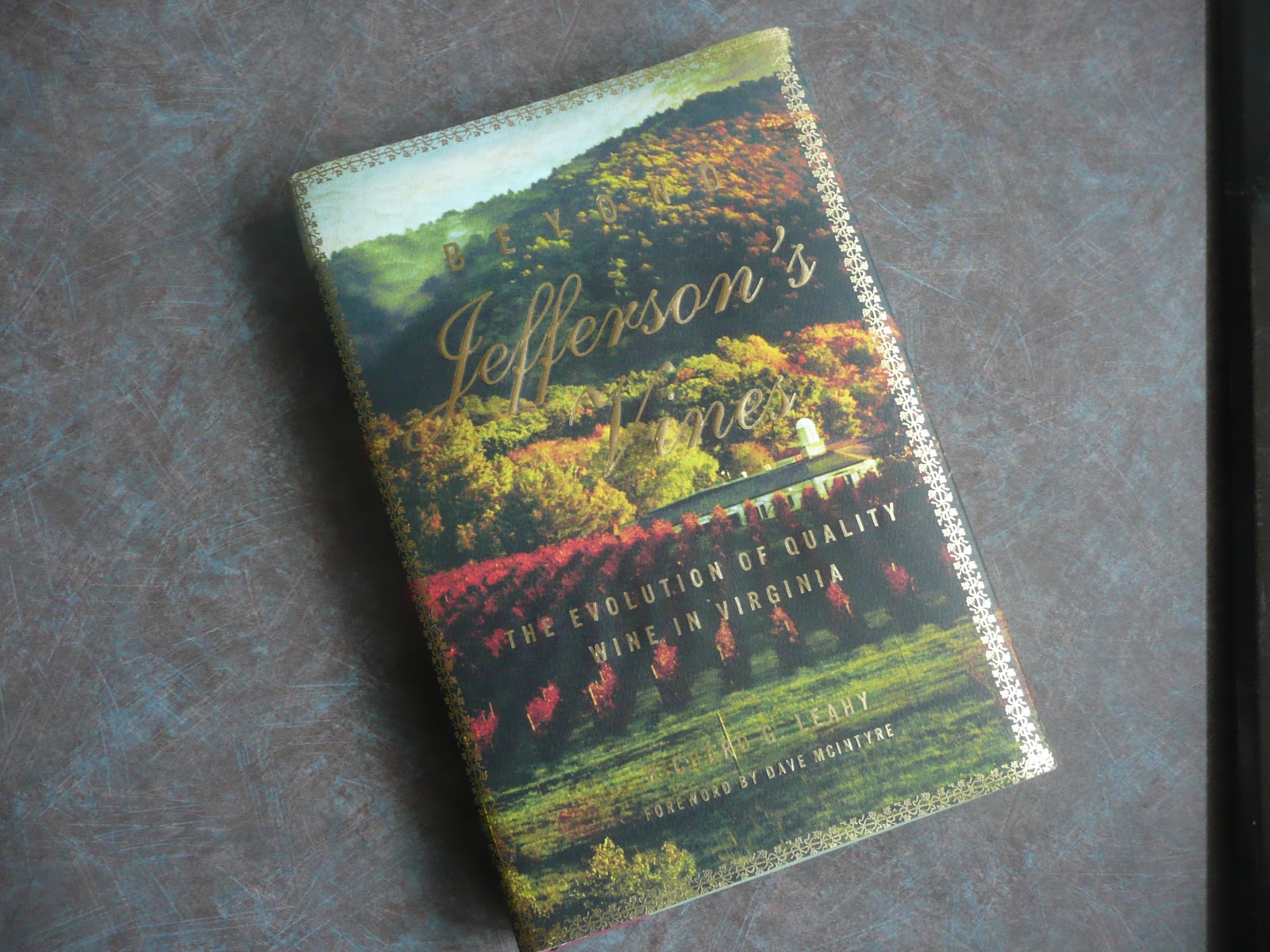
Book Review: "Beyond Jefferson's Vines - The Evolution of Quality Wine in Virginia" by Richard Leahy, USA

Picture: Christian G.E. Schiller with Richard G. Leahy at Boxwood Vineyard

"Beyond Jefferson's Vines - The Evolution of Quality Wine in Virginia" by Richard G. Leahy ($19.95, Sterling Publishing) is a fascinating book about the emerging wine region Virginia in the United States.

Over the past 50 years or so, Virginia wines have experienced a tremendous development - to elegant and balanced, mostly European vinifera-based wines. Today, Virginia is the 5th largest wine industry in the US, with about 200 wineries and 2,500 acres of vineyards.

Picture: Beyond Jefferson's Vines - The Evolution of Quality Wine in Virginia

Amazingly, Frenchman Stephane Derenoncourt, a famous wine consultant who now plays in the same league as Michel Rolland, is advising not only star producers in Bordeaux such as Chateau Canon la Gaffeliere in St. Emilion, but also newcomer Boxwood Vineyard in Virginia, USA. I recently tasted some wines with owner Count Stefan von Neipperg at Chateau Canon la Gaffeliere in St. Emilion, Bordeaux, France and I tasted some wines with owner/General Manager Rachel Martin at Boxwood Vineyard in Virginia, USA. Both wines - the Bordeauy and the Virginia wine - were made with the advice of Stéphane Derenoncourt.

It all began with Thomas Jefferson.

See  more:
The Wine Empire of the von Neipperg Family in France, Bulgaria and Germany
Boxwood Winery in Virginia: Lunch with Wine Makers Rachel Martin and Adam McTaggert in the Chai between the Tanks – TasteCamp 2012 East Kick-Off, USA

President Thomas Jefferson and Wine in Virginia

Before becoming President of the US, Thomas Jefferson was American Ambassador to France. He was appointed in 1785 and spent five years in Europe. There, the third President of the USA - and notable bon viveur - mingled effective statesmanship with frequent trips to the wine regions of France and Germany.

Picture: Christian G.E. Schiller with Gerhard Bauer, Otium Cellars

See more:
Tasting the “German” Otium Wines with Gerhard Bauer and Ben Renshaw at Otium Cellars, Virginia, USA

Thomas Jefferson visited the Rheingau in Germany in 1788 and wrote that the wine of the "Abbaye of Johnsberg is the best made on the Rhine without comparison … That of the year 1775 is the best." He also referred to the Rheingau’s Riesling as the "small and delicate Rhysslin which grows only from Hochheim to Rudesheim". Impressed by the quality of the Rheingau Riesling wines, he bought 100 grapevines in Hochheim to take back to his estate in Virginia.

Before moving to Europe, Jefferson had already tried to grow wine in Virginia, but without success. In 1773, Jefferson first tried to grow wine by hiring an Italian winemaker. However, he produced only a small quantity of American wines and none from the imported European Vitis vinefera vines.

Picture: Christian G.E. Schiller with Jim Law, Linden Vineyard

See more:
Jim Law and Linden Vineyards in Virginia – A Profile, USA

That did not change when he came back from Europe with new European plants. While his personal foray into wines only saw success as a connoisseur and not a wine producer, he was considered an expert during his lifetime. For more than 60 years, Jefferson wrote about wine growing and wine making.

Today, Jefferson's dream of wine growing in Virginia has been achieved. Virginia is among the top US wine producing regions. At Jefferson's Monticello, more than 20 varieties of grapes are grown.

The Wines of Virginia

As far as white wines are concerned, the European vinifera grapes Chardonnay and Viognier are the leading varieties today. Increasingly they are made “naked” or with little oak only, with the objective of retaining natural acidity and freshness. Indeed, Viognier has been named as the official grape of Virginia.

For French-American hybrid varieties, Seyval Blanc is still popular, but resembles now the fresh and crisp wines from France’s South West. Vidal has become the backbone of the artificially frozen ice wine (cryoextraction), which I am not a great fan of.

Picture: Christian G.E. Schiller with Owner/General Manager Rachel Martin, Boxwood Winery

See more:
Boxwood Winery in Virginia: Lunch with Wine Makers Rachel Martin and Adam McTaggert in the Chai between the Tanks – TasteCamp 2012 East Kick-Off, USA

The first ice wine was reportedly produced in Germany in 1794. Today, ice wines are highly prized wines that are made not only in Germany, but also in Austria and Canada as well as other countries, including the United States. Canada has experienced an amazing ice wine boom in the past decades. See about German and Canadian ice wine here. In the context of ice wine, some wine regions, including Virginia, are pushing cryoextraction. This is an approach, which kind of simulates the frost in the vineyard in the wine cellar. It was developed by the French. Instead of waiting for Mother Nature to produce frosty temperatures in the vineyard, the winemaker subjects the grapes to frosty temperatures in the cellar and presses them while frozen.

As far as red wines are concerned, there was a shift in top Virginia reds from straight varietal wines to blends. And blends have gone from being dominated by Cabernet Sauvignon to Merlot and Cabernet Franc, with a significant amount of Petit Verdot. There is an increasing focus on neutral oak and clean, vibrant fruit, mirroring the evolution of Virginia white wines.

Picture: Christian G.E. Schiller with Jennifer Breaux Blosser, Breaux Vibeyards

See more:
Visiting Jennifer Breaux Blosser and Breaux Vineyards in Virginia, USA

Tannat, Uruguay’ signature grape from the South West of France, is showing up in more Virginia wines, usually as a blend. The only red French American hybrid which has performed consistently well in Virginia is Chambourcin, which, with its bright cherry aromas and flavors, crisp acidity and low tannin, resembles the Gamay grape of Beaujolais.

Finally, while respectable sparkling wines have been made in Virginia in the past, sparkling wines have been taken to a new level in Virginia by Claude Thibault. His NV Thibault-Janisson Brut, made from 100 percent Chardonnay, which President Obama offered his guests at his first state dinner, is as close as you can get to Champagne outside of France.

Beyond Jefferson’s Vines: The Evolution of Quality Wine in Virginia

Richard G. Leahy’s book provides an excellent overview of the emergence of Virginia as a serious wine producer. His book is not so much a well structured textbook, but more a collection of most interesting articles about the emergence of the wine country Virginia.

Pictures: Richard G. Leahy

The book starts with a chapter about a rather new winery in Virginia, RdV Vineyards in Delaplane. Owner and principal Rutger de Vink’s “goal is nothing less than to make world-class wine in Virginia”. Indeed, is on the right track and Jancis Robinson has already reviewed his wines in her weekly column in the Financial Times.

Richard G. Leahy then moves to the 2010 vintage.

This is followed by a profile of Pippin Hill Farm and Vineyard. The husband and wife owner-operators Dean Andrews and Lynn Easton Andrews do not want to make world class wines but want to transform a spectacular mountain site into an events venue and culinary destination. Generally, some Virginia wineries concentrate on making the best possible wine, while others are entertainment venues. Richard G. Leahy sees a role for both.

The next chapter is on Virginia’s historic roots and in particular on the role of Thomas Jefferson.

In what follows, there are chapters on the women who helped shape Virginia’s wine industry, and on how Virginia wines have slowly gained national media attention. The chapter "How the British Feel about Virginia Wine ... and Why it Matters" provides a perspective from the other side of the Atlantic.

Finally, various chapters cover the different regions of winemaking in Virginia. These chapters provide useful information for a Virginia winery trip.

All in all, Richard G. Leahy’s book "Beyond Jefferson's Vines - The Evolution of Quality Wine in Virginia" is a most entertaining book on the Virginia wine success story, written by an eminent expert of Virginia wine. "The story," Richard G. Leahy writes, "encompasses many people in many fields: university researchers, grape growers, winemakers and winery owners, politicians, marketing professionals, the media and many others - all players in an industry persevering in the attempt to make not just wine, but fine wine that will restore Virginia's reputation as an important American wine region."

Richard G. Leahy

Richard Leahy is a wine writer and consultant who has been reporting on the wines of Virginia and Eastern North America since 1986. He works with numerous wineries in Virginia and along the East Coast.

Richard Leahy began writing about wine with a regular column in the Connection Newspaper Group in 1986. Under Bruce Cass and Jancis Robinson MW he was Mid-Atlantic and Southern Editor for the groundbreaking Oxford Companion to the Wines of North America (2000). He wrote the foreword to Virginia Wine From Grapes to Glass by Walker Elliott Rowe (2009, The History Press) and was featured by Todd Kliman in his book The Wild Vine (2010, Crown Publishing/Random House). He is a member of the Society of Wine Educators and is a member of the Board of Directors of “Drink Local Wine.”

schiller-wine: Related Posting

Northern Virginia Magazine October 2012: Wine Recs from Local Winos

Visiting Jennifer Breaux Blosser and Breaux Vineyards in Virginia, USA

Virginia Wines Shine in San Francisco - 2012 San Francisco International Wine Competition, USA

Judging Virginia Wines in Suffolk, Virginia - Virginia Wine Lover Magazine Wine Classic 2012

A New Winery in Virginia - The Barns at Hamilton Station Vineyards, USA

As Close as You Can Get to (French) Champagne at the US East Coast – Claude Thibaut and His Virginia Thibaut Janisson Sparklers at screwtop Wine Bar

Jim Law and Linden Vineyards in Virginia – A Profile, USA

Boxwood Winery in Virginia: Lunch with Wine Makers Rachel Martin and Adam McTaggert in the Chai between the Tanks – TasteCamp 2012 East Kick-Off, USA