Showing posts with label noble sweet wines. Show all posts

Tuesday, January 8, 2013

2012 Eiswein in Germany, Icewine in Canada, and Cryo-Extraction Wines

Picture: Eiswein Harvest 2012 at Weingut Balthasar Ress, Rheingau, Germany

When the temperature dropped considerably in Germany during the night of December 8th to 9th 2012, dozens of German wine makers spent a sleepless night and instead harvesting Eiswein. The conditions were right - thoroughly frozen grapes - and the legal requirement - temperatures below -7 °C - were fulfilled in many of the 13 German wine growing regions in that night. Other winemakers waited a few days and harvested during the night of December 12th to 13th. All German 2012 Eiswein was harvested between December 8th and 13th.

Overall, German winemakers are very enthusiastic about the 2012 Eiswein. Here are a few reports from wine makers.

Reiner Flick, Weingut Joachim Flick, Flörsheim-Wicker, Rheingau,  harvested 5000 kg within 4 hours at -13° C from 2 different vineyards: 2012er Wickerer Nonnberg Riesling Eiswein, 320 liter at 175° Oechsle and a 2012er Wickerer Mönchsgewann Riesling Eiswein, 380 liter at 168° Oechsle. Harvest started at 10 pm and ended at 2 am, with 20 people.

Armin Diel, Schlossgut Diel, Burg Layen, Nahe, harvested in the first 2 hours of December 9th 130 liter at 188° Oechsle. The temperature was -10° C. This was the only time corridor, where the harvest was possible. 7 hours later, the temperature had risen to close to zero.

Weingut Bernhard Pawis, Zscheiplitz, Saale-Unstrut, harvested on December 8th at 7 am at -12° C 100 liter of Riesling Eiswein (180° Oechsle).

In the Rheingau at Weingut Balthasar Ress in Hattenheim, General Manager Dirk Würtz harvested with 15 helpers 40 liter Eiswein at 180° Oechsle.

Here are more reports from Germany.

Deutsches Weininstitut link

VDP link

Eiswein/Ice Wine and Noble-Sweet Wines

Eiswein belongs to the group of noble-sweet wines. There are basically two methods of producing noble-sweet wines.

First, wait for the grapes to be botrytised. Botrytise Cinerea (noble rot) is a fungus that under the right conditions attacks already-ripe grapes, shriveling them, concentrating the sweetness and acidity. The grapes end up looking disgusting but they make profound sweet white wines with complex apricot, honey and spice flavors and good balancing acidity. Typically noble rot forms best in conditions where morning mist from a lake or river gets burnt off during the day by hot sun.

Second, wait for the grapes to be frozen. Grapes used for producing ice wine have a substantially lower level of sugar in the vineyard than the botrytised grapes, but that night, when the grapes are harvested, the frost has converted the grapes into ice. Because the grapes are frozen, most of the mass is water, and is left behind as ice in the press. Only a small amount of concentrated juice is extracted. This also produces profound sweet wines, but without the taste of the noble rot.

Eiswein in Germany and Icewine in Canada

Pictures: Dirk Wuertz and his 2012 Eiswein at Weingut Balthasar Ress, Rheingau, Germany (All pictures are courtesy of Weingut Balthasar Ress)

The main producers of ice wine are Germany and Canada. In Germany, there is no guarantee for the vintners for the frost to come and to allow them to pick frozen, sugar-rich grapes to make the sweet and expensive elixir. So, it is always a risk to let the fruit hang and wait for the temperature to fall. In Canada, there is no such risk and this explains why Canada has become the leading producer of ice wine in the world.

Generally, ice wine require a hard freeze to occur sometime after the grapes are ripe which means that the grapes typically hang on the vine well beyond the normal harvest. If a freeze does not come quickly enough, the grapes may rot and the crop will be lost. If the freeze is too severe, the juice extraction by pressing can be very long. The longer the harvest is delayed, the more fruit will be lost to wild animals and dropped fruit. Since the fruit must be pressed while it is still frozen, pickers often must work at night or very early in the morning, harvesting the grapes within a few hours.

The high sugar level in the must leads to a slower-than-normal fermentation. It may take months to complete the fermentation (compared to days or weeks for regular wines) and special strains of yeasts are used.

Due to the labor-intense and risky production process resulting in relatively small amounts of wine, ice wines are generally quite expensive.

Cryo-Extraction

For ice wine, the grapes are frozen while still on the vine. Alternatively, the freezing can take place after the harvest in the wine cellar (cryo-extraction). This is an approach, which kind of simulates the frost in the vineyard in the wine cellar. It was developed by the French. Instead of waiting for Mother Nature to produce frosty temperatures in the vineyard, the winemaker subjects the grapes to frosty temperatures in the cellar and presses them while frozen.

In the US, Austria, Germany, and Canada, the grapes must freeze naturally to be called ice wine.

German wine law entirely bans post-harvest freezing methods, even if not labeled "Eiswein".

In France, in the Sauternes region, cryo-extraction has been used now for several decades to support the production of noble-sweet, botrytised Sauternes wines.

In the US, TTB (Tax and Trade Bureau) regulations state that "Wine made from grapes frozen after harvest may not be labeled with the term "ice wine" or any variation thereof, and if the wine is labeled to suggest it was made from frozen grapes, the label must be qualified to show that the grapes were frozen postharvest." Non-traditional ice wines are generally given a proprietary name. The first non-traditional ice wine in the US was reportedly made in 1986 by Randall Grahm of Bonny Doon.

Nicolas Quille, head winemaker of Pacific Rim, who worked for Randall Grahm many years:  “There are several advantages to the cryo-extraction technique versus the true ice-wine method. Firstly, making ice wine in Germany or Canada (the only two countries that have laws insuring that you are getting a “true” ice wine) is a bit like playing Russian roulette; some years you get a good frost, some you don’t and you lose the crop. Secondly, with cryo-extraction, the timing of the frost is predictable; no need to get up at midnight on Christmas day (though making a “Christwein” is somewhat romantic at first glance) and it is less likely to have half the crop eaten by birds. Predictability allows a winery to get a better yield every year, which should be reflected in the price (our VDG – Vin de Glace - sells for $14 vs $100 for a true ice wine). Thirdly, the chemistry is different with cryo-extracted wine; the wines will be a bit tarter (picked earlier) and less “funky” (no botrytis and other fungal influence). We actually make both styles and but for an everyday pleasure, the VDG is perfect for the price.”

schiller-wine: Related Postings

Bumping into Randall Grahm in San Francisco, Owner of famed Bonny Doon Vineyard in Santa Cruz in California, USA

German American Wines: (1) Pacific Rim Dry Riesling, (2) Eroica, (3) Woelffer and his Schiller Wine

Visiting Winemaker Steven Sealock at Pacific Rim Winemakers in Washington State, USA

Pacific Rim Riesling #1 of Wine Enthusiast Top 100 Best Buy List 2011 - Meeting Founder Randall Grahm and Winemakers Nicolas Quille and Steven Sealock 

German Winemakers in the World: Johann Schiller - the father of Canada's wine industry

2009 German Eiswein - icewine - was harvested on December 18 and 19

German Wine Basics: Sugar in the Grape - Alcohol and Sweetness in the Wine

Eiswein in Germany and Icewine in Canada

Eiswein in Germany and Ice Wine in Canada

Tokaji: Depressing and Encouraging News from Hungary

Normally, Wine is Dry. But there are Many Sweet Wines in the World. How is Sweet Wine Made?

A Sauternes Vertical at the Embassy of France in Washington DC with Wine from Château Raymond-Lafon and Owner Jean-Pierre Meslier, France/US

Hanging out with Rheingau Winemakers: Dirk Wuertz, Desiree Eser, Alexander Jakob Jung, Hansi Bausch and Christian Ress in Hattenheim, Rheingau, Germany

Wednesday, December 12, 2012

A Sauternes Vertical at the Embassy of France in Washington DC with Wine from Château Raymond-Lafon and Owner Jean-Pierre Meslier, France/US

Picture: Christian G.E. Schiller with Jean-Pierre Meslier, Château Raymond-Lafon, at the Embassy of France in Washington DC.

The Embassy of France in Washington DC, USA, hosted a special tasting of Sauternes wine from Château Raymond-Lafon, with owner Jean-Pierre Meslier.

Making Sweet Wine

Normally, wine is dry: the sugar, naturally present in grape juice, is transformed into alcohol and carbon dioxide by the action of yeasts during fermentation - the sugar content of the must declines and eventually disappears, while the alcohol content builds up. Fermentation, however, stops naturally, when the alcohol has reached a certain level – around 15%.

Pictures: The Embassy of France in Washington DC

Thus, any sugar that is still in the must at that point of fermentation remains in the finished wine and makes the wine sweet. But this happens only under very special circumstances. Even in hot climate countries, the sugar that is in the grapes at harvest disappears completely as a result of fermentation. Thus, normally, wine is dry. But there are many ways for making sweet wine.

For an overview, see here:
Normally, Wine is Dry. But there are Many Sweet Wines in the World. How is Sweet Wine Made?

Sweet Wines and Noble Rot (Botrytis Cinerea)

Botrytis cinerea is one route to take. Also known as noble rot, Botrytis cinerea is a fungus that under the right conditions attacks already-ripe grapes, shriveling them, concentrating the sweetness and acidity. The grapes end up looking disgusting but they make profound sweet white wines. The sugar content of the grape is exceptionally high at the time of the harvest and Mother Nature is unable to ferment all the sugar. Thus, natural sugar remains in the wine and makes the wine sweet.

Picture: Annette Schiller, Ombiasy Wine Tours, with Jean-Pierre Meslier, Château Raymond-Lafon

Noble sweet wines made on the basis of noble rot are produced in a number of countries. The most famous ones are the Sauternes in France, the Beerenauslese and Trockenbeerenauslese in Germany and in Austria, the Austria Ausbruch and the Tokaji from Hungary. No doubt, the first noble rot wines were created by accident - both the Hungarians and the Germans have similar stories of how the harvest was delayed for some reason, but the over-ripe grapes were vinified anyway and then the resulting wine found to be delicious.

Sauternes

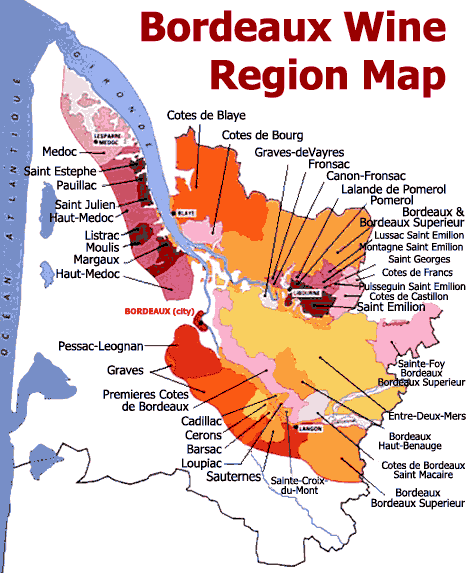
The Sauternes region is located 40 km southeast of the city of Bordeaux along the Garonne river and its tributary, the Ciron in the Graves section in Bordeaux.  Similar but less expensive and typically less-distinguished wines are produced in the neighboring regions of Monbazillac, Cérons, Loupiac and Cadillac.

Picture: Map of Bordeaux

The source of the Ciron is a spring which has cooler waters than the Garonne. In the autumn, when the climate is warm and dry, the different temperatures from the two river's meet to produce mist that descends upon the vineyards from evening to late morning. This condition promotes the development of the Botrytis cinerea fungus.

The Sauternes wine region comprises five communes— Barsac, Sauternes, Bommes, Fargues and Preignac. While all five communes are permitted to use the name Sauternes, the Barsac region is also permitted to label their wines under the Barsac AOC.

Sauternes is made from Sémillon, Sauvignon Blanc, and Muscadelle grapes.

In years when the noble rot does not develop, Sauternes producers will often make dry white wines under the generic Bordeaux AOC.

Sauternes and Barsac 1855 Classification

Along with their red counterparts of the Medoc, the sweet white wines of Sauternes and Barsac were classified in 1855. The system has just two tiers - Premiers Crus and Deuxièmes Crus - although within the higher ranking Yquem is accorded special recognition with its rating as Premier Cru Supérieur.

26 properties were (and remain) included in classification of 1855. Chateau Raymon-Lafon was not included, because it came into being in 1850 only. And so the estate went unclassified, and naturally it remains so to this day (and is not included at the annual UGC en primeur tastings).

Chateau Raymond-Lafon

Raymond Lafon, a mayor of Sauternes, was the first owner of Chateau Raymon Lafon. In 1972, after years of neglect, the Raymond-Lafon vineyard was purchased by Pierre Meslier, at that time regisseur (Technical Director) of Yquem, who began gradually restoring its brilliant reputation. Pierre Meslier retired from Yquem in 1990. Today the next generation - Marie-Françoise, Charles-Henri and Jean-Pierre - is in charge: Marie-Françoise as manager, Charles-Henri looking after production and Jean-Pierre – who I met at the French Embassy - handles sales and public relations.

Over the years the Raymond-Lafon estate has grown considerably, from a starting point of 3.5 hectares to a more significant 18 hectares today, of which 16 hectares are currently planted to vines, all sandwiched between the vineyards of Suduiraut, Lafaurie-Peyraguey and Yquem. The grape variety distribution is 80% Sémillon and 20% Sauvignon blanc of vines with an average age of 35 years.

The average annual production is 20,000 bottles.There is also a second wine named Le Cadet de Raymond-Lafon, previously named Chateau Lafon-Laroze.

Jean-Pierre Meslier

Jean-Pierre, although French by birth, has spent much of his recent life working as a wine merchant in San Francisco. "I was only fourteen when my father acquired Château Raymond-Lafon and we all were thrilled about this new challenge. I studied in a law school for a few years, then I came back to take care of the family business. I was young and I was looking for tough challenges, so I decided to open a US subsidiary and move to San Francisco, where I lived from 1990 to 2005; it was a fantastic experience and the United States became my second home! "

Pictures: Jean-Pierre Meslier, Château Raymond-Lafon with Claire Morin-Gibourg, who organized and moderated the tasting

The Wines that Jean-Pierre Poured

Château Raymond-Lafon, Sauternes 2005

Light golden in the glass, notes of jasmine, white peach and oranges on the nose, "a big vintage" Jean-Pierre said,"with a large yield", also rather "big" in terms of the style of wine, rich, lightly roasted sweetness on the palate, good acidity leading up to an intense finish.


Château Raymond-Lafon, Sauternes 1995

Amber yellow in the glass, lemony, honeyed, oaky noset, nicely aged with rich, luscious flavors on the palate, good acid core, although only very little evidence of botrytis.


Château Raymond-Lafon, Sauternes 2007

"It was hot weather in October that made the vintage", said Jean-Pierre Meslier, light golden in the glass, an exotic bouquet of tropical fruit, pineapples and mellons, rich on the palate with lush, velvety, ripe fruit flavors on the palate, good substance in the finish.

Château Raymond-Lafon, Sauternes 1997

Amber yellow in the glass, sweet and floral notes on the nose, the palate is dense with a fine bitter and pleasant character coming in at the end.


Château Raymond-Lafon, Sauternes 2009

Ligth golden in the glass, very expressive, with yellow fruits, plum and peach notes on the nose, soft and rich palate with notes of fresh honey, bright, tingling, minerally energy in the finish.

Château Raymond-Lafon, Sauternes 1999

Amber yellow in the glass, notes of mango and citrus fruit with an almond edge on the nose, lovely weight, with rich apricot-botrytis notes on the palate, lovely and appealingly bitter finish.


schiller-wine - Related Postings

Eiswein in Germany and Ice Wine in Canada

Tokaji: Depressing and Encouraging News from Hungary

German Spaetlese Wines Can Come in Different Versions. I Have Counted Five.

When Americans Drink German Wine - What They Choose

German Wine Basics: Sugar in the Grape - Alcohol and Sweetness in the Wine

JJ Pruem Goes Supermarket: Meeting Katharina Pruem and Tasting the Incredible JJ Pruem Wines at Wegmans

Normally, Wine is Dry. But there are Many Sweet Wines in the World. How is Sweet Wine Made?

Bordeaux Wines and their Classifications: The Basics

Château Brane-Cantenac, Deuxieme Grand Cru Classe en 1855, Margaux – A Profile, France

Bordeaux Trip September 2012, France

The 5 Premiers Grands Crus Chateaux en 1855 of Bordeaux, France

The Wine Empire of the von Neipperg Family in France, Bulgaria and Germany 

Monday, July 23, 2012

Normally, Wine is Dry. But there are Many Sweet Wines in the World. How is Sweet Wine Made?

Picture: Christian G.E. Schiller with Ernst Loosen, Weingut Dr. Ernst Loosen, World-renowned Producer of Low Alcohol Fruity-sweet Mosel Rieslings

See more on Ernst Loosen: The Doctor Made a House Call - A Tasting with Ernst Loosen, Weingut Dr. Loosen, at MacArthur Beverages in Washington DC, USA

On my trip last year to the Soave region in Italy, I was introduced to Reciotto di Soave. This is a sweet wine. It triggered in me the desire to do a bit of research with a view of finding out how the sugar gets into sweet wines.

Normally, Wine is Dry

Normally, wine is dry: the sugar, naturally present in grape juice, is transformed into alcohol and carbon dioxide by the action of yeasts during fermentation - the sugar content of the must declines and eventually disappears, while the alcohol content builds up. Fermentation, however, stops naturally, when the alcohol has reached a certain level – around 15%. Thus, any sugar that is still in the must at that point of fermentation remains in the finished wine and makes the wine sweet. But this happens only under very special circumstances. Even in hot climate countries, the sugar that is in the grapes at harvest disappears completely as a result of fermentation. Thus, normally, wine is dry. But …. there are many wines that are not dry. How do wine producers do this?

For more, see:  German Wine Basics: Sugar in the Grape - Alcohol and Sweetness in the Wine

Making Wine Sweet

There are a number of different approaches:

Grow grapes so sweet that they naturally have sugar to spare for both sweetness and alcohol?

This is an approach that exists as far as I know only in theory. I am not aware of any such wine. Often, the German Spaetlese and Auslese wines are mentioned in this category. But this is wrong. Germany is a cool climate country and German wine makers have always been struggling to get fully ripe grapes, although less so in recent years as a result of climate change. Of course, there are these world renowned fruity-sweet German Spaetlese and Auslese wines. But they are sweet, because of either arresting the fermentation or adding sweet reserve (see below). If you just leave it to Mother nature in the wine cellar, these wines would become bone-dry. 

Add sugar before fermentation (Chaptalization)?

Chaptalization – adding sugar to the grape juice before fermentation - is a common practice in many countries, invented in France. However, sugar is regularly added to boost the alcohol levels of flabby, unripe wines rather than for sweetness.

The EU wine law limits the amount of additional alcohol that can be achieved through this cellar technique to 3.5% by volume and 2.5% by volume, depending on the wine region.

Forced interuption of the fermentation with temperature control or similar methods

This is a very popular technique in Germany, done through a skillful manipulation of the fermentation process, such as dropping the temperature during fermentation and/or filtering out the sugar-consuming yeast. The winemaker needs to follow closely the fermentation process and must make sure that it comes to a stop at the desired level of sweetness.This is the way, the delicious low alcohol, fruity-sweet German Spaetlese and Auslese wines are produced.

Picture: Christian G.E. Schiller with Manfred Pruem, Weingut JJ Pruem - #29 on the Falstaff Top 100 Wines of the World 2012 list. I met Manfred's daughter Katharina Pruem in Washington DC recently and wrote about Weingut JJ Pruem: JJ Pruem Goes Supermarket: Meeting Katharina Pruem and Tasting the Incredible JJ Pruem Wines at Wegmans

Add sweet reserve (sterilized juice) after fermentation

This is a German technique in which sterilized grape juice is added to the wine after fermentation. In Germany, the final wine can contain no more than 15% sterilized juice by volume. This approach is less popular today than it was years ago; most German fruity-sweet wines are made by stopping the fermentation.

Often, the two approaches - arresting the fermentation and adding sweet reserve - are used in combination: You stop the fermentation at about the desired level of sweetness and then you fine-tune the level of sweetness by adding sweet reserve.

Sweet Sherry is also made by adding sweet reserve (see below).

Add alcohol before or during fermentation (fortification)

By adding alcohol, you drive up the alcohol level in the must so that the fermentation stops naturally, while not all sugar that was in the grapes is converted into alcohol. The main fortified wines are Port, Sherry, Madeira and vins doux naturels.

While Port wine is made sweet by adding alcohol to the fermenting must so the fermentation stops and the sugar of the grapes remains in the wine, Sherry, on the other hand, is made by letting the fermentation go its full way so that a dry wine emerges. Then, alcohol is added to boost the alcohol level. If the winemaker stops there, you get a dry Sherry. If he also adds sterilized juice, you get a sweet Sherry. Thus, Sherry can be sweet or dry, while Port is always sweet.

Picture: Christian G.E. Schiller with Rupert Symington from the Symington Family - One of the Oldest Families of Port Producers

See: Meeting Rupert Symington from the Symington Family - One of the Oldest Families of Port Producers

Madeira is a fortified Portuguese wine made in the Madeira Islands. Madeira is noted for its unique winemaking process which involves heating the wine up to temperatures as high as 60 °C (140 °F) for an extended period of time. Furthermore, Madeira is deliberately exposed to air, causing it to oxidize. By contrast, sweet Sherry is not fortified.

The production of vins doux naturels was perfected by Arnaud de Villeneuve at the University of Montpellier in the 13th century and they are now quite common in the Languedoc-Roussillon of southwest France (Muscat de Rivesaltes, Muscat de Frontignan, Banyuls, etc.)

Remove water - in frosty climates - by freezing out some of the water to make ice wine

Most wine laws require temperatures below at most −7 °C (19 °F) before the grapes for ice wine can be picked. At such temperatures, some of the water in the grapes freezes out, but the sugars and other solids remain dissolved in the remaining juice. If the grapes are pressed whilst frozen, a very concentrated must can result, which needs special yeast and a long time to ferment. The most famous ice wines are German Eiswein and Canadian ice wine.

Alternatively, the freezing can take place in the wine cellar (cryoextraction). This is an approach, which kind of simulates the frost in the vineyard in the wine cellar. It was developed by the French. Instead of waiting for Mother Nature to produce frosty temperatures in the vineyard, the winemaker subjects the grapes to frosty temperatures in the cellar and presses them while frozen.

For more, see: Eiswein in Germany and Ice Wine in Canada 

Remove water - in damp temperate climates - by using a fungal infection (Botrytis cinerea, noble rot)

Botrytis cinerea is the key to the success of many of the world’s most famous noble sweet wines. Also known as noble rot, Botrytis cinerea is a fungus that under the right conditions attacks already-ripe grapes, shriveling them, concentrating the sweetness and acidity. The grapes end up looking disgusting but they make profound sweet white wines.

The sugar content of the grape is exceptionally high at the time of the harvest and Mother Nature is unable to ferment all the sugar. Thus, natural sugar remains in the wine and makes the wine sweet.

Picture: Christian G.E. Schiller with Robert Weil, Weingut Wilhelm Weil, one of the World's top Producers of Noble-sweet Riesling. I visited Weingut Wilhelm Weil last year and posted about my visit: Visiting Wilhelm Weil at his Weingut Robert Weil in Kiedrich, Germany and Tasting with Wilhelm Weil the 2010 Weingut Weil Wines in Kiedrich, Germany

Noble sweet wines made on the basis of noble rot are produced in a number of countries. The most famous ones are the Sauternes in France, the Beerenauslese and Trockenbeerenauslese in Germany and in Austria, the Austria Ausbruch and the Tokaji from Hungary. No doubt, the first noble rot wines were created by accident - both the Hungarians and the Germans have similar stories of how the harvest was delayed for some reason, but the over-ripe grapes were vinified anyway and then the resulting wine found to be delicious.

For more on Hungarian noble-sweet wines, see:  Tokaji: Depressing and Encouraging News from Hungary

Remove water by air drying (in hotter climates) the grapes (raisin wine)

Northern Italy is home to a number of raisin wines, where the grapes are dried on straw, on racks, or hung from the rafters. Across the Alps, the French make straw wine (vin de paille). The Austrians also make straw wine while it is illegal in Germany.

Pictures: In the “Le Sponde” room of the Coffele Winery in Soave, where Recioto di Soave is made

For more, see: Wining and Blogging in the Soave Region, Italy


schiller-wine - Related Postings

Wining and Blogging in the Soave Region, Italy

Eiswein in Germany and Ice Wine in Canada

Tokaji: Depressing and Encouraging News from Hungary

Meeting Rupert Symington from the Symington Family - One of the Oldest Families of Port Producers

German Spaetlese Wines Can Come in Different Versions. I Have Counted Five.

1.International Riesling Symposium

Impressions from the Riesling and Co World Tour 2010 in New York

When Americans Drink German Wine - What They Choose

German Wine Basics: Sugar in the Grape - Alcohol and Sweetness in the Wine

JJ Pruem Goes Supermarket: Meeting Katharina Pruem and Tasting the Incredible JJ Pruem Wines at Wegmans

Visiting Wilhelm Weil at his Weingut Robert Weil in Kiedrich, Germany

Tasting with Wilhelm Weil the 2010 Weingut Weil Wines in Kiedrich, Germany

Thursday, April 1, 2010

Tokaji: Depressing and Encouraging News From Hungary

Picture: Budapest, Hungary

Is the Tokaji region in a crisis?

The authors of the Polish Wine Blog recently went to Hungary and came back with a depressing and at the same time encouraging report. First, the Tokaji region is in crisis; winemakers are unable to sell their noble-sweet wines. Second, the winemakers are adjusting to the difficult circumstances by moving away from the noble-sweet wines to bone-dry grand cru wines.

Noble-sweet Wines


Mother Nature, under non-special circumstances, produces dry wines in the vineyard. All the sugar in the grapes at harvest disappears during fermentation and no sweetness remains in the wine. There are, however, plenty of sweet wines made around the world. There are different techniques to make a wine sweet. One of them is to let the noble rot suck the water out of the grape, so that the degree of sugar in the grapes is extra-ordinary high.

Another technique is used in Portugal to make Port wine. Port wine is made sweet by adding alcohol to the fermenting must so the fermentation stops and the sugar of the grapes remains in the wine. What you get is a wine with lots of alcohol and remaining sweetness in the wine.

Botrytized noble-sweet wines

Botrytis cinerea is the key to the success of many of the world’s most famous noble sweet wines. Also known as noble rot, Botrytis cinerea is a fungus that under the right conditions attacks already-ripe grapes, shrivelling them, concentrating the sweetness and acidity. The grapes end up looking disgusting but they make profound sweet white wines.

Picture: 3 Noble-Sweet Wines from my Cellar

Noble sweet wines made on the basis of noble rot are produced in a number of countries. The most famous ones are the Sauternes in France, the Beerenauslese and Trockenbeerenauslese in Germany and in Austria, the Austria Ausbruch and the Tokaji from Hungary. No doubt, the first noble rot wines were created by accident - both the Hungarians and the Germans have similar stories of how the harvest was delayed for some reason, but the over-ripe grapes were vinified anyway and then the resulting wine found to be delicious.

The Tokaji

The Tokaji has been Hungary’s crowning glory for hundreds of years. Throughout the 17th and 18th centuries, Tokaji was a cherished wine enjoyed by the European Courts, including Louis XIV of France, Peter the Great, Elizabeth of Russia, and Frederick the Great; it graced the wine glasses of Beethoven, Schubert, and Hungary’s native son Franz Liszt.

The vineyards of the Tokaji region were classified long before Bordeaux, already in the 1700s, with vineyards grouped into 3 categories depending on the soil, sun exposure and potential to develop noble rot. A royal decree in 1757 established a closed production district in Tokaji and the classification system was completed in 1772.

The noble-sweet Tokaji wines nearly disappeared after World War II, as Hungary became a communist country. Family vineyards became collective farms. The Soviets forced everyone into making low-grade jug wine. Since the Berlin Wall came down and the Soviet empire desintegrated, Tokaji is starting to see a rebirth, which however is fragile.

A Tokaji is typically a blend of botrytised (aszu) and non-botrytised grapes. There are different levels of sweetness in the noble-sweet Tokaji wine. The more aszu grapes are blended into base (not- botrytised) grapes, and the sweeter the aszu grapes are, the sweeter the final wine will be.

To indicate the sweetness of the Tokaji wine on the label, the Hungarians have developed the puttonyos classification system. A puttony is a traditional wooden hottes. Generally, noble-sweet Tokaji wines range from three to six puttonyos. Since joining the EU, wine with one or two puttonyo(s) is no longer allowed to be bottled.

3 puttonyos = 60 grams of remaining sugar per liter
4 puttonyos = 90 grams of remaining sugar per liter
5 puttonyos = 120 grams of remaining sugar per liter
6 puttonyos = 150 grams of remaining sugar per liter

In addition the rare Aszú Eszencia wines contain more than 180 grams of remaining sugar per liter and the Eszencia wines more than 400 grams of remaining sugar per liter.

What is interesting is that Hungarian Tokaji wines are classified according to the level of remaining sweetness in the wine, while German and Austrian noble-sweet Beerenauslese, Trockenbeerenauslese and Eiswein are classified according to the sugar level in the grape at harvest.

Once mixed, the Tokaji must undergoes a slow and cool fermentation which can take several months or even years to complete. A practice unique to Tokaji wines is to allow a degree of oxidation to occur during fermentation. In fact, the amount of oxidation often becomes the hallmark of the producer’s unique style. When I was in Budapest last year, I was surprised by the extent of oxidation experienced in many Hungarian wines; I did not like it. In fact, when I spent a week in Budapest earlier last year, I came across several times a dry Tokaji wines, with a distinctive note of oxidation. Initially, I thought the wine was faulty. But then I learned that some wine makers in the Tokaji region still use a vinification method whereby the wine is exposed to air during fermentation , as the Sherry from Spain, and adopts a distinctive style. This style is clearly not appreciated on the international market, but I found it interesting to experience this taste in Budapest.

Depressing and Encouraging News from the Tokaji Region

The authors of the Polish Wine Blog went to Hungary recently and came back with reports that were depressing and encouraging at the same time.

Thousands of bottles of noble-sweet Tokaji wines going back as far as 1998 remain unsold. Apparently, the vineyard buying and planting over enthusiasm of the late 1990s has now become a serious hiccup. A mixture of unwise business decisions from the late 1990s and Hungary's suicidal governmental policy of the last few years has resulted in a complete standstill of noble-sweet wine sales. Large companies are reporting large losses, and many small estates are struggling to survive.

Tokaji is in crisis. Read more about the wounded heros here.

In the second posting, the authors of the Polish Wine Blog report that in response to the crisis, wine makers are moving away from noble-sweet Tokaji wine and turning to bone dry Tokaji wines. The Polish Wine Blog has tasted many of them and was impressed by the dry wines. They tasted the wines and reported about it here.

The Wine bar by Bazilika

While the Tokaji region Hungary’s is best known wine, there are a total of 14 wine regions in Hungary. A good place to get an overview of Hungarian wines in Budapest is "The Wine bar by Bazilika”. Here, they sell a wide range of Hungarian wines by the bottle to go and to consume at the premise as well as many wines by the glass. The staff speaks English and they serve cheese and charcutterie snacks. The cheese, to my disappointment, was all French cheese. See my posting here.


Schiller Wine - Related Postings

German Wine Basics: Sugar in the Grape - Alcohol and Sweetness in the Wine

German Wine Basics: How does a Sweet German Riesling Become Sweet?

Wine Bar: The Wine Bar by Bazilika, Budapest, Hungary

Eiswein in Germany and Icewine in Canada

Wednesday, January 27, 2010

German Wine Basics: Sugar in the Grape - Alcohol and Sweetness in the Wine

Picture: Christian G.E. Schiller and Betram Verch in the Red Slope in Nierstein, Germany

The sugar content of the fruit at the point of harvest is at the heart of the German wine classification system. The higher the sugar content in the grapes at the point of harvest, the higher the classification of the wine.

There are different approaches for measuring the sugar content, like Celsius and Fahrenheit for the temperature - America uses Fahrenheit, Europe uses Celsius. For the sugar content in the grapes, Americans use the Brix scale, Germans use the Oechsle scale.

Based on the Oechsle scale, German wine is classified into nine quality groups, ranging from Tafelwein with the minimum Oechsle degree of 44 to Trockenebeerenauslese with a minimum Oechsle degree of 150. The minimum Oechsle degrees differ somewhat between Germany’s wine regions and between red and white wine. The numbers indicated below are those for the white wines from the Mosel valley.

Tafelwein (Table wine) - the lowest German quality class; has to have at least 44 degrees of Oechsle in the vineyard.

Landwein (Country wine) - 47 degrees of Oechsle at the minimum.

Qualitaetswein bestimmter Anbaugebiete (QbA wine) means a quality wine from one of the thirteen specified German wine regions; close to half of German wine is QbA wine - 50 degrees Ochsle.

Kabinett - 67 degrees Oechsle.

Spaetlese means late harvest but this are simple wines made from grapes with a higher level of Oechsle - 76 degrees, not necessarily wine made with grapes harvested late in the season.

Auslese - 83 degrees of Oechsle.

Beerenauslese - 110 degrees of Oechsle.

Eiswein - icewine, the same minimu level of 110 degrees of Oechsle.

Trockenbeerenauslese - 150 degrees of Oechsle.

To be clear: the Oechsle degrees measure the sweetness of the grapes at the point of harvest. But this has nothing to do with the sweetness of the finished wine. Same basics, which are often not well understood, but which are fundamental to the issue: The fermentation of grape must is a complex process in which sugars, naturally present in grape juice, are transformed into alcohol and carbon dioxide by the action of yeasts. During fermentation, the sugar content of the must declines, while the alcohol content increases and the CO2 disappears. Another by-product is heat. This process stops automatically when the alcohol level in the wine has reached around 13 to 15 percent of the volume. If just left to mother nature, such a wine would have a normal alcohol content and would be a dry, like most of the wines in the world.

More specifically, during the process of fermentation, enzymes break down the sucrose molecules into glucose and fructose, which can then be fermented by the yeast and converted into alcohol and carbon dioxide. In addition to contributing to the body of the wine, higher alcohol levels also bring out the intensity of the fruit.

Picture: Old Cask Cellar C. von Schubert, Mosel

There is a straightforward link between the sugar content in the fruit and the resulting alcohol level in the wine. Look at the table below. For a wine with 13.0 percent alcohol, for example, one needs grapes at the 90 degrees Oechsle level. This would be a bone dry wine. 90 degrees Oechsle is well beyond the Spaetlese category and high up in the Auslese category. Thus, all of Germany’s Spaetlese wines and most Auslese wines, if left to mother nature only, should be dry. You have to go beyond that - say 110 degrees Oechsle - for the fermentation to stop naturally and sugar to remain in the wine.

40 Oechsle ===> 5.3% Alcohol
44 Oechsle = Minimum Tafelwein
47 Oechsle = Minimum Landwein
50 Oechsle = Minimum QbA ===> 6.9% Alcohol
60 Oechsle = 14.7 Brix ===> 8.4% Alcohol
67 Oechsle = Minimum Kabinett
70 Oechsle = 17.0 Brix ===> 9.9% Alcohol
76 Oechsle = Minimum Spaetlese
80 Oechsle = 18.1 Brix ===> 11.4% Alcohol
83 Oechsle = Minimum Auslese
90 Oechsle = 21.5 Brix ===> 13.0% Alcohol
100 Oechsle = 23.7 Brix ===> 14.5% Alcohol
110 Oechsle = Minimum Beerenauslese ===> 15.9% Alcohol
110 Oechsle = Minimum Eiswein ===> 15.9% Alcohol
120 Oechsle ===> 17.4% Alcohol
150 Oechsle = Minimum Trockenbeerenauslese

More general, all German wines up to the Auslese category are potentially bone-dry. Once we move above to the Auslese to Beerenauslese, Trockenbeerenauslese and Eiswein, the fermentation stops naturally and sugar remains in the wine. This are Germany’s flagship noble-sweet wines.

Three issues arise.

First, in reality you have sweet German wines that are below Auslese level.

In fact there is plenty of such wines. How do winemakers do this? There are two methods used by German winemakers to generate residual sugar in such wine:

First, stopping the fermentation; this is typically done through a skillful manipulation of the fermentation process with sulfur and temperature control. The winemaker needs to follow closely the fermentation process and must make sure that it comes to a stop at the desired level of sweetness.

Second, the other technique is to let the wine first fully ferment and then add to the dry and fully fermented wine sterilized grape juice (called in German "Suessreserve"). Here the winemakers lets the wine fully ferment to produce a dry wine and then experiments with different amounts of Suessreserve to achieve the desired level of sweetness in the final product. Ideally, the Suessreserve comes from the same wine. It needs to be sterilized so it does not begin to ferment after it is added to the wine.

Picture: Hochheim/Rheingau

Thus, any German wine ranging from Tafelwein to Spaetlese/Auslese is dry, unless the winemaker decides otherwise. If he or she does so, he or she can either arrest the fermentation or add Suessreserve. A good indication if a sweet Spaetlese was stopped or not is the level of alcohol. If it is low, the likelihood is large that the wine was made sweet by arresting the fermentation. In recent years, adding Suessreserve has become the preferred method.

Second, the noble sweet wines.

Noble sweet wines, however, is a different story. The fruit has such a high sugar level at harvest that there is nothing you can do preventing the wine to remain sweet. These noble-sweet wines are produced either from botrytised grapes or grapes that were harvested during frost, more specifically,

First, the fog in the autumn mornings at German river banks produces a fungal infection, botrytis cineria (noble rot), which removes the water in the grapes and adds a unique flavor to the grape; and

Second, the frost late in the year, which also removes the water in the grapes when the temperatures fall (but does not produce the botrytis taste).

In both cases, the sugar content of the grape is exceptionally high at the time of the harvest and mother nature is unable to ferment all the sugar. Thus, natural sugar remains in the wine and makes the wine sweet. These are the famous sweet dessert wines in Germany: Beerenauslese, Trockenbeerenauslese, Eiswein.

Third, chaptalization is legal and normal.

Chaptalization is legal and normal, but only for wines in the Tafelwein, Landwein and QbA categories, which accounts for about 60% of German wine. From Kabinett wines upwards, chaptalization is not allowed. It is obvious that chaptalization is not a means of increasing the sweetness of the wine but of the alcohol content, as in neighboring France.

For Deutscher Landwein, for example, the fruit must have at least 47 degrees of Oechle in the Mosel valley. To reach a sufficient alcohol content, the must needs to be chaptalized. Its sole purpose is to increase the final alcoholic strength of a wine - the added sugar (along with the grapes' natural sugar) is converted during fermentation. The EU wine law limits the amount of additional alcohol that can be achieved through this cellar technique to 3.5% by volume and 2.5% by volume, depending on the wine region.

The basic rule is that 100 grams of sugar per liter increases the alcohol content of a liter by 0.66 percentage points.


Schiller Wine - Related Postings

German Wine Basics: How does a Sweet German Riesling Become Sweet?

Wine Ratings: Riesling Cup 2009 - Germany's Top Dry Rieslings

German Wine Basics: Erstes Gewaechs, Grosses Gewaechs, Erste Lage