Showing posts with label Chardonnay. Show all posts

Friday, April 24, 2026

Invitation: "Comparative Pinot Noirs and Chardonnays Tasting: Germany and Burgundy" at the Washington DC Chapter of the German Wine Society on May 2, 2026, led by Annette Schiller, ombiasy WineTours


Comparative Pinot Noirs and Chardonnays Tasting: Germany and Burgundy 

Please plan to join the German Wine Society on Saturday, May 2, 2026 at 7:00 pm for a comparative presentation on Pinot Noirs and Chardonnays in Germany and the Burgundy region of France, and tasting of twelve wines to illustrate the varieties of wine made from these grapes in these countries, by our own Annette Schiller. 

Registrations for this event are due by Tuesday, April 28, 2026, and the price is $55 for GWS members, $62 for non-members. 

Please be aware that, due to limited supply of the wines and size of the venue, we have a maximum cap of 40 for attendance at this event. Reserve early to avoid disappointment! 

What comes to your mind when you hear: “Chardonnay” or “Pinot Noir”? Burgundy, of course! That is rightly so. Burgundy is one of the world’s most revered wine regions and unique in focusing on two grape varieties: Chardonnay and Pinot Noir. For more than 1000 years Burgundy vintners have understood that different soils and climates give different wines. They have honed their skills to produce wines from Chardonnay and Pinot Noir that reflect the place they are coming from. 

When you hear: “Germany” – you think Riesling. Riesling also is a terroir expressive grape variety and the Germans know about producing a wine that reflects its place. But Germany is not a mono-varietal wine region like Burgundy. There are many more grape varieties growing successfully here. For more than 1000 years Pinot Noir has been grown in Germany, where it is called “Spätburgunder,” directly translating as “late Burgundy.” Pinot Noir is now the most widely planted red grape in Germany, accounting for 11.8% of all plantings. Chardonnay, in contrast, has only officially been allowed since 1991, though there were earlier trial plantings, and is still only about 2.2% of total cultivation, while Riesling has remained the flagship grape. Climate change presents new opportunities for German vintners. There is an evolution beyond traditional wine styles and grape varieties. At the same time, Burgundy’s prices have soared and wine lovers often get priced out of their favorite wine. Germany offers a genuine alternative. 

At this tasting we will show you Chardonnay and Pinot Noir from both wine regions side by side. We start with a comparison of Chardonnay and Pinot Noir from Germany and Burgundy on the regional level. 

The next flight will be a step-up quality-wise: a comparison on the village level. As a highlight we have a comparison of 1er Cru Chardonnay and Pinot Noir from Burgundy and Erste Lage (Germany’s designation of 1er Cru) Chardonnay and Pinot Noir from Germany. 

We will taste 12 wines with many in the upper price bracket. Join us for this one-of-a-kind opportunity to have wines from top Pinot Noir and Chardonnay producers from two different but also in some aspects similar regions. It will be fun to discuss the wines during the tasting and it will be very interesting to hear the verdict of the audience on the favorites. 

The planned wine list is depicted below: 

Part 1: PINOT NOIR / SPÄTBURGUNDER Germany Burgundy 

FLIGHT A: 

REGIONAL LEVEL 2023 Weingut von Winning, Pinot Noir Royal, 2022 Albert Bichot, Bourgogne Pfalz 

FLIGHT B: 

VILLAGE LEVEL 2018 Weingut Bercher, Burkheimer, Baden 2022 Domaine Raquillet, Mercurey 

FLIGHT C: 1er CRU / ERSTE LAGE LEVEL 2022 Kallstädter Steinacker, 2022 Volnay Santenots, Weingut Rings, Pfalz Domaine Thierry Matrot 

Part 2: CHARDONNAY Germany Burgundy 

FLIGHT A: 

REGIONAL LEVEL 2021 Weingut Kühling-Gillot, Réserve, 2022 Maison Vincent Girardin, Rheinhessen Cuvée St.-Vincent, Bourgogne 

FLIGHT B: VILLAGE LEVEL 2024 Weingut Jülg, Schweigen, Pfalz 2023 Domaine Ferret, Pouilly-Fuissé 

FLIGHT C: 1er CRU / ERSTE LAGE LEVEL 2023 Bönningheimer Sonnenberg, 2023 Beaune – Grèves, Le Clos Blanc Weingut Dautel, Württemberg Louis Jadot 

A tasty buffet of cheeses, bread, crackers, charcuterie, grapes and veggies will be provided to accompany the wines. Our tasting will begin at 7 p.m on Saturday, May 2, 2026, with the doors opening at 6:30 p.m. to admit guests. 

The location is the Van Ness Room that we have often used before for membership meetings and other events, including many of Annette’s presentations to the GWS, at 3001 Veazey Terrace NW, Washington, DC 20008. Enter through the main lobby of the apartment building on the 5th floor, and then go down to the 2nd floor by elevator and proceed down the hall to the clubroom. While there is not off-street parking at this location, on-street parking is available (bear in mind DC parking restrictions and meters), and there is easy access to Metro, at the Van Ness Red Line station. 

You can register and pay for this event in either of two ways. 

First, you can register on our chapter website, https://germanwinesocietydc.org , and make payment by PayPal. You will need to create a GWS account for the website if you do not already have one, and you will also need to have a PayPal account, as we cannot accept payment by other forms of credit or online transfer. If you are coming as a couple or other group, you can either register and pay for each individual separately, or do it as part of a single transaction and complete the payment on PayPal together. If you do a single transaction, please also email the Secretary of the GWS Capital Chapter at the address below to provide the names of each individual coming, as the individual names will not all appear on the website form for multiple persons registering together. 

Second, if you prefer to register by mail and pay by check for the event, please clip off the registration form attached to this notice, indicate the names of all who will be attending, and mail a check made out to the German Wine Society in the proper amount along with the form to: Carl Willner President and Secretary, GWS Capital Chapter 1014 Reserve Champion Drive Rockville, MD 20850 You can also reach the Secretary by e-mail at carl.willner1@verizon.net . 

Whether you are registering by mail or online, please be sure to provide the names of all persons for whom you are registering, and pay the appropriate price depending on whether each person is a GWS member (with annual dues paid), or a non-member. You can also become a member or renew, if your membership is not current, together with your registration for this event by including an annual $35 dues payment (for an individual or a couple), through PayPal, or by mail using a check, in the same manner as registering for the event. If you have been a member of the GWS Capital Chapter in the past but are not sure of your current membership status, please email the Secretary at the above e-mail to confirm your status. 

We do request that if you are experiencing symptoms of covid-19, flu or other contagious illness, or have tested positive for such an illness, you stay home and recover, and avoid putting other guests at risk. Refunds can be provided in these circumstances if you notify us before the day of the event, to allow us time to find another guest to take your place. Otherwise, refunds can only be made if you notify us before the deadline for registration. All GWS members and guests are reminded that alcohol consumption can lead to intoxication. Members and guests should use public transportation to events, rely on a designated driver, or taste the wines rather than finish them. 

If you have questions about this event, you may contact the event organizer and presenter, Annette Schiller, at aschiller@ombiasypr.com , or by phone at 703-459-7513. Annette’s website is www.ombiasypr.com . 

For questions about registration and membership, please contact Carl Willner, Capital Chapter President and Secretary, at carl.willner1@verizon.net . If you no longer wish to receive our announcements, please reply to this email to the sender. To register by mail, please fill out and cut the reservation form below with your check – do not mail the entire notice. _______________________________________________________________________ REGISTRATION FORM FOR GERMAN WINE SOCIETY COMPARATIVE PINOT NOIRS AND CHARDONNAYS TASTING, MAY 2, 2026 $55.00 Members / $62.00 Non-Member Guests Member(s) Names: _____________________________________________

Guest(s) Names: ______________________________________

Total Enclosed: _______________________________________

Daytime Phone Number: ________________________________ 

 E-Mail: _____________________________________________

Overview: Germany Rhein-Mosel-Nahe 2024 by Ombiasy Public Relations and Wine Tours led by Annette Schiller - Facebook Day-by-day Postings 


Pictures: Overview: Germany Rhein-Mosel-Nahe 2024 by Ombiasy Public Relations and Wine Tours led by Annette Schiller - Facebook Day-by-day Postings 
Germany Rhein-Mosel-Nahe 2024 by ombiasy WineTours took place from August 28 – Friday, September 06, 2024. We spent 10 days visiting top wine estates in five wine regions, tasting fabulous Rieslings and Pinot Noir (aka Spätburgunder), meeting world-renowned wine makers, travelling through the world’smost beautiful wine regions, cruising on the romantic Rhein river, looking at dizzying steep vineyards along the Rhein and Mosel rivers, and delving deep into German history and culture: Rheinhessen • Rheingau • Mittelrhein • Mosel • Nahe
schiller-wine: Related Postings 
Announcement: Small Group (12 people) Wine Tours to Europe (Italy and Germany) this Year (2026) by ombiasy WineTours with Annette Schiller  
 
Overview: Rhône Valley 2024 by ombiasy WineTours led by Annette Schiller - Facebook Day-by-day Postings 

Summary of Loire Valley 2025 by ombiasy WineTours, led by Annette Schiller: Wine, Food, History, Culture 

Summary: Germany "From Berlin to Frankfurt" 2023 (Saale Unstrut, Sachsen, Franken, Württemberg) by ombiasy WineTours

Summary: From Lyon to Paris - Total Immersion in Burgundy and Champagne 2023 by ombiasy WineTours (July 02 - 13, 2023)

Summary: Austria 2023 by ombiasy WineTours - 12 Days: May 28 - June 08, 2023 

Christian Schiller`s SCHILLER-WINE Blog on Corking Wines` Top 101 Wine Writers of 2020 List

The 2025 American Wine Society National Conference in Chantilly/ Virginia/ USA, with Annette and Christian Schiller: Seen Through Christian Schiller's Camera Lens

2022 Annual Riesling Party at the Schiller Residence in McLean, Virginia, USA 

Massive Tasting of Bordeaux 1982 - the Vintage that made Robert Parker a Star, USA/ France

Kékfrankos - Blaufränkisch - Lemberger: A Grape’s Immigration Story From Central Europe To The US West Coast - Seminar at the 2023 American Wine Society National Conference in St. Louis/ Missouri/ USA led by Annette Schiller

The New German Wine Law of 2021 - Tasting at the German Wine Society (Washington DC Chapter), presented by Annette Schiller

schiller-wine Blog of Christian Schiller Top Washington DC Alcohol Blog (December, 2024)

2024 Annual Meeting of the Weinfreundeskreis Hochheim, a 45 Years Old Wine Brotherhood in the Famous Wine Village Hochheim, Rheingau, Germany, with Annette Schiller, Founding Member, and Christian Schiller

Masterclass - The Wines of Germany: Presentation by Annette Schiller at the German Embassy in Washington DC/ Consular Conference March 2024 

Dinner at JAN in Munich, Germany, with Jan Hartwig, one of the ten German 3-star Michelin Chefs (September 2024) 


2025 Rieslingfeier Gala Dinner in New York City, Sky Loft, 32nd Floor of 50 Hudson Yard, with 15 #worldclass Winemakers from Germany + Austria and Estimated 300 Wines, many 20, 30, 40 Years old, many Larger Format and almost all Ultra-premium 


Tuesday, August 29, 2017

Chardonnay: Germany versus Chablis - Salon Tasting at Schiller's Home, USA

Picture: Chardonnay: Germany versus Chablis - Salon Tasting at Schiller's Home in McLean, Virginia

The German Wine Society (Washington DC Chapter) organized a Chardonnay tasting with wines from Chablis and Germany. It took place at our home and was limited to 18 people in order to fit around our large round table. GWS Secretary Joseph Aguiar was the event coordinator. Annette Schiller and Joseph Aguiar led through the evening.

Invitation

Yes, that’s right, German Chardonnay! We are excited to present another small group tasting at the home of Christian and Annette Schiller in McLean, Virginia, this time for a comparison of the classic French Chardonnays of Chablis and the up-and-coming Chardonnays of Germany.

Not much Chardonnay from Germany makes it to the United States, but Christian and Annette Schiller have brought some back with them from their recent trip to Germany. We will begin tasting at 7:00pm, Saturday 12 August 2017 and attendance will be limited to 16 people…so sign up quickly!

German Wine Society Capital Chapter Vice President, Christian Schiller, and GWS member Annette Schiller will present on the different German Chardonnays. Germany’s cool climate is well-suited to Chardonnay production, and we will have quite a few demonstrations of just how good German Chardonnay can be. We will taste through the hierarchy of Chablis (Chablis Village, Premier Cru, and Grand Cru, plus their equivalents in Germany) alongside Germany Chardonnays from familiar places: Pfalz, Baden, Rheinhessen, and Württemberg.

You are invited to stay after the tasting for socializing and are encouraged to bring an extra bottle of wine if you would like to stay.

Light refreshments of cheese and baguette will be served with the wines and we will serve an additional sparkling wine during the beginning of the tasting while attendees are arriving.

Event cost is $35 for members and non-members alike. All payment must be received by Monday 7 August.

Picture: Reception

Chardonnays around the World

The best Chardonnays in the world come from the Bourgogne in France, but Chardonnay is grown wherever wine is made, from England to New Zealand. It is one of the most widely-planted grape varieties, with over 400,000 acres (175,000 hectares) worldwide, planted in more wine regions than any other grape.

In its homeland, France, Chardonnay is the second most widely planted white grape variety just behind Ugni Blanc, which is used mainly for the production of Cognac and Armagnac. The grape first rose to prominence in the Chablis and Bourgogne regions. In Champagne, it is most often blended with Pinot Noir and Pinot Meunier. Champagne, Chablis and Burgundy account for more than three-fifths of all Chardonnay plantings in France.

The Bourgogne Chardonnays are considered the benchmark standard of expressing terroir through Chardonnay. In Chablis, Chardonnay is the only permitted AOC grape variety. Chablis winemakers want to emphasis the terroir of the calcareous soil and cooler climate that help maintain high acidity. The wines rarely will go through malolactic fermentation or be exposed to oak. The biting, green apple-like acidity is a trademark of Chablis.

In North America, Chardonnay found another region where it could thrive. Following Chateau Montelena's victory over Burgundy Chardonnay in the famous 1976 Paris blind tasting, Californian winemakers rushed to increase plantings of Chardonnay. In the 1980s, the popularity of Californian Chardonnay would explode so much that the number of vines planted in the State eclipsed that of France. The early trend to imitate the Bourgogne wines soon gave way to more rich buttery and oaked styles. New oak barrels were used to produce wines that were big in body and mouthfeel, and high in alcohol. In recent years, Californian winemakers have been trying to make leaner Chardonnay, using less oak and processes such as reverse osmosis and spinning cones, to bring the alcohol levels down.

In Australia, one of the first successful Chardonnays was produced by Murray Tyrrell in the Hunter Valley in 1971. The export driven Australian wine industry was well situated for the Chardonnay boom of the 1980s and 1990s. In recent years, there has been a shift in style from deep golden, oily wines to lighter, paler Chardonnays with more structure. Now being more famous for its Sauvignon Blanc production, Chardonnay was New Zealand's most widely planted grape variety until only a few years ago.

In Europe, Chardonnay has a long history in Italy; but for a large part of it, the grape was commonly confused with Pinot Blanc. It is now planted a lot in the north of Italy. In Austria, the grape varieties known as Feinburgunder in Burgenland and Vienna and Morillon in Styria were not identified as Chardonnay until the 1980s. In Germany, Chardonnay was slow to gain a footing being only officially sanctioned since 1991. In Spain, Chardonnay has been increasingly used in the sparkling wine Cava.

In Latin America, in the cool-climate wine regions of Argentina's Uco Valley and Chile's Casablanca, Chardonnay has started to develop a presence. In the 1990s, Chardonnay became the second most widely planted white grape variety in Argentina. In Chile, it has surpassed Sauvignon Blanc to be the most widely planted white wine grape.

In conclusion, the area planted with Chardonnay throughout the world is estimates at around 160,000 hectares, with the US and France accounting for about half of it, and Australia, Italy and Modavia for another quarter.

Styles of Chardonnay Wines

Chardonnay lends itself to almost any style of wine making from dry still wines, to sparkling wines, to sweet late harvest and even botrytized wines. The two winemaking decisions that most widely affect the end result of a Chardonnay wine is whether or not to use malolactic fermentation and the degree of oak influence used for the wine.

First, with malolactic fermentation, the harder malic acid gets converted into the softer lactic acid, which creates the "buttery-ness" that is associated with some styles of Chardonnay. The wines that do not go though malolactic fermentation will have more green apple like flavors. Second, oak can be introduced during fermentation or after in the form of the barrel aging. Depending on the amount of charring that the oak was treated with, this can introduce a "toastiness" and flavors that many wine drinkers mistake as a characteristic of the grape itself. These flavors can include caramel, cream, smoke, spice, coconut, cinnamon, cloves and vanilla.

Other important winemaking decisions include the temperature of fermentation and what time, if any, that the wine is allowed to spend aging on the lees. Burgundian winemaking tends to favor extended contact on the lees and even "stirring up" the lees within the wine while it is aging in the barrel. Colder fermentation temperatures produce more "tropical" fruit flavors.

The time of harvesting is a crucial decision because the grape quickly begins to lose acidity as it ripens. For sparkling wine production, the grapes are harvested early and slightly unripe to maintain the acid levels.

Salon Tasting at Schiller's Home

We were 18 around our dining room table. We had 6 Germany versus Chablis fligths, followed by an aged Chablis flight and 3 other Chardonnays that guests provided. In total, including the reception, we opened 19 bottles.

Pictures: Chardonnay: Germany versus Chablis - Salon Tasting at Schiller's Home

Tasting List

Picture: Chardonnay: Germany versus Chablis - Salon Tasting at Schiller's Home

Chardonnay: Chablis versus Germany

NV Val de Mer Brut Non Dosé (Methode Champenoise) (aka “sparkling Chablis”)
2012 Weingut Jülg Chardonnay brut (Methode Champenoise) - Pfalz


2014 Domaine Seguinot-Bordet Chablis AOC
2015 Weingut Kruger Rumpf Chardonnay trocken - Nahe


2013 Domaine Jean Marc Brocard Chablis AOC 1er Cru Montmains
2015 Weingut Franz Keller Chardonnay Oberbergener Bassgeige VDP:Erste Lage - Baden


2012 Domaine Philippe Charlopin Chablis AOC “Vieilles Vignes”
2015 Weingut Martin Schwarz Chardonnay - Sachsen


2014 Domaine Servin Chablis AOC 1er Cru Montee De Tonnerre
2015 Weingut Fürst Hohenlohe Oehringen Chardonnay HADES - Württemberg


2012 Domaine Servin Chablis AOC Grand Cru Les Clos
2014 Weingut Bernhard Huber Bienenberg Chardonnay GG - Baden


Aged Chablis

2006 Domaine Louis Michel &Fils Chablis AOC Grand Cru Vaudesir
2010 Domaine Pinson Chablis AOC Grand Cru Les Clos


Chardonnays from Italy, Kazakhstan and California

2014 Assa Valley Almaty Chardonnay Kazakhstan
2016 Di Lenardo Chardonnay IGT Italy
2014 Grgich Hills Estate Carneros Chardonnay Napa Valley


The German Chardonnays

None of the 6 German Chardonnays included in the tasting is available in the USA. I bought all of them in Germany and checked them with my luggage.

Picture: The 6 German Chardonnays

2012 Weingut Jülg Chardonnay brut Sekt Methode Champenoise - Pfalz

Weingut Jülg is in Schweigen, the southernmost village in the Pfalz region, right at the border to France. The winery was founded in 1961. Today, Werner Jülg is in charge of the overall management of the winery. Since 2010, his oldest son Johannes has been responsible for the winemaking.

The vineyard area totals 18 hectares in the Einzellage (single vineyard) Sonnenberg (of which 40% is in France) and the Gewanne (lieu-dit) Springberg, Pfarrwingert, St. Paul und Wormberg.

White grape varieties account for 70% of the production, with Riesling, Weißburgunder and Grauburgunder dominating. Red grape varities account for 30% of the production, with Pinot Noir and St. Laurent in the lead.

Total production is 9.000 cases. Most of the wine is sold at the estate – in the wine tavern, the garden restaurant and directly to consumers. 20% of the wine is exported, including to the USA (5%).

Leberknödel, Saumagen, Wurst, Schnitzel and Rippchen are all home-made as is the cheese.

See also: Wine Lunch at Weingut Jülg with Johannes Jülg – Germany-South Tour by ombiasy WineTours (2015)

Pictures: At Weingut Jülg

2015 Weingut Kruger Rumpf Chardonnay trocken - Nahe

“In our family, viniculture has been tradition since 1708 - a tradition that we have been cultivating in our vineyards as well as in our manor house which was built back in 1830” said Georg Rumpf. Stefan Rumpf, Georg’s father, brought Weingut Kruger-Rumpf up to where it is today: After completing his studies in agricultural sciences, including stints in Californian wineries, and conducting research at the Geisenheim research institute, Stefan Rumpf took over the estate from his parents in 1984. Up until then, the wines were sold almost entirely in bulk. Stefan Rumpf changed this and started to bottle his wines and to market the bottles himself. Less than 10 years later, in 1992, Weingut Kruger-Rumpf was invited to join the VDP, the about 200 German elite winemakers, a clear sign of what Stefan Rumpf had achieved over the course of just 8 years.

Today, Weingut Kruger-Rumpf has 3 (of 5) grapes in the Gault Millau WeinGuide Deutschland. The vineyard area totals 22 hectares and the annual production is 14.000 cases. The top sites are: Münsterer Dautenpflänzer (slate with sandy loam); Münsterer Pittersberg (slate); Münsterer Rheinberg (weathered quartzite and sandy loam); Binger Scharlachberg Rheinhessen (Rotliegend and porphyry).

Grape varieties: 65% Riesling, 10% each of Silvaner and Weissburgunder, 5% each of Chardonnay, Grauburgunder and Spätburgunder. In fact, Kruger-Rumpf was the first estate in the Nahe region to plant Chardonnay.

Georg Rumpf has taken over the winemaking aspect of Weingut Kruger-Rumpf, while his father is now more focusing on sales and general management.

See also: Wine Dinner with Tour at Weingut Kruger-Rumpf in Münster-Sarmsheim, Nahe, with Georg Rumpf – Germany-North Tour by ombiasy WineTours (2015), Germany

Pictures: Stefan Rumpf Pouring the  2015 Weingut Kruger Rumpf Chardonnay trocken at the Wine Tavern of Weingut Kruger-Rumpf

Picture: In the Vineyard with Georg Rumpf

Pictures: Wine Dinner with Georg Rumpf at Weingut Kruger-Rumpf

2015 Weingut Franz Keller Chardonnay Oberbergener Bassgeige VDP.Erste Lage - Baden

The founder of the Keller Empire is the late Franz Keller. Franz Keller (1927 – 2007) probably was Germany’s most important early proponent of fully-fermented, dry wines and the use of barriques. He had 2 sons. One of them – Franz Keller - was initially the Chef of Restaurant Schwarzer Adler, but eventually moved to Hattenheim in the Rheingau, where he is the owner and chef at the Adlerwirtschaft. The other one – Fritz Keller – took over from his father in the 1980s and expanded the empire further.

Today, the Keller empire comprises a luxury hotel (Hotel Schwarzer Adler in Oberbergen), 3 restaurants (the Michelin starred Schwarzer Adler, the more basic Rebstock, just across the street, and the KellerWirtschaft, which is part of the new winery), a fine wine trading company, focusing on Bordeaux and Bourgogne, Weingut Franz Keller (recently joined the VDP, the association of about 200 elite winemakers in Germany) and the Edition Fritz Keller project, a very successful trademark wine project with the discount chain Aldi.

Fritz Keller, in addition to his activity as winemaker, wine trader and restaurateur, is also president of the German football club SC Freiburg.

See also: Weingut Franz Keller in Oberbergen, Kaiserstuhl, Baden: Cellar Tour and Tasting with Fritz Keller – Germany-South Wine Tour by ombiasy (2014)

Pictures: In the Cellar with Fritz Keller, Weingut Franz Keller

2015 Weingut Martin Schwarz Chardonnay - Sachsen

Martin Schwarz belongs to the group of young, ambitious, up-and coming winemakers in Sachsen. Back in the days when sipping a 1975 Château Margaux on a park bench while skipping Latin classes at school he got hooked to the world of wine, and decided to make wine his profession. He interned at the VDP winery Dr. Heger in Baden to get some practical experiences under his belt. In 1996 he graduated from the famous Geisenheim Oenological University in the Rheingau. A prominent winery in Sachsen was looking for a cellar master and Martin took on that challenge. For 16 years he worked as winemaker at the VDP winery Schloss Proschwitz before he started out on his own in 2013. Today he owns 5 acres in one the best vineyards sites on the steep slopes of the Elbe river. His wines show a very individual character and convince with their complexity and finesse.

See also: Germany-East Tour 2017 by ombiasy WineTours: Wine, Art, Culture and History

Pictures: At Weingut Martin Schwartz in Meissen wih Martin Schwartz and his Chardonnay

Pictures: In Meissen and Dreden - Germany-East Tour 2017 by ombiasy WineTours: Wine, Art, Culture and History

2015 Weingut Fürst Hohenlohe Oehringen Chardonnay HADES - Württemberg

As one of Germany’s oldest family owned businesses the Hohenlohe-Öhringen family can look back to the year 1253 as the founding year of their viticulture history. The 27th generation is now at the helm and today they manage 42 acres of the solely owned site Verrenberger Verrenberg. The vineyard is panted with the traditional Württemberg varietals Lemberger, and Riesling, and also with Spätburgunder, some Weissburgunder and Sauvignon Blanc and Cabernet Franc. Since 2008 the vineyards have been cultivated according to organic guidelines. The goal is to produce distinctive wines that not only expresses varietal character, but also that of their origin. Their 2013 Riesling Trockenbeerenauslese was awarded the Gold Medal at the 2015 Decanter World Wine Awards.

This estate was the pioneer in creating cuvées in Württemberg. More than 20 years ago Siegfried Röll, their winemaker in those days, toured Bordeaux and on the long drive back home he began wondering why they did not produce a Bordeaux type blend at home. He blended the local variety Lemberger with traditional Bordeaux grapes Cabernet Sauvignon and Merlot and voilà this cuvée came out beautifully. This was in 1986. They named the cuvée "Ex Flammis Orior" after the inscription on the family coat of arms.

See also: Germany-East Tour 2017 by ombiasy WineTours: Wine, Art, Culture and History

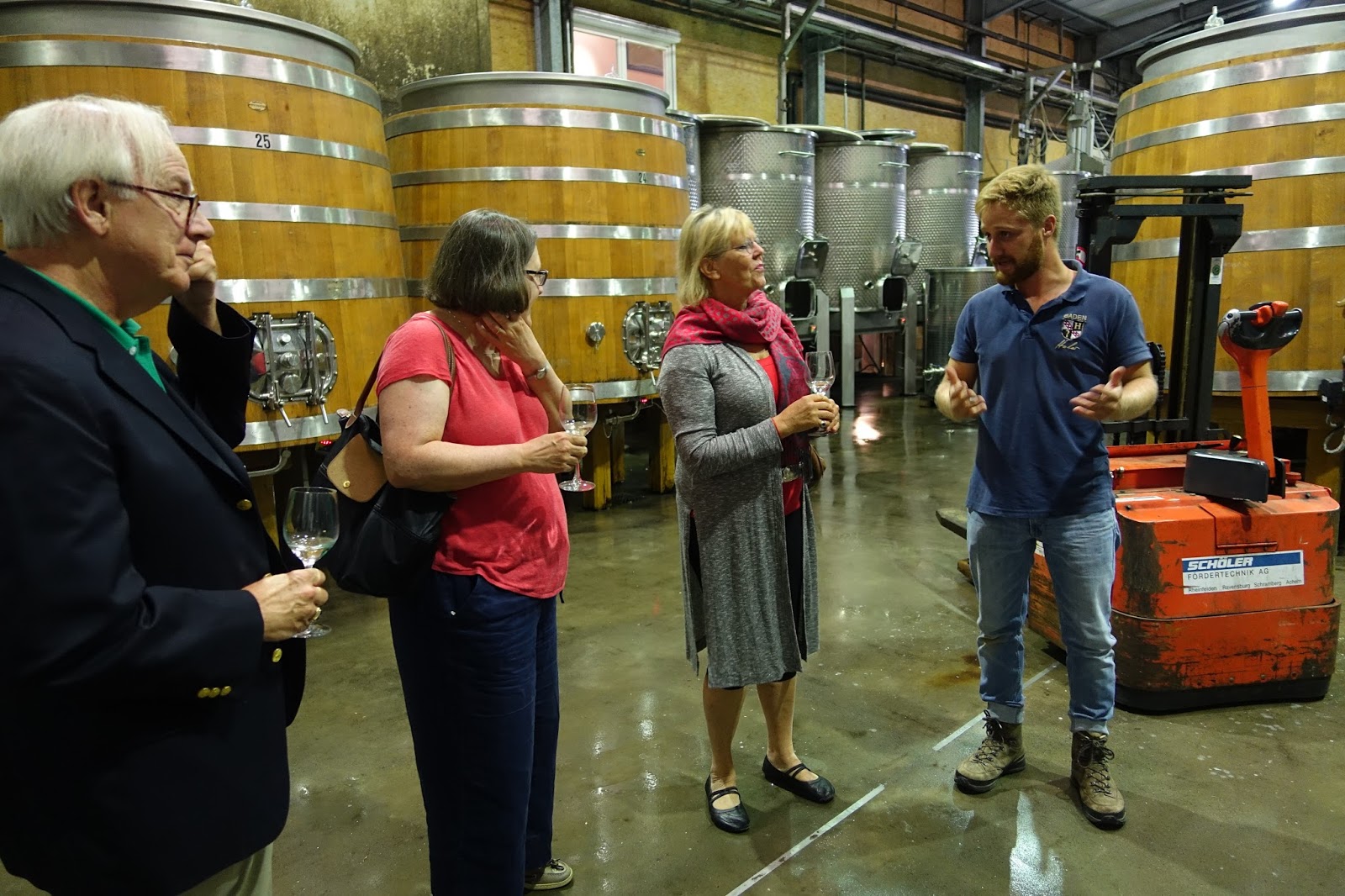
Pictures: At Weingut Fürst Hohenlohe Oehringen with General Manager/ Winemaker Jochen Brandt

2014 Weingut Bernhard Huber Bienenberg Chardonnay GG - Baden

The Huber Estate is located in Malterdingen in the Breisgau area. More than 700 years ago, Cistercian monks came to Malterdingen, and found the same terroir as in Burgundy and thus started to plant Pinot Noir grapes. Still today, in many reference books on grape varieties, “Malterdinger” is used as a synonym for Pinot Noir. In 1987 Bernhard Huber and his wife Barbara started their own estate, leaving the co-operative where they produced wine before. They now own 65 acres of vineyards of which 70% is planted with Pinot Noir and the rest with Chardonnay, Pinot Blanc, Pinot Gris, a little bit of Muskateller, Riesling, and Müller-Thurgau. All Huber wines are dry. Bernhard Huber does not produce any botrytised noble sweet wines or ice wines, nor does he chaptalize or add sweet reserve (Suessreserve) to generate sweetness in the finished wine. All his wines are fully fermented, dry and at around 13.5 percent alcohol. Bernhard regularly received the highest awards for his Pinot Noir and became something of a legend for producing top Pinot Noirs that can compete with the best of Burgundy. Bernhard Huber, only 53 years old, died in June after a battle with cancer. His wife Barbara wrote me in a moving email that she and their children try to keep Bernhard Huber's vision of wine making alive and that they will continue to produce top quality wines.

See also: Tasting at Weingut Bernhard Huber in Baden, with Yquem Viehauser and Julian Huber – Germany-South Tour by ombiasy WineTours (2015)

Pictures: A Weingut Bernhard Huber with Winemaker Julian Huber and a Picture of Bernhard Huber

The French Chardonnays: Chablis

Chablis is part of the Bourgogne wine region, one of the most famous wine regions in the world, but wines from Chablis are usually referred to by their own name. Chablis is up in the north, a separate wine region. Some way south of Chablis is the Côte d'Or, where Burgundy's most famous wines originate. All Grand Cru vineyards of Burgundy (except for Chablis Grand Cru) are here. The Côte d'Or is split into two parts: the Côte de Nuits in the north and the Côte de Beaune in the south. The wine-growing area is just 40 kilometers long, and in most places less than 2 kilometers wide; the area is made up of tiny villages. Further south is the Côte Chalonnaise, where a mix of mostly red and white wines are produced. Below the Côte Chalonnaise is the Mâconnais region, known for producing easy-drinking and more affordable white wine. Further south again is the Beaujolais region. The Bourgogne (including Chablis but excluding Beaujolais) covers a total of 28,000 hectares.

Burgundy is the most terroir-oriented region in France. Immense attention is paid to the area of origin, as opposed to Bordeaux, where classifications are producer-driven and awarded to individual chateaux. In Burgundy, a specific vineyard or region will bear a given classification, regardless of the wine producer.

Pictures: In Chablis

The main levels in the Chablis classifications, in descending order of quality, are:

(1) At the top of the classification are the Grand Cru vineyards, which are all located on a single hillside near the town of Chablis. The Grand Cru vineyards cover a 106 hectare area, made up of 7 “Climats” (Blanchot, Bougros, Les Clos, Grenouilles, Preuses, Valmur and Vaudersir) and account for around 3% of Chablis’ production.

(2) Second in quality are the Premier Cru vineyards, covering an area of 750 hectares, gathered together into 40 “Climats”.

(3) Next is the generic AOC Chablis, the largest appellation.

(4) At the lowest end of the classification is Petit Chablis, which comprises the outlying land.

Chablis wines are almost all Chardonnay, bone-dry and fresh, with good acidity. Compared with the whites from the rest of Burgundy, Chablis tends to have much less influence of oak. Typically, Chablis is completely unoaked, vinified in stainless steel tanks, although many Grand Cru and Premier Cru wines receive some maturation in oak barrels. But aging time in the barrel and the share of new wood tends to be much smaller than for white wines of the Cote d’Or.

See also:
Burgundy (and Champagne) 2016 Tour by ombiasy WineTours: From Lyon to Reims - Wine, Food, Culture and History
Schiller’s Favorite Wine Bars and other Wine Venues in Chablis, France

The 8 Chablis

NV (Methode Champenoise) Val de Mer Brut Non Dosé (aka “sparkling Chablis”)

2014 Domaine Seguinot-Bordet Chablis AOC

Domaine Séguinot-Bordet dates from 1590, having been passed down through the generations until now, with Jean-François Bordet in control, who took over from his grandfather. Jean-Francois Bordet has established his own name after an apprenticeship with his grandfather. Whereas most of his vineyards are Petit Chablis or Chablis, he is lucky enough to own a slice of Fourchaume, felt by many to be the finest of the Premier Cru vineyards.

The wines are made in a modern winery, with vinification in stainless steel vats to preserve freshness. Jean-François places particular emphasis on obtaining the best fruit possible, through careful pruning, debudding and harvesting. Jean-François Bordet practices cool fermentation and allows his wines to mature for 3-5 months on their lees; this maximizes the contact and promotes a luscious style to the wines.

Jean-François Bordet makes 10,000 cases of wine.

See also: Domaine Séguinot-Bordet in Maligny, Chablis: Tour and Tasting with Owner and Winemaker Jean-François Bordet – Bourgogne Tour by ombiasy WineTours (2015)

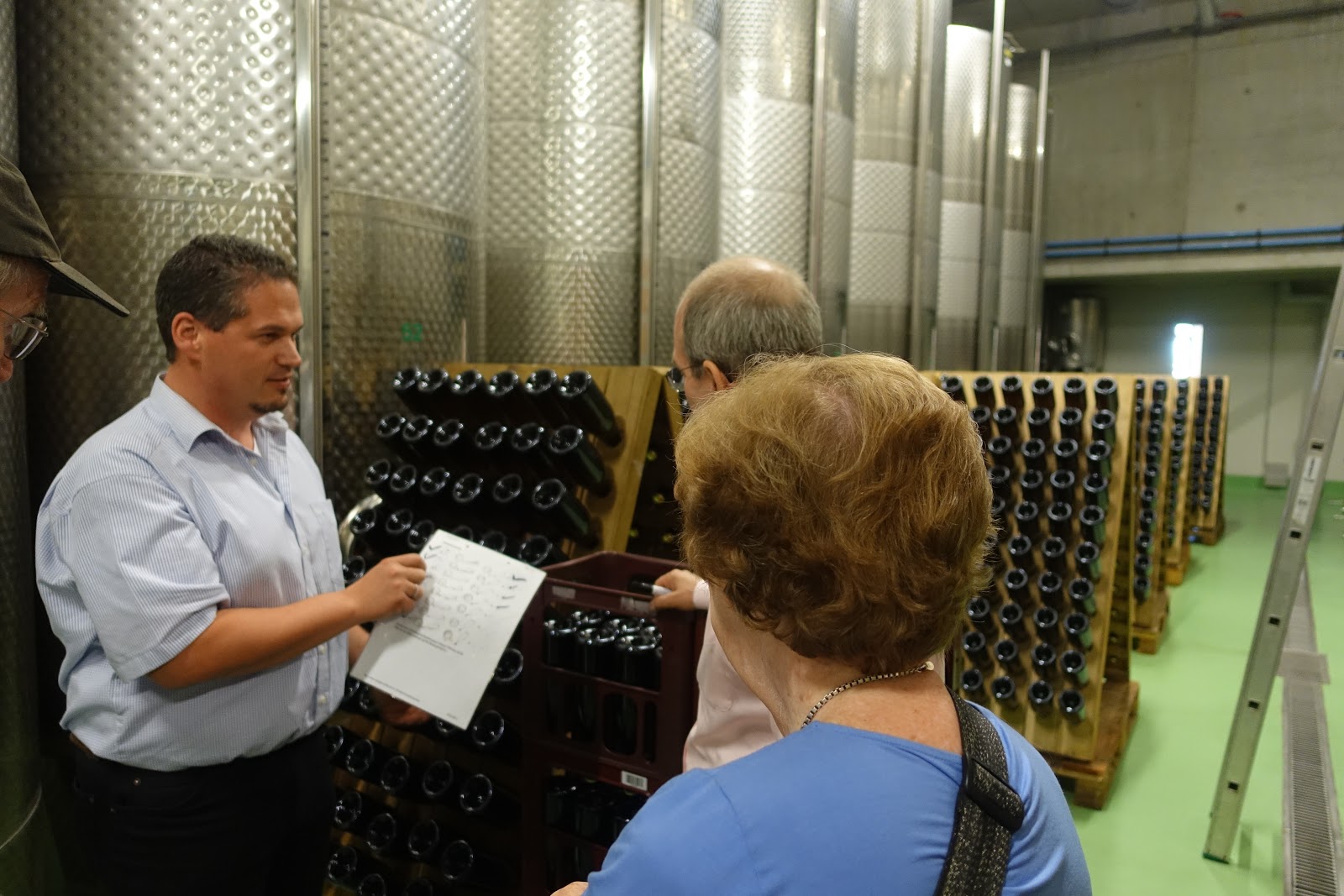
Pictures: With Owner and Winemaker Jean-François Bordet at Domaine Séguinot-Bordet

2012 Domaine Philippe Charlopin Chablis “Vieilles Vignes” AOC

2013 Domaine Jean Marc Brocard Chablis 1er Cru Montmains AOC

This domaine is a fruit of love. Jean­Marc Brocard is from the Côte d’Or region of Burgundy and fell in love with the daughter of a winemaker in Chablis. As a wedding gift, the couple got 2.5 acres of a vineyard near the church of Saint Claire in Préhy, in the vicinity of the town of Chablis. In 1973 Jean­Marc established the domaine Jean­Marc Brocard and developed the estate into a domaine with over 200 acres under vine. He had no prior connection with wine and trained with his father in­law to learn everything about winemaking. In 1996, Julien Brocard joined his father with the goal to convert to organic and biodynamic farming. The process is still ongoing. ‘La Boissonneuse’ vineyard was the first one to start with the transition process in 1997 and ‘Vielles Vignes’ followed in 2001. Today, Domaine Jean­-Marc Brocard is run by the ‘father­son’ team and stands for the upper echelon of Chablis wines.

See also: Wine Pairing Lunch, Cellar Visit, Vineyard Tour and Tasting a Domaine Jean­ Marc Brocard in Préhy, Chablis – Bourgogne (and Champagne) Tour 2016 by ombiasy WineTours, France

Pictures: With Jean­-Marc Brocard at Domaine Brocard in Préhy

2014 Domaine Servin Chablis 1er Cru Montee De Tonnerre AOC

2012 Domaine Servin Chablis Grand Cru AOC Les Clos

2006 Domaine Louis Michel &Fils Chablis Grand Cru  AOC Vaudesir

2010 Domaine Pinson Chablis Grand Cru AOCLes Clos


Previous Salon Tastings at Schiller's Home

Chardonnay: Germany versus Chablis - Salon Tasting at Schiller's Home
Salon Tasting at Schiller's Home: Sparkling Wines of the World
Salon Tasting at Schiller‘s Home: Domaine Weinbach, Alsace, Vintage 2014 (2017)

schiller-wine: Related Postings

Heads up for the 2017 Tours - to Germany and France - by ombiasy WineTours

Burgundy (and Champagne) 2016 Tour by ombiasy WineTours: From Lyon to Reims - Wine, Food, Culture and History

Germany-East Tour 2017 by ombiasy WineTours: Wine, Art, Culture and History

Salon Tasting at Schiller's Home: Sparkling Wines of the World

Salon Tasting at Schiller‘s Home: Domaine Weinbach, Alsace, Vintage 2014 (2017)

Wine Lunch at Weingut Jülg with Johannes Jülg – Germany-South Tour by ombiasy WineTours (2015)

Wine Dinner with Tour at Weingut Kruger-Rumpf in Münster-Sarmsheim, Nahe, with Georg Rumpf – Germany-North Tour by ombiasy WineTours (2015), Germany

Weingut Franz Keller in Oberbergen, Kaiserstuhl, Baden: Cellar Tour and Tasting with Fritz Keller – Germany-South Wine Tour by ombiasy (2014)

Tasting at Weingut Bernhard Huber in Baden, with Yquem Viehauser and Julian Huber – Germany-South Tour by ombiasy WineTours (2015)

Schiller’s Favorite Wine Bars and other Wine Venues in Chablis, France

Domaine Séguinot-Bordet in Maligny, Chablis: Tour and Tasting with Owner and Winemaker Jean-François Bordet – Bourgogne Tour by ombiasy WineTours (2015)

Wine Pairing Lunch, Cellar Visit, Vineyard Tour and Tasting a Domaine Jean­ Marc Brocard in Préhy, Chablis – Bourgogne (and Champagne) Tour 2016 by ombiasy WineTours, France