Showing posts with label Grosses Gewaechs. Show all posts

Thursday, September 29, 2016

Germany’s Grosses Gewächs GG Wines Released (2015 White and 2014 Red) - Notes from the Pre-release Tasting in Wiesbaden, Germany

Picture: Stuart Pigott and Jancis Robinson at the GG Pre-release Tasting in Wiesbaden, Germany

Germany’s VDP.Grosse Gewächs – Grand Cru - vintage 2015 white wines and vintage 2014 red wines were released on September 1, 2016. These are the ultra-premium dry wines from the very best vineyard sites made by some of the best producers in Germany.

At this annual occasion, a number of presentations by the VDP – the association of German elite winemakers - take place in Germany, including one in Berlin during the first days of September.

Pictures: Christian Schiller at the GG Pre-release Tasting in Wiesbaden, Germany

GG Pre-release Tasting in Wiesbaden

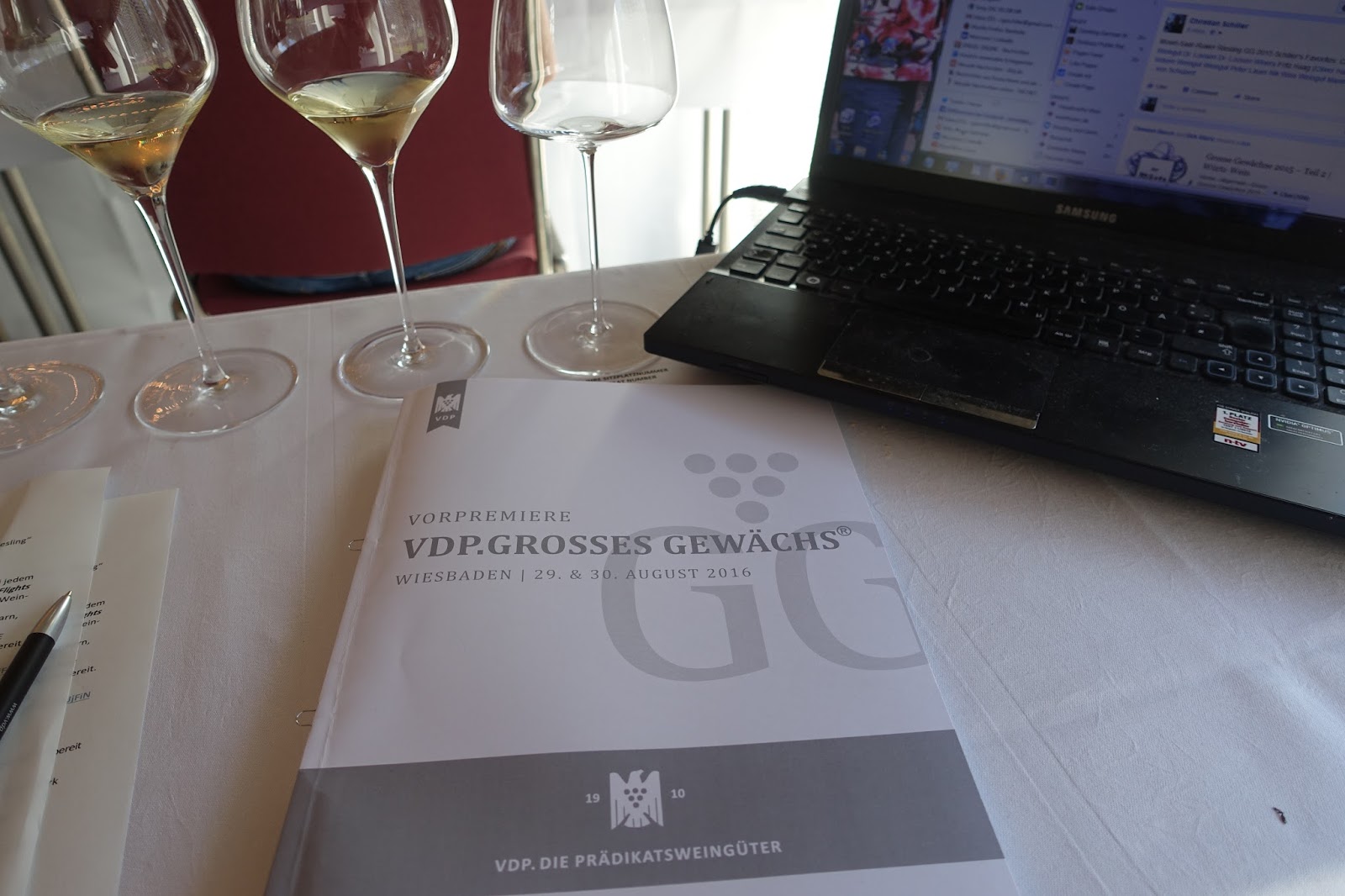
One presentation that clearly stands out is the pre-release tasting for a group of about 120 wine journalists, bloggers, sommeliers, retailers, importers, etc from all over the world, but mainly from Germany, in the Old Kurhaus in the stately German spa town of Wiesbaden, which is 45 minutes drive from Frankfurt. It is a seated, very well organized tasting where you have the chance to go through the VDP Grosses Gewächs wines during 2 1/2 days.

Pictures: GG Pre-release Tasting in Wiesbaden, Germany

The invitations for this event are highly sought after. This year, I was happy to get again invited by the VDP to participate in the event. Others I saw at the event were US wine importer Rudi Wiest, Gault Millau WeinGuide Deutschland editor Joel B. Payne, winemaker, blogger and internet-TV star Dirk Würtz and Riesling guru and wine journalist Stuart Pigott, Master of Wine Caro Maurer from Germany, US Importer Justin Christoph from New York, Switzerland-based wine critic Yves Beck and Anne Krebiehl, MW, from London.

See here for last years' tastings:
Germany’s Grosses Gewächs GG Wines Released (2014 White and 2013 Red) - Notes from the Pre-release Tasting in Wiesbaden, Germany
Germany’s 2013 Grosses Gewaechs – Grand Cru - Wines Released. Notes from the Pre-release Tasting in August 2014 in Wiesbaden, Germany
Germany’s 2012 VDP.Grosses Gewaechs – Grand Cru - Wines Released. Notes from the Pre-release Tasting in Wiesbaden, Germany
Germany’s 2011 VDP Grosses Gewaechs – Grand Cru - Wines Released. Notes from the Pre-release Tasting in Wiesbaden, Germany

Grosses Gewächs (GG)/  Grand Cru

What is a VDP.Grosses Gewächs? There is still a bit of confusion out there, as (1) Grosses Gewächs (GG) is a term that was created by the VDP only a few years ago and (2) the VDP has established a new classification for German wines that differs radically from the German standard classification (and is still in the process of refining and implementing it). The latest revisions were those that came into effect with the vintage 2012.

Picture: Benjamin Schiller Pouring for Armin Diel

Grosses Gewächs Wines and the New German Wine Classification

Although many people think that there is only one wine classification system in Germany – the classification system of the Law of 1971 – this is not correct. True, the classification system of the Law of 1971 is the standard classification system in Germany and the vast majority of winemakers in Germany use this approach. A large number of winemakers, however, have moved away from the standard, in particular the VDP producers.

In a nutshell, the VDP is moving to a classification system that resembles very much the classification system in the Bourgogne. The classification of the VDP puts the terroir principle at the center of its classification approach.

With the latest modifications of 2012, the absolutely finest vineyards are called Grosse Lage (for the 2011 vintage still called Erste Lage) and dry wines from these super top vineyards are called Grosses Gewächs. Grosses Gewächs wines are the finest dry wines from Germany’s finest vineyards.

To qualify for the Grosses Gewächs label, a number of criteria need to be respected. (i) The fruit has to come from a Grosse Lage vineyard. (ii) At harvest, the grapes need to be at least at Spätlese level in terms of the sugar content. (iii) Only certain – typical - grape varieties are allowed, including Riesling and Spätburgunder. Riesling is the only varietal allowed for Grosse Lage wines in the Mosel, Nahe, and Mittelrhein, but grapes like Spätburgunder (Pinot Noir), Lemberger, Fruehburgunder, Weissburgunder (Pinot Blanc), Grauburgunder (Pinot Gris), Gewuerztraminer, and Silvaner are included in other regions. (iv) Further restrictions apply: there are yield restrictions; only hand picking of grapes is permitted and harvest must be late in the autumn.

See also:
Steffen Christmann (Weingut A. Christmann) and Wilhelm Weil (Weingut Robert Weil) Presented the New Wine Classification of the VDP, Germany

The VDP

The VDP is the world’s oldest association of wine estates in the world. In fact, it is the only one of its kind worldwide. No other country has a national organization of the top wine makers of the entire country.

Throughout the past century, the quality-driven goals and strict standards of the VDP have played no small part in shaping the viticultural and winemaking practices in Germany. With their stringent statutes and their establishment of a German vineyard classification, the 200 members of the VDP have served as role models and justifiably can be viewed as the vanguard of the nation’s producers of top-quality wines.

Picture: Alexia Putze (VDP), the Head of the Organization Team, and Armin Diel

What did we have in the Glass in Wiesbaden?

This is what we had in the glass in Wiesbaden: White VDP.Grosses Gewächs wines from 2015 and red VDP.Grosses Gewächs wines mostly from 2014, but some also from earlier vintages. Typically, the red GGs are released a year later than the white GGs, i.e. most of the red wines were vintage 2014.

The tasting covered all winegrowing regions in Germany and it did not cover just Riesling. Grosses Gewächs status has been approved for Silvaner, Weissburgunder (Pinot Blanc), Grauburgunder (Pinot Gris), Spätburgunder (Pinot Noir), and Lemberger, plus even a Chardonnay was included this year. But the majority of the wines were, of course, Riesling wines, and each region’s wines are grouped together for comparison.

Not all potential GG wines were presented in Wiesbaden, because (1) a number of wines did not pass the internal review of the VDP and thus will never be released as GG and (2) increasingly, winemakers are holding their wines back to release them later. For example, the 2015 Kirchenstück of Dr. Bürklin-Wolf will only be released in March 2017, to give it more time to develop. Juliusspital decided to present its white GGs not after 12 months, but after 24 months aging. Peter Jakob Kühn did not show any wines. And so on.

Schiller’s Favorites

In the following, I list, region by region, my favorite GGs poured at the GG pre-release tasting in Wiesbaden in late August 2016. This is followed by the recommendations of Schnutentunker, a popular German blogger and by the recommendations of Jancis Robinson as far as white non-Riesling GGs are concerned.

Ahr

The Ahr valley north of the 50 °latitude is unquestionable the northernmost region for producing top Pinot-Noirs. The secret lies in an ideal micro-climate found in the narrow canyons along the river with their very special geological conditions, and south-facing slopes. Wine making along the tiny Ahr River goes back to Roman times.

The Ahr region showed only red wines: 1 Frühburgunder GG and 10 Spätburgunder GGs.

Schiller’s Favorites: Meyer-Näkel (Sonnenberg, Pfarrwingert, Kräuterberg), J.J. Adeneuer (Sonnenberg, Rosenthal, Gäskammer)

There is a red wine revolution going on in Germany and the world increasingly takes note of it. Of course, given its location, the red wines of Germany tend to be not like the fruity red wines we know from warmer countries, but lean and more elegant, with a lot of finesse. 30 years ago, the share of red wine in total German wine output was not more than 10 percent; in the international wine scene, people would not talk about German red wine. But this is changing. Germany now produces red wines that can compete with the best of the world; the share of red wines in terms of production has increased to about 35 percent now in Germany and increasingly the international market takes note of what is happening in Germany.

Today, Germany is the third biggest producer of Pinot Noir (called Spätburgunder in Germany), after France and the US, with more planted than Australia and New Zealand combined.

Picture: Guiseppe Lauria, Weinwisser, at the GG Pre-release Tasting in Wiesbaden, Germany

Baden

Baden is the most southerly German wine-growing area in Germany's southwestern corner. On the other side of the Rhine Valley is Alsace. Baden is known for its pinot wines – red, grey and white.

The Spätburgunder is the most widely grown variety in Baden, but Baden showed also a number of GGs from other grape varieties.

Baden showed the largest number of Spätburgunder GGs, with those of Weingut Bernhard Huber (Bienenberg, Schlossberg, Sommerhalde) standing out, but those of Weingut Salwey (Kirchberg, Henkenberg) and Weingut Dr. Heger (Schlossberg, Vorderer Winklerberg) also showing very well. Weingut Franz Keller also impressed with the Eichberg and Kirchberg GGs.

Baden also showed 9 Grauer Burgunder (Pinot Gris) GGs and 10 Weisser Burgunder (Pinot Blanc) GGs.

In addition, Baden showed 8 Chardonnay GGs (Top: Bernhard Huber) and 3 Riesling GGs.
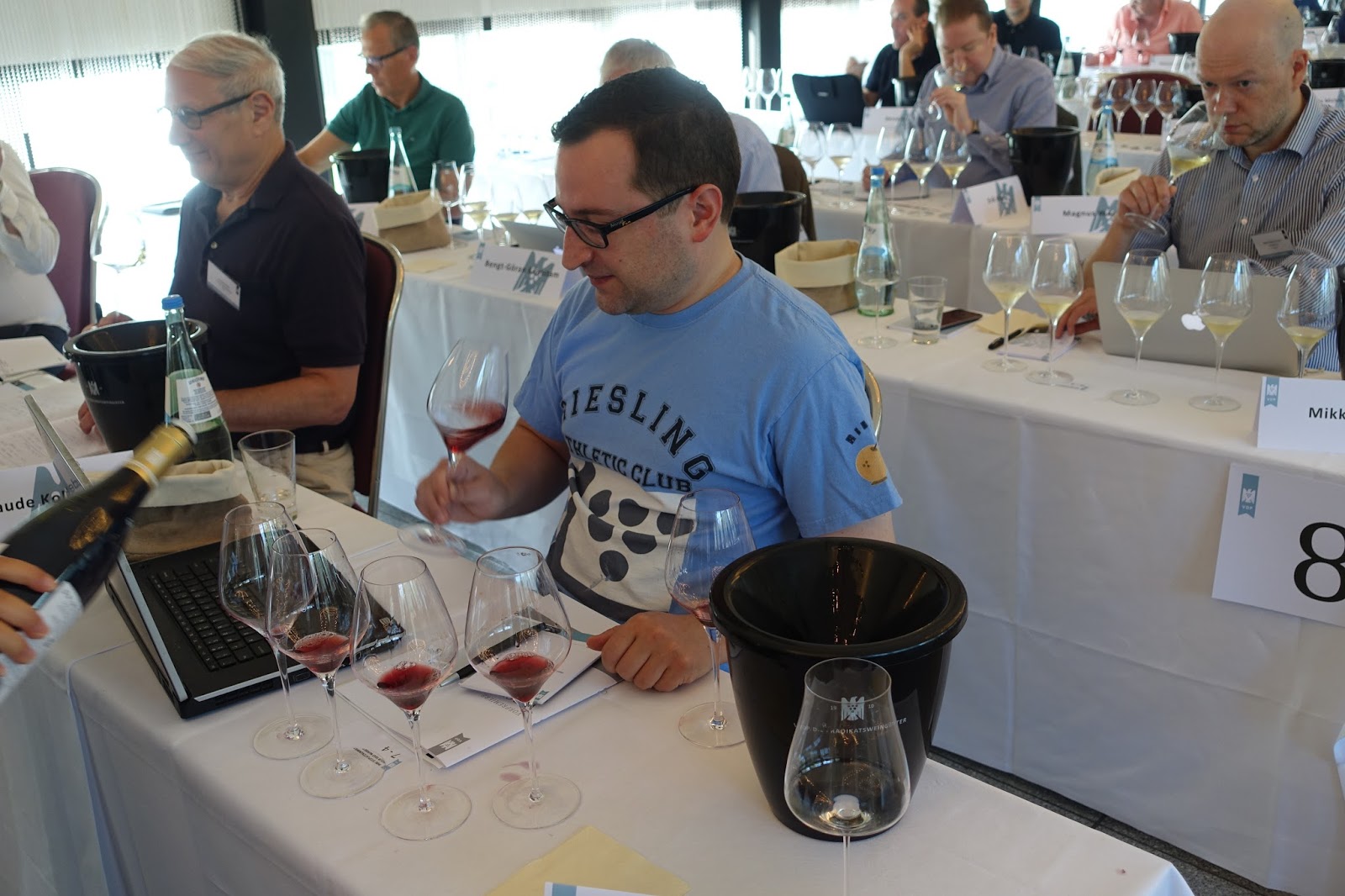
Picture: US Importer Justin Christoph at the GG Pre-release Tasting in Wiesbaden, Germany

Franken

Franken is known for its crisp, crystal clear wines from their signature grape Silvaner. Indeed, it was the only region to show Silvaner GGs, excellent wines, but hard to find outside of Germany.

Schiller’s Favorites: Staatlicher Hofkeller Würzburg (Stein), Horst Sauer (Am Lumpen 1655), Bickel-Stumpf (Mönchshof), Hans Wirsching (Kronsberg, Julius-Echter-Berg), Schmitt’s Kinder (Pfülben), Am Stein, Ludwig Knoll (Stein).

Franken also showed 18 Riesling and 2 Weisser Burgunder (Pinot Blanc) GGs.

Schiller’s Franken Riesling Favorites: Staatlicher Hofkeller Würzburg (Pfülben, Stein), Rudolf Fürst (Centgrafenberg), Am Stein, Ludwig Knoll (Stein), Hans Wirsching (Julius-Echter-Berg, Kronsberg), Horst Sauer (Am Lumpen 1655), Schmitt’s Kinder (Pfülben).

3 of the 6 Spätburgunder GGs which Franken showed came from Franken’s red wine star Weingut Rudolf Fürst: Schlossberg, Centgrafenberg and Hundsrück.

Picture: Nico Rechenberg, Dirk Würtz, Weingut Balthasar Ress, Marcus Hofschuster, Wein-Plus, Armin Diel, Schlossgut Diel, Paul Truszkowski, Wine in Black, and Felix Bodman at the GG Pre-release Tasting in Wiesbaden, Germany

Hessische Bergstrasse

Hessische Bergstrasse presented one GG: Centgericht of Hessische Staatsweingüter Kloster Eberbach

Mittelrhein

Beginning just below Bonn and extending about 100 km south along the banks of the Rhine, the Mittelrhein is a beautiful region of steep, terraced vineyards and some of the wine world's most splendid scenery, medieval castles and ruins clinging to rocky peaks, sites of ancient legends where Siegfried, Hagen and the Loreley seem to spring to life. Nearly three quarters of the vineyards are planted with Riesling. The Middle-Rhine valley is listed as a UNESCO World Heritage site.

Mittelrhein showed 5 Riesling GGs. Both the Engelstein of Matthias Müller and the Im Hahn of Toni Jost were excellent.

Mosel

Traditionally, the Mosel is not a region well known for its ultra-premium dry white wines. Instead, the fruity sweet Kabinett, Spätlese and Auslese wines as well as the noble sweet BA, TBA and Eiswein wines are sought after all over the world by the lovers of fruity and noble sweet wines. But things are changing and the Mosel showed an impressive list of Riesling GGs.

In particular, I liked the GGs of Clemens Busch (Marienburg, Marienburg Rothenpfad, Marienburg Fahrlay, Marienburg Falkenlay), Dr. Loosen (Treppchen, Prälat, Würzgarten, Sonnenuhr, Himmelreich, Domprobst), Schloss Lieser (Himmelreich, Niederberg Helden, Fritz Haag (Juffer, Juffer-Sonnenuhr), van Volxem (Goldberg, Volz, Scharzhofberg), Forstmeister Geltz-Zilliken (Rausch), Peter Lauer (Kupp. Schonfels, Saarfeilser), Nik Weis – St. Urbans-Hof (Bockstein, Saarfeilser), Maximin Grünhaus – von Schubert (Abtsberg, Herrenberg).

In total, the Mosel showed 50 GGs, up from 40 GGs last year, again all Riesling – no other grape variety.

Picture: US Importer Rudi Wiest at the GG Pre-release Tasting in Wiesbaden, Germany

Nahe

Like the Mosel, the Nahe showed only Riesling GGs – a total of 27 wines, up from 22 last year. My favorites were Kruger-Rumpf (Burgberg, Dautenpflänzer, Im Pitterberg), Diel (Pittermännchen, Goldloch, Burgberg), Schäfer-Fröhlich (Felsenberg, Felseneck, Stromberg, Frühlingsplätzchen, Halenberg) and Dönnhoff (Dellchen, Hermannshöhle, Brücke, Felsenberg “Felsentürmchen).

Pfalz

The Pfalz belongs to the group of regions that showed both white and red GGs. As for the white GGs, it showed Riesling and Weisser Burgunder GGs.

Among 60 Riesling GGs that the Pfalz showed, I saw the wines of Rings (Weilberg, Saumagen), Reichsrat von Buhl (Freundstück, Jesuitengarten, Pechstein, Ungeheuer, Kieselberg, Reiterpfad “Hofstück”, Reiterpfad “In der Hohl”, Geheimer Rat Dr. von Bassermann-Jordan (Jesuitengarten, Kirchenstück, Pechstein, Ungeheuer, Kalkofen, Grainhübel, Hohenmorgen), A. Christmann (Meerspinne im Mandelgarten, Idig, Langenmorgen, Reiterpfad “Hofstück”) and Ökonomierat Rebholz (Im Sonnenschein, “Ganz Horn” im Sonnenschein, Kastanienbusch) in the lead.

Turning to the Weisser Burgunder, the Pfalz showed 11 GGs. I liked the Langenmorgen of Geheimer Rat Dr. von Bassermann-Jordan and Im Sonnenschein and Mandelberg of Ökonomierat Rebholz best.

Picture: Joel B. Payne and Carsten Henn, Gault Millau Weinguide Deutschland

Rheingau

The Rheingau is the region that is closest to my heart. My wife Annette and I discovered the world of wines with the wines of Rheingau, while we lived in Mainz for 10 years. The Rheingau also showed 7 Spätburgunder GGs, but was one of the dominating forces in terms of the Riesling GGs.

Schiller’s Rheingau Riesling GG Favorites: Joachim Flick (Nonnberg, Hölle Kantelborn, Königin Victoriaberg), Künstler (Hölle, Kirchenstück, Weiss Erd, Berg Rottland, Berg Schlossberg), Domdechant Werner (Kirchenstück, Domdechaney), Hessische Staatsweingüter Kloster Eberbach (Domdechaney, Marcobrunn, Baikenkopf, Berg Schlossberg), Robert Weil (Gräfenberg), Toni Jost-Hahnenhof (Walkenberg), Diefenhardt (Langenberg), Jakob Jung (Hohenrain, Siegelsberg), Achim Ritter und Edler von Oetinger (Hohenrain, Marcobrunn, Siegelsberg), Barth (Wisselbrunnen, Schönhell), Hans Lang – Urban Kaufmann (Wisselbrunnen), Balthasar Ress (Wisselbrunnen, Nussbrunnen), Josef Spreitzer (Wisselbrunnen, St. Nikolaus, Rosengarten), Georg Müller Stiftung (Nussbrunnen), Prinz (Jungfer, Schönhell), Peter Jakob Kühn (St. Nikolaus, Doosberg), F.B. Schönleber (St. Nikolaus, Jesuitengarten), August Eser (Doosberg), Fritz Allendorf (Hasensprung, Jesuitengarten, Berg Roseneck), Domäne Schloss Johannisberg (Schloss Johannisberger), August Kesseler (Berg Roseneck, Berg Schlossberg), Leitz (Berg Roseneck, Berg Rottland, Berg Schlossberg, Berg Kaisersteinfels).

The Rheingau showed 7 Spätburgunder GGs, all excellent: Künstler (Reichestal, Höllenberg), Diefenhardt (Schlenzberg), Hans Lang – Urban Kaufmann (Hassel), Hessische Staatsweingüter Kloster Eberbach (Berg Schlossberg, Höllenberg), Fritz Allendorf (Höllenberg).

Picture: Jürgen Fendt, Sommelier, Bareiss

Rheinhessen

Rheinhessen showed 34 Riesling GGs, the same number as last year, and 10 Spätburgunder GGs.

Kühling-Gillot (Rothenberg “Wurzelecht”, Pettenthal, Ölberg, Hipping) Gunderloch (Rothenberg, Pettenthal, Hipping), Keller (Hubacker), Wittmann (Aulerde, Kirchspiel, Brunnenhäuschen, Morstein) and Battenfeld Spanier (Zellerweg Am Schwarzen Herrgott, Frauenberg, Kirchenstück) and Schätzel (Ölberg, Hipping) were my favorites.

Saale Unstrut

The tiny wine region in the former GDR – Saale Unstrut - showed 5 GGs, by Pawis and Lützkendorf: 2 Rieslings, 1 Traminer and 2 Weisser Burgunders, all excellent.

Sachsen

The other tiny region in the former GDR – Sachsen - present 2 GGs, a Weisser Burgunder GG and a Spätburgunder GG, both by Schloss Proschwitz – Prinz zur Lippe, both top.

Württemberg

Wine from Württemberg is mainly red wine. The main production area is along the Neckar river between Stuttgart and Heilbronn and, more wine is consumed here than anywhere else in Germany - actually twice as much as in the rest of Germany. The German poet Friedrich von Schiller wrote already several centuries ago: “A Württemberger without wine--is that a real Württemberger?”

Wines from Baden and Württemberg are hard to find in the US. This is partly explained by the production structure, which is dominated by co-operatives. Much of the wine sector in Baden and Württemberg is in the hands of local co-operatives. These co-operatives are known for producing top class wines. But they tend to be less aggressive in terms of penetrating new markets. Stuart Pigott, the German wine writer, believes that Württemberg is the area with the largest potential for quality growth in Germany.

Württemberg showed 15 Riesling GGs.

Schiller’s Favorites: Weingut des Grafen Neipperg (Ruthe, Schlossberg), Wachstetter (Höhenberg “Glaukös”), Ernst Dautel (Steingrüben), Herzog von Württemberg (Brotwasser).

In addition, in terms of white wines, Württemberg showed 4 Weisser Burgunder GGs and 2 Grauer Burgunder GGs.

Turning to red GGs, Württemberg showed 12 Spätburgunder GGs.

Schiller’s Favorites: Graf Neipperg (Schlossberg), Ernst Dautel (Schupen, Forstberg), Schnaitmann (Lämmler).

Finally, all of the Lemberger GGs were from Württemberg, with the wines of von Graf Neipperg (Ruthe, Schlossberg), Ernst Dautel (Michaelsberg), Herzog von Württemberg (Mönchberg) and Schnaitmann (Lämmler) standing out.

Schnutentunker’s Favorites

Here are the favorites of Felix Bodmann, Schnutentunker, a popular German Blogger.

Picture: Felix Bodmann, Schnutentunker, at the GG Pre-release Tasting in Wiesbaden, Germany

Achim Ritter und Edler von Oetinger Siegelsberg
Achim Ritter und Edler von Oetinger Hohenrain
Clemens Busch Marienburg „Fahrlay“
Clemens Busch Marienburg „Falkenlay“
Emrich-Schönleber Halenberg
Forstmeister Geltz-Zilliken Rausch
Fritz Allendorf Berg Roseneck
Geh. Rat Dr. von Bassermann-Jordan Ungeheuer
Heymann-Löwenstein Kirchberg
Heymann-Löwenstein Stolzenberg
Heymann-Löwenstein Röttgen
Heymann-Löwenstein Uhlen „Blaufüßer Lay“
Heymann-Löwenstein Uhlen „Laubach“
Horst Sauer Am Lumpen 1655
Jakob Jung Siegelsberg
Joachim Flick Königin Victoriaberg
Johannishof Berg Rottland
Maximin Grünhaus – von Schubert Herrenberg
Ökonomierat Rebholz Kastanienbusch
Peter Lauer Kupp
Peter Lauer Schonfels
Peter Lauer Saarfeilser
Reinhold Haart Grafenberg
Reinhold Haart Ohligsberg
Robert Weil Gräfenberg
Schäfer-Fröhlich Halenberg
Schloss Lieser Niederberg Helden
Schlossgut Diel Pittermännchen
St. Urbans-Hof Saarfeilser
St. Urbans-Hof Bockstein
von Othegraven Altenberg
von Othegraven Bockstein
Wagner-Stempel Heerkretz
Wagner-Stempel Höllberg
Wittmann Brunnenhäuschen
Zehnthof Luckert Maustal

Jancis Robinson: German non-Riesling Whites to Look for

Here are the favorites of Jancis Robinson of the Financial Times as far as non-Riesling white GGs are concerned.

Picture: Jancis Robinson at the GG Pre-release Tasting in Wiesbaden, Germany (Photo: Deutsches Weininstitut)

• Bürgerspital, Stein Silvaner 2015 Franken
• Bürgerspital, Stein-Harfe Silvaner 2015 Franken
• Ludwig Knoll, Stein Silvaner 2015 Franken
• Rudolf May, Langenberg Himmelspfad Silvaner 2015 Franken
• Horst Sauer, Am Lumpen 1655 Silvaner 2015 Franken
• Weltner, Küchenmeister Hoheleite Silvaner 2015 Franken
• Zehntof Luckert, Maustal Silvaner 2015 Franken
• Bercher, Feuerberg Haslen Weisser Burgunder 2015 Baden
• Bercher, Feuerberg Haslen Grauer Burgunder 2015 Baden
• Dr Heger, Schlossberg Grauer Burgunder 2015 Baden
• Stadt Lahr, Chardonnay 2015 Baden
• Stigler, Winklerberg Pagode Grauer Burgunder 2014 Baden
• Stigler, Winklerberg Pagode Chardonnay 2015 Baden
• Alexander Laible’s Chara dry Grauburgunder 2014

Stuart Pigott's Favorites

Stuart Pigott wrote a long article about the Wiesbaden tasting in the FAS of September 4, 2016, in German. Below, I tried to summarize his recommendations.

Picture: Stuart Pigott at the GG Pre-release Tasting in Wiesbaden, Germany

RIESLING

Nahe

At the top of my list are the 4 GGs of Dönnhoff (Felsentürmchen, Dellchen, Brücke, Herrmannshöhle)
The 3 Riesling-GGs of Schlossgut Diel
The 6 Riesling-GGs of Weingut Schäfer-Fröhlich
The Halenberg GG of Emrich-Schönleber
The Steinberg GG of Gut Herrmannsberg

Mosel

The Riesling-GGs of Heymann-Löwenstein
The Riesling-GGs of Dr. Loosen, with Prälat being the best
Peter Lauer
Van Volxem

Pfalz

Dr. von Bassermann-Jordan
Aacham-Magin

Rheingau

The Berg Schlossberg GG of August Kesseler
The Riesling-GG of Schloss Johannisberg
The 3 Riesling GGs of Achim von Öetinger
Fred Prinz

Rheinhessen

The 4 Riesling-GGs of Wittmann
The Heerkretz GG of Wagner-Stempel
A full paragraph on Schätzel and his low-alcohol GGs

WEISSBURGUNDER (Pino Blanc)

The Im Sonnenschein GG of Ökonomierat Rebholz
The Mandelberg GG of Bergdolt
The Mandelberg GG of Dr. Wehrheim

SILVANER

The Mönchshof GG of Bickel-Stumpf
The Rothlauf GG of Rudolf May

schiller-wine - Related Postings

Heads up for the 2017 Tours - to Germany and France - by ombiasy WineTours

Germany-North Tour 2016 by ombiasy WineTours: Quintessential German Riesling and the Northernmost Pinot Noirours

Germany-East Tour 2016 by ombiasy WineTours: Wine, Art, Culture and History

Germany-South Tour by ombiasy WineTours (2015)

Cellar Tour and Wine Tasting with Philipp Wittmann and Eva Clüsserath-Wittmann at Weingut Wittmann in Westhofen – Germany-South Tour by ombiasy WineTours (2014)

Tour and Tasting at Weingut A. Christmann in Gimmeldingen, Pfalz, with Steffen Christmann – Germany-South Tour by ombiasy WineTours (2015), Germany

The Dry and Ultra-premium Dry GG and GG Reserve Rieslings of Weingut Dr. Loosen – Ernie Loosen in Washington DC

Wine Tasting at Weingut Dr. Loosen in Bernkastel-Kues, Mosel – Germany-North by ombiasy WineTours (2015)

Weingut Maximin Grünhaus Joins VDP, the Association of Germany’s Elite Winemakers

Wine Tasting and Cellar Tour at Weingut Dönnhoff with Christina Dönnhoff – Germany-North Tour by ombiasy WineTours (2014)

Kiedrich: Visit of the Basilica of Saint Valentine and of Weingut Robert Weil - Germany-North Wine Tour by ombiasy (2014)

The Focus on Dry German Riesling – Daniel Hubbard Presents the German DSWE Portfolio to the German Wine Society (Washington DC Chapter)

Tasting at Weingut Balthasar Ress, Hattenheim, Rheingau, with Stefan Ress, Germany

Wine Tasting at Weingut Kühling-Gillot in Bodenheim: Kühling-Gillot and Battenfeld-Spanier Wines – Germany-North Wine Tour by ombiasy (2014)

Vineyard Tour, Cellar Tour and Tasting at Weingut Leitz in Rüdesheim, with Johannes Leitz – Germany-North Tour 2016 by ombiasy WineTours

Tasting at Weingut Ökonomierat Rebholz in Siebeldingen, Pfalz – Germany-South by ombiasy WineTours (2015)

Steffen Christmann (Weingut A. Christmann) and Wilhelm Weil (Weingut Robert Weil) Presented the New Wine Classification of the VDP, Germany

VDP.Rheingau Rhine River Boat Trip with Pre-release Presentation of the 2015 Grosses Gewächs (GG) Wines, Germany

Tour and Wine Tasting with Lunch, with Mark Barth at Wein- und Sektgut Barth in Hattenheim, Rheingau – Germany-North Tour by ombiasy WineTours (2015)

Kloster Eberbach in the Rheingau: Tour and Wine Tasting - Germany-North Wine Tour by ombiasy (2014)

Tour and Tasting at Schloss Johannisberg, Rheingau, with Christian Witte, Domaine Director – Germany-North Tour by ombiasy WineTours (2015), Germany

Kiedrich: Visit of the Basilica of Saint Valentine and of Weingut Robert Weil - Germany-North Wine Tour by ombiasy (2014)

A Combination of Extraordinary Wine and Art: Peter Winter's Georg Mueller Stiftung Estate in Germany

Tour and Tasting at Weingut Baron Knyphausen in Erbach, Rheingau - Germany-North Tour by ombiasy WineTours (2015)

Cellar Tour, Tasting and Dinner at Wein- und Sektgut F.B. Schönleber in Östrich-Winkel, Rheingau, with Ralph and Bernd Schönleber - Germany-North Tour 2016 by ombiasy WineTours schiller-wine: Related Postings


Monday, October 5, 2015

Germany’s Grosses Gewächs GG Wines Released (2014 White and 2013 Red) - Notes from the Pre-release Tasting in Wiesbaden, Germany

Picture: Germany’s Grosses Gewächs GG Pre-release Tasting in Late August 2015 in Wiesbaden, Germany

Germany’s VDP.Grosse Gewaechs – Grand Cru - vintage 2014 white wines and vintage 2013 red wines were released on September 1, 2015. These are the ultra-premium dry wines from the very best vineyard sites made by some of the best producers in Germany.

At this annual occasion, a number of presentations by the VDP – the association of German elite winemakers - take place in Germany, including one in Berlin during the first days of September and one later in the month in Frankfurt am Main.

Pre-release Tasting in Wiesbaden

One presentation that clearly stands out is the pre-release tasting for a group of about 120 wine journalists, bloggers, sommeliers, retailers, importers, etc from all over the world, but mainly from Germany, in the old Kurhaus in the stately German spa town of Wiesbaden, which is 45 minutes’ drive from Frankfurt. It is a seated, very well organized tasting where you have the chance to go through the VDP Grosses Gewaechs wines during 2 days.

Pictures: Wiesbaden

The invitations for this event are highly sought after. This year, I was happy to get again invited by the VDP and to participate in the event. Others I saw at the event were US wine importer Rudi Wiest, Gault Millau WeinGuide Deutschland editor Joel B. Payne, winemaker, blogger and internet-TV star Dirk Wuertz and Riesling guru and wine journalist Stuart Pigott, Master of Wine Caro Maurer from Germany, new Robert Parker team member Stephan Reinhardt, who has replaced David Schildknecht, US Importer Justin Christoph from New York and Anne Krebiehl, MW, from London.

See here for last years' tastings:
Germany’s 2013 Grosses Gewaechs – Grand Cru - Wines Released. Notes from the Pre-release Tasting in August 2014 in Wiesbaden, Germany
Germany’s 2012 VDP.Grosses Gewaechs – Grand Cru - Wines Released. Notes from the Pre-release Tasting in Wiesbaden, Germany
Germany’s 2011 VDP Grosses Gewaechs – Grand Cru - Wines Released. Notes from the Pre-release Tasting in Wiesbaden, Germany

Grosses Gewaechs (GG)

What is a VDP.Grosses Gewaechs? There is still a bit of confusion out there, as (1) Grosses Gewaechs (GG) is a term that was created by the VDP only a few years ago and (2) the VDP has established a new classification for German wines that differs radically from the German standard classification (and is still in the process of refining and implementing it). The latest revisions were those that came into effect with the vintage 2012.

Pictures: Germany’s Grosses Gewächs GG Pre-release Tasting in Late August 2015 in Wiesbaden, Germany

Grosses Gewaechs Wines and the New German Wine Classification

Although many people think that there is only one wine classification system in Germany – the classification system of the Law of 1971 – this is not correct. True, the classification system of the Law of 1971 is the standard classification system in Germany and the vast majority of winemakers in Germany use this approach. A large number of winemakers, however, have moved away from the standard, in particular the VDP producers.

In a nutshell, the VDP is moving to a classification system that resembles very much the classification system in the Bourgogne. The classification of the VDP puts the terroir principle at the center of its classification approach.

With the latest modifications of 2012, the absolutely finest vineyards are called Grosse Lage (for the 2011 vintage still called Erste Lage) and dry wines from these super top vineyards are called Grosses Gewächs. Grosses Gewächs wines are the finest dry wines from Germany’s finest vineyards.

Pictures: Christian G.E. Schiller

To qualify for the Grosses Gewächs label, a number of criteria need to be respected. (i) The fruit has to come from a Grosse Lage vineyard. (ii) At harvest, the grapes need to be at least at Spätlese level in terms of the sugar content. (iii) Only certain – typical - grape varieties are allowed, including Riesling and Spätburgunder. Riesling is the only varietal allowed for Grosse Lage wines in the Mosel, Nahe, and Mittelrhein, but grapes like Spätburgunder (Pinot Noir), Lemberger, Fruehburgunder, Weissburgunder (Pinot Blanc), Grauburgunder (Pinot Gris), Gewuerztraminer, and Silvaner are included in other regions. (iv) Further restrictions apply: there are yield restrictions; only hand picking of grapes is permitted and harvest must be late in the autumn.

See also:
Steffen Christmann (Weingut A. Christmann) and Wilhelm Weil (Weingut Robert Weil) Presented the New Wine Classification of the VDP, Germany

The VDP

The VDP is the world’s oldest association of wine estates in the world. In fact, it is the only one of its kind worldwide. No other country has a national organization of the top wine makers of the entire country.

Throughout the past century, the quality-driven goals and strict standards of the VDP have played no small part in shaping the viticultural and winemaking practices in Germany. With their stringent statutes and their establishment of a German vineyard classification, the 200 members of the VDP have served as role models and justifiably can be viewed as the vanguard of the nation’s producers of top-quality wines.

Picture: Stuart Pigott

What did we have in the Glass in Wiesbaden?

This is what we had in the glass in Wiesbaden: White VDP.Grosses Gewächs wines from 2014 and red VDP.Grosses Gewächs wines mostly from 2013, but some also from earlier vintages. Typically, the red GGs are released a year later than the white GGs, i.e. most of the red wines were vintage 2013.

Overall, 536 GGs from 162 VDP producers were released on September 1, 2015 and could be tasted in Wiesbaden. This was an increase of 27 wines, compared with the year before.

The tasting covered all winegrowing regions in Germany and it did not cover just Riesling. Grosses Gewächs status has been approved for Silvaner, Weissburgunder (Pinot Blanc), Grauburgunder (Pinot Gris), Spätburgunder (Pinot Noir), and Lemberger, plus even a Chardonnay was included this year. But the majority of the wines were, of course, Riesling wines, and each region’s wines are grouped together for comparison.

The GGs came from 272 vineyard sited. Riesling dominated the show, accounting for 55 percent or 297 wines of the total.

In terms of the regional distribution, the Pfalz showed the largest number of GGs – 107 wines, followed by Baden (93), Württemberg (59), Rheingau (58), Franken (55), Mosel (52) and Rheinhessen (51).

Not all potential GG wines were presented in Wiesbaden, because (1) a number of wines did not pass the internal review of the VDP and thus will never be released as GG and (2) increasingly, winemakers are holding their wines back to release them later. For example, the 2014 Kirchenstück of Dr. Bürklin-Wolf will only be released in March 2016, to give it more time to develop. Julisspital decided to present its white GGs not after 12 months, but after 24 months aging. Peter Jakob Kühn did not show any wines. And so on.

Picture: Joel B. Payne

Ahr

The Ahr valley north of the 50 °latitude is unquestionable the northernmost region for producing top Pinot-Noirs. The secret lies in an ideal micro-climate found in the narrow canyons along the river with their very special geological conditions, and south-facing slopes. Wine making along the tiny Ahr River goes back to Roman times.

The Ahr region showed only red wines: 3 Frühburgunder GGs and 14 Spätburgunder GGs.

Schiller’s Favorites: Meyer-Näkel (Sonnenberg, Pfarrwingert and Kräuterberg)

Picture: Stephan Reinhardt (Robert Parker)

There is a red wine revolution going on in Germany and the world increasingly takes note of it. Of course, given its location, the red wines of Germany tend to be not like the fruity red wines we know from warmer countries, but lean and more elegant, with a lot of finesse. 30 years ago, the share of red wine in total German wine output was not more than 10 percent; in the international wine scene, people would not talk about German red wine. But this is changing. Germany now produces red wines that can compete with the best of the world; the share of red wines in terms of production has increased to about 35 percent now in Germany and increasingly the international market takes note of what is happening in Germany.

Today, Germany is the third biggest producer of Pinot Noir (called Spaetburgunder in Germany), after France and the US, with more planted than Australia and New Zealand combined.

Picture: The Ahr GG Wines

Baden

Baden is the most southerly German wine-growing area in Germany's southwestern corner. On the other side of the Rhine Valley is Alsace. Baden is known for its pinot wines – red, grey and white.

The Spätburgunder is the most widely grown variety in Baden, but Baden showed also a number of GGs from other grape varities.

Baden showed the largest number of Spätburgunder GGs, with those of Weingut Bernhard Huber standing out, but those of Weingut Salwey and Weingut Dr. Heger also showing very well.

Baden also showed 15 Grauer Burgunder (Pinot Gris) GGs and 10 Weisser Burgunder (Pinot Blanc) GGs.
In addition, Baden showed 1 Blaufränkisch GG (Weingut Seger Herrenberg Spermen), 3 Chardonnay GGs and 6 Riesling GGs.

Picture: Weingut Bernhard Huber GGs

Franken

Franken is known for its crisp, crystal clear wines from their signature grape Silvaner. Indeed, it was the only region to show Silvaner GGs, excellent wines, but hard to find outside of Germany.

Schiller’s Favorites: Am Stein, Ludwig Knoll, Stein, Bickel-Stumpf, Mönchshof

Franken also showed 15 Riesling GGs and 1 Weisser Burgunder GG.

3 of the 6 Spätburgunder GGs which Franken showed came from Franken’s red wine star Weingut Rudolf Fürst: Schlossberg, Centgrafenberg and Hundsrück.

Justin Christoph (New York) - For Franken Riesling GGs this year, it was Wirsching and Weltner at the top, then everybody else @grapeylyle

Picture: The Franken Riesling GGs

Picture: Weingut Fürst GGs

Hessische Bergstrasse

No wines.

Mittelrhein

Mittelrhein showed 3 Riesling GGs and 1 Spätburgunder GG. Both the Riesling and Spätburgunder Hahn GG of Toni Jost were excellent.

Picture: The Rudi Wiest Team from the USA

Mosel

Traditionally, the Mosel is not a region well known for its ultra-premium dry white wines. Instead, the fruity sweet Kabinett, Spätlese and Auslese wines as well as the noble sweet BA, TBA and Eiswein wines are sought after all over the world by the lovers of fruity and noble sweet wines. But things are changing and the Mosel showed an impressive list of Riesling GGs. In particular, I like the GGs of Clemens Busch (Marienburg, Marienburg Rothenpfad, Marienburg Fahrlay, Marienburg Falkenlay) and Dr. Loosen (Treppchen, Prälat, Würzgarten, Sonnenuhr, Himmelreich, Lay). In total, the Mosel showed about 40 GGs, all Riesling – no other grape variety.

Picture: Dr. Loosen GGs

Justin Christoph (New York) - Top 2014 Mosel Riesling Grosses Gewachs from the Wiesbaden presentation: 1. Fritz Haag, Juffer-Sonnenuhr 2. Clemens Busch, Marienburg "Fahrlay" 3. Karthäuserhof, Karthäuserhofberg 4. Heymann-Löwenstein, Uhlen "Blaufüßer Lay" 5. Peter Lauer, Schonfels 6. Heymann-Löwenstein, Röttgen 7. Clemens Busch, Marienburg "Falkenlay" 8. Peter Lauer, Saarfeilser

Picture: Justin Christoph from New York

Nahe

Like the Mosel, the Nahe showed only Riesling GGs – a total of 22 wines. My favorites were Kruger-Rumpf (Dautenpflänzer, Im Pitterberg), Diel (Pittermännchen, Goldloch, Burgberg) and Dönnhoff (Dellchen, Hermannshöhle).

Justin Christoph (New York) - My Top 2014 Nahe Riesling Grosses Gewachs tasted in Wiesbaden: 1. Schäfer-Fröhlich, Felseneck 2. Diel, Pittermännchen 3. Schäfer-Fröhlich, Stromberg 4. Emrich-Schönleber, Halenberg 5. Kruger-Rumpf, Dautenpflänzer 6. Diel, Burgberg 7. Donnhoff, Felsenberg.

Picture: Yves Beck from Switzerland

Pfalz

The Pfalz belongs to the group of regions that showed both white and red GGs. As for the white GGs, it showed Riesling and Weisser Burgunder GGs.

The Pfalz showed almost 60 Riesling GGs and many of my fellow tasters thought that these wines were the stars of the whole presentation. Among those, I saw the wines of A. Christmann (Langenmorgen, Reiterpfad In der Hohl, Idig, Mandelgarten) and Ökonomierat Rebholz (Im Sonnenschein, Ganz Horn im Sonnenschein, Kastanienbusch) in the lead.

Turning to the Weisser Burgunder, I liked the Langenmorgen of von Bassermann-Jordan best among the 12 wines presented.

Picture: Anne Krebiehl, MW, from London

Rheingau

The Rheingau is the region that is closest to my heart. My wife Annette and I discovered the world of wines with the wines of Rheingau, while we lived in Mainz for 10 years. The Rheingau also showed 6 Spätburgunder GGs, but was one of the dominating forces, as far as the Riesling GGs are concerned. Overall, they all were a tick drier than last year, as the Rheingau in general is trying to brng the remaining sugar level in its Riesling GGs down. Künsterl, Toni Jost, Robert Weil, Barth, Jakob Jung, Achim von Oetinger, Josef Spreitzer, Fritz Allendorf, J. Wegeler, Schloss Johannisberg, Baltasar Ress, Leitz all showed super wines.

Flight 18 with 5 Berg Rottland Riesling GGs ( Balthasar Ress, Johannishof, Künstler, Leitz, von Mumm) was one of the most interesting flights of the tasting for me.

Picture: Guiseppe Lauria, Gault Millau WeinGuide Deutschland

Rheinhessen

Rheinhessen showed 34 Riesling GGs and 8 Spätburgunder GGs. Among the Riesling flights, flight 25 was my favorite: it included the Pettenthal from St. Antony, Rappenhof, Gunderloch and Kühling-Gillot. They were all excellent, with the last two perhaps standing out.

Overall, Gunderloch (Rothenberg, Pettenthal, Hipping), Keller (Hubacker), Kühling Gillot (Rothenberg, Ölberg, Hipping) Wittmann (Aulerde, Kirchspiel, Brunnenhäuschen, Morstein) and Battenfeld Spanier (Am Schwarzen Herrgott, Frauenberg, Kirchenstück) were my favorites.

Paul Truskowski: The Star of this years Grosse Gewächs Preview is definitely Johannes Hasselbach and his team of Weingut #Gunderloch. The collection of three Grand Cru Rieslings - #Hipping #Pettenthal and #Rothenberg - is not just impressive. It is the benchmark. At Roter Hang and also in complete #Rheinhessen. Chapeau! #vdpgg15

Justin Christoph (New York) - Top '14 Rheinhessen GGs: 1. Battenfeld-Spanier, Am Schwarzen Herrgott 2. Battenfeld-Spanier, Frauenberg 3. Kühling-Gillot, Rothenberg 4. Groebe, Kirchspiel 5.Wittman, Aulerde 6.Wagner-Stempel, Heerkretz 7.Kühling-Gillot, Pettenthal 8.St. Antony, Pettenthal 9.Wittman, Morestein

Picture: Flight 27 (Rheinhessen)

Saale Unstrut

The tiny wine region in the former GDR, showed 2 GGs, both by Pawis and both excellent: Riesling Edelacker and Weisser Burgunder Edelacker.

Sachsen

The other tiny region in the former GDR, Sachsen, did not present any wines.

Württemberg

Wine from Württemberg is mainly red wine. The main production area is along the Neckar river between Stuttgart and Heilbronn and, more wine is consumed here than anywhere else in Germany - actually twice as much as in the rest of Germany. The German poet Friedrich von Schiller wrote already several centuries ago: “A Württemberger without wine--is that a real Württemberger?”

Wines from Baden and Württemberg are hard to find in the US. This is partly explained by the production structure, which is dominated by co-operatives. Much of the wine sector in Baden and Württemberg is in the hands of local co-operatives. These co-operatives are known for producing top class wines. But they tend to be less aggressive in terms of penetrating new markets. Stuart Pigott, the German wine writer, believes that Württemberg is the area with the largest potential for quality growth in Germany.

Württemberg showed 16 Riesling GGs.

Schiller’s Favorites: Neipperg (Ruthe, Schlossberg), Wachstetter (Höhenberg), Dautel (Sonnenberg), Schnaitmann (Götzberg, Lämmler).

Picture: Dautel and Schnaitmann GGs

In addition, in terms of white wines, Württemberg showed 2 Weisser Burgunder GGs and 1 Grauer Burgunder GG.

Turning to red GGs, Württemberg showed 11 Spätburgunder GGs.

Allmost all of the Lemberger GGs were from Württemberg, with the wines of von Neipperg (Ruthe, Schlossberg), Dautel (Michaelsberg) and Schnaitmann (Lämmler) standing out.

Picture: The End

schiller-wine: Related Postings

4 Wine Tours by ombiasy coming up in 2015: Germany-East, Germany-South. Germany-Nord and Bordeaux

Germany-East Wine and Art Tour by ombiasy WineTours (2015)

Germany-North Wine Tour by ombiasy, 2014

Germany-South Wine Tour by ombiasy, 2014

Germany’s 2013 Grosses Gewaechs – Grand Cru - Wines Released. Notes from the Pre-release Tasting in August 2014 in Wiesbaden, Germany

Germany’s 2012 VDP.Grosses Gewaechs – Grand Cru - Wines Released. Notes from the Pre-release Tasting in Wiesbaden, Germany

Germany’s 2011 VDP Grosses Gewaechs – Grand Cru - Wines Released. Notes from the Pre-release Tasting in Wiesbaden, Germany

Tuesday, December 16, 2014

A New Dr. Loosen Project Setting the Standard for Dry German Rieslings

Picture: Annette Schiller, ombiasy PR and WineTours, and Ernst Loosen, Weingut Dr. Loosen, with a Prälat Auslese during the German Wine and Culture Tour by ombiasy (2013) at Weingut Dr. Loosen

Picture: The German Wine and Culture Tour by ombiasy (2013) at Weingut Dr. Loosen 

See:
German Wine and Culture Tour by ombiasy, 2013
4 Wine Tours by ombiasy coming up in 2015: Germany-East, Germany-South. Germany-Nord and Bordeaux

Weingut Dr. Loosen has just announced that they have launched two Grosses Gewächs Riesling Reserve wines which are bringing back the true origins of dry Riesling in Germany. The release of these Grosses Gewächs Riesling Reserve culminates Ernst Loosen’s 25-year search to find the most precise expression of dry Riesling and its terroir. Ernst is convinced that his Dr. L Riesling brand has been instrumental in introducing a new generation to the Riesling grape, and that the time is right to show the wine world that a dry Riesling from Grosse Lagen (Grand Cru) vineyards can make its name among the best wines in the world. To separate these wines from his normal Grosses Gewächs wines, Ernst Loosen has added the term “Reserve” to highlight their extended barrel aging.

Picture: Annette Schiller, Ernst Loosen and Christian G.E. Schiller at the 2013 Rheingau Riesling Gala at Kloster Eberbach, Rheingau, Germany

Ernst Loosen: “These Reserve Rieslings are a unique approach to Grosses Gewächs wines, which are dry Riesling from the top Grosse Lagen (Grand Cru) vineyards. I am returning to the traditions of my great grandfather who produced exclusively dry Riesling from our best vineyards and aged them for 24 to 36 months in large oak Fuder barrels. I have always believed that dry German Riesling deserved the same respect internationally as sweet Riesling, which has not been the case up to now. With the Grosses Gewächs Riesling Reserve, I feel we are now at the level of excellence I have been striving for over the last 25 years.”

Pictures: Tête-à-tête dinner at Rasika in Washington DC with Ernst Loosen, Washington Post Wine Columnist Dave McIntyre, Annette Schiller, wine tours by ombiasy and Christian Schiller.

To produce the Grosses Gewächs Riesling Reserve wines, Dr. Loosen looked for the most traditional way of making great dry Riesling. The use of Riesling grapes from Grosse Lagen parcels, fermentation using only indigenous yeasts, and aging in large old oak Fuder barrels on the full lees with no batonnage, has proven to be a winning combination. For the just-released 2011 vintage, parcels of 100-year-old Riesling vines with original rootstocks from the Ürziger Würzgarten and Erdener Prälat vineyards were aged on their lees for 24 to 36 months in 1,000-liter Fuder barrels. Due to the outstanding results, the 24-month method of aging has been expanded to another Grand Cru vineyard for the 2012 vintage, which will bring the total of Reserve Riesling to three for the 2012 vintage: Wehlener Sonnenuhr, Ürziger Würzgarten and Erdener Prälat. Dr. Loosen has also seen that a year of aging in bottle has given even more elegance and charm to the 2011 Grosses Gewächs Riesling Reserve wines; thus, in addition to the extended barrel aging the future Reserve Riesling will also be aged one year in bottle before release.

Click here for a video with Ernst Loosen explaining his new ultra-premium dry wines.

This is a press release by Dr. Loosen Imports. For more info, contact: Kirk Wille, Dr. Loosen Imports (USA) kirk.wille@drloosen.com

schiller-wine: Related Postings

Riesling from Germany and Pinot Noir from Oregon: A Winemaker Dinner with Ernst Loosen, Weingut Dr. Loosen and J.Christopher Wines, at Black Salt in Washington DC.

Riesling, Pinot Noir and Indian Cuisine: A tête-à-tête Dinner with Winemaker Ernst Loosen, Weingut Dr. Loosen, at Rasika in Washington DC, USA

Ernst Loosen and Dr. L. Riesling - His Hugely Popular Entry-level Wine Sold Throughout the World;

The Doctor Made a House Call - A Tasting with Ernst Loosen, Weingut Dr. Loosen, at MacArthur Beverages in Washington DC, USA

A Riesling Guru and a Killer Guitarist cum Cult Winemaker: Ernst Loosen and Jay Somers and their J. Christopher Winery in Newberg, Oregon

Wine ratings: Two American/German wines - Eroica and Poet's Leap - on Top 100 Wines from Washington State list for 2009

German American Wines: (1) Pacific Rim Riesling (2) Eroica and (3) Woelffer's Schillerwein

The German Winemakers at the 4th Riesling Rendezvous in Seattle, USA

4 Wine Tours by ombiasy coming up in 2015: Germany-East, Germany-South. Germany-Nord and Bordeaux

German Wine and Culture Tour by ombiasy, 2013

Tuesday, June 24, 2014

The Grand Cru Couple from VDP.Grosse Lage – Riesling Grosses Gewächs and Riesling Spätlese. A Tasting at the 2nd International Riesling Symposium, led by Giuseppe Lauria, Germany

Picture: Wilhelm Weil, Weingut Weil, and Guiseppe Lauria

The 2nd International Riesling Symposium took place on May 26 and 27, 2014, at Schloss Rheinhartshausen in the Rheingau. Riesling experts from around the world - top winemakers, representatives from the trade and restaurant sector, and journalists – gathered to celebrate, discuss and taste the arguably most noble white grape in the world - Riesling.

I have already provided an overview about the 2nd International Riesling Symposium event: The 2nd International Riesling Symposium in the Rheingau, Germany

This posting focuses on one particular event, a spectacular tasting, led by Giuseppe Lauria: The Grand Cru Couple from VDP.Grosse Lage – Riesling Grosses Gewächs and Riesling Spätlese.

Pictures: Guiseppe Lauria Leading the Tasting

Riesling in the World

There are about 47000 hectares planted with Riesling worldwide. Germany – with 22500 hectares – accounts for about half of the total. The second and third largest Riesling producer are the US (mainly Washington State and Finger Lakes Region) with 4800 hectares and Australia with 4100 hectares. But this is only about 1/10 of the total. Alsace follows with 3500 hectares. Alsace, Ukraine and Austria follow with 3500 hectares, 2700 hectares and 1900 hectares.

Pictures: Paul Fürst, Annette Schiller, H.O. Spanier, Caroline Spanier-Gillot and Guiseppe Lauria

Overall, Riesling is really a niche wine, accounting for less than 1 percent of total wine production in the world - but a very special niche wine. In terms of quality wines, Riesling is usually included in the top three white wine varieties, with Chardonnay and Sauvignon Blanc. Riesling is highly terroir-expressive, meaning that the character of Riesling wines is clearly influenced by the wine’s place of origin.

VDP.Grosse Lage, Grosses Gewächs and Spätlese

Although many people think that there is only one wine classification system in Germany – the classification system of the Law of 1971 – this is not correct. True, the classification system of the Law of 1971 with its pyramid of ripeness of the grapes at harvest (Qualitätswein, Kabinett, Spätlese, Auslese …) at the center is the standard classification system in Germany and the vast majority of winemakers in Germany use this approach. A large number of winemakers, however, have moved away from the standard, in particular the producers of premium and ultra-premium wines.

Importantly, the powerful group of German elite winemakers – the VDP (Verband Deutscher Praedikatswein Produzenten) – has conceived its own classification system and is developing it further.

Pictues: The Tasting

Following their colleagues in the Bourgogne, the terroir principle has taken center stage in the VDP classification. Effective with the 2012 harvest, the VDP classification has the following 4 quality layers (In brackets, the equivalent quality classes in the classification system of the Bourgogne):

• VDP.Grosse Lage (Grand Cru in Burgundy)
• VDP.Erste Lage (Premier Cru in Burgundy)
• VDP.Ortswein (Village level in Burgundy)
• VDP.Gutswein (Bourgogne régional in Burgundy)

The ultra-premium wines are those that come from a VDP.Grosse Lage. Dry wines from these top vineyards are called Grosses Gewächs: Grosses Gewächs wines are the finest dry wines from Germany’s finest vineyards. Wines that are not fully fermented and exhibit residual sweetness from these finest German vineyards are called VDP.Grosse Lage Kabinett, or Spätlese or Auslese, Beerenauslese, Trockenbeerenauslese, Eiswein, depending on the sugar level in the finished wine.

The Tasting

Giuseppe Lauria, from the Gault Millau WeinGuide Deutschland (responsible for the Rheingau), took us through a tasting of 12 Grand-Cru wine couples: always the same input (same vineyard, same grape varieties, same ripeness level of the grapes), but 2 different outputs - one wine fully fermented as Grosses Gewaechs and one wine not fully fermented to produce a Spätlese (in the VDP definition). In other words: what we had in the glass was the same grape material in 2 different interpretations. This was a blind tasting.

Geheimrat J.Wegeler, Mosel, 2012 Bernkastel Doctor, GG and Spätlese

Giuseppe Lauria: The GG - very acid, shows cool minerality, citrus and apple aromas. The Spätlese - a quite elegant wine, also with strong minerality.

Schloss Lieser, Mosel, 2012 Niederberg Helden, GG and Spätlese

Giuseppe Lauria: The GG – spontaneous fermentation, long contact with lees, strong minerality, shows were the wine comes from. The Spätlese – fruit is very upfront, aromas are more difficult to detect, needs more time to open up, 90 grams RS.

Picture: Christian G.E Schiller and Thomas Haag, Weingut Schloss Lieser, at Lunch

Grans-Fassian, Mosel, 2012, Trittenheim Apotheke, GG and Spätlese

Giuseppe Lauria: The GG - not a big wine, fragile, not as much in balance as the previous two GG wines.

Dönnhoff, Nahe, 2012, Niederhausen Hermannshoehle, GG and Spätlese

Giuseppe Lauria: The GG – prototype for the region, earthy notes, pronounced acidity, still a very young wine. The Spätlese – apricots, white peach, quite balanced, quite long in the mouth.

Picture: Cornelius and Helmut Dönnhoff and Martin Tesch

Emrich-Schoenleber, Nahe, 2012, Monzingen Hallenberg, GG and Spätlese

Giuseppe Lauria: The GG – got power, but remains elegant, really good structure, quite monolithic in its style. The Spätlese – wonderfully balanced, is full of energy, great drinkability.

Picture: Werner Schönleber, Weingut Schönleber

Wagner-Stempel, Rheinhessen, 2012, Siefersheim Heerkretz, GG and Spätlese

Giuseppe Lauria: The GG – fermented in wood, very mineral. Daniel Stempel: The Spätlese – only a few bottles were made of this wine, basically for the export market.

Picture: Daniel Stempel, Weingut Wagner Stempel

Toni Jost, Mittelrhein, 2012, Bacharach Hahn, GG and Spätlese

Giuseppe Lauria: The GG – explosive Riesling fruit, ripe, peaches, a fruit – forward wine, fermented in stainless steel, with 10% botrytis. The Spätlese – 50% botrytis, also fermented in stainless steel.

Pictures: Christian G.E. Schiller, Annette Schiller and Cecilia Jost, Weingut Toni Jost - Hahnenhof

Oekonomierat Rebholz, Pfalz, 2011, Birkweiler Kastanienbusch, GG and Spätlese

Giuseppe Lauria: The GG – herbal, spicy, only fully ripe grapes without botrytis were used. The Spätlese – 70 grams RZ, quite complex, big potential.

Picture: Hansjörg Rebholz, Weingut Ökonomierat Rebholz

K.F. Groebe, Rheinhessen, 2011, Westhofen, Kirchspiel, GG and Spätlese

Robert Weil, Rheingau, 2011, Kiedrich Gräfenberg, GG and Spätlese

Giuseppe Lauria: The GG – mango, yellow fruits, also lots of minerality.

Josef Spreitzer, Rheingau, 2009, Oestrich Lenchen, GG and Spätlese 303

Picture: Andreas Spreitzer, Weingut Spreitzer

Leitz, Rheingau, 2009, Rüdesheim Berg Roseneck, GG and Spätlese

Thanks

Thanks Guiseppe for a great tasting.


Postings about the 2014 International Riesling Symposium on schiller-wine

This posting is part of a series about the 2nd International Riesling Symposium in the Rheingau, Germany. Here is a list of the Postings already published and those still coming.

The 2nd International Riesling Symposium in the Rheingau, Germany
A Tour through the Rheingau - Visits of 3 Prestigious, Historic Rheingau Wineries: Weingut Wilhelm Weil, Kloster Eberbach and Schloss Johannisberg
Rieslings from the New World – More Traditional than Rieslings from the Old World? A Tasting at the 2nd International Riesling Symposium, led by Stuart Pigott, Germany
The Grand Cru Couple from VDP.Grosse Lage – Riesling Grosses Gewächs and Riesling Spätlese. A Tasting at the 2nd International Riesling Symposium, led by Giuseppe Lauria, Germany
2. International Riesling Symposium: Tasting with Cornelius and Fabian Lange Rieslings from Danube, Rhine, Nahe and Moselle: The European Riesling Route
2. International Riesling Symposium: Tasting with Caro Maurer Aged Rieslings from around the World: Riesling and its Aging Potential
German Riesling Producers at the 2. International Riesling Symposium in the Rheingau, Germany
American Riesling Producers at the 2. International Riesling Symposium in the Rheingau, Germany
Austrian Riesling Producers at the 2. International Riesling Symposium in the Rheingau, Germany
New Zealandian Riesling Producers at the 2. International Riesling Symposium in the Rheingau, Germany
Australian Riesling Producers at the 2. International Riesling Symposium in the Rheingau, Germany
Canadian Riesling Producers at the 2. International Riesling Symposium in the Rheingau, Germany

schiller-wine: Related Postings

3 Wine Tours by ombiasy Coming up in 2014: Germany-North, Germany-South and Bordeaux

New Developments in German Wine - Annette Schiller at the German Wine Society in Philadelphia, USA 

The 2nd International Riesling Symposium in the Rheingau, Germany

1st International Riesling Symposium, Rheingau, Germany

Aging Potential of Riesling – A Wine Tasting at the 1st International Riesling Symposium in Germany Led by Jancis Robinson

The World of Riesling in Seattle - Fourth Riesling Rendezvous in Washington State, USA

Visiting Wilhelm Weil at his Weingut Robert Weil in Kiedrich, Germany

When Americans Drink German Wine - What They Choose

German Wine Basics: Sugar in the Grape - Alcohol and Sweetness in the Wine

Riesling, Pinot Noir and Indian Cuisine: A tête-à-tête Dinner with Winemaker Ernst Loosen, Weingut Dr. Loosen, at Rasika in Washington DC, USA

Top 10 Riesling Producers in the World – Snooth 2012

Steffen Christmann (Weingut A. Christmann) and Wilhelm Weil (Weingut Robert Weil) Presented the New Wine Classification of the VDP, Germany