Showing posts with label Green wine. Show all posts

Monday, May 5, 2014

What is a Slow Wine? German Slow Wine Tasting with Kai Wagner in Bad Homburg, Germany

Picture: Christian G.E. Schiller and Kai Wagner in Bad Homburg, Germany

The Collegium Vini is an association of wine lovers in the greater Frankfurt area, founded in 1951, that meets regularly to taste wine together. This time, the Collegium Vini invited wine book author Kai Wagner to lead a wine tasting and to talk about his concept of slow wine and his book „Die Avantgarde der deutschen Winzer - Slow Wine und seine Erzeuger im Porträt“ (The Avantgarde of German Winemakers – Slow Wine and its Producers) ((Oekom-Verlag, München 2013). Co-author Ulrich Steeger was also present.

Slow Wine

The Slow Wine Movement grew out of the Slow Food Movement. The latter was a reaction to the fast food wave – industrialized, standardized, inexpensive food – that swept over the world during the economic upswing and globalization of the post-war area in the second half of the 1900s.

The German Slow Wine Movement is in its early stages and still in the process of defining itself. It is quite tricky. Slow wine making has to find its place within a number of other, competing concepts that all pursue similar aims: organic winemaking, biodynamic winemaking, sustainable winemaking, zero carbon footprint winemaking, zero water footprint winemaking, natural winemaking, to name the most important ones.

Picture: Christian G.E. Schiller and Slow Wine Producer Matthias Adams, Weingut von Racknitz, at 2014 Apfelwein Weltweit, see: 2014 Apfelwein Weltweit - Apple Wine World Wide - in Frankfurt, Germany: Schiller’s Favorites

Organic and Similar Concepts of Winemaking

A couple of years ago at Weingut Meinklang in Pamhagen in Austria in the stone cave below the winery with winemaker Werner Michlits, where Werner showed us his magic cow poop and other ingredients for biodynamic farming, I felt at the forefront of wine making with an ecological mindset. There are many others on this route. But these “green” winemakers come in different colors. I just tasted the Santa Julia wines of Familia Zuccardi, who produce mass wines in Argentina with organic grapes. Argentina, in general, is very well suited for organic wine making. “We practice sustainable agriculture in the vineyard” said Yann-Leon Beyer when I visited Domaine Leon Beyer in Alsace in France. The Donkey and Goat Winery in Berkeley produces wine according to the natural wine concept in the midst of the city of Berkeley, without owning any vineyards. Researchers have found out that from a point of view of minimizing the carbon footprint, New Yorkers should drink European wine instead of domestic wine from California. The following tries to shed some light on the different concepts of “green” wine making.

Picture: Christian G.E. Schiller with Slow Wine Producer Dr. Manfred Pruem, Weingut J.J. Pruem, in Germany. See more on Weingut J.J. Pruem: JJ Pruem Goes Supermarket: Meeting Katharina Pruem and Tasting the Incredible JJ Pruem Wines at Wegmans

Organic (Bio in German) generally means the use of natural as opposed to chemical fertilizers, insecticides and pesticides. The key is: no chemicals. Organic wines are changing the look of vineyards, literally. Whereas vineyards of the past commanded neat rows rid of all insects, rodents and weeds, organic vineyards are now replacing costly and damaging chemical sprays with environmental partnerships. Pesticides are giving way to introducing low-growing plants between vine rows that host beneficial insects that keep the pest insects in check.

Biodynamic is similar to organic farming in that both take place without chemicals, but biodynamic farming incorporates ideas about a vineyard as an ecosystem, and also accounting for things such as astrological influences and lunar cycles. Biodynamic is an approach following the rules and ideas of Austrian philosopher-scientist Rudolph Steiner.

Picture: Christian G.E. Schiller and Slow Wine Producer Steffen Christmann, Weingut A. Christmann, in Seattle, USA. See: The German Winemakers at the Forthcoming 4. Riesling Rendezvous in Seattle, Washington State, USA

Sustainable farming means farming in a way that will allow for continued farming throughout the ages. In its broadest interpretation, sustainability refers to a range of practices that are not only ecologically sound, but also economically viable and socially responsible. Although nowhere defined by law, there are many certifications available for “Sustainable Wine.”

Natural: The idea behind natural wine is non-intervention and a respect for Mother Nature. Natural wines are hands-off wines produced with as little intervention as possible. Generally, the concept of natural wine relates more to what happens in the wine cellar rather than what happens in the vineyard. Again, nowhere is the term defined by law; it is left open to interpretation. Typically, only natural yeasts are used, the fermentation is slow, there is little or no use of new oak barrels; and there are no filtrations or cold stabilization.

Pictures: Christian G.E.Schiller with Slow Wine Producers Lotte Pfeffer-Müller and Hans Müller, Owners of Weingut Brueder Dr. Becker. See also: Excellency and Ecology: The Wines of Gebrueder Dr. Becker in Rheinhessen, Germany

Carbon Footprint: The carbon neutral label comes from a different angle: global warming. All economic activities have a carbon footprint, including wine making. Carbon neutral wineries are trying to make a contribution to the general efforts of reducing the emission of carbon dioxide. Belgrave Park Winery in Australia, for example, is a completely carbon neutral vineyard and winery.

Water Footprint: A new thing is water footprint, reflecting the concern that the planet is moving into a period where water becomes more and more scarce.

For a primer for "green" wines see: Organic, Sustainable, Biodynamic, Natural Wines … A Primer for “Green” Wines

The German Slow Wine Concept

The German Slow Wine Concept is still in the process of defining itself. About a year ago, Ulrich Steger released a draft memorandum which is quite helpful in terms of understanding what he and Kai Wagner have in mind. He named 3 criteria that were critical in distinguishing slow wine from other wine, in particular industrial, mass wine:

Pictures: Kai Wagner and Ulrich Steeger, and their book: "Die Avantgarde der deutschen Winzer - Slow Wine und seine Erzeuger im Porträt“ (The Avantgarde of German Winemakers – Slow Wine and its Producers) ((Oekom-Verlag, München 2013).

First, a slow wine has a regional and cultural identity. A Riesling slow wine from the Rheingau region should taste differently than a Riesling from the Pfalz region; a 2010 slow wine should taste differently than a 2011 vintage. A slow wine producer grows those grape varieties that have proven to fit the soil type and the climatic conditions in the region.

Second, slow wine producers are artisanal wine makers. This starts in the vineyard with, for example, harvesting by hand, and continues in the wine cellar, with, for example, a preference for spontaneous fermenting.

Third, a slow wine producer is a winemaker with an ecological mindset. A slow wine producer will typically follow one of the above mentioned concepts of “green” winemaking.

The German Avantgarde of Slow Wine Producers

If you know the German wine scene, the list of slow wine producers included in their book is also helpful to understand what Kai Wagner and Ulrich Steeger have in mind, when they talk about slow wine. They grouped the selected winemakers under several headings.

Die Bio-Pioniere (The Organic Pioneers)

Weingut Brüder Dr. Becker, Ludwigshöhe • Rheinhessen
Weingut Hahnmühle, Mannweiler-Cölln • Nahe
Weingut Thorsten Melsheimer , Reil • Mosel
Weingut Pix, Ihringen • Baden
Weingut Roth, Wiesenbronn • Franken
Weingut Arndt F. Werner, Ingelheim • Rheinhessen
Weingut Wittmann, Westhofen • Rheinhessen
Weingut Zähringer, Heitersheim • Baden

Die Mentoren der Bewegung (The Mentors of the Movement)

Weingut A. Christmann, Neustadt-Gimmeldingen • Pfalz
Weingut Rudolf Fürst, Bürgstadt • Franken
Weingut Dr. Randolf Kauer, Bacharach • Mittelrhein
Weingut Joh. Jos. Prüm, Bernkastel-Wehlen • Mosel
Sekthaus Raumland, Flörsheim-Dalsheim • Rheinhessen
Weingut Ökonomierat Rebholz, Siebeldingen • Pfalz

Mehr Slow als Öko (More Slow than Bio)

Weingut Bickel-Stumpf, Frickenhausen, • Franken
Weingut Dr. Corvers-Kauter, Oestrich-Winkel • Rheingau
Weingut Danner, Durbach • Baden
Weingut Hofmann, Röttingen • Franken
Weingut Kistenmacher-Hengerer, Heilbronn • Württemberg
Weingut Klosterhof Töplitz, Werder (Havel) • Saale-Unstrut
Weingut Martin Müllen, Traben-Trarbach • Mosel
Weingut Schlör, Wertheim-Reicholzheim • Baden

Auf dem Weg nach ganz oben (On the Way to the Very Top)

Weingut Theo Minges, Flemlingen • Pfalz
Weingut Rainer Schnaitmann, Fellbach • Württemberg
Weingut Seeger, Leimen • Baden
Weingut St. Antony, Nierstein • Rheinhessen
Weingut Jean Stodden, Rech • Ahr
Weingut Vols, Ayl/Saar • Mosel
Weingut Wagner-Stempel, Siefersheim, • Rheinhessen
Weingut Klaus Zimmerling, Dresden-Pillnitz • Sachsen

Die Unorthodoxen heute (The Non-orthodox Winemakers Today)

Weingut J.B. Becker, Walluf • Rheingau
Weingut Gysler, Alzey-Weinheim • Rheinhessen
Weingut Heymann-Löwenstein, Winningen • Mosel
Ökologischer Weinbau Krämer, Auernhofen • Franken
Weingut Peter Jakob Kühn, Oestrich • Rheingau
Weingut Jürgen Leiner, Ilbesheim • Pfalz
Weingut Zehnthof Luckert, Sulzfeld • Franken

Die Quereinsteiger (The Career Changers)

Weingut von Racknitz, Odernheim • Nahe
Weingut Reverchon, Konz-Filzen • Mosel
Weingut Dr. Siemens, Serrig • Mosel
Weingut Van Volxem, Wiltingen • Mosel

Über wen sprechen wir in fünf Jahren? (Who will we talk about in 5 Years?)

Weingut Knauß, Weinstadt • Württemberg
Weingut Philipps-Mühle, St. Goar • Mittelrhein
Weingut Schmidt am Bodensee, Wasserburg • Württemberg
Weingut Sohns, Geisenheim • Rheingau
Weingut Zum Eulenturm, Briedel • Mosel

The Slow Wines Poured at the Tasting

Another interesting list is the one of the wines poured at the Collegium Vini event. Overall, these were all fascinating, outstanding wines. For many wines, however, participants had questions as to what made them slow wines.

Picture: At the Collegium Vini Tasting

To Accompany the Food:

Weingut von Racknitz Riesling Rotenfels 2011 Vol. 12,5 % 22 €

One of the winemaker from the career changer list. Co-owner Matthias Adams - who takes the lead in the cellar, while his wife is taking the lead in the vineyard - used to be a business execituve, before becoming a winemaker.

Tasting:

Weingut Wagner-Stempel Silvaner Siefersheimer 2012 Vol. 12,5 % 23,90 €

Weingut Luckert-Zehnthof Silvaner Creutz 2012 Vol. 13,5 % 49,00 €

Made from 80 years old vines.

Weingut Bickel-Stumpf Silvaner Barfuß 2012 Vol. 13 % 14,50 €

Kai Wagner: These three producers belong – with Paul Weltner – to the leading Silvaner producer quartet in Germany.

Weingut Knipser Gelber Orleans 2005 Vol. 13 % 24 €

Gelber Orléans is a vitis vinifera grape variety which up until the 19th century was much grown in Germany, but has almost disappeared since then. It has large berries with thick skins and a high yield. In the 1990s, Gelber Orléans returned to Rheingau when the historically interested Bernhard Breuer of Weingut Georg Breuer planted a small vineyard with 500 vines. A few years later, Weingut Knipser followed with experimental plantings of the Gelber Orléans.

Weingut Heußler Grauburgunder Rosswingert 2009 Vol. 14 % 12 €

Weingut Ziereisen Chardonnay Hard 2008 Vol. 12 % 18 €

Weingut Leiner Chardonnay Hadorne Reserve 2008 Vol. 14,5 % 24 €

Chardonnay is not a typical German grape variety - Why was the wine included in the tasting, several participants asked.

Weingut Knipser Riesling Halbstück Reserve 2004 Vol. 12 % 26 €

Weingut Van Volxem Riesling Gottesfuß GG 2007 Vol. 12 % 32 €

Weingut Wittmann Riesling Morstein GG 2011 Vol. 13,5 % 39 €

Weingut Wittmann Riesling Brunnenhäuschen GG 2011 Vol. 13,5 % 39 €

The purpose of the 2 Wittmann wines was to highlight the critical role that the terroir should play in a slow wine – two wines were everything was the same, including what Philip Wittmann did in the cellar, according to Kai Wagner.

Weingut Ziereisen Syrah Gestad 2008 Vol. 13 % 22 €

Again hotly discussed - Why Syrah in Germany? Kai Wagner referred to the climate change.

Weingut Schnaitmann Spätburgunder Lämmler GG 2009 Vol. 13 % 42€

Weingut Schlör Schwarzriesling R 2009 Vol. 14 % 19 €

Weingut Knipser Cuvée X 2006 Vol. 14 % 37,50 €

A classic Medoc cuvée (Cabernet Sauvignon, Cabernet Franc and Merlot). 18 to 20 months in mostly new barrique barrels.

Weingut Rings Cuvée Kreuz 2008 Vol. 14,5 % 26 €

This is the flagship wine of the Rings brothers – a cuvée of Cabernet Sauvignon, Merlot, Cabernet Franc and St. Laurent, fermented and aged in barrique.

Weingut von Schubert Riesling Herrenberg Kabinett 1995 Vol. 8 % 12 €

Weingut Müllen Riesling Hühnerberg Spätlese 2004 Vol. 7,5 % 18,90 €

Weingut Weiser-Künstler Riesling Ellergrub Spätlese 2009 Vol. 7,5 % 16 €

Weingut Eulenturm Riesling Trieren Auslese 2011 Vol. 8 % 10 €

As for the last 4 wines, I would argue that a fruity-sweet wine, made by (brutally) interrupting the natural fermentation process, does not qualify as slow wine. But of course, these are wines very famous and sought after in the whole world.

German Slow Wine Producers on schiller-wine

I have written about some of the German slow wine producers on schiller-wine, see:

Excellency and Ecology: The Wines of Gebrueder Dr. Becker in Rheinhessen, Germany

The Millesime Bio 2010 in Montpellier, France: A Discovery of Organic and Biodynamic Wines at the one of a Kind Wine Trade Show

The German Winemakers at the 4th Riesling Rendezvous in Seattle, USA

JJ Pruem Goes Supermarket: Meeting Katharina Pruem and Tasting the Incredible JJ Pruem Wines at Wegmans

A Tasting at Weingut Peter Jakob Kühn, Rheingau, with Angela and Peter Jakob Kühn, Germany

The (Grape) Wines and the Apple Wine of Weingut von Racknitz, Germany

schiller-wine: Related Postings

Organic, Sustainable, Biodynamic, Natural Wines … A Primer for “Green” Wines

The Natural Wines of the Donkey and Goat Winery in Berkeley, California

Visiting Jared Brandt and his Donkey & Goat Winery – Natural Wines Made in Berkeley, California

Wine Event: President Obama and the First Lady eat at the "Green" Restaurant Nora and have a "Green" Spottswoode Wine

Benzinger Wines Served at the 2010 "Green" Annual White House Correspondents Dinner

The Natural Wines of Terroir in San Francisco

Skype and Biodynamic Winemaking - Winetasting in the US with Winemaker Werner Michlits, Weingut Meinklang, in Austria

At the Forefront of Biodynamic Winemaking: Visiting Werner and Angela Michlits and their Weingut Meinklang in Austria

Julia Zuccardi from Familia Zuccardi in Argentina Visited the US to Introduce New Santa Julia Wines

One of Oregon's Pioneering Winemakers - Myron Redford - with his Amity Vineyard Wines in Washington DC

Visiting Yann-Leon Beyer at Maison Leon Beyer in Eguisheim in Alsace

Italian Natural Wines

Friday, June 28, 2013

Italian Natural Wines

Picture: Vendredi du Vin #57 - Vini Naturali d'Italia

Italian Wine

Italy is home of some of the oldest wine-producing regions in the world. Etruscans and Greek settlers produced wine in the country long before the Romans started developing their own vineyards. Two thousand years later, Italy is world leader in wine, accounting for about 20% of world wine production. Italians also lead the world in wine consumption by volume, 59 liters per capita, compared with 8 liters per capita in the US. Wine is grown in almost every region of the country.

Picture: The Wine Regions of Italy

Vendredi du Vin #57: Italian Natural Wines

This posting is being published as part of the Vendredis du Vin, a monthly blog event in France. Participating wine bloggers - mainly in France - are all releasing postings today under the same heading. This month's Vendredi du Vin is orchestrated by Patrick Böttcher, a manager of a pharmacy in Brussels, Belgium. The subject is: Italina Natural Wine: “Petit rappel, les italiens définissent leurs vins comme naturels s'ils sont issus de sols respectueux de la nature, et s'ils sont fait en respect avec l'artisanat historique tout en intervenant un minimum afin de conserver les marques de leur fruit et de leur terroir. S'ils ont effectivement souvent très peu de soufre embarqué, il n'y apas de règle absolue, juste du bon sens.”

My contribution is a bit broader than Italian natural wines. After a short primer of different concepts of “green” winemaking, including natural I profile “Agricola Querciabella” is a leading winemaker in the Super Tuscan movement, i.e. ultra-premium wines sold as IGT wine as the wines are made outside of the DOCG regulations. Agricola Querciabella has become a leading winemaker in the cruelty-free biodynamic movement, i.e. the 100% vegan approach to biodynamic winemaking.

Patrick Böttcher’s List of Italian Natural Wine Producers

Here is Patrick Patrick Böttcher’s List of Italian Natural Wine Producers: “Bon comme on est sympa et qu'on sait que vous allez caler, voici une liste de gentils vignerons dont nous vous conseillons absolument les quilles : Luca Roagna, Belotti, Giuseppe Rinaldi, Giuseppe Mascarello, Augusto Cappellano, Bartolo Mascarello, Brovia, Trinchero, Sylvio Morando, Villa Terlina, Elisabetta Foradori, Musella, Corte Sant'Alda, Tenuta Grillo, Lo Zerbone, La Stoppa, Denavolo, Tenuta di valgiano, Podere le Boncie, Pacina, Colombaia, Fonterenza, Stella di Campalto, Montevertine, Pian dell'Orino, Paradiso di Manfredi, Fattoria di Caspri, Massa Vecchia, Podere Sanguineto, Le Coste, Emilio Pepe, Cantina Giardino, Ca del Noce, Lamoresca, COS, Occhipinti, Frank Cornelissen, Paolo Bea, et tous les inspirés de la Slovénie voisine, Gravner, Princic, Radikon, Vodopivec... et j'en oublie, forcément !!!!!”

Natural and Other Green Concepts of Winemaking

What are natural wines? Generally, the idea behind natural wine is non-intervention and a respect for nature. Natural wines are part of a group of wines that I would call “green wines”, wines made with an ecological concept in mind. There are several different concepts of “green wines”.

Organic: Organic generally means the use of natural as opposed to chemical fertilizers, insecticides and pesticides. The key is: no chemicals.

Organic wines are changing the look of vineyards, literally. Whereas vineyards of the past commanded neat rows rid of all insects, rodents and weeds, organic vineyards are now replacing costly and damaging chemical sprays with environmental partnerships. Pesticides are giving way to introducing low-growing plants between vine rows that host beneficial insects that keep the pest insects in check.

Unfortunately, there is no agreement on what organic wine making as opposed to organic wine growing means. The main issue is the use of sulfur in the fermentation process. In the US, organic winemakers are not allowed to add sulfites during winemaking; an organic wine is a wine with basically zero sulfur. In Europe, sulfites are allowed to be added during fermentation and an organic wine typically contains a modest amount of sulfur.

Biodynamic: Biodynamic is similar to organic farming in that both take place without chemicals, but biodynamic farming incorporates ideas about a vineyard as an ecosystem, and also accounting for things such as astrological influences and lunar cycles. Biodynamic is an approach following the rules and ideas of Austrian philosopher-scientist Rudolph Steiner. In his 1924 lectures, he viewed the farm as an entire living ecosystem starting with the soil which is treated as a living organism and receives special applications to enhance its health.

Sustainable: Sustainability refers to a range of practices that are not only ecologically sound, but also economically viable and socially responsible. Sustainable farmers may farm largely organically or biodynamically but have flexibility to choose what works best for their individual property; they may also focus on energy and water conservation, use of renewable resources and other issues.

Natural: The idea behind natural wine is non-intervention and a respect for nature. For example, only natural yeasts are used, the fermentation is slow, there is little or no use of new oak barrels; and there are no filtrations or cold stabilization. Natural wines are minimalist wines produced with as little intervention as possible.

Vegan: Vegan refers to the process of "finning" the wine. Proteins, spent yeasts and small organic matter in wines are sometimes eliminated from wines with fining agents made from animal products. Fish bladders, egg whites, milk proteins and even bull’s blood (not allowed in the US or France) are all used as fining agents. As an alternative, Bentonite, a specific type of clay, is used for clarification in vegan wines. It’s important to note that vegan or vegetarian wines may or may not be made from organic grapes.

Fair trade: Fair trade wines first came onto the market the US in 2007, following trends in coffee, tea and produce. Fair trade refers to the conditions and wages paid to employees of the winery; it guarantees employees a fair and "livable" wage for their product. Fair Trade certification of wine has been around since 2003 in Europe. The certification means that wineries met certain standards for living wages, environmental sustainability and community improvement. Oakland's TransFair USA just announced that it has begun certifying Fair Trade wines from Argentina, Chile and South Africa for the American market.

Carbon footprint: The carbon neutral label comes from a different angle: global warming. All economic activites have a carbon footprint, including wine making. Carbon neutral wineries are trying to make a contribution to the general efforts of reducing the emission of carbon dioxide. A major aspect of carbon neutrality however is outside the control of wineries. It is the transport of the wine from the winery to the consumer. For example, the carbon dioxide emission of a Bordeaux send to New York City by ship is lower than that of a California wine transported on the road.

Water footprint: A new thing is water footprint, reflecting the concern that the planet is moving into a period where water becomes more and more scarce.

For more, see:
Organic, Sustainable, Biodynamic, Natural Wines … A Primer for “Green” Wines

Agricola Querciabella

From the Chianti Classico DOCG region in Tuscany, Agricola Querciabella has become known among wine lovers for taking the concept of premium wines to the extreme. Agricola Querciabella is a leading winemaker in the Super Tuscan movement, i.e. ultra-premium wines sold as IGT wine as the wines are made outside of the DOCG regulations. Second, Agricola Querciabella has become a leading winemaker in the cruelty-free biodynamic movement, i.e. the 100% vegan approach to biodynamic winemaking.

Agricola Querciabella was founded in 1974 by Giuseppe Castiglioni, a wine connoisseur and fine wine collector from Milan, who had made a fortune in the construction business, including in Mexico. Giuseppe Castiglioni initially planted vines as a hobby, but soon set about authoring with his Camartina—the flagship wine of Querciabella - a Super-Tuscan success story.

Money was not an issue when Giuseppe Castiglioni bought a run down estate in the Greve region. His main concern was to make wines that could match with the fine French wines from Bordeaux and Bourgogne that he liked to drink so much. The shift to vegan biodynamic winemaking was engineered by his son, Sebastiano Castiglioni, who took over the management of the estate in the 1990s. Under Sebastiano Castiglioni leadership, the trend of perfection is still the utmost priority.

Only the best of everything is used, like stainless steel tanks with computer control, peristaltic pumps, 100% natural yeast and only the finest of the fine oak barrels. Quality is something that the Castiglionis do not compromise upon. Also, over time, they established an elite winemaking cadre, including winemaker Guido de Santi and famed consultant and Super-Tuscan specialist Giacomo Tachis.

Picture: Christian G.E. Schiller and Giorgio Fragiacomo from Agricola Querciabella at a Tasting at

Agricola Querciabella Portfolio

Agricola Querciabella produces four wines from its vineyards located in the Chianti Classico zone:

Pictures: Giorgio Fragiacomo and his Querciabella Wines

Batàr, a blend of Pinot Blanc and Chardonnay; Camartina, a blend of Cabernet Sauvignon and Sangiovese; Palafreno, a monovarietal Merlot; and Querciabella, a Chianti Classico DOCG made of 100% Sangiovese. From the vineyards in coastal Maremma, Querciabella produces Mongrana, a blend of Sangiovese, Merlot, and Cabernet Sauvignon.

Camartina—the flagship of Querciabella—was Castiglioni’s first contribution to the Super-Tuscan movement. Camartina continues to be a defining example of the Super-Tuscan genre. While Sangiovese was the predominant varietal for the greater part of Camartina’s early career, the percentage of Cabernet Sauvignon has increased gradually over the years, with recent vintages favoring Cabernet.

Batàr is Querciabella’s high-level Tuscan white, inspired by the white grand cru wines of the Bourgogne. Initially, Batàr was a Pinot Blanc and Pinot Grigio blend. Today, it is a 50/50 Pinot Blanc and Chardonnay blend. Its stylistic orientation altered with the 1998 vintage, when the use of new oak was reduced, bringing Batàr within much closer range of its Burgundian archetype.

The portfolio’s penultimate wine, Palafreno, is monovarietal Merlot, debuting with the 2000 vintage. Its vinification regimen entails a fairly lengthy maceration period of 18 days and aging in 100 percent French oak (60% new and 40% first passage) for approximately 18 months.

For more, see:
The Ultra-premium Querciabella Wines and a Taste of Tuscany at Open Kitchen in Virginia, with Querciabella’s Giorgio Fragiacomo

schiller-wine: Related Postings

Organic, Sustainable, Biodynamic, Natural Wines … A Primer for “Green” Wines

Visiting Jared Brandt and his Donkey and Goat Winery – Natural Wines Made in Berkeley, California

Excellency and Ecology: The Wines of Gebrueder Dr. Becker in Rheinhessen, Germany

The Millesime Bio 2010 in Montpellier, France: A Discovery of Organic and Biodynamic Wines at the one of a Kind Wine Trade Show

At the Forefront of Biodynamic Winemaking: Visiting Werner and Angela Michlits and their Weingut Meinklang in Austria

One of Oregon's Pioneering Winemakers - Myron Redford - with his Amity Vineyard Wines in Washington DC

Natural Wine Bars: Terroir in San Francisco, Terroirs in London and La Cremerie in Paris

The Ultra-premium Querciabella Wines and a Taste of Tuscany at Open Kitchen in Virginia, with Querciabella’s Giorgio Fragiacomo

FairChoice Certified Wine in Germany: Weingut Joachim Flick in the Rheingau

Judging at the ECOVIN Ecowinner 2012 Contest in Oppenheim, Germany

Blogging for Organic Wine – New Ways of Wine Experience: The Organic Wines of Oekoweingut Hubertushof at Prowein 2012 in Germany 

Visiting Jared Brandt and his Donkey and Goat Winery – Natural Wines Made in Berkeley, California

Wine Event: President Obama and the First Lady eat at the "Green" Restaurant Nora and have a "Green" Spottswoode Wine

Benzinger Wines Served at the 2010 "Green" Annual White House Correspondents Dinner

The Natural Wines of Terroir in San Francisco

Julia Zuccardi from Familia Zuccardi in Argentina Visited the US to Introduce New Santa Julia Wines

Headwind (Gegenwind) – A Protest Wine against the Unbridled Exploitation of Culture and Nature

Tuesday, April 23, 2013

FairChoice Certified Wine in Germany: Weingut Joachim Flick in the Rheingau

Picture: Reiner Flick, Weingut Joachim Flick, and Christian G.E. Schiller in Hochheim

Weingut Joachim Flick in Floersheim-Wicker near Hochheim in the Rheingau was recently successfully FairChoice – which falls into the group of sustainable winemaking - certified. This posting profiles Weingut Joachim Flick.

“Green” Winemaking

There are many winemakers with an ecological mindset. These “green” winemakers, however, come in different colors. I recently tasted the Santa Julia wines of Familia Zuccardi, a winery that produces mass wines in Argentina with organic grapes. Argentina, in general, is very well suited for organic winemaking. The Donkey and Goat Winery in Berkeley produces wine according to the natural wine concept in the midst of the city of Berkeley without owning any vineyards.

Picture: Reiner Flick, Weingut Joachim Flick

Recently in Pamhagen in Austria in the stone cave below the winery with Werner Michlits of Weingut Meinklang, where Werner showed us his magic cow poop and other ingredients for biodynamic farming, I felt at the forefront of winemaking with an ecological mindset. “We practice sustainable agriculture in the vineyard” said Yann-Leon Beyer when I visited Domaine Leon Beyer in Alsace in France. The Leon Bayer bottles, however, do not carry a sustainability certificate.

For a primer on “green” winemaking see:
Organic, Sustainable, Biodynamic, Natural Wines … A Primer for “Green” Wines

Sustainable Winemaking

According to the University of California, sustainability in agriculture: “…integrates three main goals--environmental health, economic profitability, and social and economic equity. Sustainability rests on the principle that we must meet the needs of the present without compromising the ability of future generations to meet their own needs. Therefore, stewardship of both natural and human resources is of prime importance.”

Although nowhere defined by law, there are many certifications available for “Sustainable Wine” in the world, including “FairChoice” in Germany. In general, the “New World” is considerably ahead of the “Old World” in terms of sustainable practices.

Hochheim in the Rheingau

Weingut Joachim Flick is in Hochheim (Floersheim-Wicker) in the Rheingau region. Hochheim is at the eastern edge of the Rheingau, well known around the world for its Riesling wines. Moving from Hochheim to the west, the fairly flat, dimpled landscape evolves into progressively steep slopes. It is a quietly beautiful region, rich in tradition.

 
Picture: Map of the Rheingau

Queen Victoria's enthusiasm for Hochheim's wines contributed to their popularity in England, where they, and ultimately, Rhine wines in general, were referred to as Hock. The third President of the USA - and notable bon viveur - Thomas Jefferson visited the Rheingau in 1788 and wrote that the wine of the "Abbaye of Johnsberg is the best made on the Rhine without comparison … That of the year 1775 is the best." He also referred to the Rheingau’s Riesling as the "small and delicate Rhysslin which grows only from Hochheim to Rudesheim". Impressed by the quality of the Rheingau Riesling wines, he bought 100 grapevines in Hochheim to take back to his estate in Virginia.

Even though it belongs to the Rheingau, Hochheim is actually situated along the Main River. Its vineyards have amongst the best exposure and climate in all of the Rheingau. Hochheim is just 30 Minutes away by S-Bahn from Frankfurt am Main central railway station. Coming from Frankfurt, you arrive in vineyards and it is a beautiful walk up through the vineyards to the village.

Weingut Joachim Flick

Weingut Joachim Flick is owned and run by Reiner Flick. The vineyard area totals 19 hectares with Riesling accounting for 85%. Annual output is 12.000 cases. Weingut Joachim Flick has been a member of the VDP since 1999.

Pictures: Weingut Joachim Flick

Excellent Vineyard Portfolio

The vineyard portfolio of Weingut Joachim Flick is outstanding and includes the 2 monopolistic sites, Wickerer Nonnberg and Hochheimer Königin Victoriaberg.

Wickerer Nonnberg (solely owned) – the vineyard was mentioned for the first time, when the Abbey of Retters in the Taunus Mountains exchanged vineyards with the Abbey of Tiefenthal in the Rheingau on January 13, 1281. Later, it was owned by the Herzogtum Nassau. Since 2004, Weingut Flick owns the vineyards.

Hochheimer Königin Victoriaberg (solely leased) – since 2010, Weingut Flick leases the entire Koenigin Victoriaberg in Hochheim. Queen Victoria visited Hochheim in 1845 and was treated to a winetasting at the “nicest and best vineyard”. Five years later, the British Queen granted the owner of the vineyard the right to name the vineyard Queen Victoria Vineyard.

Picture:  Hochheimer Königin Victoriaberg (in the center) and other Wines from Hochheim

See also:
Five Hochheim (Rheingau) Winemakers Presented their Vintage 2011 Wines in Hochheim, Germany

Weingut Joachim Flick Succesfully FairChoice Certified

A rigorous assessment of the approaches and methods of Weingut Joachim Flick by an independent company, DLG TestService, took place in January 2013. All requirements of the sustainability program set forth by FairChoice were met. The testing criteria include: carbon footprint management, proof of fair treatment of employees, business partners, and customers, successful operating figures, and the fulfillment of a catalog outlining ecological criteria.

Pictures: In Duesseldorf, Certification Ceremony

Professor Armin Gemmrich of the German Wine Institute for Sustainable Development at University of Heilbronn stated “at the Flick Winery, everything is in top condition and serves as a great exemplary model.” He went on “a positive point to take note of is the marginal greenhouse gas emissions through the usage of organic fertilizers. Weingut Joachim Flick entirely avoids utilizing synthetic mineral fertilizers which are produced through heavy energy usage. In a larger general frame of wine production, there are other topics at hand such as the glass bottles or Bag-in-Box which offer an area for improvement.”

Picture: FairChoice Label

Weingut Joachim Flick is the first member of the VDP (Association of German Prädikat Wine Estates) to have undergone and passed the arduous and comprehensive testing.

Reiner Flick: “With the 2012 vintage, our winery is now FairChoice certified. Our conducts at the winery are ecologically compliant, socially lawful, and economically bearing for the well-being of future generations to come. The future generations are indubitably entitled to a livable existence in which the preceding generation is responsible for. Exhaustive cultivation in the vineyards yields only temporary success. As winemakers, we are completely aware that the foundation of our lives lies heavily in the vineyards.”

Headwind (Gegenwind)

Recently in Hochheim, I had the chance to taste the 2011 Gegenwind (Headwind) wine, a joint venture of Gunter Kuenstler, Weingut Franz Kuenstler and Reiner Flick, Weingut Joachim Flick. This is their contribution to a citizen movement in the Frankfurt am Main area “against the unbridled exploitation of culture and nature” as Reiner Flick put it and “in particular, against the expansion of the Frankfurt Airport.”

Picture: Joachim Flick, Christian G.E. Schiller and Headwind/Gegenwind

Recently, a third landing strip was opened and the resulting increased noise in the Hochheim area from aircrafts landing at and taking off from Frankfurt Airport triggered the decision to make this wine and to contribute the proceeds to the non-profit organization Gegenwind 2011 Rhein-Main.

For more see:
Headwind (Gegenwind) – A Protest Wine against the Unbridled Exploitation of Culture and Nature Vendredi du Vin #52: Soyez Coopératif! – Vent Contraire: un Vin de Protest

schiller-wine - Related Postings

Organic, Sustainable, Biodynamic, Natural Wines … A Primer for “Green” Wines

Judging at the ECOVIN Ecowinner 2012 Contest in Oppenheim, Germany

Blogging for Organic Wine – New Ways of Wine Experience: The Organic Wines of Oekoweingut Hubertushof at Prowein 2012 in Germany 

Visiting Jared Brandt and his Donkey and Goat Winery – Natural Wines Made in Berkeley, California

Excellency and Ecology: The Wines of Gebrueder Dr. Becker in Rheinhessen, Germany

Wine Event: President Obama and the First Lady eat at the "Green" Restaurant Nora and have a "Green" Spottswoode Wine

Benzinger Wines Served at the 2010 "Green" Annual White House Correspondents Dinner

The Natural Wines of Terroir in San Francisco

At the Forefront of Biodynamic Winemaking: Visiting Werner and Angela Michlits and their Weingut Meinklang in Austria

Julia Zuccardi from Familia Zuccardi in Argentina Visited the US to Introduce New Santa Julia Wines

One of Oregon's Pioneering Winemakers - Myron Redford - with his Amity Vineyard Wines in Washington DC

Visiting Yann-Leon Beyer at Maison Leon Beyer in Eguisheim in Alsace

“Hoffest” (Winery Party) at Weingut Heinrich Baison in Hochheim, Rheingau - Best of Riesling 2010 Award Winner

German Spaetlese Wines Can Come in Different Versions. I Have Counted Five.

Phil Bernstein’s Third Annual German Riesling Tasting with the German Wine Society, Washington DC Chapter - Rieslings With a Touch of Sweetness

Visiting Agnes and Fritz Hasselbach at their Weingut Gunderloch in Nackenheim, Rheinhessen, Germany

Visiting Weingut Josef Leitz in Ruedesheim – Johannes Leitz is Germany’s Winemaker of the Year, Gault Millau WeinGuide 2011

When Americans Drink German Wine - What They Choose

JJ Pruem Goes Supermarket: Meeting Katharina Pruem and Tasting the Incredible JJ Pruem Wines at Wegmans

Franz Kuenstler, Founder of the Renown Franz Kuenstler Estate in Hochheim, Rheingau, Germany dies at Age 84

The Wines of Franz Kuenstler from Hochheim, Rheingau, Germany

Christian G.E. Schiller Leads Tasting of US-American Wines in Hochheim, Germany

Headwind (Gegenwind) – A Protest Wine against the Unbridled Exploitation of Culture and Nature

Vendredi du Vin #52: Soyez Coopératif! – Vent Contraire: un Vin de Protest

Five Hochheim (Rheingau) Winemakers Presented their Vintage 2011 Wines in Hochheim, Germany 

Thursday, March 29, 2012

Vin Bio de Bordeaux - At Château Beauséjour in AOC Puisseguin-St.Emilion, France

Pictures: Christian G.E. Schiller with Gerard Dupuy and his Partner at  Chateau Beausejour in Puisseguin

My wife Annette and I visited Chateau Beausejour in Puisseguin in anticipation of the upcoming visit of the Weinfreundeskreis Hochheim in September. We did not taste any wines this time.

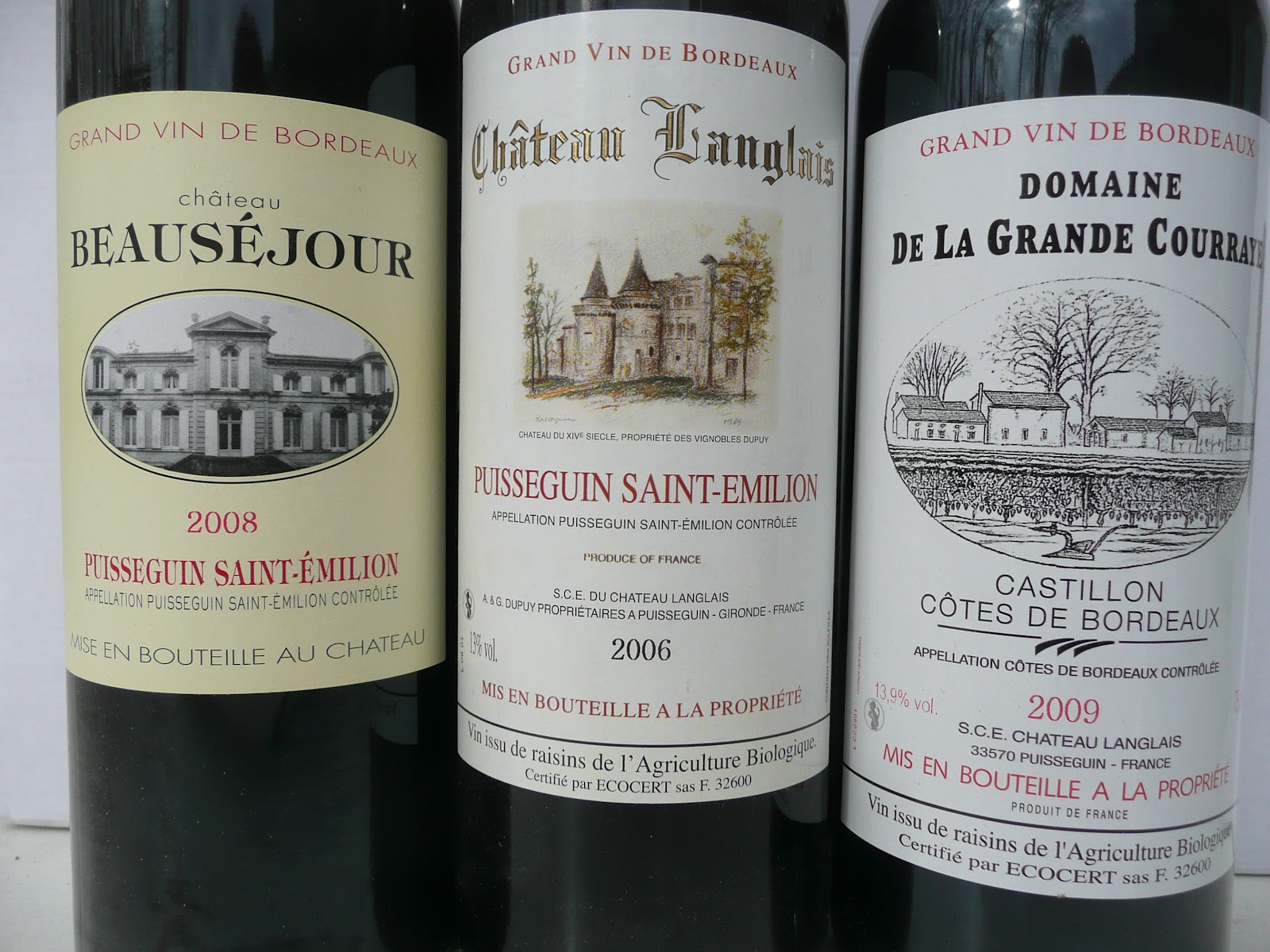
In September, we will do a cellar and vineyard tour of Chateau Beausejour and will have lunch there. We will taste the 3 wines of Gerard Dupuy, who owns and makes the wines of Chateau Beausejour (AOC Puisseguin-St.Emilion),  Chateau Langlais (AOC Puisseguin-St. Emilion) and  Domaines de la Grande Courraye (Castillon Cotes de Bordeaux). All wines are bio wines, certified by Ecocert.

Pictures: Chateau Beausejour in Puisseguin

Gerard Dupuy is not one of the 150 or so winemakers in Bordeaux, who produce a premium  Bordeaux that sells en primeur for several hundreds or even thousands of Euros per bottle. No, Gerard is one of the other 18.000 winemakers that are not in the limelight and who have to struggle against the competition of wines from all over the world, including the New World. But Gerard’s wines are interesting and special for at least 2 reasons. He produces – like so many others – good value Petite Bordeaux wines and he makes them organically.

AOC Puisseguin-St. Emilion 

Puisseguin-St. Emilion lies at the heart of the four satellite titles of the St. Emilion appellation on the right bank. The grape varieties permitted here are Merlot, Malbec, Cabernet Franc and Cabernet Sauvignon. Thus, Puisseguin-St. Emilion produces only red wines. Merlot is predominant, most often partnered with Cabernet Franc.

To qualify for the Puisseguin-St. Emilion appellation, wines must contain a minimum of 11% alcohol and come from vineyards planted to a density of less than 5500 vines per hectare. Puisseguin-St.Emilion was granted AOC status in 1936. 753 hectares of vine planted areas belong to the appellation.

Picture: Map of Bordeaux

The 4 St. Emilion satellites are St.Georges-Saint-Emilion, Montagne-St.Emilion, Lussac-St.Emilion and Puisseguin-St.Emilion itself – all located to the north of St.Emilion town. They are known as satellites because the area's more prestigious wine estates historically resented these supposedly inferior wines using the St.Emilion name.

Chateau Beausejour 

Gerard Dupuy told us that the clay and limestone soil of Chateau Beausejour is planted with Merlot (73%), Cabernet Franc (22%) and Cabernet Sauvignon (5%).

All grapes are organically grown, certified by Ecocert. Gerard Dupuy: “The refusal of chemical treatments at our wineries dates back to their appearance on the market after 1945. We practice the total grass cover. This method allows regulating the ecosystem in a monoculture, while limiting soil erosion. In our vineyards, wild tulips thrive in the vineyard rows in the spring.” The combined vineyard area of Château Beauséjour and Château Langlais is 25 hectares. The average age of the vines is 40 years.

Moving on to cellar, there he follows the natural wine philosophy. Gerard Dupuy: “In the cellar, we use a minimalist approach. Our wines are aged for a period of 12 to 24 months in oak barrels.”

Picture: Chateau Beausejour in Puisseguin

Domaine de la Grande Courraye

The vineyards of Domaine de la Grande Courraye are in the Castillon Côtes de Bordeaux appellation. I did not ask Gerard, but my hunch is that Domaine de la Grande Courraye is not more than a name under which the wine from his vineyard in Castillon Côtes de Bordeaux is sold. The same probably applies to Château Langlais.

Castillon Côtes de Bordeaux

East of St. Emilion and its 4 satellites, above the town of Castillon, lie the Côtes de Castillon and the Côtes de Francs AOCs. Côtes de Castillon is an appellation for red wines only.

The dominant grape variety is Merlot (70%). Cabernet-Franc (20%) and Cabernet-Sauvignon (10%) account for the rest.

Castillon Côtes de Bordeaux was recognized AOC only quite recently (1989). For a long time the wines of Castillon were only used as complementary alternatives to enhance Saint-Emilion blendings in poor years. Until 2009, these wines were sold as Cotes de Castillon. In 2009, the Cotes de Castillon appellation was merged with several other Bordeaux cotes to form the new Cotes de Bordeaux title.

Castillon has risen from around 2,450 hectares in 1982 to 3,250 today. During the last 25 years or so, several growers of Saint-Emilion, Pomerol  and other famous areas have recognized the Castillon Côtes de Bordeaux’s potential and invested in local vineyards. One of them is Stephan de Niepperg, who has acquired Château d'Aiguilhe. 

Ecocert

Ecocert is an inspection and certification body established in France in 1991. Ecocert has developed its own international network. With 23 offices and subsidiaries, Ecocert operates and offers its services in over 80 countries.

For a "Primer" on the various concepts of winemaking with an ecological mindset see: Organic, Sustainable, Biodynamic, Natural Wines … A Primer for “Green” Wines

The Wines of  Gerard Dupuy

We did not taste the wines of Gerard Dupuy this time, but will do so in September, when we will come back with the Weinfreundeskreis Hochheim.

Pictures: The Wines of Chateau Beausejour (AOC Puisseguin-St.Emilion),  Chateau Langlais (AOC Puisseguin-St. Emilion) and  Domaines de la Grande Courraye (Castillon Cotes de Bordeaux). All Wines are Bio Wines, Certified by Ecocert.

Organic Wine in Bordeaux and in France

French organic vineyards doubled between 2007 and 2010 and then increased again 28 percent between 2009 and 2010 to reach 50,268 hectares, compared with a total of 860,000 hectares, accounting for 7 percent of the total. 

The Aquitaine region, around the Garonne river, is today the third largest in the country to experiment with organic vineyards, behind Languedoc-Roussillon and Provences-Alpes-Cote-D'azur, respectively in southwest and southern France.

In Bordeaux, Chateau Guiraud in Sauternes - a 1855 classified producer - was recently approved to carry the organic label.


schiller-wine: Related Postings

A Glass of Bordeaux – What Else? – With Wine Journalist Panos Kakaviatos

Meeting Virginia and Bordeaux Wine Expert and Wine Blogger Allan Liska, USA

The Wines from Entre Deux Mers Winemaker Joel Duffau

In the Glass: 1970 Chateau de La Riviere, Fronsac, France

Henri Lurton and his Chateau Brane Cantenac Wines

The Emerging Wine Giant China - Mouton Cadet Bar Opening

Trends in the global wine market: old world, new world, emerging wine countries

The Label of 2007 Chateau Mouton Rothschild designed by Bernar Venet

(German) Winemakers in the World: The German Roots of Baron Philippe de Rothschild

Emerging Wine Country: China's Wine Boom Since 2000

Bordeaux Wines and their Classifications: The Basics

In the Wine Capital of the World: the City of Bordeaux, France

Organic, Sustainable, Biodynamic, Natural Wines … A Primer for “Green” Wines

Visiting Jared Brandt and his Donkey & Goat Winery – Natural Wines Made in Berkeley, California

Excellency and Ecology: The Wines of Gebrueder Dr. Becker in Rheinhessen, Germany

The Millesime Bio 2010 in Montpellier, France: A Discovery of Organic and Biodynamic Wines at the one of a Kind Wine Trade Show

The Natural Wines of Terroir in San Francisco

At the Forefront of Biodynamic Winemaking: Visiting Werner and Angela Michlits and their Weingut Meinklang in Austria

One of Oregon's Pioneering Winemakers - Myron Redford - with his Amity Vineyard Wines in Washington DC


Tuesday, November 15, 2011

Organic, Sustainable, Biodynamic, Natural Wines … A Primer for “Green” Wines

Pictures: Christian G.E. Schiller with Werner Michlits from Weingut Meinklang in Pamhagen in Austria. Weingut Michlits is at the Forefront of Biodynamic Winemaking

A few weeks ago in Pamhagen in Austria in the stone cave below the winery with Werner Michlits, where Werner showed us his magic cow poop and other ingredients for biodynamic farming, I was really at the forefront of winemaking with an ecological mindset. There are many others on this route. But these “green” winemakers come in different colors. I just tasted the Santa Julia wines of Familia Zuccardi, who produce mass wines in Argentina with organic grapes. Argentina, in general, is very well suited for organic winemaking. “We practice sustainable agriculture in the vineyard” said Yann-Leon Beyer when I visited Domaine Leon Beyer in Alsace in France. The Donkey and Goat Winery in Berkeley produces wine according to the natural wine concept in the midst of the city of Berkeley without owning any vineyards. Researchers have found out that from a point of view of minimizing the carbon footprint, New Yorkers should drink Bordeaux instead of domestic wine from California. The following tries to shed some light on the different concepts of “green” winemaking.

Organic

Organic generally means the use of natural as opposed to chemical fertilizers, insecticides and pesticides. The key is: no chemicals. Organic wines are changing the look of vineyards, literally. Whereas vineyards of the past commanded neat rows rid of all insects, rodents and weeds, organic vineyards are now replacing costly and damaging chemical sprays with environmental partnerships. Pesticides are giving way to introducing low-growing plants between vine rows that host beneficial insects that keep the pest insects in check.

Pictures: Conventional and Organic Vineyard

Unfortunately, while there is a broad consensus what organic vine growing means, there is no agreement on what organic wine making implies. The main issue is the use of sulfur in the fermentation process and the disagreement is between the US and Europe. In the US, organic winemakers are not allowed to add sulfites during winemaking; an organic wine is a wine with no added sulfur. In Europe, sulfites are allowed to be added during fermentation and an organic wine typically contains a modest amount of sulfur.

Picture: Christian G.E. Schiller with from Familia Zuccardi, who Produce Mass Wines in Argentina with Organic Grapes

Sulfites are generally considered a required addition to a fine wine before bottling for two reasons: to prevent oxidation and prevent bacteria from running wild. This is a time-honored process. The Romans practiced it over 2,000 years ago. So, as a rule all wines produced in the world have been stabilized by adding sulfur, with a few exceptions. One of these exceptions are organic wines made in the US, such as the wine of Frey Vineyards in Mendocino County in California. Frey Vineyards uses other, innovative methods to stabilize wine, which others would consider outside of “green” winemaking.

Picture: Christian G.E. Schiller with one of Oregon's Pioneering Winemakers - Myron Redford - with his Amity Vineyard Wines in Washington DC. Amity Vineyard also Produces Wines Without Adding Sulfur.

Alternatively, in the US, wine made from organically grown grapes is an organic wine a la Europe: Organic in the vineyard, but probably sulfur added in the wine cellar.

Pictures: Christian G.E.Schiller with Owner/Winemaker Lotte Pfeffer-Müller, Weingut Brueder Dr. Becker in Germany. Lotte Pfeffer-Mueller is the President of "Eco-Vin".

Biodynamic

Biodynamic is similar to organic farming in that both take place without chemicals, but biodynamic farming incorporates ideas about a vineyard as an ecosystem, and also accounting for things such as astrological influences and lunar cycles. Biodynamic is an approach following the rules and ideas of Austrian philosopher-scientist Rudolph Steiner. In his 1924 lectures, he viewed the farm as a closed circuit. Thus, farm animals are an integral part of biodynamic winemaking; they should consume the cover crops left between vines and their waste should be then replaced between those vines to rebuild the soil.

Sustainable

Sustainable farming means farming in a way that will allow for continued farming throughout the ages. In its broadest interpretation, sustainability refers to a range of practices that are not only ecologically sound, but also economically viable and socially responsible. Although nowhere defined by law, there are many certifications available for “Sustainable Wine.”

Picture: Christian G.E.Schiller with Yann-Leon and Marc Beyer at Maison Beyer in Eguisheim in Alsace. Maison Beyer follows the Concept of Sustainable Winemaking.

Natural

The idea behind natural wine is non-intervention and a respect for Mother Nature. Natural wines are hands-off wines produced with as little intervention as possible. Generally, the concept of natural wine relates more to what happens in the wine cellar rather than what happens in the vineyard. Again, nowhere is the term defined by law; it is left open to interpretation. Typically, only natural yeasts are used, the fermentation is slow, there is little or no use of new oak barrels; and there are no filtrations or cold stabilization. Commercial yeasts are one of the great culprits in today’s homogenization of wine, imparting their own aromas over those of the grape.

Pictures: Christian G.E. Schiller with Jared Brandt from the Donkey and Goat Winery in Berkeley, California. Donkey and Goat Produces in the Middle of Berkeley Natural Wines, where I recently spent a couple of hours with Jared talking about what natural wines is all about.

Carbon Footprint

The carbon neutral label comes from a different angle: global warming. All economic activities have a carbon footprint, including wine making. Carbon neutral wineries are trying to make a contribution to the general efforts of reducing the emission of carbon dioxide. Belgrave Park Winery in Australia, for example, is a completely carbon neutral vineyard and winery. But the concept of cabon footprint should not stop at the gate of the winery. Researchers have found out, for example, that from a point of view of minimizing the carbon footprint, New Yorkers should drink Bordeaux instead of domestic wine from California.

Water Footprint

A new thing is water footprint, reflecting the concern that the planet is moving into a period where water becomes more and more scarce.

Vegan

Vegan refers to the process of fining the wine - eliminating undesirable items - with fining agents made from animal products, such as fish bladders and egg whites. As an alternative, Bentonite, a specific type of clay, is used for clarification in vegan wines.

schiller-wine: Related Postings

The Natural Wines of the Donkey and Goat Winery in Berkeley, California

Visiting Jared Brandt and his Donkey & Goat Winery – Natural Wines Made in Berkeley, California

Excellency and Ecology: The Wines of Gebrueder Dr. Becker in Rheinhessen, Germany

Wine Event: President Obama and the First Lady eat at the "Green" Restaurant Nora and have a "Green" Spottswoode Wine

The Millesime Bio 2010 in Montpellier, France: A Discovery of Organic and Biodynamic Wines at the one of a Kind Wine Trade Show

Benzinger Wines Served at the 2010 "Green" Annual White House Correspondents Dinner

The Natural Wines of Terroir in San Francisco

Skype and Biodynamic Winemaking - Winetasting in the US with Winemaker Werner Michlits, Weingut Meinklang, in Austria

At the Forefront of Biodynamic Winemaking: Visiting Werner and Angela Michlits and their Weingut Meinklang in Austria

Julia Zuccardi from Familia Zuccardi in Argentina Visited the US to Introduce New Santa Julia Wines

One of Oregon's Pioneering Winemakers - Myron Redford - with his Amity Vineyard Wines in Washington DC

Visiting Yann-Leon Beyer at Maison Leon Beyer in Eguisheim in Alsace

Wednesday, June 1, 2011

In the Glass: 3 Malbecs from Santa Julia, Argentina - Santa Julia [+], Organica and Reserva

Picture: 2010 Santa Julia [+], Malbec, Bodega Santa Julia, Mendoza, Argentina (screw cap, 13% alc., made with 100% sustainably farmed grapes); 2010 Santa Julia Organica, Malbec, Bodega Santa Julia,Mendoza, Argentina (cork, 12,5% alc., made with organic grapes certified by Letis S.A.); 2009, Santa Julia Reserva, Malbec, Bodega Santa Julia, Mendoza, Argentina (cork, 13,5% alc., made with 100% sustainably farmed grapes, aged in French oak for 10 months)

I met Julia Zuccardi recently, when she toured the US to present the new Santa Julia [+] line of wines of the Familia Zuccardi winery. I wrote about it here. This posting focuses on 3 different Malbecs Julia Zuccardi brought along, more specifically: (1) All three wines are made by the Familia Zuccardi Winery in Mendoza, Argentina. I will talk a bit about the producer and Argentina more generally. (2) All three wines are Malbec, which has become the signature grape of Argentina, but originates from Cahors in France. (3) All three wines are “green” wines, one is made with organically grown grapes and two are made following Familia Zuccardi’s principles of sustainable winemaking.

Familia Zuccardi winery in Mendoza, Argentina

The Santa Julia line of wines is the main brand of the Familia Zuccardi winery in Mendoza, Argentina. Argentina has always been a giant wine producer. But historically, Argentine winemakers were more interested in quantity than quality with the country consuming 90% of the wine it produced. For most of the 1900s, Argentina produced more wine than any other country outside Europe, with the vast majority being consumed domestically. Argentine wines started being exported during the 1990s. it is now the second biggest wine exporter in Latin America, following Chile. The devaluation of the Argentine peso in 2002, following the economic collapse, further fueled the wine industry.

Picture: The Wine Regions of Argentina

Argentina is the 5th largest producer of wine in the world, following Spain, France, Italy and the US. Like much of the new world, Argentina owes its first vineyards to the Catholic Church. As early as 1556, missionary priests crossed the Andes from the Spanish colony in what is now Chile, to Argentina. The wine industry grew rapidly, as the Spanish and Italian immigrants brought with them the habit of having a bottle of wine with every meal. In the 1920s, Argentina was the 8th richest nation in the world. Domestic wine consumption was as high as 90 liters per person. Yet it is only very recently - perhaps over the last ten or fifteen years - that the wine industry has really begun to develop the methods, attitudes and will to become a serious player in the international wine market.

The Andes Mountains are the dominant geographical feature of Argentine wine regions, with the snow cap mountains often serving as a back drop view in the vineyards. Most of the wine regions are located within the foothills of the Andes. The most important wine regions of the country are located in the provinces of Mendoza and San Juan and La Rioja. Salta, Catamarca, Río Negro and more recently Southern Buenos Aires are also wine producing regions. The Mendoza province produces more than 60% of the Argentine wine and is the source of an even higher percentage of the total exports.

There are many different varieties of grapes cultivated in Argentina, reflecting her many immigrant groups. The French brought Malbec, which makes most of Argentina's best known wines. The backbone of the early Argentine wine industry were the high yielding, pink skin grapes Cereza, Criolla Chica and Criolla Grande which still account for nearly 30% of all vines planted in Argentina today.

Mendoza

Mendoza is the leading producer of wine in Argentina. The vineyard acreage in Mendoza alone is slightly less than half of the entire planted acreage in the US and more than the acreage of New Zealand and Australia combined. Located in the shadow of Mount Aconcagua, the average vineyards in Mendoza are planted at altitudes of 1,970-3,610 feet (600-1,100 meters) above sea level. The soil of the region is sandy and alluvial on top of clay substructures and the climate is continental with four distinct seasons that affect the grapevine, including winter dormancy.

Familia Zuccardi – The Story

Familia Zuccardi is a family company founded in 1963 by Engineer Alberto Zuccardi. He set up his own irrigation company in 1950 in Mendoza, experimenting with irrigation methods used in California. To illustrate the working of his irrigation system, he planted in 1963 the first vineyard in Maipù - at that time totally desert area. He did the same ten years later in Santa Rosa, half an hour drive from Mendoza. In both cases, the arid, unfertile soil was transformed into a flourishing vineyard. In 1968, he built a winery and started to make his own wine. He was also instrumental in introducing the Italian pergolas system, in Argentina called ‘parral’, in Argentina, for a better canopy management and fruit ripeness.

Pictures: Christian G.E.Schiller and Julia Zuccardi in Washington DC

In 1976, Alberto’s son Jose Alberto joined the family company. He created the Santa Julia brand in the 1980s, named after Jose Alberto’s only daughter Julia, who I had the pleasure to meet and to have lunch with. I was very pleased to sit and talk to her for a couple of hours. In the 1990s, the Santa Julia line was complemented by the Zuccardi line of wines. While the Santa Julia line is an entry level line, the Zuccardi wines are all quality and premium wines. Today, 3 generations are active in the company: the founder Alberto Zuccardi, Julia’s father Jose Alberto, and his 3 children: Sebastian is in charge of the estate the family has in the region of Uco Valley; Miquel went for another product than wine and started to make olive oil; Julia is in charge of the tourism sector of the company, including the new visitor center and the restaurant at the winery.

Familia Zuccardi produces 1.000.000 cases annually, of which 60% is exported. The main export market is Canada, followed by the US (100.000 cases) and Brazil. In total, there are 750 hectares of grapes under cultivation: Maipú 170 Ha; Santa Rosa 473 Ha and Uco Valley 107 Ha.

Malbec


All 3 wines are Malbec. When people talk about Malbec, at least in the US, they talk about Malbec from Argentina. Indeed, over the course of last 20 years, Malbec has become Argentina's signature grape and Argentina now grows more than 70 percent of the world’s production of that grape. But Cahors in the South West of France is were it all started and were Malbec originates from. April 17th was World Malbec Day and I wrote about its birthplace here.

Cahors

Cahors wines have a long history. The wine industry was developed by the Romans, who planted vines in Cahors even before they got to Bordeaux. The “black wine” of Cahors reached its heyday in the Middle Ages, when they were on the table at the marriage of Eleanor of Aquitaine with Henry II of England in 1152. But Bordelais winemakers saw the Cahors wines as a competitor to their own wines and introduced taxes and levies that hindered Cahors’ export out of Bordeaux, and, in turn, its reputation. In addition, in the late-19th century, phylloxera nearly destroyed the wine business in Cahors. The vines recovered eventually. Things looked pretty bleak until 1971, when Cahors achieved AOC status.

Malbec from Cahor and from Argentina

Malbecs from Cahor and Argentina tend to be strikingly different. Argentina Cahors are a New World style wines - fruity and smooth. The Malbecs from Cahor, on the other hand, tend to be more earthy and leathery, the flavors and textures a bit more rustic and chewy. And yet both Cahors and Argentina always feature Malbec’s essential flavors of cassis and black cherry. One style is not necessarily better than the other; they are just delightfully different. The American consumer, without doubt, favors overwhelmingly the Malbecs from Argentina.

Organic and sustainably Made Wines

The Santa Julia [+] and the Santa Julia Reserva have the Familia Zuccardi’s “Sustainable by Nature” logo on the label, while the third wine is made from organically grown grapes. All the wines belong to the family of what one could call “green” wines. The following tries to shed some light on the different concepts of “green” winemaking.

Organic: Organic generally means the use of natural as opposed to chemical fertilizers, insecticides and pesticides. The key is: no chemicals. Organic wines are changing the look of vineyards, literally. Whereas vineyards of the past commanded neat rows rid of all insects, rodents and weeds, organic vineyards are now replacing costly and damaging chemical sprays with environmental partnerships. Pesticides are giving way to introducing low-growing plants between vine rows that host beneficial insects that keep the pest insects in check.

Unfortunately, there is no agreement on what organic wine making as opposed to organic wine growing means. The main issue is the use of sulfur in the fermentation process. In the US, organic winemakers are not allowed to add sulfites during winemaking; an organic wine is a wine with basically zero sulfur. In Europe, sulfites are allowed to be added during fermentation and an organic wine typically contains a modest amount of sulfur.

Biodynamic: Biodynamic is similar to organic farming in that both take place without chemicals, but biodynamic farming incorporates ideas about a vineyard as an ecosystem, and also accounting for things such as astrological influences and lunar cycles. Biodynamic is an approach following the rules and ideas of Austrian philosopher-scientist Rudolph Steiner. In his 1924 lectures, he viewed the farm as an entire living ecosystem starting with the soil which is treated as a living organism and receives special applications to enhance its health.

Pictures: Julia Zuccardi

Sustainable: Sustainability refers to a range of practices that are not only ecologically sound, but also economically viable and socially responsible. Sustainable farmers may farm largely organically or biodynamically but have flexibility to choose what works best for their individual property; they may also focus on energy and water conservation, use of renewable resources and other issues.

Natural: The idea behind natural wine is non-intervention and a respect for nature. For example, only natural yeasts are used, the fermentation is slow, there is little or no use of new oak barrels; and there are no filtrations or cold stabilization. Natural wines are minimalist wines produced with as little intervention as possible.

Vegan: Vegan refers to the process of fining the wine - eliminating undesirable items - with fining agents made from animal products, such as fish bladders and egg whites. As an alternative, Bentonite, a specific type of clay, is used for clarification in vegan wines. It’s important to note that vegan or vegetarian wines may or may not be made from organic grapes.

Carbon Footprint: The carbon neutral label comes from a different angle: global warming. All economic activites have a carbon footprint, including wine making. Carbon neutral wineries are trying to make a contribution to the general efforts of reducing the emission of carbon dioxide.

Water Footprint: A new thing is water footprint, reflecting the concern that the planet is moving into a period where water becomes more and more scarce.

Favorable Conditions for Santa Julia Wines in Argentina

Due to the high altitude and low humidity of the main wine producing regions, Argentine vineyards rarely face the problems of insects, fungi, molds and other grape diseases that affect vineyards in other countries. This permits cultivating with little or no pesticides, allowing even organic wines to be easily produced. Argentina, like Chile, is unique in the wine world for the absence of the phylloxera threat that has devastated vineyards across the globe. Unlike Chile, the phylloxera louse is present in Argentina but is a particular weak biotype that doesn't survive long in the soil. Because of this most of the vineyards in Argentina are planted on ungrafted rootstock.

Picture: 2010 Santa Julia [+], Malbec, Bodega Santa Julia, Mendoza, Argentina (screw cap, 13% alc., made with 100% sustainably farmed grapes); 2010 Santa Julia Organica, Malbec, Bodega Santa Julia,Mendoza, Argentina (cork, 12,5% alc., made with organic grapes certified by Letis S.A.); 2009, Santa Julia Reserva, Malbec, Bodega Santa Julia, Mendoza, Argentina (cork, 13,5% alc., made with 100% sustainably farmed grapes, aged in French oak for 10 months)

The Santa Julia [+] Malbec as well as the Santa Julia Reserva are produced in Familia Zuccardi’s “Sustainable By Nature” framework. In this context, the Santa Julia [+] line is using lighter weight glass bottles to lower CO2 emissions (12,5% lighter). Another aspect of the Zuccardi Sustainability By Nature approach is a water recycling program to minimize the water footprint of wine making. It also includes a commitment to organic farming and social programs for the workforce. “We now have a permanent workforce of over 450 people. Workers at Familia Zuccardi are employed year-round and the winery provides subsidized health care and free education to all its workers” said Julia Zuccardi.

The Santa Julia Organica Malbec is produced with 100% organically grown grapes, certified by Letis, S.A.

Schiller Wine - Related Postings

The Wines of Argentina's Cult Winemaker Achaval-Ferrer

Argentinian Wine Removed from Shelves in Germany Because of an Antibiotic in the Wine

World Malbec Day - Malbec from its Birthplace: Cahors in France

Julia Zuccardi from Familia Zuccardi in Argentina Visited the US to Introduce New Santa Julia Wines

The Wines of Chateau La Caminade in the Cahors, France - Malbec from its Birthplace