Showing posts with label Vendredis du Vin. Show all posts

Friday, September 27, 2013

Winemaker Martin Tesch, Weingut Tesch in the Nahe Valley, and Rock ‘N’ Roll, Germany

Picture: Christian G.E. Schiller and Martin Tesch in Wiesbaden, Germany

Martin Tesch is one of Germany’s leading winemakers. Wine Journalist and Riesling Guru Stuart Pigott named him Winemaker of the Year 2013. Martin has a passion for Rock ‘N’ Roll and has managed to integrate his passion into his winemaking: Martin Tesch’s signature wine is “Unplugged”; Martin Tesch has documented his passion for wine and Rock ‘N’ Roll in a book entitled Riesling People Vol. 1; Martin Tesch has made the wine “Weisses Rauschen” with the leading German Punk Group “Tote Hosen” and - to celebrate the 10th anniversary of "Unplugged" - Martin Tesch released the audio book Riesling People Vol. 2..

See also:
Martin Tesch, Weingut Tesch, Winemaker of the Year (Germany, 2012) - Stuart Pigott/FAZ

Vendredi du Vin #59: Wine and Music

This posting is being published as part of the Vendredis du Vin, a monthly blog event in France. Participating wine bloggers - mainly in France - are all releasing postings today under the same heading. This month's Vendredi du Vin is orchestrated by Lolita Sene of "J'aimetonwine". The theme is “Wine and Music”.

Picture: Vendredi du Vin #59

Dr. Martin Tesch and Weingut Tesch

Martin Tesch owns and runs Weingut Tesch in the Nahe Valley. The winery has been family-owned and run since 1723 and is a member of the prestigious VDP, the century-old association of Germany’s top winemakers.

In his mid-thirties, Dr. Martin Tesch is a Ph.D. microbiologist by training. He took over Weingut Tesch in 1996 and has presided over fundamental changes both in the vineyard and the wine cellar as well as in the marketing of the Tesch wines.

When Martin Tesch stepped in, the vineyards totaled over 30 hectares and the wine portfolio was pretty mainstream, with a multitude of grape varieties, of quality levels according to the German wine law and of styles in terms of sweetness of the wine.

Picture: Martin Tesch in Mainz

Martin changed this radically.

First, he cut back on the overall output of the winery. All the north-facing vineyard slopes were abandoned as they naturally produced poorer grapes. These slopes have now reverted to nature and helped create habitat and biodiversity.

Next, he concentrated on Riesling and Pinot Noir, the king and the queen of German grape varieties. All other grapes were grubbed up. Today the vineyard area totals 20 hectares of which 17 is Riesling and the remainder Pinot Noir.

Starting in 2001, Martin stopped producing sweet-style wines. All Tesch wines are now bone-dry, except, it seems, for the occasional Eiswein when conditions allow.

Further, he has moved to natural and non-interventionist winemaking and strict yield control of between 20-30 hl/ha. The harvest is manual and he picks the grapes at full ripeness, but avoids botrytis.

Also, he changed and simplified the label design. There are no long words anymore on the label. Each wine is color-coded and has individual artwork to distinguish it.

Finally, Martin Tesch now uses the Stelvin glass closure. It is an ultra-modern and expensive technical fitting; Martin Tesch and an increasing number of his colleagues are very upbeat about it.

Riesling Unplugged

Martin’s signature wine is “Riesling Unplugged”. "Unplugged" by Eric Clapton has always been one of my favorite albums. Clapton recorded the album for the MTV unplugged series. This was a series of CDs recorded live with as much authenticity as possible. Martin Tesch's "Riesling Unplugged" is - like Eric Clapton’s “unplugged” music and the music of the other unplugged CD series artists - a natural wine, with minimal intervention, just as Mother Nature nature intended it.

Riesling Weißes Rauschen

In a joint venture with the Die Toten Hosen, Martin Tesch produced the wine "Weisses Rauschen". Of course, Martin is in the lead, but Martin told me that the band played an active role in the selection of wine, the name of the wine and the design of the bottle. The wine was named after a song of Die Toten Hosen from the album Zurueck zum Glueck (Back to Happiness).

Die Toten Hosen is the leading German punk band. The members of Die Toten Hosen are Campino (Andreas Frege), Kuddel (Andreas von Holst), Vom (Stephen 'Vom' Ritchie), Andi (Andreas Meurer) and Breiti (Michael Breitkopf).

The band has existed for over 20 years. The debut single "Wir sind bereit" (we are ready) was released in 1982. Their 1000th concert was on 28 June 1997, in the Düsseldorfer Rheinstadium, and was attended by more than 60,000 fans.

Picture: Die Toten Hosen

Riesling People Vol. 1

Martin Tesch has documented his passion for wine and Rock and Roll in a book entitled Riesling People Vol. 1.

This is an unusual book. It explains in a straightforward way, without words, what makes Martin Tesch tick and the wines he produces so special. As a picture-book and travelogue, Riesling People Vol. 1 differs dramatically from the usual wine books. Almost without words, the book tells the story of Martin Tesch and his love for Riesling and Rock and Roll music. It is narrated by black and white photography, printed on glossy paper, and showcases the ecclectic mix of wine and music in Martin's world.

The central theme of the book is the Rolling Riesling Show, which was jointly organized by Martin Tesch and the guitar manufacturer Gibson. Martin Tesch took an audience that was not necessary knowledgeable about wine through six different dry Rieslings and their soil-specific differences. In addition to the Rolling Riesling Show events, the book includes pictures from London wine bars, from Hong Kong, New York, Jancis Robinson and Stuart Pigott, proud Australian importers with the first container of Tesch wines, Martin Tesch at the concert of the Tote Hosen in Trier and backstage with the Düsseldorfer Punk Rockers at Rock am Ring.

Pictures: Riesling People Vol.1 and Vol.2

Riesling People Vol. 2

With the 2010 vintage, Martin Tesch's Riesling Unplugged celebrated its 10th anniversary. At this occasion, Martin produced the audio book Riesling People Vol. 2. It is a medley of diverse contributions of a group of friends of Martin Tesch - sommeliers, customers, journalists, writers, chefs and musicians. The sommeliers Natalie Lumpp, Jürgen Fendt, Billy Wagner and others comment on Riesling Unplugged of each of the 10 vintages; Stuart Pigott talks about hunting sharks on the Nahe river. The Rock and Roll Band Die Toten Hosen – Martin Tesch produced the wine Weisses Rauschen with them (see below) – contributed a song to the Riesling People Vol. 2, as did Koester + Hocker and the Group Les Sauvignons. All in all, a highly entertaining and informative audio book about Martin Tesch’s Riesling Unplugged.

Schiller Wine - Related Postings

In the Glass: Unplugged - Eric Clapton and Martin Tesch

Impressions from the Riesling + Co World Tour 2010 in New York

In the Glass: 2009 Weisses Rauschen – A Joint Venture of Winemaker Martin Tesch and Punk-Rock Band Die Toten Hosen

The Avantgarde Wine World of Dr. Martin Tesch

Tesch Riesling Unplugged 2010 and Duo Favo FAVOriten

Wine Maker Martin Tesch: Riesling People Vol. 2, Germany

Best German Wine and Winemakers – Stuart Pigott’s Favorites (2011)

Stuart Pigott at the Weinhalle in Frankfurt am Main, Germany

Martin Tesch, Weingut Tesch, Winemaker of the Year (Germany, 2012) - Stuart Pigott/FAZ

Friday, June 28, 2013

Italian Natural Wines

Picture: Vendredi du Vin #57 - Vini Naturali d'Italia

Italian Wine

Italy is home of some of the oldest wine-producing regions in the world. Etruscans and Greek settlers produced wine in the country long before the Romans started developing their own vineyards. Two thousand years later, Italy is world leader in wine, accounting for about 20% of world wine production. Italians also lead the world in wine consumption by volume, 59 liters per capita, compared with 8 liters per capita in the US. Wine is grown in almost every region of the country.

Picture: The Wine Regions of Italy

Vendredi du Vin #57: Italian Natural Wines

This posting is being published as part of the Vendredis du Vin, a monthly blog event in France. Participating wine bloggers - mainly in France - are all releasing postings today under the same heading. This month's Vendredi du Vin is orchestrated by Patrick Böttcher, a manager of a pharmacy in Brussels, Belgium. The subject is: Italina Natural Wine: “Petit rappel, les italiens définissent leurs vins comme naturels s'ils sont issus de sols respectueux de la nature, et s'ils sont fait en respect avec l'artisanat historique tout en intervenant un minimum afin de conserver les marques de leur fruit et de leur terroir. S'ils ont effectivement souvent très peu de soufre embarqué, il n'y apas de règle absolue, juste du bon sens.”

My contribution is a bit broader than Italian natural wines. After a short primer of different concepts of “green” winemaking, including natural I profile “Agricola Querciabella” is a leading winemaker in the Super Tuscan movement, i.e. ultra-premium wines sold as IGT wine as the wines are made outside of the DOCG regulations. Agricola Querciabella has become a leading winemaker in the cruelty-free biodynamic movement, i.e. the 100% vegan approach to biodynamic winemaking.

Patrick Böttcher’s List of Italian Natural Wine Producers

Here is Patrick Patrick Böttcher’s List of Italian Natural Wine Producers: “Bon comme on est sympa et qu'on sait que vous allez caler, voici une liste de gentils vignerons dont nous vous conseillons absolument les quilles : Luca Roagna, Belotti, Giuseppe Rinaldi, Giuseppe Mascarello, Augusto Cappellano, Bartolo Mascarello, Brovia, Trinchero, Sylvio Morando, Villa Terlina, Elisabetta Foradori, Musella, Corte Sant'Alda, Tenuta Grillo, Lo Zerbone, La Stoppa, Denavolo, Tenuta di valgiano, Podere le Boncie, Pacina, Colombaia, Fonterenza, Stella di Campalto, Montevertine, Pian dell'Orino, Paradiso di Manfredi, Fattoria di Caspri, Massa Vecchia, Podere Sanguineto, Le Coste, Emilio Pepe, Cantina Giardino, Ca del Noce, Lamoresca, COS, Occhipinti, Frank Cornelissen, Paolo Bea, et tous les inspirés de la Slovénie voisine, Gravner, Princic, Radikon, Vodopivec... et j'en oublie, forcément !!!!!”

Natural and Other Green Concepts of Winemaking

What are natural wines? Generally, the idea behind natural wine is non-intervention and a respect for nature. Natural wines are part of a group of wines that I would call “green wines”, wines made with an ecological concept in mind. There are several different concepts of “green wines”.

Organic: Organic generally means the use of natural as opposed to chemical fertilizers, insecticides and pesticides. The key is: no chemicals.

Organic wines are changing the look of vineyards, literally. Whereas vineyards of the past commanded neat rows rid of all insects, rodents and weeds, organic vineyards are now replacing costly and damaging chemical sprays with environmental partnerships. Pesticides are giving way to introducing low-growing plants between vine rows that host beneficial insects that keep the pest insects in check.

Unfortunately, there is no agreement on what organic wine making as opposed to organic wine growing means. The main issue is the use of sulfur in the fermentation process. In the US, organic winemakers are not allowed to add sulfites during winemaking; an organic wine is a wine with basically zero sulfur. In Europe, sulfites are allowed to be added during fermentation and an organic wine typically contains a modest amount of sulfur.

Biodynamic: Biodynamic is similar to organic farming in that both take place without chemicals, but biodynamic farming incorporates ideas about a vineyard as an ecosystem, and also accounting for things such as astrological influences and lunar cycles. Biodynamic is an approach following the rules and ideas of Austrian philosopher-scientist Rudolph Steiner. In his 1924 lectures, he viewed the farm as an entire living ecosystem starting with the soil which is treated as a living organism and receives special applications to enhance its health.

Sustainable: Sustainability refers to a range of practices that are not only ecologically sound, but also economically viable and socially responsible. Sustainable farmers may farm largely organically or biodynamically but have flexibility to choose what works best for their individual property; they may also focus on energy and water conservation, use of renewable resources and other issues.

Natural: The idea behind natural wine is non-intervention and a respect for nature. For example, only natural yeasts are used, the fermentation is slow, there is little or no use of new oak barrels; and there are no filtrations or cold stabilization. Natural wines are minimalist wines produced with as little intervention as possible.

Vegan: Vegan refers to the process of "finning" the wine. Proteins, spent yeasts and small organic matter in wines are sometimes eliminated from wines with fining agents made from animal products. Fish bladders, egg whites, milk proteins and even bull’s blood (not allowed in the US or France) are all used as fining agents. As an alternative, Bentonite, a specific type of clay, is used for clarification in vegan wines. It’s important to note that vegan or vegetarian wines may or may not be made from organic grapes.

Fair trade: Fair trade wines first came onto the market the US in 2007, following trends in coffee, tea and produce. Fair trade refers to the conditions and wages paid to employees of the winery; it guarantees employees a fair and "livable" wage for their product. Fair Trade certification of wine has been around since 2003 in Europe. The certification means that wineries met certain standards for living wages, environmental sustainability and community improvement. Oakland's TransFair USA just announced that it has begun certifying Fair Trade wines from Argentina, Chile and South Africa for the American market.

Carbon footprint: The carbon neutral label comes from a different angle: global warming. All economic activites have a carbon footprint, including wine making. Carbon neutral wineries are trying to make a contribution to the general efforts of reducing the emission of carbon dioxide. A major aspect of carbon neutrality however is outside the control of wineries. It is the transport of the wine from the winery to the consumer. For example, the carbon dioxide emission of a Bordeaux send to New York City by ship is lower than that of a California wine transported on the road.

Water footprint: A new thing is water footprint, reflecting the concern that the planet is moving into a period where water becomes more and more scarce.

For more, see:
Organic, Sustainable, Biodynamic, Natural Wines … A Primer for “Green” Wines

Agricola Querciabella

From the Chianti Classico DOCG region in Tuscany, Agricola Querciabella has become known among wine lovers for taking the concept of premium wines to the extreme. Agricola Querciabella is a leading winemaker in the Super Tuscan movement, i.e. ultra-premium wines sold as IGT wine as the wines are made outside of the DOCG regulations. Second, Agricola Querciabella has become a leading winemaker in the cruelty-free biodynamic movement, i.e. the 100% vegan approach to biodynamic winemaking.

Agricola Querciabella was founded in 1974 by Giuseppe Castiglioni, a wine connoisseur and fine wine collector from Milan, who had made a fortune in the construction business, including in Mexico. Giuseppe Castiglioni initially planted vines as a hobby, but soon set about authoring with his Camartina—the flagship wine of Querciabella - a Super-Tuscan success story.

Money was not an issue when Giuseppe Castiglioni bought a run down estate in the Greve region. His main concern was to make wines that could match with the fine French wines from Bordeaux and Bourgogne that he liked to drink so much. The shift to vegan biodynamic winemaking was engineered by his son, Sebastiano Castiglioni, who took over the management of the estate in the 1990s. Under Sebastiano Castiglioni leadership, the trend of perfection is still the utmost priority.

Only the best of everything is used, like stainless steel tanks with computer control, peristaltic pumps, 100% natural yeast and only the finest of the fine oak barrels. Quality is something that the Castiglionis do not compromise upon. Also, over time, they established an elite winemaking cadre, including winemaker Guido de Santi and famed consultant and Super-Tuscan specialist Giacomo Tachis.

Picture: Christian G.E. Schiller and Giorgio Fragiacomo from Agricola Querciabella at a Tasting at

Agricola Querciabella Portfolio

Agricola Querciabella produces four wines from its vineyards located in the Chianti Classico zone:

Pictures: Giorgio Fragiacomo and his Querciabella Wines

Batàr, a blend of Pinot Blanc and Chardonnay; Camartina, a blend of Cabernet Sauvignon and Sangiovese; Palafreno, a monovarietal Merlot; and Querciabella, a Chianti Classico DOCG made of 100% Sangiovese. From the vineyards in coastal Maremma, Querciabella produces Mongrana, a blend of Sangiovese, Merlot, and Cabernet Sauvignon.

Camartina—the flagship of Querciabella—was Castiglioni’s first contribution to the Super-Tuscan movement. Camartina continues to be a defining example of the Super-Tuscan genre. While Sangiovese was the predominant varietal for the greater part of Camartina’s early career, the percentage of Cabernet Sauvignon has increased gradually over the years, with recent vintages favoring Cabernet.

Batàr is Querciabella’s high-level Tuscan white, inspired by the white grand cru wines of the Bourgogne. Initially, Batàr was a Pinot Blanc and Pinot Grigio blend. Today, it is a 50/50 Pinot Blanc and Chardonnay blend. Its stylistic orientation altered with the 1998 vintage, when the use of new oak was reduced, bringing Batàr within much closer range of its Burgundian archetype.

The portfolio’s penultimate wine, Palafreno, is monovarietal Merlot, debuting with the 2000 vintage. Its vinification regimen entails a fairly lengthy maceration period of 18 days and aging in 100 percent French oak (60% new and 40% first passage) for approximately 18 months.

For more, see:
The Ultra-premium Querciabella Wines and a Taste of Tuscany at Open Kitchen in Virginia, with Querciabella’s Giorgio Fragiacomo

schiller-wine: Related Postings

Organic, Sustainable, Biodynamic, Natural Wines … A Primer for “Green” Wines

Visiting Jared Brandt and his Donkey and Goat Winery – Natural Wines Made in Berkeley, California

Excellency and Ecology: The Wines of Gebrueder Dr. Becker in Rheinhessen, Germany

The Millesime Bio 2010 in Montpellier, France: A Discovery of Organic and Biodynamic Wines at the one of a Kind Wine Trade Show

At the Forefront of Biodynamic Winemaking: Visiting Werner and Angela Michlits and their Weingut Meinklang in Austria

One of Oregon's Pioneering Winemakers - Myron Redford - with his Amity Vineyard Wines in Washington DC

Natural Wine Bars: Terroir in San Francisco, Terroirs in London and La Cremerie in Paris

The Ultra-premium Querciabella Wines and a Taste of Tuscany at Open Kitchen in Virginia, with Querciabella’s Giorgio Fragiacomo

FairChoice Certified Wine in Germany: Weingut Joachim Flick in the Rheingau

Judging at the ECOVIN Ecowinner 2012 Contest in Oppenheim, Germany

Blogging for Organic Wine – New Ways of Wine Experience: The Organic Wines of Oekoweingut Hubertushof at Prowein 2012 in Germany 

Visiting Jared Brandt and his Donkey and Goat Winery – Natural Wines Made in Berkeley, California

Wine Event: President Obama and the First Lady eat at the "Green" Restaurant Nora and have a "Green" Spottswoode Wine

Benzinger Wines Served at the 2010 "Green" Annual White House Correspondents Dinner

The Natural Wines of Terroir in San Francisco

Julia Zuccardi from Familia Zuccardi in Argentina Visited the US to Introduce New Santa Julia Wines

Headwind (Gegenwind) – A Protest Wine against the Unbridled Exploitation of Culture and Nature

Friday, May 31, 2013

Winemaker Jordan Harris from Tarara Winery in Virginia: One of “40 American Tastemakers under 40” (Wine Enthusiast), USA

Picture: Christian G.E. Schiller and Jordan Harris,Winemaker and General Manager, Tarara Winery, Leesburg, VA

The Wine Enthusiast has just published a list of “40 American Tastemakers under 40”. One of the young stars is Virginia winemaker Jordan Harris from Tarara. Here is why the Wine Enthusiast selected him:

Jordan Harris, 32, Winemaker and General Manager, Tarara Winery, Leesburg, VA

“While many of Virginia’s vintners are concentrating their efforts on the sure sellers—namely Bordeaux-style blends, Chardonnay and the state’s signature grape, Viognier— Harris champions varieties that are oft overlooked in the Commonwealth. Pushing the boundaries of his blends, Harris is blazing trails in the state with bottlings like his 2010 #SocialSecret, a heavy-hitting hodgepodge of Tannat, Petit Verdot and Pinotage; and his 2010 Honah Lee White, a sapid mix of Viognier, Roussanne and Petit Manseng.”

See also:
An Afternoon with Jordan Harris, Winemaker of Tarara, Virginia, USA
TasteCamp 2012 in Virginia, USA – A Tour d’Horizont
Vineyard Walk, Wine Tasting in the Vineyard and Lunch in the Tarara Tank Cellar with Wine Maker Jordan Harris, Tarara Winery, USA

Vendredi du Vin #52 : Rare and Forgotten Grapes

This posting is being published as part of the Vendredis du Vin, a monthly blog event in France. Participating wine bloggers - mainly in France - are all releasing postings today under the same heading.

Picture: Vendredi du Vin

This month's Vendredi du Vin is orchestrated by Jef Heering from Balthazar Magnum. The theme is l'Arche de Noé des Cépages Rares et Oubliés – rare and forgotten grapes. Well, “Harris champions varieties that are oft overlooked in the Commonwealth”.

Jordan Harris and Tarara Winery

Tarara Winery is in Loudoun County, about an hour by car from Washington DC. The beautifully manicured 475 acre farm stretches along the Potomac River. Founded in 1989 by RJ (Whitie) and Margaret Hubert, Tarara is home to some of Virginia’s finest wines. Annual production is 10.000 cases.

Jordan grew up in a little village in Canada, an hour north of Toronto. He went to a Culinary School and became the manager of a fine Italian restaurant. He left the restaurant and went back to school for Oenology and Viticulture at Niagara College. Before moving on to Virginia, he made wine in the Niagara region of Ontario, Canada, where he worked for a few wineries.

Jordan shares the winemaker job with his Canadian compatriot Jonathan Boyle.

In the Vineyard with Jordan Harris

Tarara’s main vineyards are Nevaeh (the estate vineyard managed by Ben Renshaw), Tranquility (in Purcellville, also managed by Ben Renshaw), Honah Lee (in Orange managed by Wayne and Vera Preddy), Mountainview (in Roanoke County managed by Megan and Andy Seibel), and Indian Springs (in the Winchester area managed by Steven Brown).

Pictures: Jordan Harris,Winemaker and General Manager, Tarara Winery, Leesburg, VA

Nevaeh is made up of three distinct blocks – The Hill, The Road and The Pond.

The Hill has the deepest soils made up of red clay with limestone deposits cutting through the block. The varieties planted on the Hill and used for Tarara bottlings include: Chardonnay, Cabernet Franc, Cabernet Sauvignon, Merlot, Syrah, Viognier and Petit Manseng.

The Road is the flattest of the sights and furthest from the Potomac River. Varieties planted and used for Tarara bottlings: Syrah, Cabernet Sauvignon, and Merlot.

The Pond is the coolest site of Nevaeh. This block is the best for Tarara’s aromatic whites like Viognier, but is also home to some of Tarara’s most elegant Merlot due to the length of the growing season it can have and small amounts of Grenache and Mourvedre.

Tranquility Vineyard is a seven acre vineyard planted in 1999 by it's owners: Al and Mary Taylor, set in the rolling hills of the Virginia Piedmont. Starting with the 2011 season, the Tranquility Vineyard is being leased entirely by Tarara Winery. Tarara only bottles wine using the Cabernet Sauvignon and Tannat.

Honah Lee Vineyard is a very steep South-West facing slope at about 1000 feet elevation. The wines from Honah Lee tend to be the most “exotic” of the wines produced at Tarara with soft structures and lovely rich ripe fruit. Honah Lee grows the following varieties for Tarara: Viognier, Petit Manseng, Roussanne, Chardonnay, Petit Verdot, Tannat and Pinotage.

In the Cellar with Jordan Harris

Jordan Harris is very passionate about the natural wine concepts. The idea behind the winemaking at Tarara Winery is to take a minimalist approach to allow the vineyards to best express themselves. Jordan believes that fine wines are made in the vineyard. Every time they have to get in the way of the wine, it is less of an expression of that vineyard.

Pictures: Christian G.E. Schiller and Jordan Harris,Winemaker and General Manager, Tarara Winery, Leesburg, VA

The Tarara wines are made in a 6000 square foot cave – which we did not visit, but I could look at the cave from the tasting area - to allow nature to give the winemaker consistent cellar temperatures and perfect humidity. This allows the wine to age gracefully in predominately Virginia Oak barrels until the wine is ready for bottling and eventual release.

Jordan Harris: “All of our wines are meant to be a definition of the grapes. The wines are not treated with enzymes, fining agents or any unnecessary additives. The wines will occasionally need slight adjustments with sugar or acid to help the wines keep their balance and to fine tune the alcohol. All of the wines are fermented on indigenous yeasts with limited temperature control. Our belief is that the natural warmer fermentations allow wines to have more structure and depth, while the cooler temperatures are less necessary to preserve the aromatics which are abundant from the vineyard.”

40 Under 40: America's Tastemakers

http://www.winemag.com/Wine-Enthusiast-Magazine/May-2013/40-Under-40-Americas-Tastemakers/
Published on Apr 30, 2013
By Wine Enthusiast Editors

Ian Brand, 32
Winemaker, Coastview Vineyards, Le P'tit Paysan, Monterey, CA

Bibiana González Rave, 35
Winemaker, Rave Vines & Wines, Santa Rosa, CA

Morgan Twain-Peterson, 32
Winemaker/Proprietor, Bedrock Wine Co., Sonoma, CA

Matt Stamp, MS, 35
Education Director, Guild of Sommeliers, Napa, CA

Erin Sullivan, 33
Wine Director, Acme Fine Wine shop, Napa, CA

Ian Cauble, MS, 32
U.S. Ambassador, Krug Champagne, San Mateo, CA

Jordan Harris, 32
Winemaker and General Manager, Tarara Winery, Leesburg, VA

Carla Rzeszewki, 34
Wine Director, The Breslin, John Dory Oyster Bar and The Spotted Pig, New York City

Ivy Mix, 27
Co-founder, Speed Rack, Brooklyn, NY

Ravi DeRossi, 38
Owner, DeRossi Global, New York City

Greg Engert, 33
Beer Director and Partner, Neighborhood Restaurant Group, Washington, D.C.

Christina Turley, 28
Brand Ambassador and Head of Sales, Turley Wine Cellars, Napa, CA

Jesse Katz, 29
Winemaker, Lancaster Estate and Roth, Healdsburg, CA

Nicole Erny, 28
Master Cicerone, Oakland, CA

Alpana Singh, MS, 36
Proprietor, The Boarding House, Chicago

Andy Lewis, 31
Distiller, Rock Town Distillery, Little Rock, AR

Marko Karakasevic, 39
Master Distiller, Charbay Distillers, St. Helena, CA

Kristy Melton, 32
Winemaker, Clos du Val, Napa, CA

Pascaline Lepeltier, 32
Beverage Director, Rouge Tomate, New York City

“Within a year of taking over the dusty 4,500- bottle cellar of two-star L’Auberge Bretonne in the Pays Nantais, this Angers, France-native was named Best Loire Valley Young Sommelier and Best Sommelier in all of Brittany. In 2008, she took second place in the Best French Sommelier competition, the highest finish ever for a woman. In addition to upping the quality of the wine list at Rouge Tomate NYC, Lepeltier years ago quietly outflanked scores of so-called mixology meccas by transforming the Midtown restaurant’s cocktail menu into one of the first truly season-driven, farm- to-bar affairs.”

Leo Robitschek, 31
Bar Manager, The Bar at the NoMad Hotel, New York City

Jasmine Hirsch, 33
Director of Sales and Marketing, Hirsch Vineyards, Cazadero, CA

Laura Maniec, MS, 33
Owner, Corkbuzz Wine Studio, New York City

Philip Rubin, 28
Director of Sales & Marketing

Phillip Zucchino, 29
Director of Wine Programs, The Wine Feed, Raleigh, NC

Joe Campanale, 29
Beverage Director/Partner L’Artusi, dell’anima, L’Apicio and Anfora, New York City

Matt Taylor, 35
Winemaker/Farmer, Reuling Vineyard and Front Porch Farm, Forestville, CA

Paul Zitarelli, 35
Owner, Full Pull Wines, Seattle

Fred Merwarth, 35
Winemaker and Vineyard Manager, Co-owner
Oskar Bynke, 37

Finger Lakes pioneer Hermann J. Wiemer revolutionized fine winemaking in the region. Since 2007, the infusion of Wiemer’s long-time winemaking assistant, Fred Merwarth, and friend, Oskar Bynke, as co-owners, has elevated not just the winery, but Finger Lakes wines as a category. Merwarth and Bynke met over a decade ago while students at Cornell University. Ironically, while Merwarth studied business and Bynke studied agronomy, it’s Merwarth who is known for his thoughtful winemaking and Bynke for his business savvy and strident ambassadorship.

Nicholas Miller, 33
VP of Sales and Marketing, Bien Nacido Vineyards, Santa Barbara, CA

Karl Wente, 36
Winemaker, Wente Vineyards, Livermore, CA

Hardy Wallace, 39
Winemaker, blogger Dirty and Rowdy Family Winery, Calistoga, CA

Fernando Beteta, MS, 36
Director of Education and Social Technologies, Tenzing Wine & Spirits, Chicago

Lesley Townsend Duval, 34
Founder and Executive Director, Manhattan Cocktail Classic, New York City

Tyler Baillet, 33
President and Founder, Second Glass, Boston

Jason Littrell, 32
Former president U.S. Bartenders’ Guild, New York Chapter, New York City

Damon Boelte, 31
Radio Host on the The Speakeasy & Bar Director, Prime Meats, Brooklyn

Erin Barbour Scala, 32
Wine Director, Public, New York City

Gavin Chanin, 26
Winemaker, Price Chanin Vineyards and Chanin Wine Co., Sonoma, CA

Scott Beattie, 38
Bar Manager and Partner, Goose & Gander, St. Helena, CA

schiller-wine: Related Posting

Northern Virginia Magazine October 2012: Wine Recs from Local Winos

Visiting Jennifer Breaux Blosser and Breaux Vineyards in Virginia, USA

Virginia Wines Shine in San Francisco - 2012 San Francisco International Wine Competition, USA

Judging Virginia Wines in Suffolk, Virginia - Virginia Wine Lover Magazine Wine Classic 2012

A New Winery in Virginia - The Barns at Hamilton Station Vineyards, USA

As Close as You Can Get to (French) Champagne at the US East Coast – Claude Thibaut and His Virginia Thibaut Janisson Sparklers at screwtop Wine Bar

Jim Law and Linden Vineyards in Virginia – A Profile, USA

Boxwood Winery in Virginia: Lunch with Wine Makers Rachel Martin and Adam McTaggert in the Chai between the Tanks – TasteCamp 2012 East Kick-Off, USA

Book Review: "Beyond Jefferson's Vines - The Evolution of Quality Wine in Virginia" by Richard Leahy, USA

An Afternoon with Jordan Harris, Winemaker of Tarara, Virginia, USA

TasteCamp 2012 in Virginia, USA – A Tour d’Horizont 

Vineyard Walk, Wine Tasting in the Vineyard and Lunch in the Tarara Tank Cellar with Wine Maker Jordan Harris, Tarara Winery, USA

Friday, April 26, 2013

Touring Wine Country Maryland, USA

Picture: Christian G.E. Schiller with Robert B. Deford, President, at Boordy Winery in Maryland

In connection with the 5th annual Drink Local Wine Conference in Baltimore in Maryland, USA (May 14, 2013), about 40 wine bloggers, columnists and writers toured wine country Maryland. I have reported about it here:  
At the Fifth Annual Drink Local Wine Conference in Baltimore, Maryland, USA

Blue crabs (see below) are iconic in Maryland. Few food and wine aficiniados, however, would point to premium wines, when talking about Maryland; instead, Maryland has the reputation of being a mediocre wine producer. But Maryland winemakers are very successfully changing that. Increasingly, winemakers in Maryland are moving away from fruit wines and non-European grape varieties that have long plagued the East Coast to produce wines that can compete with the best wines in the world. As Drew Baker of the brand-new Old Westminster Winery explained to Frank Morgan, a popular wine blogger, “Maryland has great potential and I believe that the quality bar is rising quickly. Soon, poorly made wines will be the exception in an otherwise great region.” Old Westminster Winery, led by the three siblings Drew, Lisa, and Ashli, who manage the vineyard, winemaking, and marketing, respectively, has not yet released any wine, but is already generating a buzz. Other promising newcomers include Black Ankle, Slack, Sugar Loaf Mountain and Port of Leonardtown. Add to that the Maryland classics Boordy, Basignani and Elk Run, which are in the process of changing gears.

Vendredi du Vin #55 : "Le vin contre-pied"

This posting is being published as part of the Vendredis du Vin, a monthly blog event in France. Participating wine bloggers - mainly in France - are all releasing postings today under the same heading. This month's Vendredi du Vin is orchestrated by David Faria from the “le bicéphale buveur”. The subject of this month’s vendredi du vin is: "Le vin contre-pied" - Un vin vous a dérouté, bougé vos certitudes, a pris votre palais à contre-pied...

Picture: Vendredi du Vin

Why a tour of Maryland’s wineries under this heading? Well, most people, even those who live in Maryland, would not expect to be served premium wines when going on a winery tour in Maryland. We visited 3 wineries and in each of them, we were poured premium wines, in one case made by a French winemaker. Thus,  … le vin de Maryland m’ a dérouté, bougé mes certitudes, a pris mone palais à contre-pied...

Wine in the USA

To put this into perspective, the USA has become the 4th largest wine producing country in the world, after France, Italy, and Spain (and the largest wine consuming country in the world). Wine is now produced in all 50 States, with California, Washington State and Oregon leading the way. However, some states outside the Northwest do not grow vitis vinifera grapes such as Cabernet Sauvignon and Chardonnay easily, and some wineries in the smaller wine-producing states buy juice or grapes from other states. For reviews of wines from all 50 states go here for an excellent Time Magazine article.

Wine in Maryland

Maryland’s modern wine history dates to the 1970s, but grapes have been planted in the area since the 17th century. Most of Maryland’s 60 plus wineries are in the Piedmont Plateau in central Maryland, but grapes also thrive in the Eastern Shore, Southern Plain, and Western Mountains: (1) A majority of the state’ vineyards are planted in Piedmont Plateau in central Maryland. (2) The Chesapeake Bay has always been among my favorite regions, but the Eastern Shore is also a fantastic growing region. The soil is sandy and well-drained, and the climate is moderated/protected by the water, perfect for warm days and cool nights. (3) In the Southern Plain in southern Maryland it can get rather hot. And stay hot during the night. Barbera, Sangiovese, and Chardonnay dominate. (4) Western Maryland is mountainous, and while there are only two wineries, there is a number of vineyards.

Picture: Maryland

Maryland Blue Crabs

Last year in May, wine guru and Maryland resident Robert J. Parker tweeted: “Maryland’s greatest culinary delicacy – blue channel soft-shelled crabs are starting to arrive … lightly floured and sautéed in butter.” Maryland – with the large Chesapeake Bay – is indeed blessed with Blue Crabs which came in different forms, when you eat them at a Crab Shack. Unfortunately, Maryland’s delicious seafood was on the backburner during the conference.

The blue crab is a crustacean found in the waters of the western Atlantic Ocean, the Pacific Coast of Central America and the Gulf of Mexico. Chesapeake Bay Blue Crabs undergo a seasonal migration; after mating, the female crab travels to the southern portion of the Chesapeake, fertilizing her eggs with sperm stored up from the last mating months or almost a year later. In November or December, the female crab releases her eggs. The crabs hatch in a larval form and float in the mouth of the bay for four to five weeks, then the juvenile crabs make their way back up into the bay.

Four Ways to Eat Chesapeake Blue Crabs

Hard Shell Blue Crabs

Blue crabs are most often eaten in the hard shell. Steaming them in large pots with water, vinegar and seasoning is the norm on the East coast. You need the whole experience: the smell of steamed crabs in the air, a pile of large steamed blue crabs covered with Old Bay Seasoning, ready to be cracked with wooden mallets, accompanied by corn on the cob, plus a roll of paper towels and a metal bucket for tossing the empty shells.

Picture: Hard Shell Blue Crabs

Soft Shell Crabs

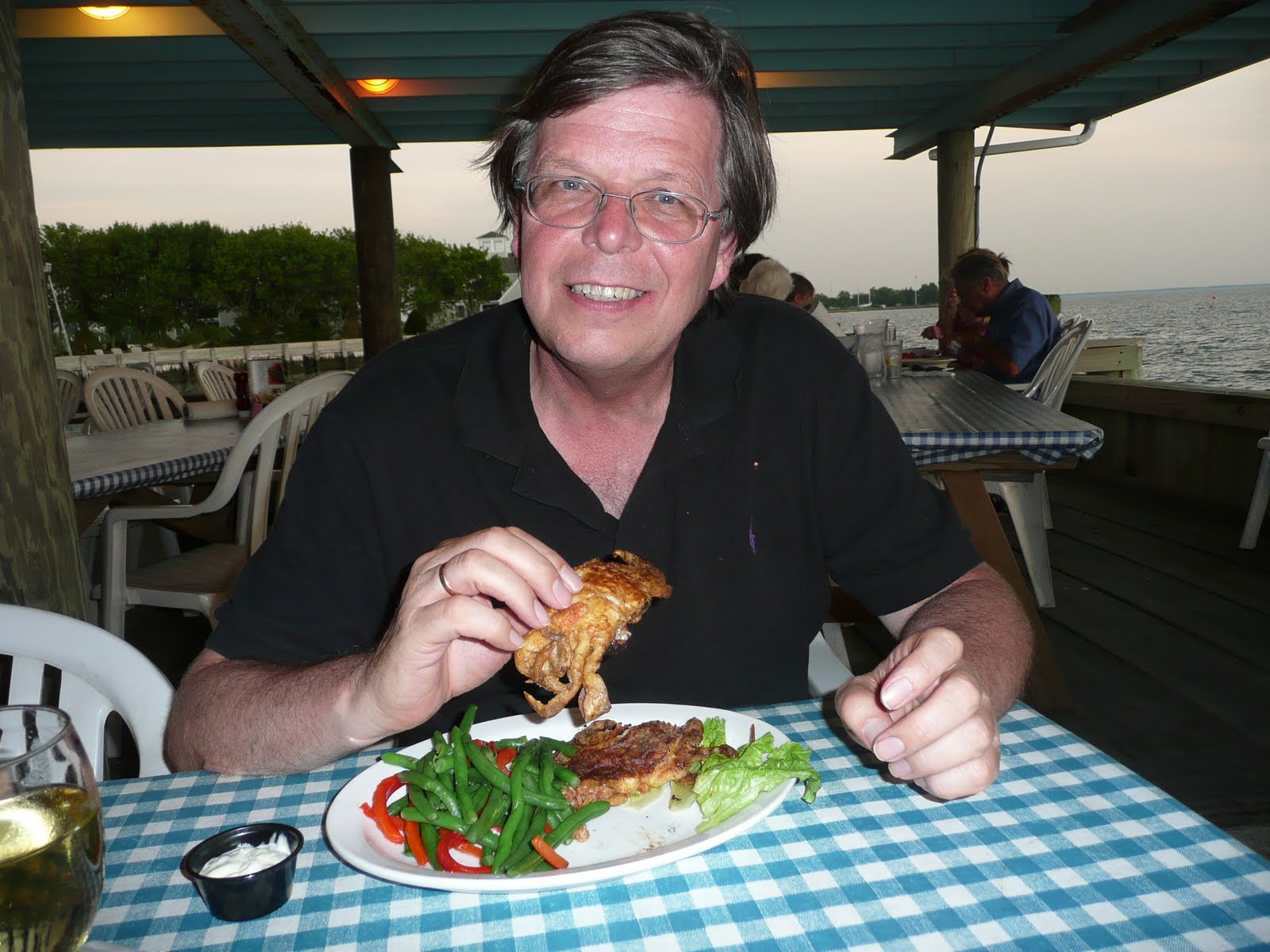
The Chesapeake Bay is famous for its soft-shell blue crabs. As crabs grow larger, their shells cannot expand, so they molt the exteriors and have a soft covering for a matter of days when they are vulnerable and considered usable. Crabs caught just after molting are prepared as soft shell crabs: first cutting out the gills, face, and guts; the crab is then battered in flour, egg, and seasoning, then fried in oil until crispy. The entire crab is consumed, legs and all.


Pictures: Christian G.E. Schiller eating Soft Shell Crabs

Crab Cake

Crab cakes is another delicacy. Crab Cakes are basically Hamburgers made out of crab meat. We ate it recently as a starter with tomatoes and avocado on the side.

Picture: Maryland Crab Cake

See more:
Wine and Crab Cakes: Amy Brandwein from Casa Nonna and Chris Clime from PassionFish win the 6th Annual Crab Cake Competition in Washington DC, USA

Maryland Crab Soup

Usually I start my crab dinner with a Maryland Crab Soup. This is a kind of an Italian Minestrone with crab meat.

Pictures: Annette Schiller, Ombiasy PR and Wine Tours, eating Maryland Crab Soup

See more:
Maryland Crabs and Wine
Schiller's World of Seafood

Sugarloaf Mountain Vineyard

We began our tour by visiting Sugarloaf Mountain Vineyards.

Sugarloaf Mountain Vineyard is only a 45 minute drive from Washington, DC. The 92-acre farm abuts the scenic Sugarloaf Mountain conservation and recreation area. The winery is easily identifiable by its signature red barn, silo and windmill, built in the early 1900s.

Pictures: Sugar Loaf Mountain Vineyard

Purchased by Dan and Polly O'Donoghue in 1962, the farm has been a working farm and family retreat ever since. Today, it is owned and operated by their four children – the McGarry, McKenna and two O’Donoghue families. The transformation from a traditional farm to a vineyard broke ground in 2002. A wine making team was formed, and soon vines were planted and being nurtured. By 2005, the winery was complete and Sugar Loaf Mountain was making its first vintage.


Pictures: Dave McIntyre from the Washington Post and Michael McKenna and Michael McGarry, both Co-owners of Sugar Loaf Mountain Vineyard

In 2011, Benoit Pineau took over the wine-making responsibilities. He hails from France and has been educated in oenology and viticulture in Bordeaux and Toulouse. As of January, 2013 Manolo Gomez has become the official winemaker, with Benoit Pineau the consultant winemaker.

Sugar Loaf Mountain Vineyard specializes in Bordeaux style wines. They grow Cabernet Sauvignon, Cabernet Franc, Merlot, Malbec and Petit Verdot; and three white varieties: Chardonnay, Pinot Grigio and Viognier.

The Wines we tasted:


2011 Sugarloaf Mountain Vineyard, Pinot Grigio, $19

100% Pinot Grigio which was aged for 6 months in stainless steel.  Alcohol 13.0%.

2011 Sugarloaf Mountain Vineyard, Circe, $24

This wine is a blend of 73% Cabernet Sauvignon, 10% Cabernet Franc, 10% Petit Verdot, and 7% Merlot which was aged 5 months in 20% new French oak.  Alcohol 12.5%.

2011 Sugarloaf Mountain Vineyard, Comus $26

This wine is a blend of 44% Cabernet Sauvignon, 35% Merlot, 8% Petit Verdot, 8% Cabernet Franc, and 5% Malbec which was aged 12 months in 25% French oak. Alcohol 13.0%

2010 Sugarloaf Mountain Vineyard, Evoe! $39

This wine is a blend of 51% Cabernet Franc, 22% Petit Verdot, 16% Merlot, and 11% Cabernet Sauvignon which was aged 24 months in 25% new French oak. Alcohol 14.5%.

Black Ankle Vineyards

The second stop was Black Ankle Vineyards. We were visiting Black Ankle Vineyards to both taste wine and to eat lunch catered by the Woodberry Kitchen of Baltimore, a restaurant devoted to eating and drinking local. I will prepare a separate posting about the lunch.

Pictures: Christian G.E. Schiller with Owners Sarah O’Herron and Ed Boyce, Black Ankle Vineyard

Owners Sarah O’Herron and Ed Boyce (both former management consultants) planted their first vines in 2003 after a lengthy search looking for farms with the worst soil. They succeeded, buying a 142-acre farm on Black Ankle Road in the rolling hills of Carroll County near Mt. Airy.

Black Ankle sets the new standard for what is going on in Maryland wine. Black Ankle has won numerous awards for their wines, including recent Maryland Governor’s Cup Awards.

Ed and Sarah explained that the meager 1 1/2 feet of soil is 60 percent rock with a solid layer of rock below. Although this soil environment would be a nightmare for a farmer planting traditional agricultural crops, it proved perfect for their vision of a world-class vineyard growing vinifera grapes.

Currently, Black Ankle has 42 producing acres. Since Ed and Sarah purchased the property, they have made and applied compost in place of chemical fertilizers and they have never used herbicides of any kind. “Although we are not yet able to farm 100% organically, we are optimistic that with more research and ingenuity we will get there before too long,” say Ed and Sarah. “We have also made the decision to farm with the principles of Biodynamics. Black Ankle’s barrel room holds 300 French oak barrels. It is constructed with hay-bale walls coated with a plaster made from the farm’s earth and wood harvested from their acreage.

The business has been a bit of a juggling act for Ed and Sarah, who have kept their house in Silver Spring and, except at harvest time, alternate days at Black Ankle with working from home. They have five children, one in college and four at home.

The Wines that were poured:


2012 Black Ankle Vineyards, Gruner Veltliner – (Barrel Sample)

2011 Black Ankle Vineyards, Bedlam

This wine is a blend of Albarino, Viognier, Chardonnay, Gruner Veltliner, and Muscat.

2010 Black Ankle Vineyards, Rollings Hills

This wine is a blend of 47% Cabernet Sauvignon, 21% Cabernet Franc, 21% Merlot, 8% Malbec, and 3% Petit Verdot which was aged for 18 months in French oak barrels. Alcohol 13.6%.

2010 Black Ankle Vineyards, Leaf Stone Syrah

This wine is 100% Syrah which was aged for 18 months in 65% new French oak.  Alcohol 14.6%.

NV Black Ankle Vineyards, Terra Dulce II

A fortified wine.

Boordy Vineyards

The tour concluded with a visit and tasting at Boordy Vineyards, which is the oldest commercial winery in Maryland. Boordy was founded in 1945 by Philip and Jocelyn Wagner. The Wagner’s enthusiasm for experimentation and the winery’s rapid growth eventually lead to a partnership with the Deford family who purchased  Boordy in 1980. The Defords moved the winery to its present day location at their Long Green Valley farm, just north of Baltimore. The farm has since been placed in permanent preservation with the Maryland Environmental Trust, demonstrating owner Rob’s commitment to agriculture.

Pictures: Boordy Vineyards, Maryland

The winery is currently housed in the ground-floor level of a 19th century barn. Next to the barn a new similarly sized building is going up.  The new building will become the home of the winery.  As it is purpose-built, future wines will see more gravity and less pumps along with being raised with more accurate temperature control.  The original barn will become a barrel cellar.

Boordy produces three tiers of wines: Just for Fun, Icons of Maryland and the Landmark series.  The Landmark series is the very best of each vintage year; the Icons of Maryland are designed with food in mind; and the Just for Fun series offers sweet, party wines.

We only tasted Landmark wines. These wines are produced from 100% Maryland fruit of which 95% is estate fruit.  The Landmark Project was begun in 2006. It follows the guidance of viticulturist Lucie Morton which initiated a complete replanting of the vineyards.  The vineyards were replanted with closer spacing, 1 meter by 8 feet, averaging 1500 vines per acre for all 45 acres.

The Wines we tasted:


2010 Boordy Vineyards, Landmark, Cabernet Franc Reserve – $25

This wine was aged for 18 months in French oak.

2010 Boordy Vineyards, Landmark Reserve – $35

This wine is a blend of 69% Merlot, 19% Syrah, 6% Cabernet Sauvignon, and 6% Petit Verdot which were fermented separately. It was aged for 24 months in French oak.

2010 Boordy Vineyards, Landmark, Merlot Reserve

schiller-wine: Related Postings

At the Fifth Annual Drink Local Wine Conference in Baltimore, Maryland, USA 

Wine and Crab Cakes: Amy Brandwein from Casa Nonna and Chris Clime from PassionFish win the 6th Annual Crab Cake Competition in Washington DC, USA

Maryland Crabs and Wine

Schiller's World of Seafood

Friday, March 29, 2013

Virginia versus the World – A Blind Taste-Off, USA

Picture: The Tasters - (from left to right) Christian Schiller (schiller-wine) Isaac James Baker (Reading, Writing and Wine) Annette Schiller (Ombiasy Wine Tours) Aaron Nix-Gomez (Hogshead Wine) David White (Terroirist) Frank Morgan (Drink What You Like)

Virginia wineries continue to gain national and international recognition. 10 of them recently won awards at the 2012 San Francisco International Wine Competition. The competition, held in June 2012, is the largest international wine competition in America, with more than 4,500 wines from 26 U.S. States and 29 countries competing. In that context, Frank Morgan and David White, recently organized a blind taste-off: Virginia versus the World.

See more:
Virginia Wines Shine in San Francisco - 2012 San Francisco International Wine Competition, USA

Vendredi du Vin #54 : Soyons Joueurs!

This posting is being published as part of the Vendredis du Vin, a monthly blog event in France. Participating wine bloggers - mainly in France - are all releasing postings today under the same heading. This month's Vendredi du Vin is orchestrated by Anne Graindorge, recent winner of the Wine Blog Trophy de Loire. The theme is "soyons joueurs!" - "Let us Gamble", on blind tasting.


Picture: Anne Graindorge Tasting Blind

Wine Producer Virginia

Virginia is the 5th largest wine industry in the US, with more than 200 wineries and 2,500 acres of vineyards.

In the original charter of the thirteen colonies was a royal commission to pursue three luxury items that England was unable to provide for itself: wine, silk, and olive oil. Every colony made attempts to satisfy the requirements of its charter. Despite many years of failure, the early Americans persisted in their efforts. A big step forward was made in 1740 when a natural cross pollination occurred between a native American grape and a European vitis vinifera. Other successful crossings followed.

In 1762, John Carter, who had 1,800 vines growing at Cleve Plantation, sent 12 bottles to the Royal Society of Encouragement of the Arts, Manufacture and Commerce in London for their evaluation. Minutes of their meeting on the 20th of October 1762 declared Carter’s wines to be “excellent” and a decision was taken to reward Carter’s efforts with a gold medal for his wines. These were the first internationally recognized fine wines produced in America.

Over the past 30 years or so, Virginia wines have experienced a tremendous development - to elegant and balanced, mostly European vinifera-based wines. Recently, Donald Trump as well as AOL founder Steve Case bought a Virginia winery.

Today, the vitis vinifera grapes Chardonnay and Viognier are the leading white varieties.Increasingly they are made without any or with neutral oak, to retain natural acidity and freshness. It appears Viognier is on its way to becoming Virginia’s official “signature grape”.

For French-American hybrid varieties, Seyval Blanc is still popular, but resembles now the fresh and crisp wines from France’s South West. Vidal has become the backbone of the artificially frozen (cryoextraction), ice wine which I am not a great fan of.  Cryoextraction is an approach, developed by the French, which kind of simulates the frost in the vineyard in the wine cellar.


Pictures: At the Tasting

As far as red wines are concerned, there has been a shift from straight varietal wines to blends, with the blends now being dominated by Merlot and Cabernet Franc. Mirroring the Virginia white wines, there is an increasing focus on neutral oak and clean, vibrant fruit.

Tannat, Uruguay’ signature grape from the South West of France, is showing up in more Virginia wines, usually as a blend. The only red French American hybrid which has performed consistently well in Virginia is Chambourcin, which resembles the Gamay grape of Beaujolais.

Finally, Claude Thibault, a native from France, has taken Virginia sparkling wines to a new level. His NV Thibault-Janisson Brut, made from 100 percent Chardonnay, which President Obama offered his guests at his first state dinner, is as close as you can get to Champagne outside of France.

Washington DC Tasting of March 2013

The tasters were:

Frank Morgan (Drink What You Like),
David White (Terroirist),
Aaron Nix-Gomez (Hogshead Wine). 
Isaac James Baker (Reading, Writing & Wine),
Annette Schiller (Ombiasy Wine Tours),
Christian Schiller (Schiller-Wine).


Picture: Annette Schiller (Ombiasy Wine Tours)

Hosted by the Washington Wine Academy, the theme was to pit Virginia Chardonnays and Bordeaux blends against similar, comparatively-priced wines from other regions in the world. We tried to stick to the $18-$35 price range for Chardonnays and $25-$55 for the red blends. While we managed to have all white wines from the 2010 vintage, for the red wines we ended up with wines from2006 to 2009. The wines were all brown-bagged and tasted blind.

Chardonnays: Overall Rankings

The overall rankings were:
•    1st – 2010 Domaine des Moirots, Le Vieux Chateau, Montagny 1er Cru, Bourgogne
•    2nd – 2010 Linden, Hardscrabble Chardonnay, Virginia and 2010 Ankida Ridge, Chardonnay, Virginia
•    4th – 2010 Domaine Luquet Roger, Vieilles Vignes, Pouilly-Fuisse, Bourgogne
•    5th – 2010 Stag’s Leap Wine Cellars, Karia, Chardonnay, California
•    6th – 2010 Ox-Eye Vineyards, Chardonnay, Virginia

Tasting Notes

Here are my tasting notes.

2010 Gloria Ferrer Vineyards, Chardonnay, Carneros

100% Chardonnay, 100% barrel fermented with 29% undergoing malolactic fermentation, aged for 9 months in medium-toast French oak barrels, alcohol 13.5%.


Off bottle. Not Rated.

2010 Ankida Ridge Vineyards, Chardonnay, Virginia

100% Chardonnay, fermented in oak barrels with inoculated yeasts, 50% underwent malolactic fermentation, aged for nine months in barrel where it underwent regular batonnage.


Light yellow in the glass, notes of honeysuckle, green pears and citrus peel on the nose, a bit bitter on the palate, good finish.

2010 Linden, Hardscrabble, Chardonnay, Virginia

100% Chardonnay, fermented in new and used barrels with cultured and indigenous yeasts, some barrels underwent malolactic fermentation, aged for 10 months on the lees with batonnage, alcohol 14.2%.


Medium gold yellow in the glass, notes of honeysuckle, vanilla on the nose, a rich wine, round on the palate, lovely finish.

For more on Linden Vinyards, see:
Jim Law and Linden Vineyards in Virginia – A Profile, USA

2010 Domaine des Moirots, Le Vieux Chateau, Montagny 1er Cru, Bourgogne

100% Chardonnay, alcohol 12.5%.


Light straw yellow in the glass, notes citrus, lemon, honeysuckle on the nose, a crisp and fresh wine, notes of green apple and pear fruit on the palate, long mineral-laden finish.

2010 Stag’s Leap Wine Cellars, Chardonnay, Karia, Napa Valley

100% Chardonnay, in barrels (83%) and stainless steel tanks (17%) of which 55% underwent malolactic fermentation, aged for 8 months on the lees in 29% new French oak, alcohol 13.5%.


Light yellow in the glass, notes of vanilla and caramel on the nose, a full-bodied wine, notes of ripe pear and melon on the palate, short finish.

2010 Domaine Luquet Roger, Vieilles Vignes, Pouilly-Fuisse, Bourgogne

100% Chardonnay sourced from vines 40-65 years of age, alcohol 13.5%.


Light yellow gold in the glass, beautiful, sweet notes of apricots, lychees on the nose, fresh and crisp on the palate, good texture.

For more on Pouilly-Fuisse, see:
In the Most Prestigious AOC in the Mâconnais: Pouilly-Fuissé, France

2010 Ox-Eye Vineyards, Chardonnay, Shenandoah Valley, Virginia

100% Chardonnay sourced from vines at 1,830 feet, fermented in stainless steel then aged in barrels, alcohol 13.2%.


Light straw yellow in the glass, notes of spices and vanilla on the nose, lively acidity on the palate, followed by some toast, and spice.

Red Blends: Overall Rankings

The overall rankings were:

•    1st – 2008 RdV Vineyards, Rendezvous, Virginia
•    2nd – 2009 Chateau d’Aiguilhe, Cotes de Castillon, Bordeaux
•    3rd – 2008 Dry Creek, Meritage, Sonoma, California
•    4th – 2006 Baron de Brane, Chateau Brane-Cantenac, Margaux, Bordeaux
•    5th – 2008 Barboursville, Octagon, Virginia
•    6th – 2007 Boxwood Winery, Topiary, Virginia
•    7th – 2008 Chateau O’Brien, Padlock Red; Virginia

2009 Chateau d’Aiguilhe, Cotes de Castillon, France

80% Merlot and 20% Cabernet Sauvignon sourced from 28-year-old vines, fruit was destemmed and fermented in temperature controlled wooden vats for 25-30 days, underwent malolactic fermentation then was aged on the lees in up to 80% new oak barrels for 15-20 months, alcohol 14.5%.

Chateau d'Aiguilhe is one of the wineries of Count Stefan von Neipperg. The von Neipperg portfolio also includes Chateau Canon La Gaffeliere and La Mondotte, 2 of 4 estates promoted to Premier Grand Cru Classés B last year.


Medium cherry in the glass, rich notes of sweet plums, red licorice on the nose, a yummy wine, notes of ripe fruit and chewy tannins on the palate, long finish.

For more on Chateau d’Aiguilhe, Cotes de Castillon, see:
The Wine Empire of the von Neipperg Family in France, Bulgaria and Germany  

2007 The Boxwood Winery, Topiary, Virginia

Cabernet Franc, Merlot, and Malbec, alcohol 13.8%.


Medium garnet in the glass, notes of cassis, leather, wet dirt on the nose, nice mouthfeel, soft tannins and creamy blackberry fruit on the palate, good finish with a hint of tobacco.

For more on Boxwood, see:
Boxwood Winery in Virginia: Lunch with Wine Makers Rachel Martin and Adam McTaggert in the Chai between the Tanks – TasteCamp 2012 East Kick-Off, USA

Interestingly, the von Neipperg and the Boxwood wines are "made" by the same winemaker,Stephane Derenoncourt, who consults at both wineries.

See here:
Drinking the Wines of Stephane Derenoncourt at Chateau Canon la Gaffeliere in St. Emilion, Bordeaux, and at Boxwood Vineyard in Virginia, USA

2008 RdV Vineyards, Rendezvous, Virginia

62% Merlot, 29% Cabernet Sauvignon, 6% Cabernet Franc, and 3% Petit Verdot.


Medium to dark cherry garnet in the glass, rich notes of sweet roses, toasted oak, dark cherries on the nose, good mouthfeel, spicy tannins, flavors of cranberry sauce and blackberry jam on the palate, impressive depth, too young.

2008 Barboursville Vineyards, Octagon, Virginia

Merlot, Cabernet Franc, Cabernet Sauvignon, and Petit Verdot, fermented in stainless steel tanks, macerated for 10-20 days, aged 12-14 months in new Gamba barriques, alcohol 13.5%.


Light to medium cherry in the glass, notes of cassis, smoke and rhubarb on the nose, a medium-bodied wine with tangy acid and bright tannins on the palate, good finish.

The 2009 Octagon won the 2013 Governor's Cup, see more:
Governor’s Cup Competition 2013, Virginia, USA

2008 Chateau O’Brien, Padlock Red, Virginia

63% Cabernet Sauvignon, 25% Cabernet Franc and 12% Petit Verdot, alcohol 13.9%.


Medium garnet in the glass, notes of candied cherries, spices on the nose, a medium-bodied wine with notes rhubarb and again spices on the palate, soft finish with some tannins.

2008 Dry Creek Vineyards, Meritage, Sonoma County, California

33% Cabernet Sauvignon, 30% Merlot, 17% Cabernet Franc, 14% Malbec, and 6% Petit Verdot, aged for 22 months in French and American oak, alcohol 14.5%.


Medium cherry in the glass, notes of fig, loam, leather on the nose, a fruity wine with notes of green pepper and wet earth on the palate, nice finish with a hint of vanilla.

2006 Baron de Brane, Margaux, Bordeaux

70% Cabernet Sauvignon and 30% Merlot, aged for 12 months in 20% new barriques, alcohol 13%. The second wine of Chateau Brane-Cantenac, a Deuxieme Grand Cru Classe en 1855.


Medium garnet in the glass, appealing on the nose, with ripe dark fruits and some oak, a medium- to full bodied wine, good acidity, cherries on the palate with a gentle layer of ripe tannins, long finish.

For more on Chateau Brane-Cantenac, see:
An Afternoon with Owner Henri Lurton at Château Brane-Cantenac, a Deuxieme Grand Cru Classe en 1855, in Margaux, France


Other Postings about the Event

Isaac James Baker (Reading and Writing, Wine), Frank Morgan (Drink What You Like) and Aaron Nix-Gomez (Hogshead Wine) have already posted about the event on their blog.