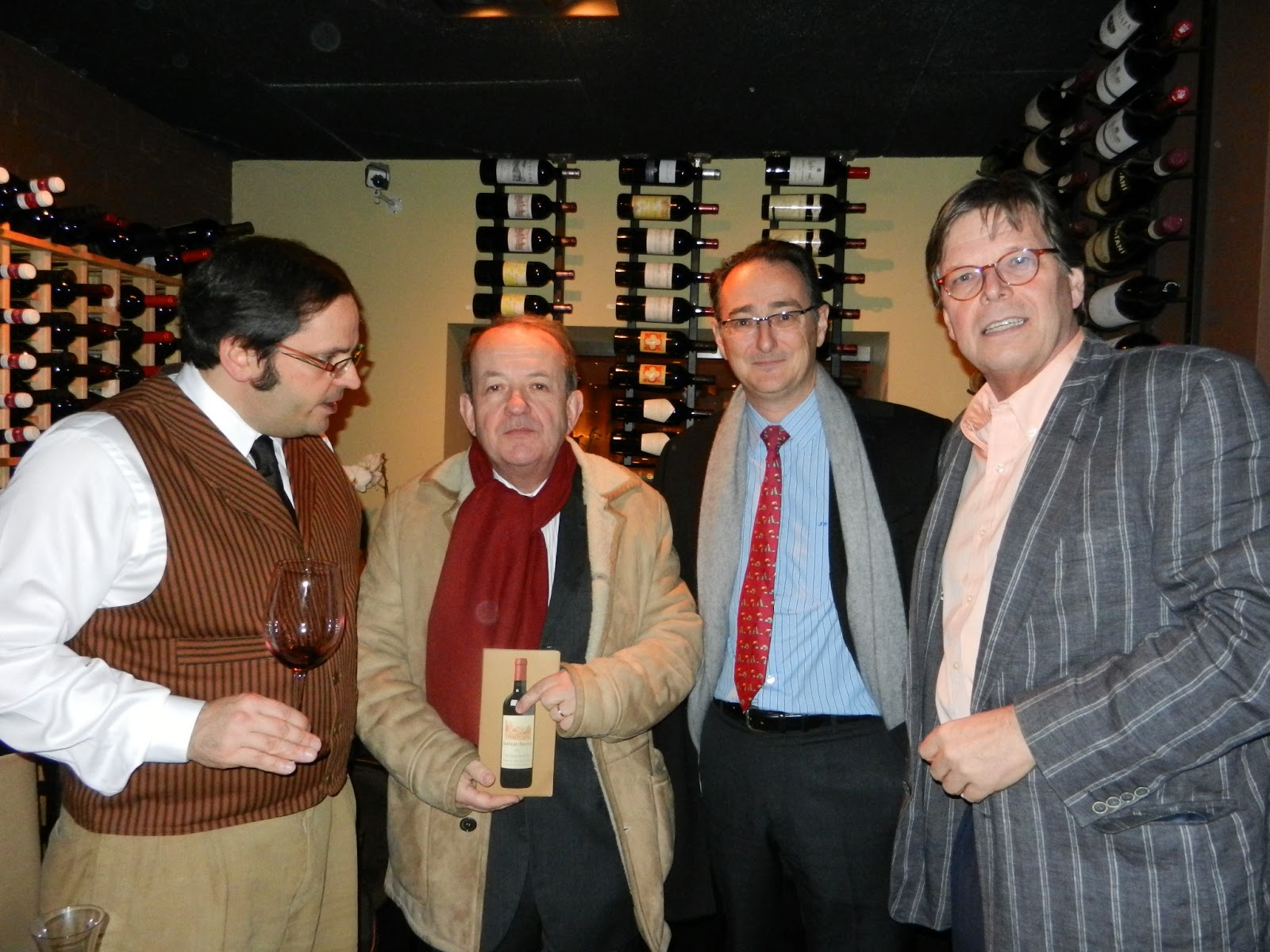
Picture: Christian G.E. Schiller and Joachim and Silvia Heger, Weingut Dr. Heger. Joachim Heger won the Eichelmann Best Red Wine Collection Award; Joachim Heger is also the Gault Millau WeinGuide 2013 Winemaker of the Year
See more:
Joachim Heger, Weingut Dr. Heger: Winemaker of the Year, Gault Millau WeinGuide Deutschland 2013, Germany
There are 3 influential wine guides in Germany: the Eichelmann and the GaultMillau, followed by the Feinschmecker.
The 2013 Eichelmann Wine Guide Deutschland was released in November 2012.
The Eichelmann uses a scale of 1 to 5 stars. I have already reported about the 5- star-producers in the Eichelmann Wine Guide Deutschland 2013, it is a group of 28 winemakers.
Picture: Gerhard Eichelmann at the 2012 VDP.Grosses Gewaechs Pre-release Tasting in Wiesbaden, sitting just behind me
See:
Germany’s 2011 VDP Grosses Gewaechs – Grand Cru - Wines Released. Notes from the Pre-release Tasting in Wiesbaden, Germany
Here are the special awards of the Eichelmann Wine Guide Deutschland 2013.
Best White Wine Collection of the Year: Weingut Rainer Sauer (Franken)
“If you like Silvaner, go to Escherndorf and visit Rainer Sauer” said Gerhard Eichelmann.
Best Red Wine Collection of the Year: Joachim Heger and his Weingut Dr. Heger (Baden)
Gerhard Eichelmann: “Year after year, Joachim Heger makes fascinating Pinot Noir wines, both from the Ihringer Winklerberg and the Achkarrer Schlossberg. In the last few years, they had even more finesse and have become even more complex, more Burgundian.”
Best Collection of Noble-Sweet Wines of the Year: Thomas Haag and his Weingut Schloss Lieser (Mosel)
Gerhard Eichelmann: “Outstanding, fascinating wines with a lot of finesse and elegance, very complex and never ending on the palate.”
Rising Star of the Year: André Landgraf’s and his Weingut Landgraf (Saulheim, Rheinhessen)
Gerhard Eichelmann: “André Landgraf’s organic wines are a good example of the general upswing in the Rheinhessen region”.
Wine Classics (A wine of high quality, which shows year after year a clear profile)
Morstein Grosses Gewaechs Riesling of Weingut Wittmann in Westhofen, Rheinhessen
Picture: Christian G.E. Schiller with Philipp Wittmann in Mainz
Best Riesling 2002 (Re-tasted after 10 Years)
Monzinger Halenberg Riesling Auslese trocken, Weingut Emrich-Schönleber (Nahe)
Best Other Red Wine 2002 (Re-tasted after 10 Years)
Lemberger trocken "S", Weingut Dautel (Württemberg)
Best Pinot Noir 2002 (Re-tasted after 10 Years)
Spätburgunder "R" Bürgstadter Centgrafenberg, Weingut Paul Fürst (Franken)
Picture: Paul Fuerst, Weingut Rudolf Fuerst, at Schloss Johannisberg, Germany. The 2009 Weingut Rudolf Fürst Centgrafenberg Spätburgunder Grosses Gewächs was ranked #4 overall and was #2 of the German wines at a now famous Tim Atkin Pinot Noir Tasting in London, where German wines performed very strongly: The Tim Atkin Pinot Noir Taste-Off of October 2011: Germany Versus the Rest of the World - German Red Wines Show Stong Performance
Previous Years’ Eichelmann Wine Guide Deutschland
Best German Wines - Eichelmann Wine Guide 2012 Awards, Germany
Wine ratings: German wine --- Eichelmann 2010
schiller-wine - Related Postings
“The only guide to German Riesling you’ll ever need to read”
German Spaetlese Wines Can Come in Different Versions. I Have Counted Five.
When Americans Drink German Wine - What They Choose
Approaches to Classifying German Wine: The Standard Approach (the Law of 1971), the VDP Approach and the Zero Classification Approach
German Wine Basics: Sugar in the Grape - Alcohol and Sweetness in the Wine
The VDP - the Powerful Group of German Elite Winemakers - Refines its Classification System, Germany
JJ Pruem Goes Supermarket: Meeting Katharina Pruem and Tasting the Incredible JJ Pruem Wines at Wegmans
The Wines of the Roter Hang (Red Slope) in Nierstein, Rheinhessen, Germany
The Doctor Made a House Call - A Tasting with Ernst Loosen, Weingut Dr. Loosen, at MacArthur Beverages in Washington DC, USA
One of the Fathers of the German Red Wine Revolution: Weingut Huber in Baden
A Pinot Noir Star: Visiting August Kesseler and his Weingut August Kesseler in Assmannshausen, Germany
Visiting Armin and Caroline Diel and their Schlossgut Diel in Burg Layen in Germany
Wednesday, April 24, 2013
Tuesday, April 23, 2013
FairChoice Certified Wine in Germany: Weingut Joachim Flick in the Rheingau
Picture: Reiner Flick, Weingut Joachim Flick, and Christian G.E. Schiller in Hochheim
Weingut Joachim Flick in Floersheim-Wicker near Hochheim in the Rheingau was recently successfully FairChoice – which falls into the group of sustainable winemaking - certified. This posting profiles Weingut Joachim Flick.
“Green” Winemaking
There are many winemakers with an ecological mindset. These “green” winemakers, however, come in different colors. I recently tasted the Santa Julia wines of Familia Zuccardi, a winery that produces mass wines in Argentina with organic grapes. Argentina, in general, is very well suited for organic winemaking. The Donkey and Goat Winery in Berkeley produces wine according to the natural wine concept in the midst of the city of Berkeley without owning any vineyards.
Picture: Reiner Flick, Weingut Joachim Flick
Recently in Pamhagen in Austria in the stone cave below the winery with Werner Michlits of Weingut Meinklang, where Werner showed us his magic cow poop and other ingredients for biodynamic farming, I felt at the forefront of winemaking with an ecological mindset. “We practice sustainable agriculture in the vineyard” said Yann-Leon Beyer when I visited Domaine Leon Beyer in Alsace in France. The Leon Bayer bottles, however, do not carry a sustainability certificate.
For a primer on “green” winemaking see:
Organic, Sustainable, Biodynamic, Natural Wines … A Primer for “Green” Wines
Sustainable Winemaking
According to the University of California, sustainability in agriculture: “…integrates three main goals--environmental health, economic profitability, and social and economic equity. Sustainability rests on the principle that we must meet the needs of the present without compromising the ability of future generations to meet their own needs. Therefore, stewardship of both natural and human resources is of prime importance.”
Although nowhere defined by law, there are many certifications available for “Sustainable Wine” in the world, including “FairChoice” in Germany. In general, the “New World” is considerably ahead of the “Old World” in terms of sustainable practices.
Hochheim in the Rheingau
Weingut Joachim Flick is in Hochheim (Floersheim-Wicker) in the Rheingau region. Hochheim is at the eastern edge of the Rheingau, well known around the world for its Riesling wines. Moving from Hochheim to the west, the fairly flat, dimpled landscape evolves into progressively steep slopes. It is a quietly beautiful region, rich in tradition.
Picture: Map of the Rheingau
Queen Victoria's enthusiasm for Hochheim's wines contributed to their popularity in England, where they, and ultimately, Rhine wines in general, were referred to as Hock. The third President of the USA - and notable bon viveur - Thomas Jefferson visited the Rheingau in 1788 and wrote that the wine of the "Abbaye of Johnsberg is the best made on the Rhine without comparison … That of the year 1775 is the best." He also referred to the Rheingau’s Riesling as the "small and delicate Rhysslin which grows only from Hochheim to Rudesheim". Impressed by the quality of the Rheingau Riesling wines, he bought 100 grapevines in Hochheim to take back to his estate in Virginia.
Even though it belongs to the Rheingau, Hochheim is actually situated along the Main River. Its vineyards have amongst the best exposure and climate in all of the Rheingau. Hochheim is just 30 Minutes away by S-Bahn from Frankfurt am Main central railway station. Coming from Frankfurt, you arrive in vineyards and it is a beautiful walk up through the vineyards to the village.
Weingut Joachim Flick
Weingut Joachim Flick is owned and run by Reiner Flick. The vineyard area totals 19 hectares with Riesling accounting for 85%. Annual output is 12.000 cases. Weingut Joachim Flick has been a member of the VDP since 1999.
Pictures: Weingut Joachim Flick
Excellent Vineyard Portfolio
The vineyard portfolio of Weingut Joachim Flick is outstanding and includes the 2 monopolistic sites, Wickerer Nonnberg and Hochheimer Königin Victoriaberg.
Wickerer Nonnberg (solely owned) – the vineyard was mentioned for the first time, when the Abbey of Retters in the Taunus Mountains exchanged vineyards with the Abbey of Tiefenthal in the Rheingau on January 13, 1281. Later, it was owned by the Herzogtum Nassau. Since 2004, Weingut Flick owns the vineyards.
Hochheimer Königin Victoriaberg (solely leased) – since 2010, Weingut Flick leases the entire Koenigin Victoriaberg in Hochheim. Queen Victoria visited Hochheim in 1845 and was treated to a winetasting at the “nicest and best vineyard”. Five years later, the British Queen granted the owner of the vineyard the right to name the vineyard Queen Victoria Vineyard.
Picture: Hochheimer Königin Victoriaberg (in the center) and other Wines from Hochheim
See also:
Five Hochheim (Rheingau) Winemakers Presented their Vintage 2011 Wines in Hochheim, Germany
Weingut Joachim Flick Succesfully FairChoice Certified
A rigorous assessment of the approaches and methods of Weingut Joachim Flick by an independent company, DLG TestService, took place in January 2013. All requirements of the sustainability program set forth by FairChoice were met. The testing criteria include: carbon footprint management, proof of fair treatment of employees, business partners, and customers, successful operating figures, and the fulfillment of a catalog outlining ecological criteria.
Pictures: In Duesseldorf, Certification Ceremony
Professor Armin Gemmrich of the German Wine Institute for Sustainable Development at University of Heilbronn stated “at the Flick Winery, everything is in top condition and serves as a great exemplary model.” He went on “a positive point to take note of is the marginal greenhouse gas emissions through the usage of organic fertilizers. Weingut Joachim Flick entirely avoids utilizing synthetic mineral fertilizers which are produced through heavy energy usage. In a larger general frame of wine production, there are other topics at hand such as the glass bottles or Bag-in-Box which offer an area for improvement.”
Picture: FairChoice Label
Weingut Joachim Flick is the first member of the VDP (Association of German Prädikat Wine Estates) to have undergone and passed the arduous and comprehensive testing.
Reiner Flick: “With the 2012 vintage, our winery is now FairChoice certified. Our conducts at the winery are ecologically compliant, socially lawful, and economically bearing for the well-being of future generations to come. The future generations are indubitably entitled to a livable existence in which the preceding generation is responsible for. Exhaustive cultivation in the vineyards yields only temporary success. As winemakers, we are completely aware that the foundation of our lives lies heavily in the vineyards.”
Headwind (Gegenwind)
Recently in Hochheim, I had the chance to taste the 2011 Gegenwind (Headwind) wine, a joint venture of Gunter Kuenstler, Weingut Franz Kuenstler and Reiner Flick, Weingut Joachim Flick. This is their contribution to a citizen movement in the Frankfurt am Main area “against the unbridled exploitation of culture and nature” as Reiner Flick put it and “in particular, against the expansion of the Frankfurt Airport.”
Picture: Joachim Flick, Christian G.E. Schiller and Headwind/Gegenwind
Recently, a third landing strip was opened and the resulting increased noise in the Hochheim area from aircrafts landing at and taking off from Frankfurt Airport triggered the decision to make this wine and to contribute the proceeds to the non-profit organization Gegenwind 2011 Rhein-Main.
For more see:
Headwind (Gegenwind) – A Protest Wine against the Unbridled Exploitation of Culture and Nature Vendredi du Vin #52: Soyez Coopératif! – Vent Contraire: un Vin de Protest
schiller-wine - Related Postings
Organic, Sustainable, Biodynamic, Natural Wines … A Primer for “Green” Wines
Judging at the ECOVIN Ecowinner 2012 Contest in Oppenheim, Germany
Blogging for Organic Wine – New Ways of Wine Experience: The Organic Wines of Oekoweingut Hubertushof at Prowein 2012 in Germany
Visiting Jared Brandt and his Donkey and Goat Winery – Natural Wines Made in Berkeley, California
Excellency and Ecology: The Wines of Gebrueder Dr. Becker in Rheinhessen, Germany
Wine Event: President Obama and the First Lady eat at the "Green" Restaurant Nora and have a "Green" Spottswoode Wine
Benzinger Wines Served at the 2010 "Green" Annual White House Correspondents Dinner
The Natural Wines of Terroir in San Francisco
At the Forefront of Biodynamic Winemaking: Visiting Werner and Angela Michlits and their Weingut Meinklang in Austria
Julia Zuccardi from Familia Zuccardi in Argentina Visited the US to Introduce New Santa Julia Wines
One of Oregon's Pioneering Winemakers - Myron Redford - with his Amity Vineyard Wines in Washington DC
Visiting Yann-Leon Beyer at Maison Leon Beyer in Eguisheim in Alsace
“Hoffest” (Winery Party) at Weingut Heinrich Baison in Hochheim, Rheingau - Best of Riesling 2010 Award Winner
German Spaetlese Wines Can Come in Different Versions. I Have Counted Five.
Phil Bernstein’s Third Annual German Riesling Tasting with the German Wine Society, Washington DC Chapter - Rieslings With a Touch of Sweetness
Visiting Agnes and Fritz Hasselbach at their Weingut Gunderloch in Nackenheim, Rheinhessen, Germany
Visiting Weingut Josef Leitz in Ruedesheim – Johannes Leitz is Germany’s Winemaker of the Year, Gault Millau WeinGuide 2011
When Americans Drink German Wine - What They Choose
JJ Pruem Goes Supermarket: Meeting Katharina Pruem and Tasting the Incredible JJ Pruem Wines at Wegmans
Franz Kuenstler, Founder of the Renown Franz Kuenstler Estate in Hochheim, Rheingau, Germany dies at Age 84
The Wines of Franz Kuenstler from Hochheim, Rheingau, Germany
Christian G.E. Schiller Leads Tasting of US-American Wines in Hochheim, Germany
Headwind (Gegenwind) – A Protest Wine against the Unbridled Exploitation of Culture and Nature
Vendredi du Vin #52: Soyez Coopératif! – Vent Contraire: un Vin de Protest
Five Hochheim (Rheingau) Winemakers Presented their Vintage 2011 Wines in Hochheim, Germany
Weingut Joachim Flick in Floersheim-Wicker near Hochheim in the Rheingau was recently successfully FairChoice – which falls into the group of sustainable winemaking - certified. This posting profiles Weingut Joachim Flick.
“Green” Winemaking
There are many winemakers with an ecological mindset. These “green” winemakers, however, come in different colors. I recently tasted the Santa Julia wines of Familia Zuccardi, a winery that produces mass wines in Argentina with organic grapes. Argentina, in general, is very well suited for organic winemaking. The Donkey and Goat Winery in Berkeley produces wine according to the natural wine concept in the midst of the city of Berkeley without owning any vineyards.
Picture: Reiner Flick, Weingut Joachim Flick
Recently in Pamhagen in Austria in the stone cave below the winery with Werner Michlits of Weingut Meinklang, where Werner showed us his magic cow poop and other ingredients for biodynamic farming, I felt at the forefront of winemaking with an ecological mindset. “We practice sustainable agriculture in the vineyard” said Yann-Leon Beyer when I visited Domaine Leon Beyer in Alsace in France. The Leon Bayer bottles, however, do not carry a sustainability certificate.
For a primer on “green” winemaking see:
Organic, Sustainable, Biodynamic, Natural Wines … A Primer for “Green” Wines
Sustainable Winemaking
According to the University of California, sustainability in agriculture: “…integrates three main goals--environmental health, economic profitability, and social and economic equity. Sustainability rests on the principle that we must meet the needs of the present without compromising the ability of future generations to meet their own needs. Therefore, stewardship of both natural and human resources is of prime importance.”
Although nowhere defined by law, there are many certifications available for “Sustainable Wine” in the world, including “FairChoice” in Germany. In general, the “New World” is considerably ahead of the “Old World” in terms of sustainable practices.
Hochheim in the Rheingau
Weingut Joachim Flick is in Hochheim (Floersheim-Wicker) in the Rheingau region. Hochheim is at the eastern edge of the Rheingau, well known around the world for its Riesling wines. Moving from Hochheim to the west, the fairly flat, dimpled landscape evolves into progressively steep slopes. It is a quietly beautiful region, rich in tradition.
Picture: Map of the Rheingau
Queen Victoria's enthusiasm for Hochheim's wines contributed to their popularity in England, where they, and ultimately, Rhine wines in general, were referred to as Hock. The third President of the USA - and notable bon viveur - Thomas Jefferson visited the Rheingau in 1788 and wrote that the wine of the "Abbaye of Johnsberg is the best made on the Rhine without comparison … That of the year 1775 is the best." He also referred to the Rheingau’s Riesling as the "small and delicate Rhysslin which grows only from Hochheim to Rudesheim". Impressed by the quality of the Rheingau Riesling wines, he bought 100 grapevines in Hochheim to take back to his estate in Virginia.
Even though it belongs to the Rheingau, Hochheim is actually situated along the Main River. Its vineyards have amongst the best exposure and climate in all of the Rheingau. Hochheim is just 30 Minutes away by S-Bahn from Frankfurt am Main central railway station. Coming from Frankfurt, you arrive in vineyards and it is a beautiful walk up through the vineyards to the village.
Weingut Joachim Flick
Weingut Joachim Flick is owned and run by Reiner Flick. The vineyard area totals 19 hectares with Riesling accounting for 85%. Annual output is 12.000 cases. Weingut Joachim Flick has been a member of the VDP since 1999.
Pictures: Weingut Joachim Flick
Excellent Vineyard Portfolio
The vineyard portfolio of Weingut Joachim Flick is outstanding and includes the 2 monopolistic sites, Wickerer Nonnberg and Hochheimer Königin Victoriaberg.
Wickerer Nonnberg (solely owned) – the vineyard was mentioned for the first time, when the Abbey of Retters in the Taunus Mountains exchanged vineyards with the Abbey of Tiefenthal in the Rheingau on January 13, 1281. Later, it was owned by the Herzogtum Nassau. Since 2004, Weingut Flick owns the vineyards.
Hochheimer Königin Victoriaberg (solely leased) – since 2010, Weingut Flick leases the entire Koenigin Victoriaberg in Hochheim. Queen Victoria visited Hochheim in 1845 and was treated to a winetasting at the “nicest and best vineyard”. Five years later, the British Queen granted the owner of the vineyard the right to name the vineyard Queen Victoria Vineyard.
Picture: Hochheimer Königin Victoriaberg (in the center) and other Wines from Hochheim
See also:
Five Hochheim (Rheingau) Winemakers Presented their Vintage 2011 Wines in Hochheim, Germany
Weingut Joachim Flick Succesfully FairChoice Certified
A rigorous assessment of the approaches and methods of Weingut Joachim Flick by an independent company, DLG TestService, took place in January 2013. All requirements of the sustainability program set forth by FairChoice were met. The testing criteria include: carbon footprint management, proof of fair treatment of employees, business partners, and customers, successful operating figures, and the fulfillment of a catalog outlining ecological criteria.
Pictures: In Duesseldorf, Certification Ceremony
Professor Armin Gemmrich of the German Wine Institute for Sustainable Development at University of Heilbronn stated “at the Flick Winery, everything is in top condition and serves as a great exemplary model.” He went on “a positive point to take note of is the marginal greenhouse gas emissions through the usage of organic fertilizers. Weingut Joachim Flick entirely avoids utilizing synthetic mineral fertilizers which are produced through heavy energy usage. In a larger general frame of wine production, there are other topics at hand such as the glass bottles or Bag-in-Box which offer an area for improvement.”
Picture: FairChoice Label
Weingut Joachim Flick is the first member of the VDP (Association of German Prädikat Wine Estates) to have undergone and passed the arduous and comprehensive testing.
Reiner Flick: “With the 2012 vintage, our winery is now FairChoice certified. Our conducts at the winery are ecologically compliant, socially lawful, and economically bearing for the well-being of future generations to come. The future generations are indubitably entitled to a livable existence in which the preceding generation is responsible for. Exhaustive cultivation in the vineyards yields only temporary success. As winemakers, we are completely aware that the foundation of our lives lies heavily in the vineyards.”
Headwind (Gegenwind)
Recently in Hochheim, I had the chance to taste the 2011 Gegenwind (Headwind) wine, a joint venture of Gunter Kuenstler, Weingut Franz Kuenstler and Reiner Flick, Weingut Joachim Flick. This is their contribution to a citizen movement in the Frankfurt am Main area “against the unbridled exploitation of culture and nature” as Reiner Flick put it and “in particular, against the expansion of the Frankfurt Airport.”
Picture: Joachim Flick, Christian G.E. Schiller and Headwind/Gegenwind
Recently, a third landing strip was opened and the resulting increased noise in the Hochheim area from aircrafts landing at and taking off from Frankfurt Airport triggered the decision to make this wine and to contribute the proceeds to the non-profit organization Gegenwind 2011 Rhein-Main.
For more see:
Headwind (Gegenwind) – A Protest Wine against the Unbridled Exploitation of Culture and Nature Vendredi du Vin #52: Soyez Coopératif! – Vent Contraire: un Vin de Protest
schiller-wine - Related Postings
Organic, Sustainable, Biodynamic, Natural Wines … A Primer for “Green” Wines
Judging at the ECOVIN Ecowinner 2012 Contest in Oppenheim, Germany
Blogging for Organic Wine – New Ways of Wine Experience: The Organic Wines of Oekoweingut Hubertushof at Prowein 2012 in Germany
Visiting Jared Brandt and his Donkey and Goat Winery – Natural Wines Made in Berkeley, California
Excellency and Ecology: The Wines of Gebrueder Dr. Becker in Rheinhessen, Germany
Wine Event: President Obama and the First Lady eat at the "Green" Restaurant Nora and have a "Green" Spottswoode Wine
Benzinger Wines Served at the 2010 "Green" Annual White House Correspondents Dinner
The Natural Wines of Terroir in San Francisco
At the Forefront of Biodynamic Winemaking: Visiting Werner and Angela Michlits and their Weingut Meinklang in Austria
Julia Zuccardi from Familia Zuccardi in Argentina Visited the US to Introduce New Santa Julia Wines
One of Oregon's Pioneering Winemakers - Myron Redford - with his Amity Vineyard Wines in Washington DC
Visiting Yann-Leon Beyer at Maison Leon Beyer in Eguisheim in Alsace
“Hoffest” (Winery Party) at Weingut Heinrich Baison in Hochheim, Rheingau - Best of Riesling 2010 Award Winner
German Spaetlese Wines Can Come in Different Versions. I Have Counted Five.
Phil Bernstein’s Third Annual German Riesling Tasting with the German Wine Society, Washington DC Chapter - Rieslings With a Touch of Sweetness
Visiting Agnes and Fritz Hasselbach at their Weingut Gunderloch in Nackenheim, Rheinhessen, Germany
Visiting Weingut Josef Leitz in Ruedesheim – Johannes Leitz is Germany’s Winemaker of the Year, Gault Millau WeinGuide 2011
When Americans Drink German Wine - What They Choose
JJ Pruem Goes Supermarket: Meeting Katharina Pruem and Tasting the Incredible JJ Pruem Wines at Wegmans
Franz Kuenstler, Founder of the Renown Franz Kuenstler Estate in Hochheim, Rheingau, Germany dies at Age 84
The Wines of Franz Kuenstler from Hochheim, Rheingau, Germany
Christian G.E. Schiller Leads Tasting of US-American Wines in Hochheim, Germany
Headwind (Gegenwind) – A Protest Wine against the Unbridled Exploitation of Culture and Nature
Vendredi du Vin #52: Soyez Coopératif! – Vent Contraire: un Vin de Protest
Five Hochheim (Rheingau) Winemakers Presented their Vintage 2011 Wines in Hochheim, Germany
Labels:
Germany,
Green wine,
Hochheim,
Rheingau,
sustainability
Monday, April 22, 2013
At the Fifth Annual Drink Local Wine Conference in Baltimore, Maryland, USA
Picture: Christian G.E.Schiller with Ed Boyce and Sarah O’Herron, Black Ankle Vineyards, Maryland
The 5th annual Drink Local Wine Conference in Baltimore in Maryland (May 14, 2013) was a day about Maryland wine. Interesting panel discussions in the morning were followed by a luncheon with Maryland wines and a grand tasting featuring the wines of Maryland’s top winemakers in the afternoon.
Picture: At the Tremont Hotel
Thanks to Kevin Atticks, Executive Director of the Maryland Wineries Association along with Marketing Director Briana Berg and Events Director Jade Ostner, for an outstanding conference.
Wine in the USA
The USA has become the 4th largest wine producing country in the world, after France, Italy, and Spain (and the largest wine consuming country in the world). Wine is now produced in all 50 States, with California, Washington State and Oregon leading the way. However, some states outside the Northwest do not grow vitis vinifera grapes such as Cabernet Sauvignon and Chardonnay easily, and some wineries in the smaller wine-producing states buy juice or grapes from other states. For reviews of wines from all 50 states go to here for an excellent Time Magazine article.
Wine in Maryland
Blue crabs are iconic in Maryland (see below), but few wine/food aficionados know premium wines from Marylandof. In fact, Maryland has long had the reputation of being a mediocre wine producer. But Maryland winemakers are successfully changing that. Increasingly, winemakers in Maryland are moving away from fruit wines and non-European grape varieties that have long plagued the East Coast to produce wines that can compete with the best wines in the world.
Picture: Map of Maryland
As Drew Baker of Old Westminster Winery explained to Frank Morgan, a popular wine blogger, “Maryland has great potential and I believe that the quality bar is rising quickly. Soon, poorly made wines will be the exception in an otherwise great region.” Old Westminster Winery, led by the three siblings Drew, Lisa, and Ashli, who manage the vineyard, winemaking, and marketing, respectively, has not yet released any wines, but is already generating a buzz. Other promising newcomers include Black Ankle, Slack, Sugar Loaf Mountain and Port of Leonardtown. Add to that the Maryland classics Boordy, Basignani and Elk Run, to name a few.
Maryland’s modern wine history dates to the 1970s, but grapes have been planted in the area since the 17th century. Most of the state’s 60 plus wineries are in the Piedmont Plateau in central Maryland, but grapes also thrive in the Eastern Shore, Southern Plain, and Western Mountains: (1) A majority of the state’ vineyards are planted in Piedmont Plateau in central Maryland. (2) The Chesapeake Bay has always been among my favorite regions, but the Eastern Shore is also a fantastic growing region. The soil is sandy and well-drained, and the climate is moderated/protected by the water, perfect for warm days and cool nights. (3) In the Southern Plain in southern Maryland it can get rather hot. And stay hot during the night. Barbera, Sangiovese, and Chardonnay dominate. (4) Western Maryland is mountainous, and while there are only two wineries, there’s a number of vineyards.
Maryland Blue Crabs
Last year in May, wine guru and Maryland resident Robert J. Parker tweeted: “Maryland’s greatest culinary delicacy – blue channel soft-shelled crabs are starting to arrive … lightly floured and sautéed in butter.” Maryland – with the large Chesapeake Bay – is indeed blessed with Blue Crabs which came in different forms, when you eat them at a Crab Shack. Unfortunately, Maryland’s delicious seafood was on the backburner during the conference.
The blue crab is a crustacean found in the waters of the western Atlantic Ocean, the Pacific Coast of Central America and the Gulf of Mexico. Chesapeake Bay Blue Crabs undergo a seasonal migration; after mating, the female crab travels to the southern portion of the Chesapeake, fertilizing her eggs with sperm stored up from the last mating months or almost a year later. In November or December, the female crab releases her eggs. The crabs hatch in a larval form and float in the mouth of the bay for four to five weeks, then the juvenile crabs make their way back up into the bay.
Four Ways to Eat Chesapeake Blue Crabs
Hard Shell Blue Crabs
Blue crabs are most often eaten in the hard shell. Steaming them in large pots with water, vinegar and seasoning is the norm on the East coast. You need the whole experience: the smell of steamed crabs in the air, a pile of large steamed blue crabs covered with Old Bay Seasoning, ready to be cracked with wooden mallets, accompanied by corn on the cob, plus a roll of paper towels and a metal bucket for tossing the empty shells.
Picture: Hard Shell Blue Crabs
Soft Shell Crabs
The Chesapeake Bay is famous for its soft-shell blue crabs. As crabs grow larger, their shells cannot expand, so they molt the exteriors and have a soft covering for a matter of days when they are vulnerable and considered usable. Crabs caught just after molting are prepared as soft shell crabs: first cutting out the gills, face, and guts; the crab is then battered in flour, egg, and seasoning, then fried in oil until crispy. The entire crab is consumed, legs and all.

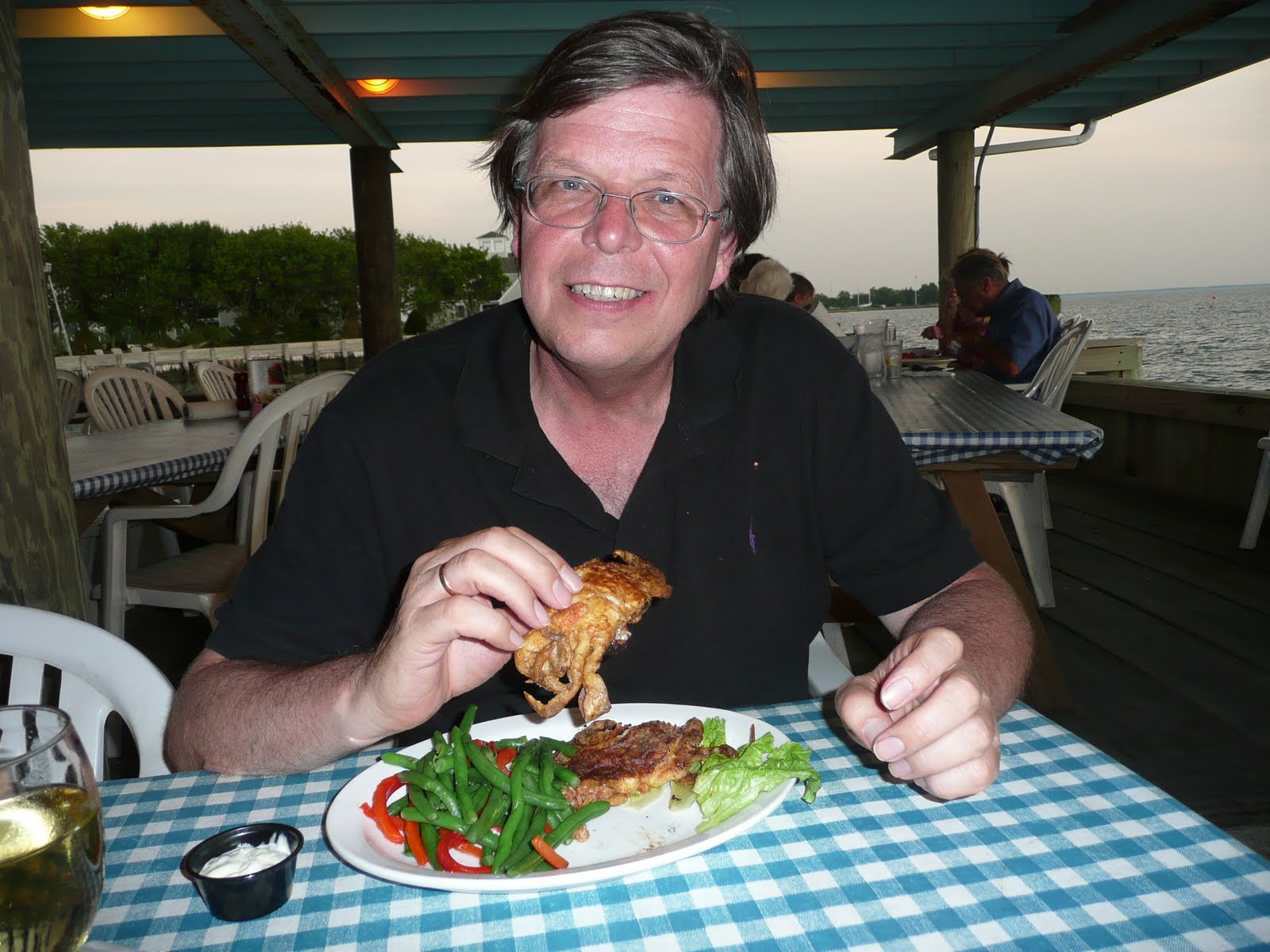
Pictures: Christian G.E. Schiller eating Soft Shell Crabs
Crab Cake
Crab cakes is another delicacy. Crab Cakes are basically Hamburgers made out of crab meat. We ate it recently as a starter with tomatoes and avocado on the side.
Picture: Maryland Crab Cake
See more:
Wine and Crab Cakes: Amy Brandwein from Casa Nonna and Chris Clime from PassionFish win the 6th Annual Crab Cake Competition in Washington DC, USA
Maryland Crab Soup
Usually I start my crab dinner with a Maryland Crab Soup. This is a kind of an Italian Minestrone with crab meat.

Pictures: Annette Schiller, Ombiasy PR and Wine Tours, eating Maryland Crab Soup
See more:
Maryland Crabs and Wine
Schiller's World of Seafood
Drink Local Wine 2013: The Panel Sessions
About 150 bloggers, journalists and wine lovers attended the conference.
Picture: At the Tremont Hotel
Session I 9:00 am – 9:45 am: Creating Maryland’s Wine Identity (Tremont Hotel)
Moderator: Carlo DeVito, author of East Coast Wineries: A Complete Guide from Maine to Virginia published by Rutgers University Press.
Panelists: Robert Deford, owner, Boordy Vineyards; Marguerite Thomas, author, Touring East Coast Wine Country; Dr. Joe Fiola, Cooperative Extension, College of Agriculture & Natural Resources, University of Maryland.
This session took a look at Maryland’s wine industry. Dr. Fiola believes that the future of the Maryland wines lies with the Bordeaux varieties, Chambourcin, Chardonnay, Barbera, Sauvignon Blanc and Albarino.
Session II 10:00 am – 10:45 am: Drinking Local (Tremont Hotel)
Moderator: Dave McIntyre, Washington Post wine columnist, Drink Local Wine co-founder.
Panelists: Jerry Pellegrino, chef, Waterfront Kitchen; Jade Ostner, Director of Events, Maryland Wineries Association; Al Spoler, co-host, Cellar Notes/Radio Kitchen, WYPR Radio.
Do Marylanders appreciate their home-grown wine, and if not, how to get the message out.
Session III 11:00 – 11:45 am: Maryland’s New Guard (Tremont Hotel)
Moderator: Kevin Atticks, executive director, Maryland Wineries Association.
Panelists: Ed Boyce, founder, Black Ankle Vineyards; Tom Shelton, owner and winemaker, Bordeleau Vineyards & Winery; Dave Collins, co-owner, Big Cork Vineyards.
Lunch 12:00 – 1:15 pm
Session IV 1:30 – 2:15 pm: Tasting Maryland’s Future (Tremont Hotel)
Moderator: Joseph A. Fiola, Ph.D, Specialist in Viticulture and Small Fruit, University of Maryland Extension
Dr. Fiola’s viticulture and enology program concentrates testing the varieties imported from the fine winegrowing areas of the word that have climates similar to the diverse regional climates of Maryland.
He poured three pairs of wines: two whites, two reds, and two dessert wines that are made from grapes he has been conducting research trials with.
Grand Tasting of Maryland Wines and Twitter Taste-off
Grand Tasting of Maryland Wines and Twitter Taste-off: 3:00 pm – 6:00 pm (The Warehouse at Camden Yards)
Picture: At The Warehouse at Camden Yards
The Twitter Taste-Off was the grand finale of the DLW Conference. Held at The Warehouse at Camden Yards, it featured 20 Maryland wineries. 425 wine enthusiasts, vintners and bloggers came to taste Maryland wines and learn more about the local industry.
“Of course, Drink Local Wines is always a social media event and our tweets and updates quickly became the leading trend on Twitter — above even Tiger Woods and his two-stroke penalty at the Masters or Kobe Bryant’s ruptured Achilles tendon,” writes DrinkLocalWine.com co-founder Dave McIntyre on his blog. “We realized something was happening when advertisements began popping up on #dlw13 and #mdwine.”
Twitter Taste-off Winners
The winners were:
White: Black Ankle for its 2011 Albarino
Picture: Sarah O’Herron and Ed Boyce, Black Ankle
Red: Sugarloaf Mountain Vineyards for its 2010 EVOE, a Bordeaux-style blend
Picture: Annette Schiller, wine tours by ombiasy, and Michael McGarry, Sugar Loaf Vineyard, Co-Owner
Other: Millstone Cellars for its Ciderberry, a tasty cider made of Rome Beauty and Stayman Winesap apples and flavored with raspberries.
Drink Local Wine Conferences: 2009 to 20013
The Drink Local Wine goal is to spotlight wine made in the 47 states and Canada that aren't California, Washington, and Oregon. It's the brainchild of Washington Post wine columnist Dave McIntyre and wine blogger Jeff Siegel, the Wine Curmudgeon. The current president is Michael Wangbickler (Through the Bunghole).
So far, 5 annual conferences have taken place:
in Dallas featuring Texas wine in 2009,
in Loudoun County featuring Virginia wine in 2010,
in St. Louis featuring Missouri wine in 2011,
in Denver featuring Colorado wine in 2012, and
in Baltimore featuring Maryland wine in 2013.
This was my third DLW conference; I participated in the Virginia and Missouri conferences and have written about them on schiller-wine.
For Virginia, see:
The 2010 DrinkLocalWine Conference in Virginia, US
For Missouri, see:
Drink Local Wine Conference 2011 in St. Louis: The World of Missouri Wine
Wine Producer Missouri – Once a Major Force in the US Wine Market, Then Non-existant and Now on a Rebound with French American Hybrid Grapes
The 5th annual Drink Local Wine Conference in Baltimore in Maryland (May 14, 2013) was a day about Maryland wine. Interesting panel discussions in the morning were followed by a luncheon with Maryland wines and a grand tasting featuring the wines of Maryland’s top winemakers in the afternoon.
Picture: At the Tremont Hotel
Thanks to Kevin Atticks, Executive Director of the Maryland Wineries Association along with Marketing Director Briana Berg and Events Director Jade Ostner, for an outstanding conference.
Wine in the USA
The USA has become the 4th largest wine producing country in the world, after France, Italy, and Spain (and the largest wine consuming country in the world). Wine is now produced in all 50 States, with California, Washington State and Oregon leading the way. However, some states outside the Northwest do not grow vitis vinifera grapes such as Cabernet Sauvignon and Chardonnay easily, and some wineries in the smaller wine-producing states buy juice or grapes from other states. For reviews of wines from all 50 states go to here for an excellent Time Magazine article.
Wine in Maryland
Blue crabs are iconic in Maryland (see below), but few wine/food aficionados know premium wines from Marylandof. In fact, Maryland has long had the reputation of being a mediocre wine producer. But Maryland winemakers are successfully changing that. Increasingly, winemakers in Maryland are moving away from fruit wines and non-European grape varieties that have long plagued the East Coast to produce wines that can compete with the best wines in the world.
Picture: Map of Maryland
As Drew Baker of Old Westminster Winery explained to Frank Morgan, a popular wine blogger, “Maryland has great potential and I believe that the quality bar is rising quickly. Soon, poorly made wines will be the exception in an otherwise great region.” Old Westminster Winery, led by the three siblings Drew, Lisa, and Ashli, who manage the vineyard, winemaking, and marketing, respectively, has not yet released any wines, but is already generating a buzz. Other promising newcomers include Black Ankle, Slack, Sugar Loaf Mountain and Port of Leonardtown. Add to that the Maryland classics Boordy, Basignani and Elk Run, to name a few.
Maryland’s modern wine history dates to the 1970s, but grapes have been planted in the area since the 17th century. Most of the state’s 60 plus wineries are in the Piedmont Plateau in central Maryland, but grapes also thrive in the Eastern Shore, Southern Plain, and Western Mountains: (1) A majority of the state’ vineyards are planted in Piedmont Plateau in central Maryland. (2) The Chesapeake Bay has always been among my favorite regions, but the Eastern Shore is also a fantastic growing region. The soil is sandy and well-drained, and the climate is moderated/protected by the water, perfect for warm days and cool nights. (3) In the Southern Plain in southern Maryland it can get rather hot. And stay hot during the night. Barbera, Sangiovese, and Chardonnay dominate. (4) Western Maryland is mountainous, and while there are only two wineries, there’s a number of vineyards.
Maryland Blue Crabs
Last year in May, wine guru and Maryland resident Robert J. Parker tweeted: “Maryland’s greatest culinary delicacy – blue channel soft-shelled crabs are starting to arrive … lightly floured and sautéed in butter.” Maryland – with the large Chesapeake Bay – is indeed blessed with Blue Crabs which came in different forms, when you eat them at a Crab Shack. Unfortunately, Maryland’s delicious seafood was on the backburner during the conference.
The blue crab is a crustacean found in the waters of the western Atlantic Ocean, the Pacific Coast of Central America and the Gulf of Mexico. Chesapeake Bay Blue Crabs undergo a seasonal migration; after mating, the female crab travels to the southern portion of the Chesapeake, fertilizing her eggs with sperm stored up from the last mating months or almost a year later. In November or December, the female crab releases her eggs. The crabs hatch in a larval form and float in the mouth of the bay for four to five weeks, then the juvenile crabs make their way back up into the bay.
Four Ways to Eat Chesapeake Blue Crabs
Hard Shell Blue Crabs
Blue crabs are most often eaten in the hard shell. Steaming them in large pots with water, vinegar and seasoning is the norm on the East coast. You need the whole experience: the smell of steamed crabs in the air, a pile of large steamed blue crabs covered with Old Bay Seasoning, ready to be cracked with wooden mallets, accompanied by corn on the cob, plus a roll of paper towels and a metal bucket for tossing the empty shells.
Soft Shell Crabs
The Chesapeake Bay is famous for its soft-shell blue crabs. As crabs grow larger, their shells cannot expand, so they molt the exteriors and have a soft covering for a matter of days when they are vulnerable and considered usable. Crabs caught just after molting are prepared as soft shell crabs: first cutting out the gills, face, and guts; the crab is then battered in flour, egg, and seasoning, then fried in oil until crispy. The entire crab is consumed, legs and all.
Crab Cake
Crab cakes is another delicacy. Crab Cakes are basically Hamburgers made out of crab meat. We ate it recently as a starter with tomatoes and avocado on the side.
See more:
Wine and Crab Cakes: Amy Brandwein from Casa Nonna and Chris Clime from PassionFish win the 6th Annual Crab Cake Competition in Washington DC, USA
Maryland Crab Soup
Usually I start my crab dinner with a Maryland Crab Soup. This is a kind of an Italian Minestrone with crab meat.
See more:
Maryland Crabs and Wine
Schiller's World of Seafood
Drink Local Wine 2013: The Panel Sessions
About 150 bloggers, journalists and wine lovers attended the conference.
Picture: At the Tremont Hotel
Session I 9:00 am – 9:45 am: Creating Maryland’s Wine Identity (Tremont Hotel)
Moderator: Carlo DeVito, author of East Coast Wineries: A Complete Guide from Maine to Virginia published by Rutgers University Press.
Panelists: Robert Deford, owner, Boordy Vineyards; Marguerite Thomas, author, Touring East Coast Wine Country; Dr. Joe Fiola, Cooperative Extension, College of Agriculture & Natural Resources, University of Maryland.
This session took a look at Maryland’s wine industry. Dr. Fiola believes that the future of the Maryland wines lies with the Bordeaux varieties, Chambourcin, Chardonnay, Barbera, Sauvignon Blanc and Albarino.
Session II 10:00 am – 10:45 am: Drinking Local (Tremont Hotel)
Moderator: Dave McIntyre, Washington Post wine columnist, Drink Local Wine co-founder.
Panelists: Jerry Pellegrino, chef, Waterfront Kitchen; Jade Ostner, Director of Events, Maryland Wineries Association; Al Spoler, co-host, Cellar Notes/Radio Kitchen, WYPR Radio.
Do Marylanders appreciate their home-grown wine, and if not, how to get the message out.
Session III 11:00 – 11:45 am: Maryland’s New Guard (Tremont Hotel)
Moderator: Kevin Atticks, executive director, Maryland Wineries Association.
Panelists: Ed Boyce, founder, Black Ankle Vineyards; Tom Shelton, owner and winemaker, Bordeleau Vineyards & Winery; Dave Collins, co-owner, Big Cork Vineyards.
Lunch 12:00 – 1:15 pm
Session IV 1:30 – 2:15 pm: Tasting Maryland’s Future (Tremont Hotel)
Moderator: Joseph A. Fiola, Ph.D, Specialist in Viticulture and Small Fruit, University of Maryland Extension
Dr. Fiola’s viticulture and enology program concentrates testing the varieties imported from the fine winegrowing areas of the word that have climates similar to the diverse regional climates of Maryland.
He poured three pairs of wines: two whites, two reds, and two dessert wines that are made from grapes he has been conducting research trials with.
Grand Tasting of Maryland Wines and Twitter Taste-off
Grand Tasting of Maryland Wines and Twitter Taste-off: 3:00 pm – 6:00 pm (The Warehouse at Camden Yards)
Picture: At The Warehouse at Camden Yards
The Twitter Taste-Off was the grand finale of the DLW Conference. Held at The Warehouse at Camden Yards, it featured 20 Maryland wineries. 425 wine enthusiasts, vintners and bloggers came to taste Maryland wines and learn more about the local industry.
“Of course, Drink Local Wines is always a social media event and our tweets and updates quickly became the leading trend on Twitter — above even Tiger Woods and his two-stroke penalty at the Masters or Kobe Bryant’s ruptured Achilles tendon,” writes DrinkLocalWine.com co-founder Dave McIntyre on his blog. “We realized something was happening when advertisements began popping up on #dlw13 and #mdwine.”
Twitter Taste-off Winners
The winners were:
White: Black Ankle for its 2011 Albarino
Picture: Sarah O’Herron and Ed Boyce, Black Ankle
Red: Sugarloaf Mountain Vineyards for its 2010 EVOE, a Bordeaux-style blend
Picture: Annette Schiller, wine tours by ombiasy, and Michael McGarry, Sugar Loaf Vineyard, Co-Owner
Other: Millstone Cellars for its Ciderberry, a tasty cider made of Rome Beauty and Stayman Winesap apples and flavored with raspberries.
Drink Local Wine Conferences: 2009 to 20013
The Drink Local Wine goal is to spotlight wine made in the 47 states and Canada that aren't California, Washington, and Oregon. It's the brainchild of Washington Post wine columnist Dave McIntyre and wine blogger Jeff Siegel, the Wine Curmudgeon. The current president is Michael Wangbickler (Through the Bunghole).
So far, 5 annual conferences have taken place:
in Dallas featuring Texas wine in 2009,
in Loudoun County featuring Virginia wine in 2010,
in St. Louis featuring Missouri wine in 2011,
in Denver featuring Colorado wine in 2012, and
in Baltimore featuring Maryland wine in 2013.
This was my third DLW conference; I participated in the Virginia and Missouri conferences and have written about them on schiller-wine.
For Virginia, see:
The 2010 DrinkLocalWine Conference in Virginia, US
For Missouri, see:
Drink Local Wine Conference 2011 in St. Louis: The World of Missouri Wine
Wine Producer Missouri – Once a Major Force in the US Wine Market, Then Non-existant and Now on a Rebound with French American Hybrid Grapes
Friday, April 19, 2013
Austria’s Best Red Wines - Falstaff RotweinGuide 2013
Pictures: Christian G.E. Schiller and Christine and Franz Netzl in Göttlesbrunn in the Carnuntum
The Fallstaff RotweinGuide 2013, a wine guide for Austrian red wine, was released in December 2012 in Vienna, Austria. In the Fallstaff RotweinGuide 2013, more than 1000 wines of almost 400 winemakers are described on 306 pages. This key reference for Austrian wine was released for the 16th time by Peter Moser. The focus of the Falstaff RotweinGuide 2013 is on the 2010 vintage. The Falstaff RotweinGuide 2013 awarded prizes in 11 categories.
Picture: Christian G.E. Schiller with Peter Moser in Frankfurt am Main, Germany
For previous years see:
Austria’s Best Red Wines - Falstaff RotweinGuide 2010/2011
Wine ratings: Austria - Falstaff Top Red Wines 2009/2010
Austria’s Red Wine Boom
At first thought one might think of Austria’s climate as being quite cool for red wine. In the Alps and the western and northern reaches of the country this tends to be true. The eastern plains that border Hungary and Slovenia, however, are a different story. Yes, Austria has an international reputation for its white wines, but the reds have been improving. Like in Germany, in Austria there has been a revolution going on in terms of red wines in recent years. In both countries, red wine now accounts for about 1/3 of the wine production.
There are 3 key Austrian red grape varieties, although others are also grown, including international grapes. Zweigelt accounts for 9.0 % of Austria’s total production, Blaufraenkisch for 5.5 % and Blauer Portugieser 5.0 %. All other red grape varieties - including the international grapes Pinot Noir, Merlot, Cabernet Sauvignon and Syrah as well as St. Lauren - are below 2 percent each of Austria’s wine production.
Zwiegelt: The most abundant red grape; makes good wines ranging from simple cherry fruit reds to more substantial reds destined for aging.
Blaufränkisch: Common in Burgenland, this makes spicy, sturdy, berry fruited reds which can have some tannic structure. Probably Austria’s best red grape.
Blauer Portugieser: This red grape makes soft, approachable, juicy wines mainly for early consumption. The most widely planted red grape but not for top quality wines.
St. Laurent: Came from France in the mid-19th century, and seems to have substantial Pinot Noir parentage. It makes soft, slight herby, expressive reds; it’s a bit like Pinot Noir.
See more:
Wine Producer Austria - Not Only Gruener Veltliner
The Fallstaff 2013 Awards
Falstaff-Sieger 2012
These are the 3 overall winners, with the highest scores (Punkte).
1. Pannobile 2010 – Weingut Anita und Hans Nittnaus, Gols (94 Falstaff-Punkte)
2. Rosenberg 2010 – Weingut Gerhard Markowitsch, Göttlesbrunn (94 Falstaff-Punkte)
3. Blaufränkisch Spiegel 2010 – Weingut Paul Achs, Gols (94 Falstaff-Punkte)
Weingut Anita und Hans (John) Nittnaus
The Neusiedlersee region has seen quite a bit of national and international recognition in recent years and the good work and wines of Anita und Hans (John) Nittnaus are one of the reasons, why this has happened.
Nittnaus is a very common name in the Burgenland. I believe there are at least 3 Hans Nittnaus in the Neusiedlersee, producing wine, which creates a problem for the consumer. So, one way of distinguishing themselves from the others is via their spouses (Anita) and the other one is via nicknames (John).
Weingut Anita and Hans (John) Nittnaus is located in Gols on the east side of Lake Neusiedl. The history of Weingut Anita and Hans Nittnaus goes back to the 17th century. Since then, the family has always been in agriculture and viticulture. The winery as you see it today was constructed in 1927 by Hans’ grandfather. Two generations later, in 1985, Anita and Hans Nittnaus took over the family business. They had met in Vienna, where they both were studying. Together they decided to continue with the family business. Anita and Hans (John) have four children.
Picture: Hans (John) Nittnaus in Rust
Today, the vineyard area totals 35 hectares, with about 90 percent planted with red wine. The plots are widely scattered. The main varieties are Blaufränkisch and Zweigelt, but there is also Pinot Noir, St. Laurent, Cabernet Sauvignon and Merlot.
The winemaking philosophy of the Nittnaus' is very simple: terroir-driven and naturally produced (in the sense of as little intervention as possible) wines of the highest quality. Since 2007, Anita and Hans (John) Nittnaus have fully switched to biodynamic viticulture.
Hans (John) Nittnaus clearly is a wine pioneer. With his cuvees he has set new standards in the Burgenland wine culture. If you would want to write a book about the red wine revolution in Austria, you could take Weingut Anita and Hans (John) Nittnaus as a case study.
See also:
Meeting “John” Nittnaus from Gols, Burgenland, Austria
Vienna Insurance Group – Falstaff Reserve-Trophy 2012
This award is for wines that have spent more time aging before being released.
1. Blaufränkisch Reserve Oberer Wald 2009 – Weingut Günter und Regina Triebaumer, Rust (96 Falstaff-Punkte)
2. Blaufränkisch Tannenberg 2009 – Weingut Anita und Hans Nittnaus, Gols (96 Falstaff-Punkte)
3. massive a. rot 2009 SY/ZW/ME – Weingut Artner, Höflein (96 Falstaff-Punkte)
Zweigelt-Grand-Prix 2012
1. Zweigelt Alte Reben 2011 – Weingut Paul Achs, Gols (92 Falstaff-Punkte)
2. Zweigelt Rubin Carnuntum 2011 – Weingut Trapl, Stixneusiedl (92 Falstaff-Punkte)
3. All Red 2011 – Weingut Vinum Pannonia Allacher, Gols (92 Falstaff-Punkte)
Blaufränkisch
1. Blaufränkisch Spiegel 2010 – Weingut Paul Achs, Gols (94 Falstaff-Punkte)
2. Blaufränkisch Perwolff 2010 – Weingut Krutzler, Deutsch Schützen (94 Falstaff-Punkte)
3. Blaufränkisch Bärnreiser 2010 – Weingut Hans und Philipp Grassl, Göttlesbrunn (94 Falstaff-Punkte)
Cabernet Sauvignon
1. Cabernet Sauvignon 2010 – Weingut Erich Scheiblhofer, Andau (91 Falstaff-Punkte)
2. Cabernet Sauvignon Tribun 2010 – Weingut Taferner, Göttlesbrunn (91 Falstaff-Punkte)
3. Cabernet Sauvignon Aubühel 2010 – Weingut Franz und Christine Netzl, Göttlesbrunn (91 Falstaff-Punkte)
Cuvée
1. Pannobile 2010 – Weingut Anita und Hans Nittnaus, Gols (94 Falstaff-Punkte)
2. Rosenberg 2010 – Weingut Gerhard Markowitsch, Göttlesbrunn (94 Falstaff-Punkte)
3. Xur 2010 – Weingut Werner Achs, Gols (94 Falstaff-Punkte)
Merlot
1. Merlot Bärnreiser 2010 – Weingut Franz und Christine Netzl, Göttlesbrunn (92 Falstaff-Punkte)
2. Merlot Rotundo 2010 – Weinbau Gottschuly-Grassl, Höflein (92 Falstaff-Punkte)
3. Merlot Reserve 2010 – Weingut Anton Bauer, Feuersbrunn (92 Falstaff-Punkte)
Weingut Franz und Christine Netzl
The Netzl Estate is located in the small town of Göttlesbrunn in the Carnuntum. The family has been involved in wine production since 1820. Weimgut Christine and Franz Netzl is regarded as one of those responsible for the red wine boom in Austria.
The vineyard area totals 26 hectares, with holdings in the Aubühel, Bärnreiser, Haidacker, Holzweg, Kräften and Neuberg sites. 80% of the area is planted with the red varieties Zweigelt, St. Laurent, Cabernet Sauvignon, Merlot and Syrah, while the remaining 20% is planted with the white varieties Grüner Veltliner, Pinot Blanc, Chardonnay and Welschriesling. A bottle-fermented sparkling wine is also produced. Annual production is around 80.000 bottles of wine, which includes the wine made from grapes on the market, equivalent to about 5 hectares.
See more:
Visiting Christine, Christina and Franz Netzl in their Weingut Netzl in Carnuntum, Austria
Welcome to America: Franz and Christine Netzl Estate, Carnuntum, Austria
Pinot Noir
1. Pinot Noir Holzspur 2010 – Weingut Johanneshof Reinisch, Tattendorf (93 Falstaff-Punkte)
2. Pinot Noir Reserve 2010 – Weingut Gerhard Markowitsch, Göttlesbrunn (93 Falstaff-Punkte)
3. Pinot Noir Best of 2010 – Winzerhof Landauer-Gisperg, Tattendorf (93 Falstaff-Punkte)
St. Laurent
1. St. Laurent Reserve 2010 – Weingut Hans und Philipp Grassl, Göttlesbrunn (92 Falstaff-Punkte)
2. St. Laurent Reserve 2010 – Weingut Juris, Gols (92 Falstaff-Punkte)
3. St. Laurent Zagersdorf 2010 – Weingut Rosi Schuster, St. Margarethen (92 Falstaff-Punkte)
Syrah
1. Syrah 2010 – Weingut Toni Hartl, Reisenberg (92 Falstaff-Punkte)
2. Syrah 2010 – Weingut Erich Scheiblhofer, Andau (92 Punkte Falstaff-Punkte)
3. Syrah Schüttenberg 2010 – Weingut Franz und Christine Netzl, Göttlesbrunn (92 Punkte Falstaff-Punkte)
Zweigelt
1. Schwarz Rot 2010 – Schwarz Wein, Andau (92 Falstaff-Punkte)
2. Zweigelt Salzberg 2010 – Weingut Vinum Pannonia Allacher, Gols (92 Falstaff-Punkte)
3. Zweigelt Haidacker 2010 – Weingut Franz und Christine Netzl, Göttlesbrunn (92 Falstaff-Punkte)
schiller-wine: Related Postings
Dinner with Wine Maker Gerhard Wohlmuth sen., his Wines and the Food of Steierland’s Chef Ruth Stelzer, Austria
Schiller’s Favorite Wine Bars and Other Wine Spots in Vienna, Austria
Producing Wines in Austria and Hungary - Franz and Franz Reinhard Weninger
With the WienWein Winemakers in Vienna in the Heurigen Drinking Gemischter Satz Wine
Visiting Leo Hillinger, Michael Hoeffken and Edgar Brutler at the Leo Hillinger Winery in Jois, Austria
Wine Producer Austria - Not Only Gruener Veltliner
Meeting “John” Nittnaus from Gols, Burgenland, Austria
At the Forefront of Biodynamic Winemaking: Visiting Werner and Angela Michlits and their Weingut Meinklang in Austria
Visiting Christine, Christina and Franz Netzl in their Weingut Netzl in Carnuntum, Austria
Austria’s Best Wines and Winemakers - Falstaff WeinGuide 2010
Austria’s Best Wines and Winemakers - Falstaff WeinGuide 2011
Austria’s Best Wines and Winemakers - Falstaff WeinGuide 2012
Austria’s Best Red Wines - Falstaff RotweinGuide 2010/2011
Wine ratings: Austria - Falstaff Top Red Wines 2009/2010
The Fallstaff RotweinGuide 2013, a wine guide for Austrian red wine, was released in December 2012 in Vienna, Austria. In the Fallstaff RotweinGuide 2013, more than 1000 wines of almost 400 winemakers are described on 306 pages. This key reference for Austrian wine was released for the 16th time by Peter Moser. The focus of the Falstaff RotweinGuide 2013 is on the 2010 vintage. The Falstaff RotweinGuide 2013 awarded prizes in 11 categories.
Picture: Christian G.E. Schiller with Peter Moser in Frankfurt am Main, Germany
For previous years see:
Austria’s Best Red Wines - Falstaff RotweinGuide 2010/2011
Wine ratings: Austria - Falstaff Top Red Wines 2009/2010
Austria’s Red Wine Boom
At first thought one might think of Austria’s climate as being quite cool for red wine. In the Alps and the western and northern reaches of the country this tends to be true. The eastern plains that border Hungary and Slovenia, however, are a different story. Yes, Austria has an international reputation for its white wines, but the reds have been improving. Like in Germany, in Austria there has been a revolution going on in terms of red wines in recent years. In both countries, red wine now accounts for about 1/3 of the wine production.
There are 3 key Austrian red grape varieties, although others are also grown, including international grapes. Zweigelt accounts for 9.0 % of Austria’s total production, Blaufraenkisch for 5.5 % and Blauer Portugieser 5.0 %. All other red grape varieties - including the international grapes Pinot Noir, Merlot, Cabernet Sauvignon and Syrah as well as St. Lauren - are below 2 percent each of Austria’s wine production.
Zwiegelt: The most abundant red grape; makes good wines ranging from simple cherry fruit reds to more substantial reds destined for aging.
Blaufränkisch: Common in Burgenland, this makes spicy, sturdy, berry fruited reds which can have some tannic structure. Probably Austria’s best red grape.
Blauer Portugieser: This red grape makes soft, approachable, juicy wines mainly for early consumption. The most widely planted red grape but not for top quality wines.
St. Laurent: Came from France in the mid-19th century, and seems to have substantial Pinot Noir parentage. It makes soft, slight herby, expressive reds; it’s a bit like Pinot Noir.
See more:
Wine Producer Austria - Not Only Gruener Veltliner
The Fallstaff 2013 Awards
Falstaff-Sieger 2012
These are the 3 overall winners, with the highest scores (Punkte).
1. Pannobile 2010 – Weingut Anita und Hans Nittnaus, Gols (94 Falstaff-Punkte)
2. Rosenberg 2010 – Weingut Gerhard Markowitsch, Göttlesbrunn (94 Falstaff-Punkte)
3. Blaufränkisch Spiegel 2010 – Weingut Paul Achs, Gols (94 Falstaff-Punkte)
Weingut Anita und Hans (John) Nittnaus
The Neusiedlersee region has seen quite a bit of national and international recognition in recent years and the good work and wines of Anita und Hans (John) Nittnaus are one of the reasons, why this has happened.
Nittnaus is a very common name in the Burgenland. I believe there are at least 3 Hans Nittnaus in the Neusiedlersee, producing wine, which creates a problem for the consumer. So, one way of distinguishing themselves from the others is via their spouses (Anita) and the other one is via nicknames (John).
Weingut Anita and Hans (John) Nittnaus is located in Gols on the east side of Lake Neusiedl. The history of Weingut Anita and Hans Nittnaus goes back to the 17th century. Since then, the family has always been in agriculture and viticulture. The winery as you see it today was constructed in 1927 by Hans’ grandfather. Two generations later, in 1985, Anita and Hans Nittnaus took over the family business. They had met in Vienna, where they both were studying. Together they decided to continue with the family business. Anita and Hans (John) have four children.
Picture: Hans (John) Nittnaus in Rust
Today, the vineyard area totals 35 hectares, with about 90 percent planted with red wine. The plots are widely scattered. The main varieties are Blaufränkisch and Zweigelt, but there is also Pinot Noir, St. Laurent, Cabernet Sauvignon and Merlot.
The winemaking philosophy of the Nittnaus' is very simple: terroir-driven and naturally produced (in the sense of as little intervention as possible) wines of the highest quality. Since 2007, Anita and Hans (John) Nittnaus have fully switched to biodynamic viticulture.
Hans (John) Nittnaus clearly is a wine pioneer. With his cuvees he has set new standards in the Burgenland wine culture. If you would want to write a book about the red wine revolution in Austria, you could take Weingut Anita and Hans (John) Nittnaus as a case study.
See also:
Meeting “John” Nittnaus from Gols, Burgenland, Austria
Vienna Insurance Group – Falstaff Reserve-Trophy 2012
This award is for wines that have spent more time aging before being released.
1. Blaufränkisch Reserve Oberer Wald 2009 – Weingut Günter und Regina Triebaumer, Rust (96 Falstaff-Punkte)
2. Blaufränkisch Tannenberg 2009 – Weingut Anita und Hans Nittnaus, Gols (96 Falstaff-Punkte)
3. massive a. rot 2009 SY/ZW/ME – Weingut Artner, Höflein (96 Falstaff-Punkte)
Zweigelt-Grand-Prix 2012
1. Zweigelt Alte Reben 2011 – Weingut Paul Achs, Gols (92 Falstaff-Punkte)
2. Zweigelt Rubin Carnuntum 2011 – Weingut Trapl, Stixneusiedl (92 Falstaff-Punkte)
3. All Red 2011 – Weingut Vinum Pannonia Allacher, Gols (92 Falstaff-Punkte)
Blaufränkisch
1. Blaufränkisch Spiegel 2010 – Weingut Paul Achs, Gols (94 Falstaff-Punkte)
2. Blaufränkisch Perwolff 2010 – Weingut Krutzler, Deutsch Schützen (94 Falstaff-Punkte)
3. Blaufränkisch Bärnreiser 2010 – Weingut Hans und Philipp Grassl, Göttlesbrunn (94 Falstaff-Punkte)
Cabernet Sauvignon
1. Cabernet Sauvignon 2010 – Weingut Erich Scheiblhofer, Andau (91 Falstaff-Punkte)
2. Cabernet Sauvignon Tribun 2010 – Weingut Taferner, Göttlesbrunn (91 Falstaff-Punkte)
3. Cabernet Sauvignon Aubühel 2010 – Weingut Franz und Christine Netzl, Göttlesbrunn (91 Falstaff-Punkte)
Cuvée
1. Pannobile 2010 – Weingut Anita und Hans Nittnaus, Gols (94 Falstaff-Punkte)
2. Rosenberg 2010 – Weingut Gerhard Markowitsch, Göttlesbrunn (94 Falstaff-Punkte)
3. Xur 2010 – Weingut Werner Achs, Gols (94 Falstaff-Punkte)
Merlot
1. Merlot Bärnreiser 2010 – Weingut Franz und Christine Netzl, Göttlesbrunn (92 Falstaff-Punkte)
2. Merlot Rotundo 2010 – Weinbau Gottschuly-Grassl, Höflein (92 Falstaff-Punkte)
3. Merlot Reserve 2010 – Weingut Anton Bauer, Feuersbrunn (92 Falstaff-Punkte)
Weingut Franz und Christine Netzl
The Netzl Estate is located in the small town of Göttlesbrunn in the Carnuntum. The family has been involved in wine production since 1820. Weimgut Christine and Franz Netzl is regarded as one of those responsible for the red wine boom in Austria.
The vineyard area totals 26 hectares, with holdings in the Aubühel, Bärnreiser, Haidacker, Holzweg, Kräften and Neuberg sites. 80% of the area is planted with the red varieties Zweigelt, St. Laurent, Cabernet Sauvignon, Merlot and Syrah, while the remaining 20% is planted with the white varieties Grüner Veltliner, Pinot Blanc, Chardonnay and Welschriesling. A bottle-fermented sparkling wine is also produced. Annual production is around 80.000 bottles of wine, which includes the wine made from grapes on the market, equivalent to about 5 hectares.
See more:
Visiting Christine, Christina and Franz Netzl in their Weingut Netzl in Carnuntum, Austria
Welcome to America: Franz and Christine Netzl Estate, Carnuntum, Austria
Pinot Noir
1. Pinot Noir Holzspur 2010 – Weingut Johanneshof Reinisch, Tattendorf (93 Falstaff-Punkte)
2. Pinot Noir Reserve 2010 – Weingut Gerhard Markowitsch, Göttlesbrunn (93 Falstaff-Punkte)
3. Pinot Noir Best of 2010 – Winzerhof Landauer-Gisperg, Tattendorf (93 Falstaff-Punkte)
St. Laurent
1. St. Laurent Reserve 2010 – Weingut Hans und Philipp Grassl, Göttlesbrunn (92 Falstaff-Punkte)
2. St. Laurent Reserve 2010 – Weingut Juris, Gols (92 Falstaff-Punkte)
3. St. Laurent Zagersdorf 2010 – Weingut Rosi Schuster, St. Margarethen (92 Falstaff-Punkte)
Syrah
1. Syrah 2010 – Weingut Toni Hartl, Reisenberg (92 Falstaff-Punkte)
2. Syrah 2010 – Weingut Erich Scheiblhofer, Andau (92 Punkte Falstaff-Punkte)
3. Syrah Schüttenberg 2010 – Weingut Franz und Christine Netzl, Göttlesbrunn (92 Punkte Falstaff-Punkte)
Zweigelt
1. Schwarz Rot 2010 – Schwarz Wein, Andau (92 Falstaff-Punkte)
2. Zweigelt Salzberg 2010 – Weingut Vinum Pannonia Allacher, Gols (92 Falstaff-Punkte)
3. Zweigelt Haidacker 2010 – Weingut Franz und Christine Netzl, Göttlesbrunn (92 Falstaff-Punkte)
schiller-wine: Related Postings
Dinner with Wine Maker Gerhard Wohlmuth sen., his Wines and the Food of Steierland’s Chef Ruth Stelzer, Austria
Schiller’s Favorite Wine Bars and Other Wine Spots in Vienna, Austria
Producing Wines in Austria and Hungary - Franz and Franz Reinhard Weninger
With the WienWein Winemakers in Vienna in the Heurigen Drinking Gemischter Satz Wine
Visiting Leo Hillinger, Michael Hoeffken and Edgar Brutler at the Leo Hillinger Winery in Jois, Austria
Wine Producer Austria - Not Only Gruener Veltliner
Meeting “John” Nittnaus from Gols, Burgenland, Austria
At the Forefront of Biodynamic Winemaking: Visiting Werner and Angela Michlits and their Weingut Meinklang in Austria
Visiting Christine, Christina and Franz Netzl in their Weingut Netzl in Carnuntum, Austria
Austria’s Best Wines and Winemakers - Falstaff WeinGuide 2010
Austria’s Best Wines and Winemakers - Falstaff WeinGuide 2011
Austria’s Best Wines and Winemakers - Falstaff WeinGuide 2012
Austria’s Best Red Wines - Falstaff RotweinGuide 2010/2011
Wine ratings: Austria - Falstaff Top Red Wines 2009/2010
Thursday, April 18, 2013
Bordeaux - En Primeur, Negociants, Courtiers, the Quai de Chartons and the Place de Bordeaux – A Short Introduction
Picture: The Quai de Chartons (Painting at Millesima in Bordeaux City)
Wine maker Doug Fabbioli from Fabbioli Cellars in Virginia sells the wine he produces during the course of the year to the consumers who show up at his winery and by the wine directly from him. Wine maker Ernst Loosen from Dr. Loosen in the Mosel Valley in Germany, whose wines are available all over the world, works, I assume, with wholesalers in Germany as well as with importers from all over the world, who buy the wine from him during the course of the year. The wines of both Doug Fabbioli and Ernst Loosen are sold after the wines have been bottled and are ready to be consumed.
The way the system works for the premium Bordeaux wines is different. And it is unique in the world. The wines are sold well before they are bottled (en primeur system) and the wines are sold and distributed to the world through the Place de Bordeaux.
Pictures: Millesima (Negociant) in Bordeaux City
Buying Bordeaux wines en primeur is like buying commodity futures, with cash laid down now for later delivery of something that does not yet exist as a finished product. The futures reach the consumer through a series of phases.
It all starts with a barrel tasting in Bordeaux for a week with journalists and buyers from around the world in late March. The participating chateaux than release their prices for the Place de Bordeaux negociants in May. After the courtiers ( brokers) take a percentage, the futures are allocated to the local négociants. Courtiers and négociants make up the Place de Bordeaux.
Once past this phase, the importers take over. Some importers offer futures for sale directly to individual consumers. Others sell their futures allocations to wholesalers, retailers and restaurants. The consumers all over the world are the final part of the process. A consumer can expect to pay a 200 percent to 250 percent markup once the title to the wine has made its journey from château to merchant.
Pictures: Christian G.E. Schiller and Annette Schiller, wine tours by ombiasy, at Millesima
For years, the Place de Bordeaux has allowed the producers to release their wine at one fixed price to the negociants they are dealing with and the negociants taking care of the marketing and distribution worldwide, ideally in one day.
Until the mid-1970s, however, a Bordeaux wine would only be marketed on to final customers by the merchants at the moment of bottling, or perhaps just before. The first really successful en primeur campaign to consumers was in 1970, when the newly affluent wine-drinking American public bought large amounts of Bordeaux.
Stepping back further in time, the Quai des Chartrons in the Chartons district in Bordeaux City at the Garonne is full with old warehouses which used to form the offices and warehouses of the négociant firms. Today, the Chartrons district buzzes with cafés, craft workshops and is a prized residential area. Few négociants remain in the Chartrons area now.
Negociants were also much more involved in the production of wine than today. In addition to marketing and shipping, they were responsible for bottling and labeling. They were producing custom blends ordered by customers that could range from assemblages that included blends from different producers. This started to change with the advent of Chateau bottling which was heavily promoted by Baron Rothschild at Chateau Mouton Rothschild in 1924. By 1970, the vast majority of Bordeaux chateaux bottled their own wine.
The Place de Bordeaux system system has its roots in Irish, English and Dutch merchants from over four centuries ago. Names of today’s wine merchants such as Barton, Schroeder, Kressman and Sichel all attest to the success of these ventures that were started centuries ago and are still trading from Bordeaux today.
Pictures: Annette Schiller, wine tours by ombiasy, Panos Kakaviatos, Wine Journalist, Jean-Bernard Grenié, Chateau Angelus, Ivanhoe Johnston, Negociant, and Christian G.E. Schiller in Washington DC
For more, see:
Owner Jean-Bernard Grenié and Wine Journalist Panos Kakaviatos Presented the Wines of Chateau Angélus and Chateau Daugay at Black Salt Restaurant in Washington DC, USA
Today, there are 400 négociants on the Place de Bordeaux, and most labels are purchased by an average of 40. Each chateau works with a different number of negociants. Some properties work with 5 different negociants, others work with over 100.
Of course, a few properties, most notably Tertre Roteboeuf in St. Emilion sell direct and do not offer their wines for sale to negociants on the Place de Bordeaux.
As for the courtiers, before phones, faxes and Emails, traveling by horse or carriage between the negociants quarter in Bordeaux City and the chateaux took an entire day. The courtier stepped in and carried messages back and forth between the negociants and the chateaux, helping to arrange an agreement between the two parties. For this role, the courtier earns 2% of the transaction. In 1855, it was the brokers who set the ranking for the classification.
Pictures: Millesima
In today’s world, when communication is instant, their role has become questionable. There are over 120 active courtiers. But the number of courtiers working with the top properties is small. Less than 20 are actively working with the most famous estates.
As for tranches, where the production is released in slices, very few chateaux release their wine in tranches. That practice is mostly limited to the First Growths.
Changes in the system have taken place, but in ways the long-established negociants are not happy with. They have more competition for allocations of the top wines than they were use to obtaining. This is because some of the top properties have started their own negociants companies, not only to sell their wines, but to market the wines of other chateaux as well. Plus, some companies, like Millésima. have an Internet division that sells directly to consumers.
Chateau Latour told its negociants that 2011 will be the last vintage it sells en primeur. From now on, only bottled wines will be sold from the winery, and vintages will be released when the chateau believes they are ready to drink.
One reason is that modern wine lovers are less interested in buying wines and aging them, particularly in Asia, and many are concerned with the provenance of top wines sold in the world. In other words, they want to buy wines for drinking that are properly stored. Latour is currently increasing its storage space at the chateau with a perfectly controlled environment for wine.
For more information, Jeff Leve from The Wine Cellar Insider has an excellent write-up about "En Primeur, Negociants, Courtiers, the Quai de Chartons and the Place de Bordeaux" on his website.
schiller-wine: Related Postings
Bordeaux Trip September 2012, France
Bordeaux Wines and their Classifications: The Basics
What is a Bordeaux Cru Bourgeois? France
The Saint Emilion 2012–2022 Classification, Bordeaux
Schiller's Favorite Wine Bars in Bordeaux (City), France
Plateau des Fruits de Mer and a Pessac-Leognan Wine in Bordeaux City, France
An Afternoon with Owner Henri Lurton at Château Brane-Cantenac, a Deuxieme Grand Cru Classe en 1855, in Margaux, France
An Afternoon with Owner Michel Tesseron at Château Lafon-Rochet, 4ème Cru Classé en 1855, in Saint-Estèphe, Bordeaux
The Wine Empire of the von Neipperg Family in France, Bulgaria and Germany
Château Léoville-Poyferré, Chateau Le Crock, Didier Cuvelier in Bordeaux and the Cuvelier Los Andes Wines in Argentina
Château Pape Clément in Pessac-Léognan and the World Wide Wine Empire of Bernard Magrez, France
Tasting with Alfred Tesseron the last 10 Vintages of Château Pontet-Canet in Washington DC, USA/France
Union des Grands Crus de Bordeaux (UGCB) on North America Tour in Washington DC - Schiller’s Favorites
Owner Jean-Bernard Grenié and Wine Journalist Panos Kakaviatos Presented the Wines of Chateau Angélus and Chateau Daugay at Black Salt Restaurant in Washington DC, USA
Wine maker Doug Fabbioli from Fabbioli Cellars in Virginia sells the wine he produces during the course of the year to the consumers who show up at his winery and by the wine directly from him. Wine maker Ernst Loosen from Dr. Loosen in the Mosel Valley in Germany, whose wines are available all over the world, works, I assume, with wholesalers in Germany as well as with importers from all over the world, who buy the wine from him during the course of the year. The wines of both Doug Fabbioli and Ernst Loosen are sold after the wines have been bottled and are ready to be consumed.
The way the system works for the premium Bordeaux wines is different. And it is unique in the world. The wines are sold well before they are bottled (en primeur system) and the wines are sold and distributed to the world through the Place de Bordeaux.
Pictures: Millesima (Negociant) in Bordeaux City
Buying Bordeaux wines en primeur is like buying commodity futures, with cash laid down now for later delivery of something that does not yet exist as a finished product. The futures reach the consumer through a series of phases.
It all starts with a barrel tasting in Bordeaux for a week with journalists and buyers from around the world in late March. The participating chateaux than release their prices for the Place de Bordeaux negociants in May. After the courtiers ( brokers) take a percentage, the futures are allocated to the local négociants. Courtiers and négociants make up the Place de Bordeaux.
Once past this phase, the importers take over. Some importers offer futures for sale directly to individual consumers. Others sell their futures allocations to wholesalers, retailers and restaurants. The consumers all over the world are the final part of the process. A consumer can expect to pay a 200 percent to 250 percent markup once the title to the wine has made its journey from château to merchant.
Pictures: Christian G.E. Schiller and Annette Schiller, wine tours by ombiasy, at Millesima
For years, the Place de Bordeaux has allowed the producers to release their wine at one fixed price to the negociants they are dealing with and the negociants taking care of the marketing and distribution worldwide, ideally in one day.
Until the mid-1970s, however, a Bordeaux wine would only be marketed on to final customers by the merchants at the moment of bottling, or perhaps just before. The first really successful en primeur campaign to consumers was in 1970, when the newly affluent wine-drinking American public bought large amounts of Bordeaux.
Stepping back further in time, the Quai des Chartrons in the Chartons district in Bordeaux City at the Garonne is full with old warehouses which used to form the offices and warehouses of the négociant firms. Today, the Chartrons district buzzes with cafés, craft workshops and is a prized residential area. Few négociants remain in the Chartrons area now.
Negociants were also much more involved in the production of wine than today. In addition to marketing and shipping, they were responsible for bottling and labeling. They were producing custom blends ordered by customers that could range from assemblages that included blends from different producers. This started to change with the advent of Chateau bottling which was heavily promoted by Baron Rothschild at Chateau Mouton Rothschild in 1924. By 1970, the vast majority of Bordeaux chateaux bottled their own wine.
The Place de Bordeaux system system has its roots in Irish, English and Dutch merchants from over four centuries ago. Names of today’s wine merchants such as Barton, Schroeder, Kressman and Sichel all attest to the success of these ventures that were started centuries ago and are still trading from Bordeaux today.
Pictures: Annette Schiller, wine tours by ombiasy, Panos Kakaviatos, Wine Journalist, Jean-Bernard Grenié, Chateau Angelus, Ivanhoe Johnston, Negociant, and Christian G.E. Schiller in Washington DC
For more, see:
Owner Jean-Bernard Grenié and Wine Journalist Panos Kakaviatos Presented the Wines of Chateau Angélus and Chateau Daugay at Black Salt Restaurant in Washington DC, USA
Today, there are 400 négociants on the Place de Bordeaux, and most labels are purchased by an average of 40. Each chateau works with a different number of negociants. Some properties work with 5 different negociants, others work with over 100.
Of course, a few properties, most notably Tertre Roteboeuf in St. Emilion sell direct and do not offer their wines for sale to negociants on the Place de Bordeaux.
As for the courtiers, before phones, faxes and Emails, traveling by horse or carriage between the negociants quarter in Bordeaux City and the chateaux took an entire day. The courtier stepped in and carried messages back and forth between the negociants and the chateaux, helping to arrange an agreement between the two parties. For this role, the courtier earns 2% of the transaction. In 1855, it was the brokers who set the ranking for the classification.
Pictures: Millesima
In today’s world, when communication is instant, their role has become questionable. There are over 120 active courtiers. But the number of courtiers working with the top properties is small. Less than 20 are actively working with the most famous estates.
As for tranches, where the production is released in slices, very few chateaux release their wine in tranches. That practice is mostly limited to the First Growths.
Changes in the system have taken place, but in ways the long-established negociants are not happy with. They have more competition for allocations of the top wines than they were use to obtaining. This is because some of the top properties have started their own negociants companies, not only to sell their wines, but to market the wines of other chateaux as well. Plus, some companies, like Millésima. have an Internet division that sells directly to consumers.
Chateau Latour told its negociants that 2011 will be the last vintage it sells en primeur. From now on, only bottled wines will be sold from the winery, and vintages will be released when the chateau believes they are ready to drink.
One reason is that modern wine lovers are less interested in buying wines and aging them, particularly in Asia, and many are concerned with the provenance of top wines sold in the world. In other words, they want to buy wines for drinking that are properly stored. Latour is currently increasing its storage space at the chateau with a perfectly controlled environment for wine.
For more information, Jeff Leve from The Wine Cellar Insider has an excellent write-up about "En Primeur, Negociants, Courtiers, the Quai de Chartons and the Place de Bordeaux" on his website.
schiller-wine: Related Postings
Bordeaux Trip September 2012, France
Bordeaux Wines and their Classifications: The Basics
What is a Bordeaux Cru Bourgeois? France
The Saint Emilion 2012–2022 Classification, Bordeaux
Schiller's Favorite Wine Bars in Bordeaux (City), France
Plateau des Fruits de Mer and a Pessac-Leognan Wine in Bordeaux City, France
An Afternoon with Owner Henri Lurton at Château Brane-Cantenac, a Deuxieme Grand Cru Classe en 1855, in Margaux, France
An Afternoon with Owner Michel Tesseron at Château Lafon-Rochet, 4ème Cru Classé en 1855, in Saint-Estèphe, Bordeaux
The Wine Empire of the von Neipperg Family in France, Bulgaria and Germany
Château Léoville-Poyferré, Chateau Le Crock, Didier Cuvelier in Bordeaux and the Cuvelier Los Andes Wines in Argentina
Château Pape Clément in Pessac-Léognan and the World Wide Wine Empire of Bernard Magrez, France
Tasting with Alfred Tesseron the last 10 Vintages of Château Pontet-Canet in Washington DC, USA/France
Union des Grands Crus de Bordeaux (UGCB) on North America Tour in Washington DC - Schiller’s Favorites
Owner Jean-Bernard Grenié and Wine Journalist Panos Kakaviatos Presented the Wines of Chateau Angélus and Chateau Daugay at Black Salt Restaurant in Washington DC, USA
Labels:
Bordeaux,
France,
global wine market
Wednesday, April 17, 2013
Malbec World Day 2013 – Malbec in Argentina, Cahors and Bordeaux
Today, April 17, is World Malbec Day. When people talk about Malbec, at least in the US, they talk about Malbec from Argentina. Indeed, over the course of last 20 years, Malbec has become Argentina's signature grape and Argentina now grows more than 70 percent of the world’s production of that grape. But France is where it all started and where Malbec originates from.I posted at the occasion of Malbec World Day:
2011: World Malbec Day - Malbec from its Birthplace: Cahors in France
Malbec World Day 2012 - Malbec in Bordeaux, France
Malbec in Argentina
Argentina is the 5th largest producer of wine in the world, following Spain, France, Italy and the US. Like much of the new world, Argentina owes its first vineyards to the Catholic Church. As early as 1556, missionary priests crossed the Andes from the Spanish colony in what is now Chile, to Argentina. The wine industry grew rapidly, as the Spanish and Italian immigrants brought with them the habit of having a bottle of wine with every meal. In the 1920s, Argentina was the 8th richest nation in the world. Domestic wine consumption was as high as 90 liters per person. Yet it is only very recently - perhaps over the last ten or fifteen years - that the wine industry has really begun to develop the methods, attitudes and will to become a serious player in the international wine market.
The Andes Mountains are the dominant geographical feature of Argentine wine regions, with the snow cap mountains often serving as a back drop view in the vineyards. Most of the wine regions are located within the foothills of the Andes. The Mendoza province produces more than 60% of the Argentine wine and is the source of an even higher percentage of exported wines.
There are many different varieties of grapes cultivated in Argentina, reflecting her many immigrant groups. The French brought Malbec, which makes most of Argentina's best known wines. The backbone of the early Argentine wine industry were the high yielding, pink skin grapes Cereza, Criolla Chica and Criolla Grande which still account for nearly 30% of all vines planted in Argentina today.
Due to the high altitude and low humidity of the main wine producing regions, Argentine vineyards rarely face the problems of insects, fungi, molds and other grape diseases that affect vineyards in other countries. This permits cultivating with little or no pesticides, allowing even organic wines to be easily produced. Argentina, like Chile, is unique in the wine world for the absence of the phylloxera threat that has devastated vineyards across the globe. Unlike Chile, the phylloxera louse is present in Argentina but is a particular weak biotype that doesn't survive long in the soil. Because of this most of the vineyards in Argentina are planted on ungrafted rootstock.
Malbec from Familia Zuccardi
Familia Zuccardi produces 1.000.000 cases annually, of which 60% is exported. In total, there are 750 hectares of grapes under cultivation. I met Julia Zuccardi recently, when she toured the US to present the new Santa Julia [+] line of wines of the Familia Zuccardi winery.
Picture: 2010 Santa Julia [+], Malbec, Bodega Santa Julia, Mendoza, Argentina (screw cap, 13% alc., made with 100% sustainably farmed grapes); 2010 Santa Julia Organica, Malbec, Bodega Santa Julia, Mendoza, Argentina (cork, 12,5% alc., made with organic grapes certified by Letis S.A.); 2009, Santa Julia Reserva, Malbec, Bodega Santa Julia, Mendoza, Argentina (cork, 13,5% alc., made with 100% sustainably farmed grapes, aged in French oak for 10 months)
The Santa Julia [+] Malbec as well as the Santa Julia Reserva are produced in Familia Zuccardi’s “Sustainable By Nature” framework. In this context, the Santa Julia [+] line is using lighter weight glass bottles to lower CO2 emissions (12,5% lighter). Another aspect of the Zuccardi Sustainability By Nature approach is a water recycling program to minimize the water footprint of wine making. It also includes a commitment to organic farming and social programs for the workforce. “We now have a permanent workforce of over 450 people. Workers at Familia Zuccardi are employed year-round and the winery provides subsidized health care and free education to all its workers” said Julia Zuccardi. The Santa Julia Organica Malbec is produced with 100% organically grown grapes, certified by Letis, S.A.
For more, see:
Julia Zuccardi from Familia Zuccardi in Argentina Visited the US to Introduce New Santa Julia Wines
In the Glass: 3 Malbecs from Santa Julia, Argentina - Santa Julia [+], Organica and Reserva
Malbec in France
Overall, Malbec is at a low in France currently, but may stage a come-back. Over recent decades, the popularity of Malbec has been steadily declining with only 6,000 hectares remaining. Its stronghold remains Cahors where AOC regulations stipulate that Malbec must compose at least 70% of the blend.
Outside of Cahors, Malbec is still found in small amounts as a permitted variety in the AOCs of Bergerac, Buzet, Côtes de Duras, Côtes du Marmandais and Bordeaux.
Malbec in Cahors
Cahors
Cahors wines have a long history. The wine industry was developed by the Romans, who planted vines in Cahors even before they got to Bordeaux. The “black wine” of Cahors reached its heyday in the Middle Ages, when they were on the table at the marriage of Eleanor of Aquitaine with Henry II of England in 1152. But Bordelais winemakers saw the Cahors wines as a competitor to their own wines and introduced taxes and levies that hindered Cahors’ export out of Bordeaux, and, in turn, its reputation. In addition, in the late-19th century, phylloxera nearly destroyed the wine business in Cahors. The vines recovered eventually. Things looked pretty bleak until 1971, when Cahors achieved AOC status.
The dominant grape variety in AOC Cahors wines is Malbec, which must make up a minimum of 70% of the wine, with Merlot and Tannat making up the rest. Cahors wines are notoriously tannic when young, benefiting greatly from aging.
Malbec from La Caminade
La Caminade has been around since well before the French Revolution, resting in the hands first of the clergy and then, since 1895, in the hands of the Resses family. The Resses family, with others, has been instrumental since the 1950s in the rebirth of Cahors as a major wine-producing region.
2007 Mission La Caminade Cahors $9.99
2006 Château La Caminade "La Commandery" $19.99
97% Malbec and 3% Tannat; leafs are thinned and yield is limited to a maximum of 40 hectolitres per hectare; and grapes are 100% destalked and sorted fallowed by a long maceration and maturation in oak barrels of which 50% are new each year.
Tasting notes: dark red in the glass, hints of stones and smoke with black cherries and cassis on the nose, a full-bodied wine, with nuances of damp earth, black currant, smoke and licorice on the palate,”La Commandery” is a textbook Cahors.
For more, see:
The Wines of Chateau La Caminade in the Cahors, France - Malbec from its Birthplace
Malbec in Bordeaux
Though Malbec was historically a major planting in Bordeaux, providing color and fruit to the blend, in the 20th century, it started to lose ground to Merlot and Cabernet Franc due, in part, to its sensitivities to so many different vine ailments (coulure, downy mildew, frost). The severe 1956 frost wiped out a significant portion of Malbec vines in Bordeaux.
One can, however, observe a comeback of Malbec in Bordeaux. Some experts predict that if Bordeaux becomes hotter due to climate change, Malbec would have a chance to ripen more consistently and you may start to see much more Malbec in Bordeaux blends in years to come.
Malbec is one of the six permitted red grape varieties - Cabernet Sauvignon, Cabernet Franc, Merlot, Petit Verdot, Malbec and Carmenere - in the Bordeaux region, but in contrast to Cahor only rarely used in Bordeaux blends today.
Chateau Haut Bailly in Pessac Leognan is one of the producers that has reportedly all 6 red grape varieties growing in its vineyards. Château Cheval Blanc uses a tiny amount of Malbec in its blend as do Chateau L’Enclos and Chateau Gruaud Larose. Examples of famous châteaux that use Carmenere are the Fifth Growth Château Clerc Milon and the Second Growth Château Brane Cantenac. Only the regions of the Côtes-de-Bourg, Blaye and Entre-Deux-Mers have any significant plantings in Bordeaux.
However if you go back to the year 1855 when the famous Left Bank Classification of 1855 was established, all chateaux had Malbec in their vineyards. At that time, Malbec was the most planted grape in Bordeaux, probably up to 60%. First Growth Château Lafite’s vineyards, for example, were dominated by Malbec and First Growth Château Latour was mostly Malbec and Cabernet Sauvignon. In Saint Emilion, on the right bank, Malbec was known as Noir de Pressac and very popular.
Malbec from Chateau Bel-Air la Royere
Nowadays the Bordeaux appellation with the highest percentage of Malbec under vine is the Côtes de Bourg. The leader of the Bourg and Blaye Malbec gang is Chateau Bel-Air la Royere in the AOC Blaye. Chateau Bel-Air la Royere is owned by Xavier Loriaud and Corinne Chevrier-Loriaud. Xavier and Corinne bought the run-down estate in the 1990s, when Xavier was working as a wine consultant, mainly with Medoc chateaux. In the beginning, they sold the wine in bulk but started to bottle it in 1995. In the meantime, Xavier has moved on and become a politician, while his wife Corinne has taken over the management of Chateau Bel-Air la Royere. She is assisted by winemaker Christian Veyry.
Picture: Christian G.E. Schiller and Corinne Chevrier-Loriaud at Château Bel-Air la Royère
25% of the 23 hectares of vineyard area is accounted for by Malbec, with the Malbec plantings dating from 1947, 1949, 1953 and also some from the 2000s. Merlot accounts for 65% and Cabernet Sauvignon for the remaining 10%.
In addition to their Bel-Air La Royère, which is 25% Malbec, Chateau Bel-Air La Royère also produces 3 other wines, including the only single variety Malbec in Bordeaux – Malbec Fig. 10. I do not know if this is done every year, but the 2006 Malbec Fig. 10 is currently sold in Germany for Euro 20 retail.
For more, see:
An Afternoon with Owner/Winemaker Corinne Chevrier-Loriaud at Chateau Bel Air La Royere in Blaye, Bordeaux, France
schiller-wine: Related Postings
World Malbec Day - Malbec from its Birthplace: Cahors in France
Malbec World Day 2012 - Malbec in Bordeaux, France
The Wines of Argentina's Cult Winemaker Achaval-Ferrer
Julia Zuccardi from Familia Zuccardi in Argentina Visited the US to Introduce New Santa Julia Wines
In the Glass: 3 Malbecs from Santa Julia, Argentina - Santa Julia [+], Organica and Reserva
Tasting Don Manuel Villafane Wines from Argentina with Wine Maker Frederico Isgro, USA
The Wines of Chateau La Caminade in the Cahors, France - Malbec from its Birthplace
An Afternoon with Owner/Winemaker Corinne Chevrier-Loriaud at Chateau Bel Air La Royere in Blaye, Bordeaux, France
Subscribe to:
Posts (Atom)