


From June 16 to July 3, 2025, Annette and I spent time in wine country Italy, by car.
For an overview of the whole trip, go here: Wine Country Italy - Lake Como, Tuscany, Alto Adige - in the Summer of 2025

Third Stop: Chianti Classico (Tuscany)
From Bolgheri we drove to Chianti Classico and stayed 3 nights at Fattoria e Villa di Rignana.
On the arrival day, we went to the pool and had dinner at La Cantinetta di Rignana.
On the second day, we visited Greve and several Chianti Classico estates. The day ended with dinner again at La Cantinetta di Rignana.
On the third day, we started with an extensive winery visit at our hotel, at Fattoria di Rignana, with owner and winemaker Cosimo Gericke, followed by visits of more wineries in the Chianti Classico region. For dinner, as La Cantinetta di Rignana was closed on that day, we went to Locanda di Poggio al Sole, the restaurant of the Poggio al Sole winery, near Fattoria et Villa di Rignana.
Barone Ricasoli
At Barone Ricasoli, I returned to a place where I had spent amazing time with Francesco Ricasoli, the 32nd Baron, in 2011, arranged by the European Wine Bloggers Conference. I met Francesco Ricasoli again at Cafe Milano in Washington Dc at a Barone Ricasoli wine maker dinner.
Barone Ricasoli is the largest and oldest wine estate in the Chianti Classico region and is one of the four oldest businesses in the world. Based at the famous Castello di Brolio in Gaiole, it is known for its top-quality Sangiovese-dominant wines, and has a reputation for fair pricing.
The flagship brand, Barone Ricasoli Castello di Brolio Chianti Classico DOCG, was first produced in 1997. Its 2006 vintage received Gambero Rosso’s tre bicchieri (three glasses), the highest award of the well-regarded Italian wine magazine, and was ranked #5 on the Wine Spectator’s Top 100 Wines for 2009
Barone Ricasoli (wine searcher)
The estate has around 235 hectares (580 acres) of vineyards in its grounds, which surround the Castello di Brolio, stretching across the communes of Gaiole and Castelnuovo Berardenga. The cellars are situated at the foot of the castle and combine the traditional with the new in terms of winemaking. Ricasoli's wines are vinified in small, gravity-fed steel vats, which allow vineyard lots to be kept separate.
Ricasoli's flagship wine is the Gran Selezione Chianti Classico, sourced from various plots across the estate. The blend combines 80 percent Sangiovese, with 10 percent each of Cabernet Sauvignon and Merlot.
Other important wines in the portfolio include the Coledilà Chianti Classico, a varietal Sangiovese from a single vineyard, and Casalferro, a single-vineyard Merlot. All three wines are matured in oak for 18 months.
There is a range of other red wines, falling under both the Chianti Classico appellation and the IGT Toscana designation, where there is a little more freedom for blending. A rosé and two white wines made from Chardonnay and Sauvignon Blanc complete the range of dry wines, and finally, Ricasoli makes a Vin Santo and a passito wine.
Documentary evidence for the Ricasoli family dates back to the 7th Century and the time of Charlemagne, and Brolio Castle has been in the family's ownership since 1141. Bettino Ricasoli, the Iron Baron, was the second prime minister of the united Italy.
In the 1960s, the family sold the Castello di Brolio wine name to Seagram along with production, although they continued to manage the land. Since 1993, all aspects of the business have been back under family control and output has been much reduced in favor of quality.
The company is headed-up by Francesco Ricasoli.


Visiting Barone Francesco Ricasoli and his Castello di Brolio in Chianti Classico, Italy (2011)
See: Visiting Barone Francesco Ricasoli and his Castello di Brolio in Chianti Classico, Italy
Following the 2011 European Wine Bloggers Conference in Brescia, I
spent 3 days in a beautiful and exciting location: In the Chianti
Classico region in Tuscany, at the invitation of the Chianti Classico
Consortium. We visited several wineries and tasted perhaps as many as
70 different wines from Chianti Classico producers, both big and small.
The couple of hours we spent at Barone Ricasoli Wine Estate and
Castello di Brolio consisted of 2 parts: A tour of Castello di Brolio,
where in 1872 the so-called Iron Baron, Bettino Ricasoli, created the
original Sangiovese-based Chianti formula (blend), and a tasting of
Barone Ricasoli wines with Barone Ricasoli.


Sienna, Florence and Chianti Classico
The Chianti Classico region covers an area of approximate 100 square miles between the city of Florence in the north and the city of Siena in the south.
Historically, the Chianti Classico zone is where the production of Chianti started. In 1716, Cosimo III de’ Medici, Grand Duke of Tuscany, issued an edict legislating that the 3 villages of the Lega del Chianti, the village of Greve and a 2 mile hillside north of Greve as the only officially recognized producers of Chianti. This delineation existed until the 1930s when the Italian Government expanded the zone. Subsequent expansions throughout the twentieth century would bring the Chianti zone to cover almost all of Tuscany. The original zone of the edict of Cosimo III de' Medici would eventually be considered the heart of the Chianti Classico region.

The Chianti Classico zone is a truly unending source of culture, scenery, architecture, gastronomy and wines. Here lie the lines of defense of the two Republics, Siena and Florence, which have scowled at each other through its woods and vineyards for centuries. Interspersed with the countryside are castles: some are still occupied by the noble families whose ancestors built them in the feudal middle ages; others - ruined, perhaps in battle centuries ago, and abandoned - still dominate their hilltops with proud arrogance. There are numerous hill towns and hamlets, villas and farmhouses, guarded by sentinel cypresses, by people who may make their living tending the vineyards, or have already made more than a living and have retired to beautiful old houses. Be aware that the British, German, Dutch, Swiss, French and Hong Kong have bought up much of the Tuscan landscape. They too have become wine makers with a vengeance.
Sangiovese - the Soul of Chianti
Sangiovese is the signature grape of Chianti. It is the soul of Chianti wine. The Sangiovese grape, like the Pinot Noir, is not an easy grape variety, but has the potential of producing world class wines.
Since 2006, the use of white grape varieties such as Malvasia and Trebbiano has been prohibited in Chianti Classico. The share of Sangiovese can range from 80% to up to 100%, with the remainder either other native red grapes, like Canaiolo and Colorino, or international varieties, such as Cabernet Sauvignon and Merlot. Wines that do not comply with these rules – of which we tasted a number during the trip - cannot be sold as Chianti Classico, though produced in the same area.

Barone Ricasoli Winery and Castello di Brolio
Owned by Barone Francesco Ricasoli, the 32nd-generation baron of his family, the Barone Ricasoli Winery is based in Gaiole, northeast of Siena. The Barone Ricasoli Wine Estate has 240 hectares of vineyards planted around the magnificent Castello Brolio, the castle at the heart of both the winery and property.
Castello di Brolio
Castello di Brolio was built in the eleventh century, destroyed and rebuilt several times because it is mid- way between Florence and Sienna – two powerful cities that were fighting all the time to define their border.
After the tour of the Castello di Brolio, we got to walk through the grounds of the castle. The estate is a magnificent sprawling 1,200 hectare land. The beautiful sunny day let us have a clear view of the two Towers of Sienna and the hills of Montalcino.


Bettino Ricasoli and the Chianti Formula
One name that comes up again and again at Castello di Brolio and the Barone Ricasoli Wine Estate is Bettina Ricasoli. Born in 1809, the “Iron Baron” was the Prime Minister of the United Italy twice, founded the newspaper “La Patria”, held the title of Gonfaloniere of Florence, was the Tuscan Minister of the Interior, started research on silk worms (thinking of an alternate industry to wine in the age of phylloxera), and is credited with establishing the original formula of Chianti wine (in 1872).
The Barone Ricasoli Wine Estate
The Barone Ricasoli Wine Estate is the oldest winery in Italy; it has a winemaking history dating back to 1141 when the Ricasoli family assumed ownership. The Ricasoli family was one the first to produce and sell wine in the region, starting in the 1500s. For many centuries, the Barone Ricasoli wine was a favorite of northern Italian royalty. More recently, it was by many called the Italian Chateau Lafite-Rothschild.


Period of Foreign Ownership
The Barone Ricasoli Wine Estate’s history includes a recent period of 20 years, when the company was under foreign ownership. In the 1970s, the family separated the Estate into vineyards and winery/brand, and sold the latter to Seagram's. Subsequently, the Ricasoli brand went through several owners while the wines deteriorated, with some of the 1 million annual cases eventually being made in giant plastic vats. By the 1990s, Hardy's owned it, but was loosing a fortune.
Francesco Ricasoli and the Barone Ricasoli Wine Estate Today
In stepped the current Baron, Francesco Ricasoli, then a professional photographer with no wine experience. Along with some investors, the family bought the winery back in 1993. Since then, the share of the family has increased to 95%.
Francesco Ricasoli reorganized the winery under an Italian version of chapter 11 bankruptcy. He invested in replanting with a view of improving quality and drastically cut back on production and the number of labels. The current production of 2 million bottles is still a whole lot of wine but it's a far cry from the 12 million under foreign ownership.


See: Winemaker Dinner at Cafe Milano in Washington DC with Barone Francesco Ricasoli of Castello di Brolio and Executive Chef Franco Sangiacomo, Washington DC, USA/ Italy


The charismatic Chianti Classico Producer Barone Francesco Ricasoli of Castello di Brolio was in Washington DC and I attended a winemaker dinner with him at Cafe Milano. Before taking over the kitchen of Cafe Milano, Franco Sangiacomo was the resident chef at Castello di Brolio. I visited and wrote about Castello di Brolio in 2012.
See: Visiting Barone Francesco Ricasoli and his Castello di Brolio in Chianti Classico, Italy
Invitation
Our honored guest and whom we welcome to A Night in Chianti, Baron Francesco Ricasoli is a most superb wine producer in the Chianti Classico area. Dating back to 1141, his family still owns Castello di Brolio, a storied rural castle in the beautiful hills of Gaiole in Chianti (Siena, Tuscany).
Set in the 1890s and generations prior, the legendary statesman Baron Bettino Ricasoli, Prime Minister of the Kingdom of Italy, created the Chianti formula, which we share with you on this special evening.


Cafe Milano
Since owner Franco Nuschese blazed onto the DC dining scene over twenty-five years ago, Cafe Milano has been a power center for diplomats, politicians, journalists, broadcasters, lobbyists, entertainers, and all who enjoy fine Italian food and gracious attentive service.
Nuschese, who was born in the town of Minori on the Amalfi Coast in Italy, has been a resident of Washington, DC for more than 20 years. Nuschese first began his career in London, then in Las Vegas. During his initial tenure in Las Vegas, Nuschese managed restaurants for Caesars Place and was the assistant vice president/Europe and Middle East operations for Caesars World, Inc.


In 1992, he opened Cafe Milano in Washington, DC. At Cafe Milano, guests savor genuine Italian cuisine in a setting reminiscent of a stylish Milan boutique. Framed designer scarves adorn the walls in a creative and colorful homage to Italian fashion. The ceiling gives way to coves of hand-painted murals celebrating Italian culture, including the stunning portrait of famed opera singer, Placido Domingo, in the room named in his honor.

In 2016, Cafe Milano opened its second location at the world famous Four Seasons Hotel in Abu Dhabi, in the vibrant atmosphere of the Al Maryah Island waterfront.
During warm-weather months, the front wall of floor-to-ceiling windows open onto an outdoor sidewalk patio, adding a touch of the spirit of Italy to the Georgetown streetscape and creating one of the most sought after dining spots in Washington.
Dinner

ANTIPASTI
OLIVE, SALAME, BOMBOLONE CON SCAROLA E RICOTTA
Olives, Cured Meat Salame, Fried Donut with Escarole and Ricotta
BACCALÀ FRITTO, SALSA DI CACCIUCCO
Fried Salted Cod, Fish Soup Sauce
Chianti Classico Brolio 2015


PRIMI
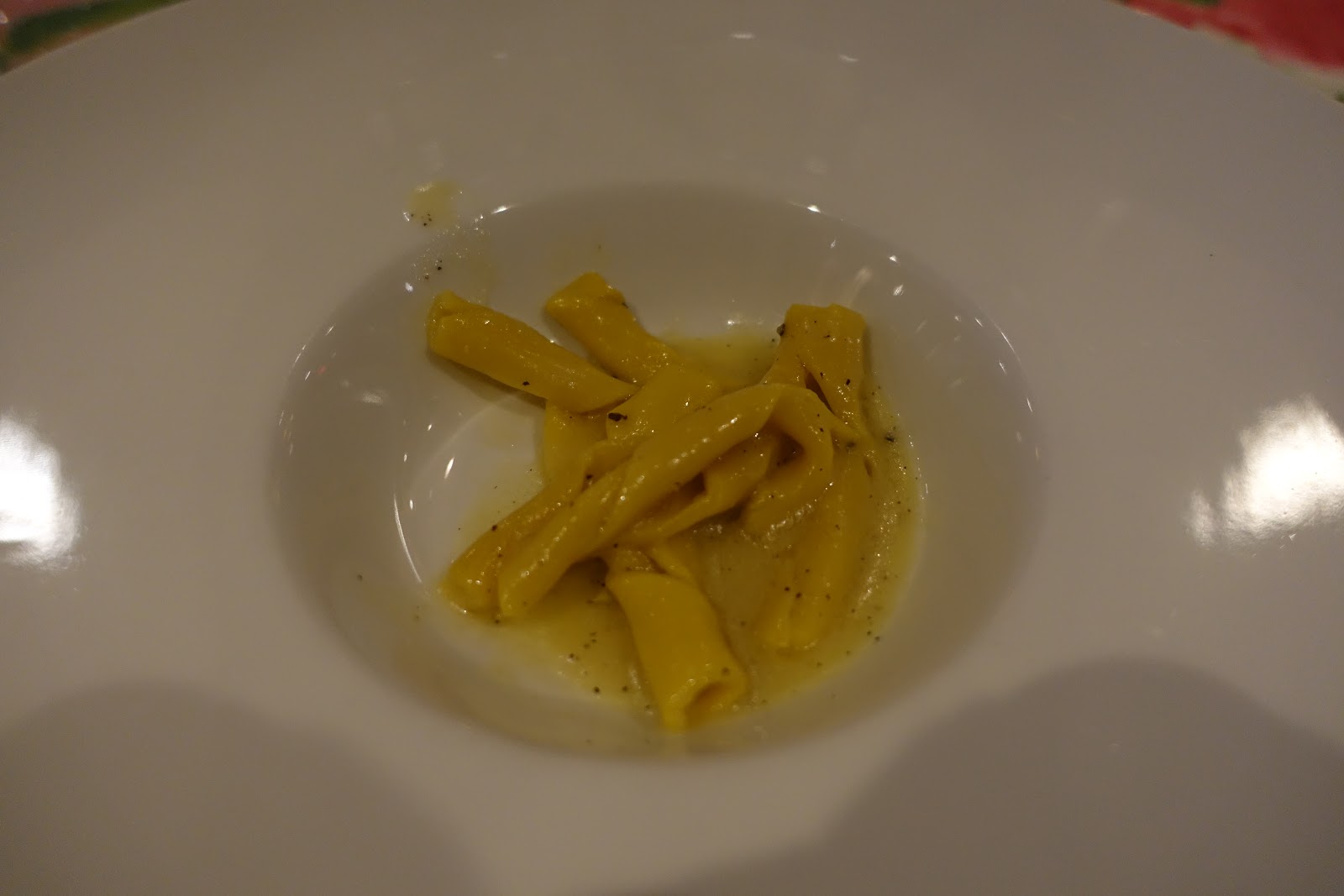
STROZZAPRETI CACIO E PEPE
House-Made Saffron Strozzapreti “Cacio e Pepe Style” with Pecorino and Fresh Black Pepper Sauce
TORTELLI DI PEPOSO, SALSA DI PATATE E TARTUFO NERO
House-Made Tortelli Filled with Braised Beef, Potato Sauce, Black Truffle
Chianti Classico Gran Selezione “Castello di Brolio” 2015


SECONDO
ANATRA ARROSTO, AGLIO NERO, SALSA AL SANGIOVESE, POLENTA, PORCINI
Roasted Duck, Black Garlic, Sangiovese Wine Sauce, Polenta, Porcini Mushrooms
Colle di La’ 2015


FORMAGGIO
SELEZIONE DI FORMAGGI ITALIANIA
Selection of Italian Cheese
Casalferro 201


CAFE

Bye-bye
Many thanks Barone Francesco Ricasoli and Chef Franco Sangiacomo for a great event.


.jpg)
Wine Country Italy - Lake Como, Tuscany, Alto Adige - in the Summer of 2025
Lake Como
At Villa Almana in Cernobbio at Lake Como - Wine Country Italy (Lake Como, Tuscany, Alto Adige) in 2025
Bolgheri
Dinner at La Tana del Pirata in Marina di Castagneto Carducci, Bolgheri, Tuscany - Wine Country Italy (Lake Como, Tuscany, Alto Adige) in 2025
Winery Tour and Tasting at Tenuta Argentiera, Bolgheri, Tuscany - Wine Country Italy (Lake Como, Tuscany, Alto Adige) in 2025
Florentine Steak - Dario Cecchini Selection - for Lunch at Osteria Magona in Bolgheri, Tuscany - Wine Country Italy (Lake Como, Tuscany, Alto Adige) in 2025
Running into Marco Balsimelli, Production Director, Ornellaia and Masseto, at Osteria Magona, Bolgheri, Tuscany - Wine Country Italy (Lake Como, Tuscany, Alto Adige) in 2025
Vineyard Tour, Cellar Tour and Tasting at La Macchiole, Bolgheri, Tuscany - Wine Country Italy (Lake Como, Tuscany, Alto Adige) in 2025
Visiting Vigna Lodovico and Tasting Lodovico Antinori's Cult Wines Lodovico and Il Nicchio with his Assistant at Locanda dell' Aioncino - Wine Country Italy (Lake Como, Tuscany, Alto Adige) in 2025
Dinner at Locanda dell' Aioncino, Bibbona, Tuscany - Wine Country Italy (Lake Como, Tuscany, Alto Adige) in 2025
Tasting the Wines of Tenuta di Biserno and Staying at Relais di Biserno, Bibbona, Tuscany - Wine Country Italy (Lake Como, Tuscany, Alto Adige) in 2025
Tenuta San Guido (Sassicaia): Barrel Cellar Tour and Tasting - Wine Country Italy (Lake Como, Tuscany, Alto Adige) in 2025
Bistecca alla Fiorentina for Lunch at Osteria Enoteca San Guido (Sassicaia), Bolgheri, Tuscany - Wine Country Italy (Lake Como, Tuscany, Alto Adige) in 2025
Vineyard Tour, Cellar Tour and Tasting at Ornellaia, Bolgheri, Tuscany - Wine Country Italy (Lake Como, Tuscany, Alto Adige) in 2025
Dinner at La Pineta, with Chef/ Co-owner Daniele Zazzeri, a Michelin Starred Seafood Restaurant, at Marina die Bibbona, Tuscany - Wine Country Italy (Lake Como, Tuscany, Alto Adige) in 2025
Cellar Tour and Tasting at Grattamacco, a Benchmark Producer in Bolgheri, Tuscany - Wine Country Italy (Lake Como, Tuscany, Alto Adige) in 2025





No comments:
Post a Comment